For decades, managing your metabolic health meant living by the sharp, painful jab of a finger-stick test — a snapshot that tells you where your glucose was, not where it is going. Continuous Glucose Monitors (CGMs) have flipped that script, offering a dynamic, real-time stream of data that reveals how your body responds to every meal, workout, and night of sleep. This guide cuts through the noise to help you select the device that fits your lifestyle and health goals.
I’m Emma — the founder and writer behind Baby Bangs. I have spent years analyzing the raw performance data, sensor accuracy figures, and real-world user experiences across every major CGM and metabolic tracking device on the market to bring you this focused comparison.
Whether you are managing diabetes, optimizing a ketogenic diet, or simply curious about your body’s daily glucose rhythm, finding the right tool is essential. This guide evaluates the very best cgm device options available today to help you make a smart, informed purchase.
How To Choose The Best CGM Device
Selecting a CGM that truly fits your life goes beyond just looking at the sticker price. The right device depends heavily on your primary health goal—whether it is managing a diagnosed condition or exploring your metabolic flexibility. Consider these three critical factors before you decide.
Prescription vs. Over-the-Counter Access
The biggest divide in the CGM market today is between medical-grade devices requiring a doctor’s prescription and the newer class of OTC biosensors. Prescription models like the Dexcom G7 are indicated for diabetes management and often feature alarm systems for dangerous lows. OTC options, such as the Stelo or Lingo, are designed for general wellness and typically skip hypocemia alerts. Choosing the wrong class means either paying for features you cannot use or missing critical safety alarms.
Sensor Accuracy and Calibration
All CGMs measure glucose in the interstitial fluid, which lags behind blood glucose by roughly 5 to 15 minutes. Accuracy is reported as a Mean Absolute Relative Difference (MARD) score—lower is better. Many newer biosensors come pre-calibrated from the factory, meaning you do not need to prick your finger to set them up. Some budget-friendly options still require occasional finger-stick calibrations to stay accurate, especially during periods of rapid glucose change.
Wear Time, Waterproofing, and Data Portability
The typical sensor lasts between 10 to 15 days, but actual wear time varies by brand and your own skin chemistry. A device that falls off after a week is a waste. Check the waterproof rating (anything under 3 feet is for sweat only, not swimming). Furthermore, ensure the data syncs with the apps you already use, such as Apple Health or Cronometer, so your glucose trends live alongside your activity and food logs.
Quick Comparison
On smaller screens, swipe sideways to see the full table.
| Model | Category | Best For | Key Spec | Amazon |
|---|---|---|---|---|
| Stelo by Dexcom | OTC Biosensor | Longest wear & waterproofing | 15-day sensor, waterproof to 8ft | Amazon |
| Lingo by Abbott | OTC Biosensor | Nutrition optimization & insight | 14-day sensor, painless app | Amazon |
| Keto-Mojo GK+ | Dual Meter | Keto & ketone tracking | Glucose + ketone strips | Amazon |
| PTS A1C Now+ | Lab-Grade | Hemoglobin A1C testing at home | 5-minute A1C result | Amazon |
| Accu-Chek FastClix | Starter Kit | Reliable finger-stick monitoring | Bluetooth + mySugr app | Amazon |
| PetTest Classic Genteel | Pet-Specific | Diabetic dogs & cats | Painless vacuum lancing | Amazon |
| Genteel Lancing Device | Accessory | Pain-free blood draws | Vacuum + depth control tips | Amazon |
In‑Depth Reviews
1. Stelo Glucose Biosensor & App by Dexcom

The Stelo from Dexcom is the most impressive OTC biosensor available right now. It offers a full 15-day wear time with a 12-hour grace period, meaning you get over two weeks of continuous data per sensor. Its official waterproof rating of 8 feet is the highest in its class, so swimmers and active users can wear it without worry. The accompanying app provides personalized spikes and pattern detection, plus full integration with Apple Health, Google Health Connect, and Oura.
Real-world accuracy lands around a MARD of roughly 10%, which is standard for a sensor that measures interstitial fluid rather than blood. Users report that the first 24 hours can occasionally read higher than a finger stick, but the trend data is exceptionally reliable thereafter. The biosensor is pre-calibrated, meaning zero finger sticks are needed to start. The free replacement policy for early sensor failures is straightforward, handled through the app’s chat support.
On the downside, customer service responsiveness has drawn sharp criticism in lower ratings, with some users facing long hold times and automated loops when trying to replace a defective sensor. It is also priced at a premium compared to Lingo, though the longer wear time and superior waterproofing justify the difference for most active users. It is not indicated for those on insulin or with problematic hypoglycemia.
Why it’s great
- 15-day wear plus 12-hour grace period extends value
- 8-foot waterproof rating for swimming and sports
- Deep integration with Apple Health, Google Health Connect, and Oura
Good to know
- Customer support can be slow and automated
- Not for insulin users or those with severe hypoglycemia
- Accuracy may drift after day 10 for some users
2. Lingo Continuous Glucose Monitor by Abbott

The Lingo biosensor, built by Abbott, is designed primarily for nutrition and lifestyle optimization rather than medical management. Its app gives you minute-by-minute glucose data and clear feedback on how specific meals, exercise, and sleep affect your levels. The device is HSA/FSA eligible, requires no prescription, and attaches painlessly to the back of your arm. Each biosensor lasts up to 14 days, and the kit comes with two sensors in the box.
User feedback highlights the app’s clarity and actionable insights. Many reviewers noted that the Lingo runs about 10 points lower than a finger-stick reading, which is consistent with interstitial fluid measurement. The sensor reads instantly rather than the 15-minute update cycle of some competitors, giving you near-real-time feedback. The free replacement guarantee for sensors that fail before 14 days is a solid safety net, though the process requires contacting support.
However, setup problems have plagued a segment of users, particularly with Samsung phones, where the app has failed to pair with the sensor. A few units shipped with loose needles or sensors that failed within hours. The app does not provide alarms for dangerous lows or highs, making it unsuitable for those managing diabetes. It syncs with Apple Health and Health Connect, but does not support direct data export to CSV.
Why it’s great
- Instant, minute-by-minute glucose readings
- HSA/FSA eligible with no prescription required
- Helpful food logging and pattern recognition
Good to know
- No alarms for hypoglycemia or hyperglycemia
- App pairing issues reported with some Android phones
- Reads typically lower than finger sticks
3. Keto-Mojo GK+ Glucose & Ketone Testing Kit

The Keto-Mojo GK+ is not a CGM in the strictest sense, but it is the best tool for anyone who needs precise, lab-grade readings for both glucose and ketones. This dual meter includes 70 glucose test strips and 70 ketone test strips right in the box. The Bluetooth-enabled meter syncs with the MyMojoHealth app, which tracks your Glucose Ketone Index (GKI) and works with Apple Health, Cronometer, and Carb Manager. It is a favorite among ketogenic, carnivore, and fasting communities.
Accuracy is the GK+’s strong suit. It is clinically validated and used in over 100 clinical trials, giving it a level of trust that consumer biosensors have not yet matched. The app records every result automatically, eliminating manual logging. The meter runs on two AAA batteries (included) and comes with a lifetime warranty for registered devices. The control solutions allow you to verify strip accuracy at home.
The primary drawback is the per-test cost, which is significantly higher than a basic glucose meter. Ketone strips are especially expensive. This is also a finger-stick device, so you will still need to prick your skin. The Genteel lancing device (reviewed below) pairs perfectly with this meter for a near-painless experience. The kit does not include a dedicated carrying case, though the box is well-organized.
Why it’s great
- Measures both glucose and ketones in one meter
- Clinically validated accuracy used in trials
- Lifetime warranty for registered devices
Good to know
- Per-strip cost is high, especially for ketone tests
- Requires finger sticks (no continuous data)
- No carrying case included
4. PTS Diagnostics A1C Now+ Multi-Test

The A1C Now+ from PTS Diagnostics fills a very specific niche: home-based hemoglobin A1C testing. Unlike a CGM that shows real-time fluctuations, this device gives you the gold-standard three-month average in about five minutes. Each kit includes 10 tests, making it a practical option for monthly or quarterly monitoring between doctor visits. The device is 99% accurate compared to lab results, according to user reports, with many seeing a difference of only 0.1%.
It is a professional-use device, so the instructions must be followed precisely. The kit includes pipettes, wipes, and lancets, and you must set a timer for exactly four minutes before reading the result. The device stores at room temperature for up to three months, but must be refrigerated for longer shelf life—a critical detail that catches new users off guard. Many users find it cheaper than paying a copay for a lab draw.
The biggest limitation is that supplies are not sold separately. Once you use the 10 strips, you must buy an entirely new kit. A small percentage of tests (around 20%) fail to produce a result, which wastes a test strip. There is no data logging or Bluetooth connectivity, so you must record results manually. It does not show daily glucose patterns, just the long-term average.
Why it’s great
- Lab-accurate A1C results in 5 minutes at home
- Cost-effective alternative to clinic visits
- 10 tests per kit for multi-month tracking
Good to know
- Supplies cannot be refilled; you must rebuy the full kit
- Requires refrigeration for maximum shelf life
- No Bluetooth or app connectivity
5. Accu-Chek FastClix Glucose Monitor Kit

The Accu-Chek FastClix kit is the highest-rated traditional blood glucose monitor on the market, and for good reason. It comes with everything you need to start: a Guide Me meter with Bluetooth, the FastClix lancing device with a 6-lancet drum (no individual needle handling), 100 Guide test strips, 108 lancets, control solution, and a carrying case. The meter syncs with the mySugr app, which automatically logs results and can generate reports for your doctor.
The FastClix lancing device is a standout feature. It offers 11 depth settings and uses a drum of 6 ultra-thin lancets, making each poke nearly painless. The meter requires only a tiny blood sample—far less than older models—and the test strips have an easy-fill area that reduces waste. The Swiss engineering is evident in the reliability: users report zero failed strips and consistent accuracy across hundreds of tests. It is an excellent starter kit for newly diagnosed diabetics.
The main complaint is the frequency of error codes, specifically E-4 and E-6, which waste test strips when they appear. Some users also find the lancet cylinder difficult to remove for replacement. The test strips are not the cheapest on the market, though they are widely available. The meter does not have a backlight, which can make reading in low light slightly difficult. For daily finger-stick monitoring, this remains the benchmark.
Why it’s great
- Painless FastClix drum lancing with 11 depth settings
- Bluetooth sync with mySugr app for auto-logging
- Complete all-in-one starter kit with case
Good to know
- Occasional error codes (E-4, E-6) waste test strips
- Lancet cylinder can be tricky to remove
- Meter screen has no backlight
6. PetTest Painless Glucose Monitoring Kit for Dogs & Cats

Managing diabetes in pets is uniquely challenging because the stress of a needle can spike their glucose artificially. The PetTest Classic Genteel Kit was purpose-built to solve this. It pairs a classic Advocate PetTest glucose meter with the Genteel vacuum lancing device, which uses suction to draw blood without hitting pain nerves. The kit includes 50 test strips, 50 lancets, control solution, and a soft carrying case. The test strips are individually foil-wrapped to protect against humidity.
Users consistently report that the Genteel device transforms the testing experience for animals. Dogs that previously cried or fought during testing now tolerate the process calmly. The recommended technique involves shaving the base of the tail, warming the area with a rice sock, applying Vaseline, and holding the device in place for about six seconds to let the vacuum work. The meter requires only 0.3 microliters of blood and delivers results in five seconds. The app lets you track trends over time.
The learning curve is real. The rubber contact tips need to be swapped to find the right fit for your pet’s skin. Some users struggle to get enough blood from small dogs (under 15 pounds) even with the largest tip. Customer service for defective units has been described as unhelpful and slow. The test strips are specific to the Advocate meter, so you cannot use cheaper generic strips. For owners committed to at-home care, this is the best kit available.
Why it’s great
- Genteel vacuum lancing is nearly pain-free for pets
- Individually foil-wrapped strips ensure accuracy
- Complete kit with case, meter, and control solution
Good to know
- Steep learning curve for optimal tip and technique
- Struggles with very small pets under 15 pounds
- Customer support can be slow to resolve issues
7. Genteel Lancing Device (Butterfly Blue)
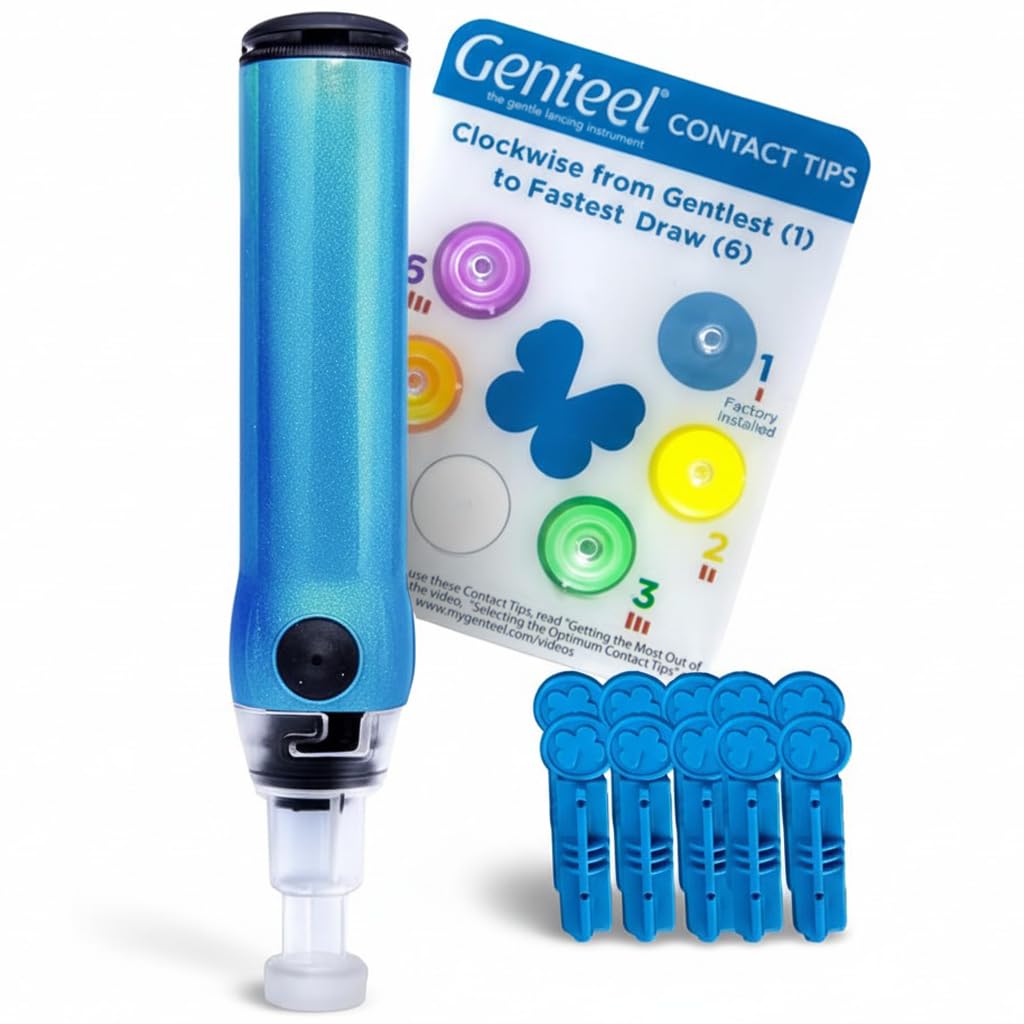
The Genteel is the only lancing device that uses vacuum technology to draw blood, making it a critical accessory for anyone who dreads finger sticks. It works with any standard meter and test strips, meaning you can pair it with the Keto-Mojo GK+ or Accu-Chek FastClix to convert a painful experience into a nearly imperceptible one. The device includes six patented contact tips with ultra-precise depth control, allowing you to test on your palm or other less-sensitive areas.
Users with neuropathy or needle phobia report a dramatic reduction in pain—from a 7/10 with standard lancets down to a 1.5/10 with the Genteel. The suction mechanism pulls the skin taut and draws blood without the violent strike of a spring-loaded lancet. It also eliminates the need to squeeze the finger for a drop, which causes additional pain and bruising. It works for both humans and pets, making it a versatile addition to any diabetes kit.
The biggest catch is that Genteel’s own Butterfly Touch lancets are disliked by many users, who find them painful and recommend switching to third-party 33g or 36g lancets like the Tiniboy. The device requires a small learning curve to master the right tip and depth combination. It is not cheap, but for someone who tests multiple times a day, the reduction in finger soreness is transformative. The device does not include a meter or test strips.
Why it’s great
- Unique vacuum suction eliminates pain from lancet strike
- Works with any brand of meter and test strips
- Allows testing on palm and other less-sensitive areas
Good to know
- Genteel’s own lancets are not recommended; use third-party
- Requires practice to find the right tip and technique
- Premium price for a lancing device only
FAQ
Can I use a CGM without a prescription?
How long does a CGM sensor actually last on the arm?
Why does my CGM read lower than my finger stick?
Are Zulu GL1-PRO or similar third-party lancets compatible with the Genteel device?
Final Thoughts: The Verdict
For most users, the cgm device winner is the Stelo by Dexcom because it offers the longest wear time, best waterproofing, and deepest app integration of any OTC biosensor. If you want dual glucose and ketone data for a keto or fasting lifestyle, grab the Keto-Mojo GK+ and pair it with the Genteel lancing device. And for pain-free, reliable finger-stick monitoring on a budget, nothing beats the Accu-Chek FastClix kit.