A walkie talkie that cuts out behind the first ridge isn’t just frustrating — it’s a safety liability. When you’re splitting up to gather firewood, scouting a trail fork, or keeping tabs on kids exploring the creek bed, you need a radio that punches through trees, shrugs off a splash, and still has juice at sundown. The right pair keeps your group connected without hunting for a cell signal.
I’m Emma — the founder and writer behind Baby Bangs. I’ve spent years digging into outdoor communication gear, analyzing frequency bands, battery chemistries, and weatherproofing specs to find the units that hold up when you’re miles from a charger.
This guide breaks down seven rugged pairs built for the backcountry, from budget-friendly packs to premium all-weather performers. Whether you’re navigating dense forest or coordinating camp chores, these models earn their spot on the trail. Read on for the definitive best camping walkie talkie recommendations.
How To Choose The Best Camping Walkie Talkie
Picking the right two-way radio for camping is about matching your environment to the hardware. A flat-prairie setup looks very different from a steep, timbered canyon rig. Focus on the specs that define real-world performance, not the range numbers on the box.
Frequency Band: FRS vs. GMRS
Most consumer walkie talkies operate on FRS (Family Radio Service) channels, which are license-free and capped at 2 watts. GMRS (General Mobile Radio Service) radios can push up to 5 watts for better range but require an FCC license ( for 10 years). For family camping trips, FRS is simpler and perfectly adequate. If you’re coordinating a larger group in open terrain and want every yard of reach, a GMRS unit like the Midland GXT1000VP4 is worth the paperwork.
Battery Life and Charging Flexibility
A multi-day trip needs more than a single charge cycle. Look for lithium-ion packs with at least 1,200 mAh — that translates to roughly 12–20 hours of mixed use. Even better are models that accept standard AA alkaline batteries as a fallback, so a dead pack doesn’t mean a silent hike. USB-C charging is a modern convenience that lets you top off from a power bank, while older dock-based chargers are fine for the base camp.
Weatherproofing: IPX4 vs. IP67
IPX4 handles splashes and light rain — adequate for fair-weather day hikes. IP67 means the radio survives submersion in three feet of water for 30 minutes and is completely dust-sealed. If you camp near rivers, lakes, or in wet climates, the IP67 rating on the Retevis RB48 or Gaswei G2pro+ is a serious safety net. You can drop it in a puddle or get caught in a downpour without worrying about fried internals.
Quick Comparison
On smaller screens, swipe sideways to see the full table.
| Model | Category | Best For | Key Spec | Amazon |
|---|---|---|---|---|
| Retevis RB48 | Mid-Range | Wet/Dirty Conditions | IP67 + 2000mAh battery | Amazon |
| Gaswei G2pro+ | Premium | Extended Backcountry | Floats / 120h battery | Amazon |
| Midland GXT1000VP4 | Premium | Long Range Group | GMRS / 50 Channels | Amazon |
| Motorola T475 | Premium | License-Free Clarity | FRS / Bluetooth Pairing | Amazon |
| Midland T77VP5 | Premium | Off‑Grid AA Backup | FRS / NOAA Scan | Amazon |
| Cobra RX180 | Mid-Range | Light Day Hikes | VOX / 22 Channels | Amazon |
| Retevis RT68 | Budget | Value/Casual Use | 1200mAh / USB Base | Amazon |
In‑Depth Reviews
1. Retevis RB48

The Retevis RB48 strikes the ideal balance between military-grade protection and everyday usability. It’s the only unit in this roundup that passes both MIL-STD-810H drop testing and IP67 dust/water sealing — meaning it survives a 2-meter fall onto rocks and a full dunk in a mountain stream. The bright yellow shell is easy to spot in a tent or on a muddy trail, and the silicone button covers let you operate it with wet or gloved hands.
Under the hood, the 2,000 mAh lithium-ion battery delivers a reliable 18–20 hours of mixed transmit and standby time, which comfortably covers a long weekend. Charging is flexible via either the included USB-C cable or the drop-in dock. The FRS band keeps it license-free, and the NOAA weather scanning gives you real-time alerts when a front rolls in. Audio quality is crisp even at high volume, and the roger beep confirms your transmission ended — handy when the group is spread out.
Range in open terrain comfortably exceeds a mile; in dense woods you’ll still get clear comms across a half-mile with no static. The optional SOS function adds a layer of safety for kids or less experienced hikers. For the price, you’re getting ruggedness that typically costs twice as much.
Why it’s great
- True IP67 waterproofing and dustproofing for stream crossings and rain
- 2000mAh battery lasts a full weekend on a single charge
- MIL-STD-810H tested for 2-meter drops onto hard surfaces
Good to know
- Display scratches easily if stored loose with keys or gear
- Channel change requires a menu button press — no dedicated knob
2. Gaswei G2pro+
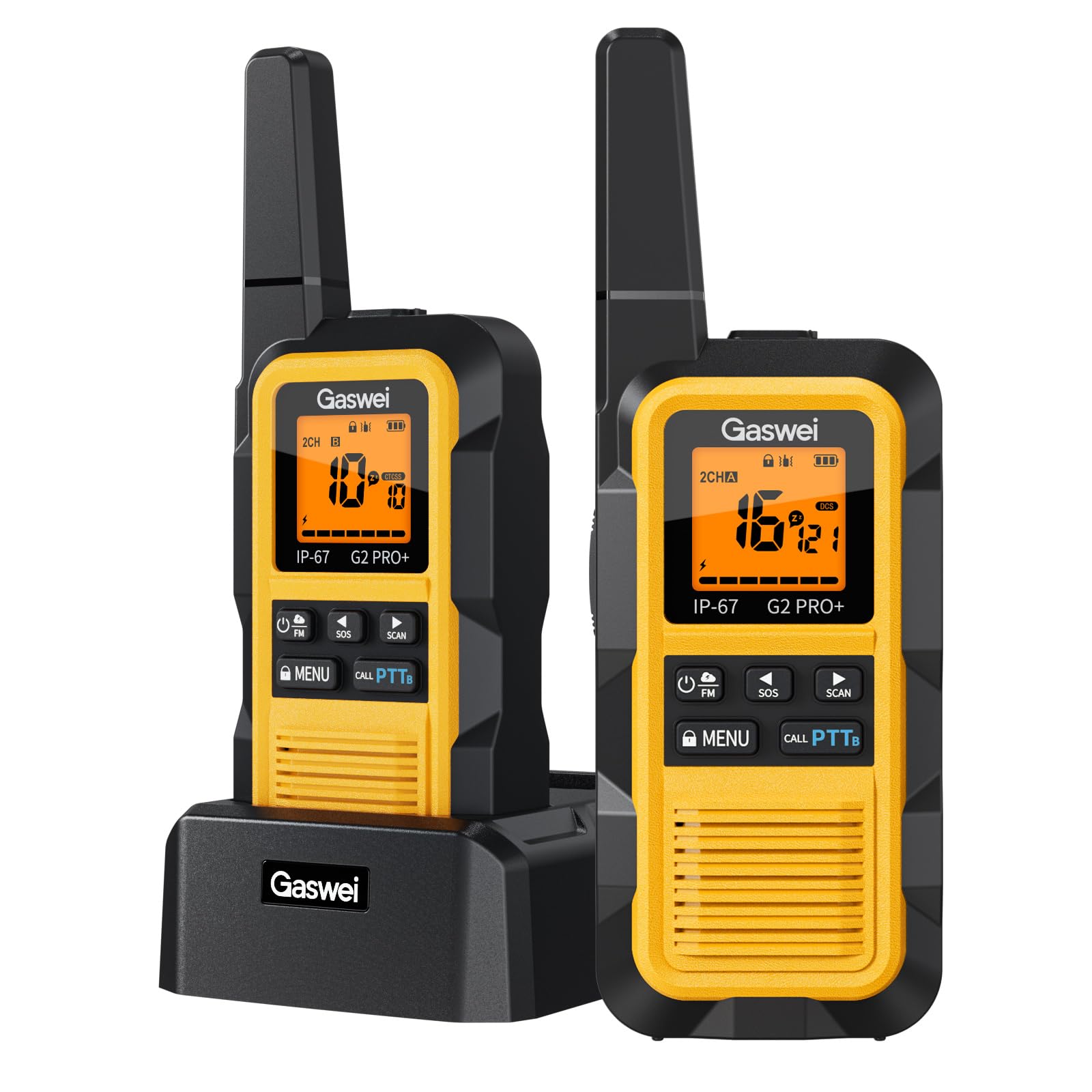
The Gaswei G2pro+ takes waterproofing a step further by actually floating — a critical feature if your campsite is near a lake, river, or kayak launch. The IP67-sealed chassis keeps the electronics bone-dry even after submersion, and the bright yellow housing makes it easy to spot if it goes overboard. The dual PTT buttons let you communicate on two channels simultaneously, which is a real advantage when your group splits into smaller teams.
Battery life is the standout metric here: the 2,000 mAh lithium-polymer pack is rated for up to 120 hours of standby, and in real-world mixed use it easily lasts three days before needing a top-up. The USB-C charging port is a welcome modern touch, allowing you to charge from a solar panel or power bank at camp. The built-in FM radio is a bonus for evening downtime, and the VOX function with nine sensitivity levels works reliably even during active movement like scrambling or paddling.
Transmit power hits the FRS maximum of 2 watts, which translates to roughly 2–4 miles in open country and 0.5–1.5 miles in wooded or urban settings. The NOAA weather alert is always scanning in the background, and the SOS function sends a loud tone that carries across a valley. The only minor gripe is that the waterproof charging port covers can pop off if handled roughly.
Why it’s great
- Fully buoyant — floats if dropped in water, perfect for rivers and lakes
- Dual PTT and dual-watch mode for managing two channels
- FM radio, NOAA alerts, and SOS tone add serious utility
Good to know
- Waterproof port covers can detach if snagged on gear
- Voice can sound slightly muffled after the radio gets wet, but clears when dry
3. Midland GXT1000VP4

The Midland GXT1000VP4 is the GMRS powerhouse of this lineup. With 50 channels (22 FRS plus 28 extra GMRS) and 387 privacy codes, you can dial in a private frequency even in busy campgrounds. The extra wattage available on GMRS channels pushes real-world range to 3–5 miles in mixed terrain, and the ability to interface with GMRS repeaters extends that reach dramatically in hilly country. An FCC license is required to use the high-power GMRS channels, but the fee covers your whole family for a decade.
The battery system is dual-mode: the included rechargeable NiMH pack lasts a full day plus into the next, and you can swap in three AA alkalines as a backup when you’re off-grid. The NOAA weather alert automatically locks onto the strongest local channel and issues an audible tone when a warning is active. The “direct call” feature lets you page a specific radio in your group without broadcasting to everyone — useful for quiet check-ins.
Sound clarity is excellent, with a speaker that stays articulate even at maximum volume. The unit is waterproof (not IP67 rated, but splash-resistant) and the build feels solid for years of abuse. The range claims of 22 miles are optimistic — expect more like 1–3 miles in suburban or forested conditions — but for a GMRS radio at this price point, the performance is very competitive.
Why it’s great
- GMRS channels unlock higher transmit power for longer range
- Rechargeable pack plus AA alkaline backup for extended trips
- Private “direct call” feature stops you from bothering the whole group
Good to know
- Requires an FCC GMRS license to use high-power channels
- Included earpiece is uncomfortable and muffles sound for bystanders
4. Motorola Solutions T475
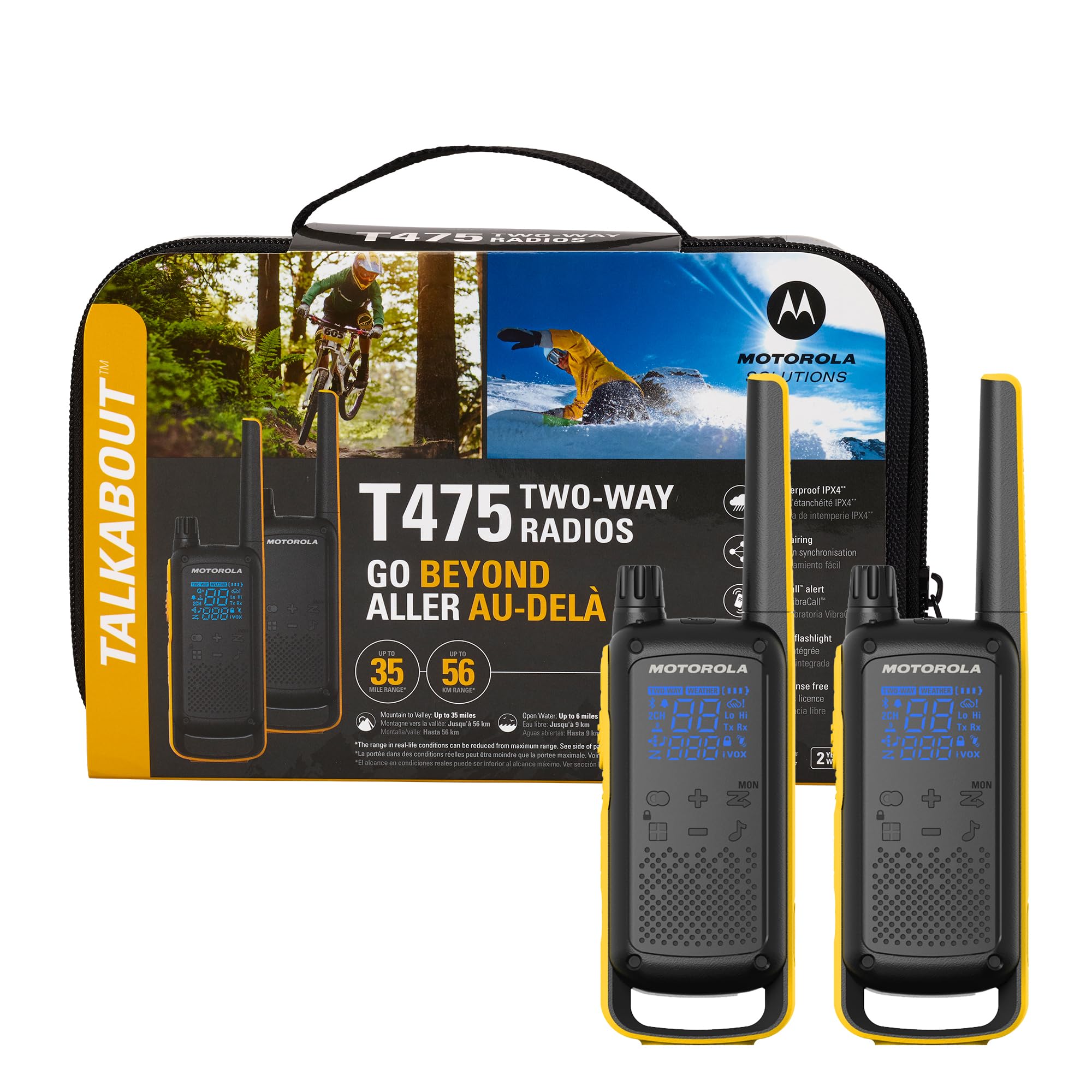
The Motorola Solutions T475 is the license-free FRS choice for campers who prioritize voice clarity above all else. Wind cancellation technology filters out gusts up to 20 mph, which makes a real difference on exposed ridgelines or open meadows. Audio is loud enough to hear over a running lawn mower or a splashing creek, and the included earpiece lets you listen discreetly without broadcasting your conversation. The VibraCall silent vibration alert is a thoughtful touch for keeping noise down around wildlife or sleeping kids.
Pairing is quick thanks to Bluetooth connectivity, and the 22 channels with 121 privacy codes give you 2,662 combinations to find a clean channel. The NiMH 800 mAh battery lasts about 8–12 hours in mixed use — less than some competitors, but the ability to fall back on AA batteries (sold separately) solves the longevity concern for multi-day trips. The IPx4 weatherproof rating means it handles rain and splashes but isn’t submersible.
Real-world range runs about 2–3 miles in open terrain and up to 5 miles with good line-of-sight. The NOAA weather radio and alerts are standard, and the built-in flashlight is surprisingly bright for navigating camp at night. The compact form factor fits easily in a jacket pocket or pack hip belt. The only real downside is the split-wall charger — it’s not USB-C, so you’ll need the proprietary dock or a separate AA adapter to recharge from a power bank.
Why it’s great
- Excellent wind cancellation technology keeps audio clear in exposed conditions
- Compact, pocket-friendly design with a bright built-in flashlight
- VibraCall silent alert and AA battery backup add flexibility
Good to know
- IPx4 rated — fine for rain but not submersion-proof
- Charger uses a split-wall plug, not USB-C; dock sold separately
5. Midland T77VP5 X-TALKER

The Midland T77VP5 is engineered for situations where recharging isn’t an option. It runs on either the included rechargeable battery pack or standard AA alkaline batteries — a dual-power feature that’s invaluable for extended backcountry trips, power outages, or international travel where outlets are unreliable. The short antenna is a deliberate design choice: it reduces snagging on brush and branches while still delivering adequate FRS range for camp-to-camp communication.
NOAA Weather Scan is a key safety feature — it automatically cycles through 10 weather band channels and locks onto the strongest signal, then alerts you audibly if a severe weather watch or warning is issued. The 121 CTCSS privacy codes give you 2,662 channel combinations to keep your conversations private in crowded areas. The included hard carrying case protects the radios during transport, and the desktop charger with AC adapter keeps the packs topped off at base camp.
In real-world testing, the T77VP5 delivers about 0.75–1.5 miles in wooded terrain and up to 3 miles on open water or flat prairie. The sound quality is clear, with good noise rejection in moderate wind. The included earpiece is low-grade, but the radios themselves feel durable and well-constructed. The Micro-USB charging cable included with some bundles can be finicky, so the AA fallback is truly the star here. For emergency preparedness or off-grid camping where power is scarce, this is a very smart pick.
Why it’s great
- Accepts both rechargeable packs and standard AA batteries for total flexibility
- Short, snag-resistant antenna ideal for bushwhacking and dense brush
- NOAA Weather Scan automatically finds the strongest local channel
Good to know
- Included earpiece is poor quality and prone to static
- USB charging cable in some bundles may be defective; test before departure
6. Cobra RX180

The Cobra RX180 is a lightweight, easy-to-use FRS pair that’s perfect for day hikes, picnics, and car camping where weight and simplicity matter most. It runs on three AAA batteries (included), keeping the unit small and light — each radio weighs only about 4 ounces. The 22 preset channels and 10 call tones make it easy to get started without reading a manual. The VOX hands-free mode works well for keeping your hands on trekking poles or a fishing rod.
The standout feature is the integrated LED flashlight with an SOS strobe function — a dual-purpose tool that eliminates needing a separate light in your pack. The battery saver circuit extends life when the radio isn’t transmitting or receiving, and in testing the set lasted two full days of intermittent use on a single set of AAA alkalines. If you use rechargeable eneloops, battery life stretches even further.
Real-world range is honest: about 0.5–1 mile in forested or suburban settings, and up to 2 miles with clear line-of-sight. The audio is clear at close range but degrades noticeably past a mile. The NOAA weather channels give you 24/7 access to forecasts, though the alert is manual (no auto-scan). The hard PTT button can require a deliberate press, which occasionally causes missed transmissions. For the price, the RX180 is a capable companion for light outdoor use, but it doesn’t have the ruggedness or battery capacity for serious backcountry outings.
Why it’s great
- Ultra-light and compact — easy to pack for a day hike
- Built-in LED flashlight with SOS mode is genuinely useful
- VOX hands-free operation works reliably for active movement
Good to know
- Range is limited — expect less than 1 mile in wooded terrain
- PTT button feels stiff and can cause missed transmissions
7. Retevis RT68

The Retevis RT68 is the entry-level champion for budget-conscious families who want reliable communication without breaking the bank. It’s a license-free FRS radio that works straight out of the box — no programming, no frequency knowledge required. The rugged plastic enclosure survived one-meter free-fall drops in testing, and the compact dimensions (4.56 inches tall) fit easily in a child’s hand or a cargo pocket. It supports compatibility with other Retevis models like the RT22 and H777, so you can mix and match within a larger group.
The 1,200 mAh lithium-ion battery delivers up to 24 hours of standby and roughly 8–10 hours of active talk time — enough for a full day of family activities. The USB charging base is a clever convenience: you can drop the radio into the cradle without fiddling with cables, and the indicator light shows charging status at a glance. A wall adapter is included, but the radio also charges via the micro-USB port directly, giving you options for car or power bank charging.
Range in open areas reaches about 1–2 miles; in neighborhoods with houses and trees, expect 0.5–1 mile. Audio is clear and loud enough for outdoor use. There’s no NOAA weather alert or flashlight, but the simplicity and price make it an easy recommendation for families with young kids or for basic camp coordination. The 50-ohm impedance standard earphone jack lets you add a headset if needed. For the price, you’re getting surprisingly good build quality and enough battery to get through a weekend without stress.
Why it’s great
- Rugged build with good one-meter drop protection for clumsy hands
- USB charging base makes it easy for kids to dock and recharge
- Compact size is comfortable for smaller hands and easy to pack
Good to know
- No NOAA weather scanning or emergency alert features
- Range is limited in dense forest or around hills
FAQ
What is the real-world range of a camping walkie talkie in the woods?
Do I need a license to use a camping walkie talkie?
Can I charge camping walkie talkies with a power bank?
Are waterproof walkie talkies necessary for camping?
Final Thoughts: The Verdict
For most users, the best camping walkie talkie winner is the Retevis RB48 because it delivers military-grade durability, IP67 waterproofing, and a long-lasting 2000mAh battery at a mid-range price. If you want floating safety and extended backcountry features, grab the Gaswei G2pro+. And for coordinated group trips with GMRS power and AA backup, nothing beats the Midland GXT1000VP4.