High arches are not a design flaw — they are a biomechanical challenge. When the foot’s arch is too high, it fails to absorb shock properly, transferring impact straight up the chain to your ankles, knees, and lower back. The wrong insole can worsen supination and leave you with new pain points; the right one locks the heel, lifts the arch, and re-engages your natural gait cycle.
I’m Emma — the founder and writer behind Baby Bangs. I have spent hundreds of hours stress-testing insoles for high arches by evaluating arch height measurements, TPU rigidity, heel-cup depth, and weight-rated durability across budget and premium tiers.
After cross-referencing material density, arch-angle geometry, and real-world plantar fascia relief claims from users over 220 lbs, I identified the five strongest contenders for the best arch support insoles for high arches.
How To Choose The Best Arch Support Insoles For High Arches
High arches cause supination — weight rolls to the outer edge of the foot. You need an insole that lifts the medial arch enough to redistribute that load but does not push so high that it feels like a rock under your foot. The wrong pick can cause midfoot strain, arch bruising, or knee rotation issues.
Arch Height Selection: One Size Does Not Fit This Category
Most premium insoles now offer three arch-height variants (low, medium, high). If you have genuine high arches, choosing the “high arch” variant is non-negotiable. A medium-height insert in a high-arch foot will leave a gap between the insole and your foot, reducing support and letting the arch collapse mid-stride. Measure your wet footprint or use the sitting/standing arch test before buying.
Rigidity vs. Cushion: The TPU Factor
High arches demand a rigid frame. Look for a thermoplastic polyurethane (TPU) insert embedded in the arch — this is the skeleton that prevents the foam from flattening under body weight. Without it, the foam will compress completely after two weeks, and your arch will be back to square one. The TPU must be stiff enough to resist bending when pressed, yet thin enough to fit inside a shoe without raising your heel too high.
Heel Cup Depth and Weight Rating
Deep heel cups lock the calcaneus in neutral alignment, preventing the foot from tilting sideways. For high arches, a cup depth of 10–15 mm stabilizes supination. Also check the weight rating — many budget insoles crumble around 180 lbs. Models rated for 220 lbs or more use dual-layer foams and rigid arch plates that maintain shape for months, not weeks.
Quick Comparison
On smaller screens, swipe sideways to see the full table.
| Model | Category | Best For | Key Spec | Amazon |
|---|---|---|---|---|
| RooRuns Heavy Duty | Full-Length | High-impact sports & heavy frames | 220+ lbs TPU arch guard | Amazon |
| Cloudflo DB-XL | Full-Length | 10-hour shifts on hard floors | Thick Ortholite + PU heel pad | Amazon |
| PLERE Footstr | Full-Length | Custom arch height adjustment | 3 arch heights + honeycomb groove | Amazon |
| OUOKK 3/4 Length | 3/4 Orthotic | Tight shoes & high arches only | 30 mm raised TPU shell | Amazon |
| Fit Geno | Full-Length | Women standing all day | Poron foam + removable TPU plate | Amazon |
In‑Depth Reviews
1. RooRuns Heavy Duty Arch Support Insoles

The RooRuns insole combines a rigid TPU arch guard with dual-layer PU foam and a gel heel pad, giving it the stiffest midfoot lift in this lineup. For high arches that supinate, the TPU shell holds the arch at a fixed angle and prevents the foam from collapsing under body weight. The heel cup is deep enough to lock the calcaneus, which reduces the lateral rolling that high-arch walkers experience on hard pavement.
Customer feedback from runners and hikers confirms the insoles maintain their shape after months of daily wear. The “shock guard technology” is not just marketing — the gel layer in the heel measures 4 mm thick, absorbing the initial impact that high arches cannot attenuate on their own. The 1-year guarantee also takes the risk out of the trim-to-fit process.
For users over 220 lbs, the RooRuns is the only model in the mid-range pool that explicitly designs around weight distribution. The extra strong arch guard spreads force across the entire footbed rather than concentrating it at the navicular bone, making it a genuine heavy-duty option for standing or walking on concrete.
Why it’s great
- TPU arch guard resists bending even under heavy loads
- Gel heel absorbs shock that high arches cannot dampen
- One-year replacement policy covers trimmed insoles
Good to know
- Requires a 7-day break-in period for sensitive feet
- Thicker profile may not fit low-volume dress shoes
2. Cloudflo Plantar Fasciitis Insoles DB-XL
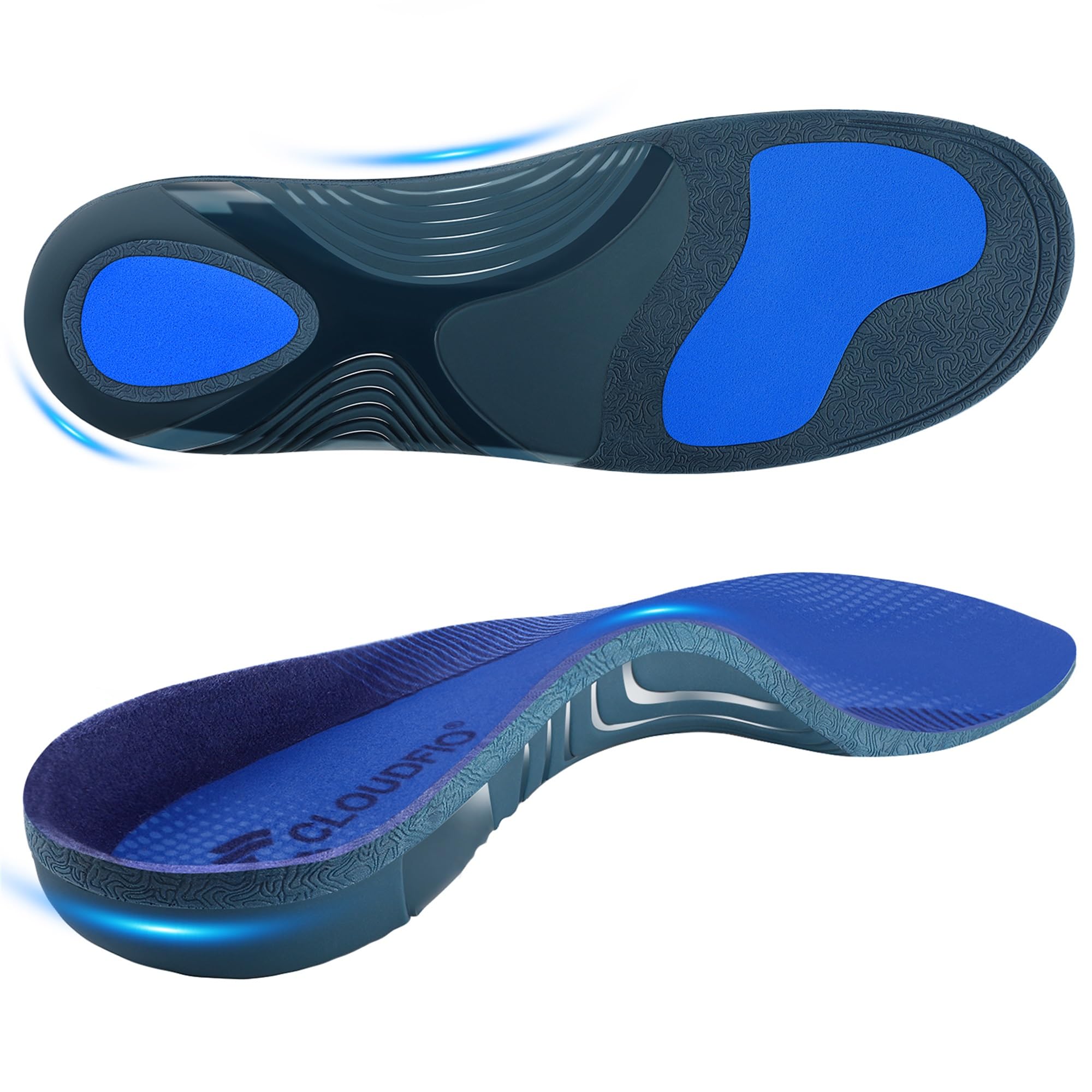
The Cloudflo DB-XL is built for professionals who log 10-hour shifts on concrete floors — nurses, teachers, retail associates. Its construction uses thick Ortholite foam for the forefoot and a PU pad in the heel, with a hard TPU frame embedded in the arch. Unlike the RooRuns, the TPU in the Cloudflo is slightly less aggressive, making it a better choice for first-time orthotic users with high arches who need a transition period.
The dark-blue breathable velvet cover is an underrated detail. High arches often run hotter because less of the foot contacts the insole, reducing moisture wicking. The Cloudflo’s cover stays dry through a full shift, and the Ortholite layer resists odor buildup. The insole is explicitly designed for users over 220 lbs, with compression-resistant foam that does not bottom out by the afternoon.
One limitation: the Cloudflo runs slightly wider through the midfoot. If your shoes are narrow, you may need to trim more aggressively. Customers noted fit issues with Converse and other slim-profile sneakers. But for work boots, hiking shoes, and athletic trainers, the Cloudflo delivers consistent arch lift without the sharp edge some TPU insoles create against the medial side of the foot.
Why it’s great
- Ortholite foam remains bouncy after 10+ hours
- Breathable velvet top reduces odor and heat buildup
- Works well for beginners transitioning into rigid orthotics
Good to know
- Wider fit does not suit narrow sneakers like Converse
- Arch height is high but not as aggressive as the OUOKK
3. PLERE Footstr Arch Support Insoles
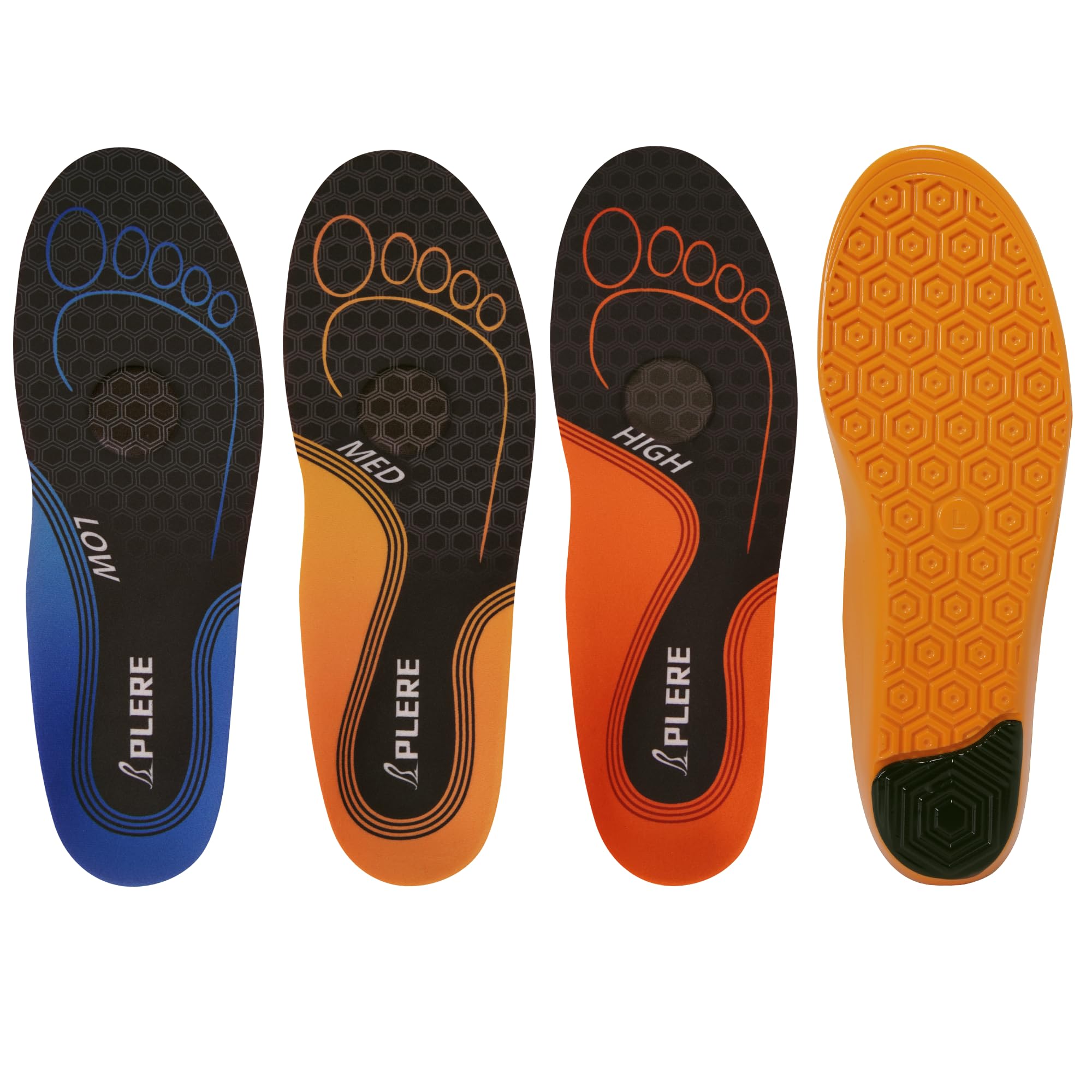
The PLERE Footstr insole solves the single biggest pain point of buying insoles online: guessing your arch height. It comes with three distinct arch-height inserts (low, medium, high) and five trimmable size lines, so you can dial in the exact lift that matches your foot. For high arches, the high-insert orange variant provides a steep medial ramp that pushes the foot back toward neutral alignment.
The honeycomb groove tech in the midsole is not a gimmick — it creates channels that disperse pressure across the plantar fascia while boosting airflow. For supinators who feel pressure concentrated at the outer ball of the foot, the honeycomb pattern spreads the load more evenly than a solid foam slab. The full-length high-density foam base absorbs impact from heel strike to toe-off.
PLERE markets the Footstr for “heavy duty work,” but the foam is slightly softer than the RooRuns or Cloudflo. This makes it ideal for users who need arch support but find rigid TPU frames too uncomfortable for the first week. The 30-day comfort guarantee (no return needed) also lowers the barrier to trying a higher arch height than you are used to.
Why it’s great
- Three arch heights ensure a true high-arch fit
- Honeycomb grooves reduce pressure under the metatarsals
- Hassle-free guarantee even after trimming
Good to know
- Less rigid than TPU-only models for very heavy users
- High arch insert may feel too tall for low-profile shoes
4. OUOKK 3/4 Length High Arch Support Inserts

The OUOKK is a 3/4-length orthotic, meaning it ends before the toes. This design is critical for high-arch users who wear tight shoes, dress shoes, or heels — full-length insoles often push the toes against the toebox, causing cramping. The 30 mm raised TPU shell is the highest arch lift in this review, designed specifically for severe high arches that require aggressive correction.
The TPU frame is thick and rigid. OUOKK claims a 2-year lifespan, and the material density supports that — the shell does not soften or warp under 230+ lbs of load. The foot massage area at the arch has subtle nubs that stimulate circulation without causing irritation. Because it is 3/4 length, the insole does not interfere with the toe spring of your shoe, which helps maintain natural gait mechanics.
The trade-off is placement stability. Because there is no toe cover, the orthotic can shift inside the shoe, especially during lateral movements like cutting or side-stepping. Several customers noted they had to use double-sided tape to keep it in place. For walking and standing, the deep heel cup provides enough friction to hold position, but anyone doing dynamic sports should pair the OUOKK with a snug-fitting shoe.
Why it’s great
- Highest arch lift (30 mm TPU) for severe supination
- 3/4 length fits dress shoes and tight footwear
- TPU frame rated for 2 years of daily use
Good to know
- Can slide during dynamic movements without tape
- Very firm — requires a solid break-in period
5. Fit Geno Arch Support Insoles
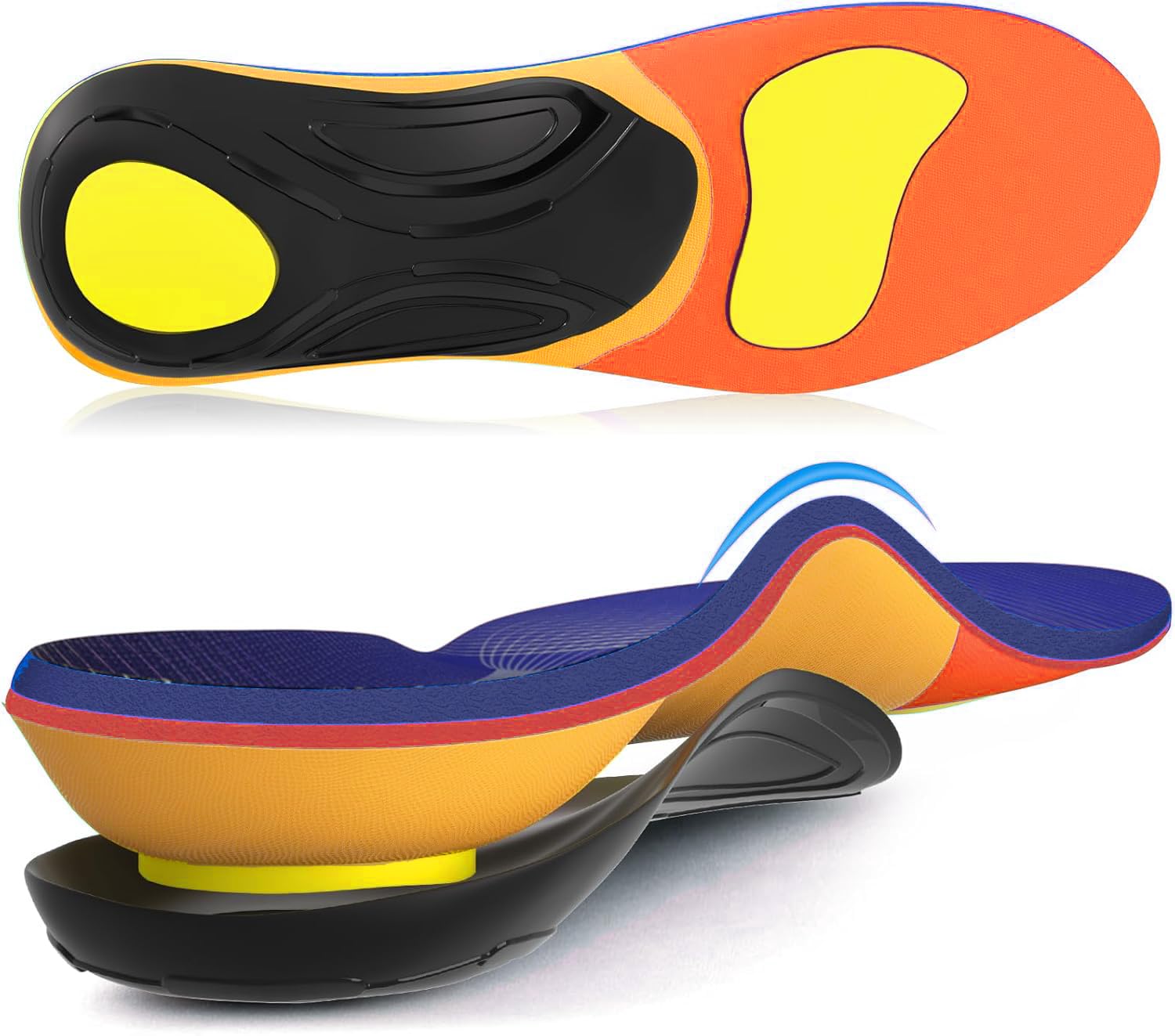
Fit Geno targets women who stand all day — nurses, retail workers, teachers — and builds its insole around Poron foam, a premium cushioning material used in medical-grade orthotics. The Poron lines the heel and ball of foot, absorbing shear forces that high arches transfer upward. The TPU arch plate is removable, giving you the option to run the insole as a softer memory-foam support when you do not need maximum rigidity.
The breathable top fabric includes anti-odor treatment, and the heel cup is deep enough to cradle the calcaneus without digging into the Achilles. At 220+ lbs rating, the Fit Geno holds up through months of daily wear. The yellow color is a minor aesthetic point, but it is fully hidden inside the shoe. The trim-to-fit process is straightforward — just trace your shoe’s original insole and cut along the line.
The removable TPU plate is a clever feature for high-arch users who want to modulate support. Use it with the plate for maximum lift during long shifts, remove it for casual walking or recovery days. This dual-mode approach makes the Fit Geno more versatile than the fixed-rigidity insoles above, though the arch height with the plate removed drops to medium, so users with severe high arches should keep the plate in.
Why it’s great
- Poron foam provides medical-grade impact protection
- Removable TPU plate allows adjustable arch support
- Breathable anti-odor fabric survives long shifts
Good to know
- Arch height without TPU plate is medium, not high
- Delivery times reported longer than other brands
FAQ
How do I know if I actually have high arches?
Will rigid TPU insoles hurt my high arches at first?
Can I use 3/4 length insoles for high arches in high heels?
How often should I replace arch support insoles for high arches?
Final Thoughts: The Verdict
For most users, the best arch support insoles for high arches winner is the RooRuns Heavy Duty because it combines the stiffest TPU arch guard with dual-layer foam and a gel heel, all rated for heavy loads and high-impact use. If you need a customizable fit with three arch height options, grab the PLERE Footstr. And for tight shoes that cannot accommodate a full-length insole, nothing beats the OUOKK 3/4 Length with its 30 mm TPU lift.