An at-home rower is the only piece of cardio equipment that builds both aerobic capacity and total-body strength without driving your knees into early retirement. The problem is the market is flooded with flimsy rails, noisy fans, and resistance systems that either feel like nothing or snap under pressure.
I’m Emma — the founder and writer behind Baby Bangs. I’ve spent hundreds of hours cross-referencing magnetic, water, and air resistance specs, reading through the real complaints of buyers, and comparing the actual build quality of rowers from the budget floor to the premium ceiling.
Finding a quiet, durable machine that delivers a smooth stroke without dominating your living room is the real trick, and I’ve narrowed the list down to the nine best options to help you pick the right at home rower for your space and fitness level.
How To Choose The Best At Home Rower
The right rower comes down to understanding the tradeoffs between resistance type, build materials, and storage footprint. Magnetic rowers are silent but often lack the feel of real water. Air rowers are the gold standard for performance tracking but can be loud. Water rowers look beautiful and sound relaxing but require maintenance. Match your priority — quiet, realism, or data accuracy — to the system that fits your home.
Resistance Type: Magnetic vs. Air vs. Water
Magnetic resistance uses magnets to create drag on a flywheel. It is virtually silent and requires zero maintenance, but the rowing feel can be artificial because there’s no fluid or air rush. Air resistance uses a fan that gets harder the faster you pull, which feels natural and scales with effort, but the whoosh noise is unavoidable. Water resistance uses a paddle spinning in a tank — the sound is soothing like a river, and the feel is the closest to on-water rowing, but you have to add water and occasionally treat it to prevent algae.
Rail Length and Seat Height
A short rail cramps the leg drive of taller users and causes the seat to stop abruptly. Look for a rail of at least 45 inches if you are over six feet tall. Seat height matters for ease of getting on and off — a 20-inch seat height (like the Concept2 with tall legs) is a game-changer for older users or anyone with knee issues. Measure your inseam and compare it to the rail length spec before buying.
Build Quality and Weight Capacity
Steel frames with thick gauge tubing last longer and wobble less during hard pulls. Cardboard-thin aluminum rails flex under heavy use and create squeaks. A weight capacity of at least 300 pounds is a good baseline, but 350-400 pounds indicates a more robust frame. Check the monitor’s data accuracy — cheaper consoles inflate stroke count or miscalculate distance, which erodes motivation over time.
Quick Comparison
On smaller screens, swipe sideways to see the full table.
| Model | Category | Best For | Key Spec | Amazon |
|---|---|---|---|---|
| Concept2 RowErg | Air | Performance & Data Accuracy | PM5 monitor, 500 lb capacity | Amazon |
| WaterRower Club S4 | Water | Aesthetics & Silent Workouts | Handcrafted ash wood, S4 BLE | Amazon |
| FITNESS REALITY 4000MR | Magnetic | Programmed Workouts | 15 workout programs, dual handles | Amazon |
| PASYOU PR70 | Air | Budget-Friendly Air Rower | 2.5 mm steel tubing, foldable | Amazon |
| pooboo H18801 | Wind/Magnetic | Dual Resistance Flexibility | 360° rotating handles, 400 lb limit | Amazon |
| YOSUDA Water Rower | Water | Foldable Water Rower | FSC-certified beech wood, 180° fold | Amazon |
| MERACH Sculls R26 | Magnetic | Scull-Style Arm Motion | 120° outward arm motion, 80 lb peak | Amazon |
| MERACH Q1SE | Magnetic | Compact Magnetic Value | Dual slide rail, 350 lb capacity | Amazon |
| WENOKER Rowing Machine | Magnetic | Budget Entry-Level | 32 resistance levels, 350 lb capacity | Amazon |
In‑Depth Reviews
1. Concept2 RowErg with PM5

The Concept2 RowErg is the benchmark that every other rower is measured against. Its air resistance system scales infinitely with your effort — the harder you pull, the more resistance you feel — making it suitable for beginners and elite athletes alike. The PM5 monitor is the gold standard for data accuracy, displaying split times, watts, stroke rate, and calories with proven consistency that competitive rowers and CrossFit gyms rely on.
Build quality is industrial-grade: a welded steel frame, nickel-plated chain, and aluminum front legs support a 500-pound weight capacity. The 20-inch seat height with tall legs makes mounting and dismounting easy for older users or anyone with limited mobility. It separates into two pieces for storage and rolls on casters. The fan noise is noticeable — it sounds like a jet taking off during sprints — but that’s the tradeoff for the best mechanical feel and data tracking in the industry.
Assembly is straightforward with a YouTube video, though the included paper instructions are thin. Some users report minor cosmetic scratches on the monorail out of the box, and the standard seat is firm enough that many buy an aftermarket cushion for longer sessions. This is the rower you buy when you want to compare your times to the world ranking database without wondering if the numbers are real.
Why it’s great
- Industry-standard PM5 monitor with accurate, comparable data
- 500-pound weight capacity with durable steel frame
- 20-inch seat height for easy access
- Separates into two pieces for compact storage
Good to know
- Fan noise is loud during intense workouts
- Seat is firm; many users add a cushion
- Assembly instructions are sparse
2. WaterRower Club S4

The WaterRower Club S4 is the only rower on this list that doubles as furniture. Handcrafted from solid Appalachian ash wood and stained to a rich finish, it looks beautiful in a living room or home office. The water flywheel creates resistance that feels natural — the faster you pull, the more drag the paddle encounters, mimicking the physics of real rowing without the harsh fan noise of an air rower.
The S4 monitor tracks standard metrics like distance, time, stroke rate, and calories, and it connects via Bluetooth to apps like Kinomap and WaterRower’s own platform. It is not as data-rich as the Concept2 PM5 — no watt tracking or world rankings — but it is sufficient for steady-state cardio and interval training. The water swoosh sound is meditative rather than annoying, and at 103 pounds with water, the unit is stable during hard pulls.
Assembly is straightforward but requires filling the tank with water and adding purification tablets to prevent algae. Some units arrive with cracked tanks during shipping, but the customer service from both WaterRower and Amazon-authorized sellers like Gronk Fitness is responsive. The footrests feel less premium than the wood frame, and barefoot users may find the plastic pedals uncomfortable. This rower is best for someone who values aesthetics, silence, and a relaxing workout over competitive data analysis.
Why it’s great
- Furniture-grade handcrafted ash wood construction
- Natural water resistance with soothing sound
- Stores vertically and blends with home decor
- Low-impact, joint-friendly rowing feel
Good to know
- Monitor lacks advanced metrics like watts
- Requires water and occasional purification tablets
- Foot pedals feel cheap compared to frame
3. FITNESS REALITY 4000MR

The FITNESS REALITY 4000MR stands out for its programmable workout variety. With 10 preset programs, 5 customizable programs, and 3 goal-based settings (time, distance, calories), it offers more structured training than any other magnetic rower in this range. The 16-level magnetic resistance is virtually silent, and the 5-inch backlit LCD console shows watts, RPM, stroke count, and heart rate data clearly.
The dual independent handles move like sculling oars, engaging the upper body differently than a single center-pull cable. The seat is wide and contoured, the frame is welded alloy steel, and the unit folds vertically for storage. The 300-pound weight capacity is lower than some competitors, but the sturdy build accommodates users up to 6’5”. The rail is long enough for full leg extension.
The console has known quirks: the stroke counter freezes at 999, the display can be hard to read without backlight, and the manual mode resets resistance every 10 minutes. The unit weighs 116 pounds, making it heavy to move despite the transport wheels. The programming depth is excellent for someone who gets bored with manual rowing, but the console limitations hold it back from being a perfect machine. Good for tech-focused home users who want guided workouts without a subscription.
Why it’s great
- 15 workout programs plus goal-based settings
- Silent magnetic resistance
- Dual independent handles for varied upper-body engagement
- Backlit 5-inch LCD console with watts and RPM
Good to know
- Stroke counter freezes at 999 and cannot be reset
- Heavy at 116 pounds
- Manual mode resets resistance every 10 minutes
4. PASYOU PR70 Air Rower

The PASYOU PR70 is built for the buyer who wants a Concept2-like experience without paying the premium. It uses a 9.92-pound flywheel with 10 levels of air resistance, and the pull feels smooth and progressive — the faster you row, the harder the fan pushes back. The frame is constructed from 2.5 mm thick carbon steel, which gives it the heft and stability of a commercial-grade machine. The 54-inch rail accommodates taller users comfortably.
The backlit monitor tracks time, stroke rate, distance, calories, and pulse, with an adjustable device holder for tablets or phones. It pairs with apps like Kinomap for virtual rowing courses. The unit separates into two halves for storage and rolls on built-in wheels. At 70 pounds, it is lighter than the Concept2 and easier to move around a home gym.
Build quality is close to the Concept2 standard, but some small compromises exist: the foot pedals are hard plastic rather than padded, the monitor lacks the deep data analysis of the PM5, and the rail connection has a snug fit that can feel tight when separating the halves. Users report the monitor shows fewer accumulated calories than expected — some say it feels like double the work for half the calorie readout — which may matter if you track output carefully. The seat is more comfortable than the Concept2’s, however, and the price is significantly lower. This is a solid entry-level air rower for home use.
Why it’s great
- Thick 2.5 mm steel frame for commercial-grade stability
- 54-inch rail fits tall users
- More comfortable seat than Concept2
- Separates in half for compact storage
Good to know
- Monitor underestimates calorie burn compared to Concept2
- Hard plastic foot pedals
- Rail connection is tight when separating
5. pooboo H18801 Wind & Magnetic Rower
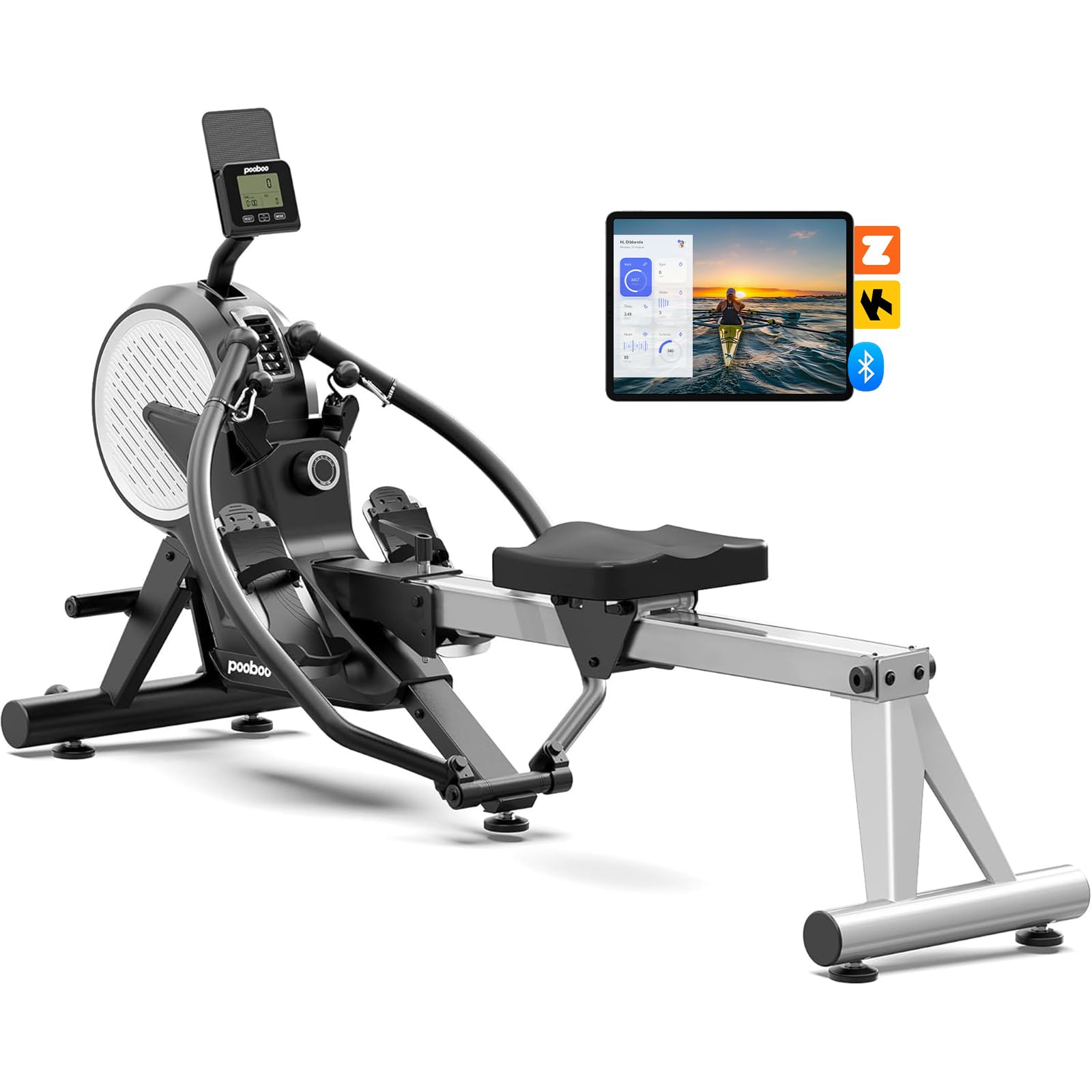
The pooboo H18801 combines wind and magnetic resistance into a single machine, giving you the auditory feedback of air resistance with the quiet control of a magnetic brake. The 14 resistance levels transition smoothly, and the 360-degree rotating handlebars allow independent arm movement — you can row with one arm, alternate strokes, or pull with both. This scull-style motion engages the lats, rhomboids, and biceps differently than a fixed-center cable.
The rail is 38 inches long with a 15-inch seat height, designed to accommodate users up to 6’6” and 400 pounds. The frame is alloy steel with a foldable design — it compresses vertically for storage, and the built-in wheels make relocation easy. The LCD monitor shows nine data fields including stroke rate, power, and average time per 500 meters, and it connects to the Kinomap app via Bluetooth.
The dual resistance setup is a clever compromise, but purists may find the pull less consistent than a dedicated air or water system. The arms add complexity — more moving parts means more potential wear over time. The seat is ergonomically shaped for long sessions, and the assembly time is about 20 minutes with 90% pre-assembly. This rower is best for someone who wants variety in their stroke mechanics and doesn’t want to choose between wind and magnetic systems.
Why it’s great
- Dual wind and magnetic resistance for quiet but adjustable feel
- 360-degree rotating handles for scull-style rowing
- Folds upright for vertical storage
- Accommodates users up to 6’6” and 400 lb
Good to know
- Dual resistance system adds mechanical complexity
- Consistency of pull may vary between wind and magnetic modes
- Monitor data fields can be cluttered
6. YOSUDA Water Rower (Pro)

The YOSUDA Water Rower is the most affordable foldable water rower on the market. The frame is made from FSC-certified solid beech wood that is 25% thicker than earlier versions, and the 180-degree folding mechanism lets it collapse to a compact size for storage. The oversized water tank uses patented sealing technology to prevent leaks even when stored upright — a genuine pain point for water rowers that this machine addresses well.
The resistance from the water paddle is smooth and forgiving, engaging 90% of your muscle groups with each stroke. The display tracks distance, time, and calories, and the Bluetooth module transmits data to your smartphone for app-based workouts. The seat is gel-cushioned and comfortable for long sessions, and the rail length accommodates users up to 6’7” and 400 pounds.
Assembly takes about 10 minutes with 98% pre-assembly, though two people make the process easier. Some units develop a squeak from the plastic rail guards after a few days — running a fingernail along the guard eliminates the noise. The foot straps are functional but feel cheap compared to the wood frame, and the display is small and basic. The water sound is pleasant but can be amplified if the rower sits on a hard floor without a mat. This is the best entry point for someone who wants the water rowing experience without spending over a thousand dollars.
Why it’s great
- Folds 180 degrees for compact storage
- FSC-certified beech wood frame
- Patented sealing prevents leaks when upright
- Fast 10-minute assembly
Good to know
- Plastic rail guards can squeak initially
- Foot straps feel low-quality
- Display is small and basic
7. MERACH Sculls R26 Rowing Machine
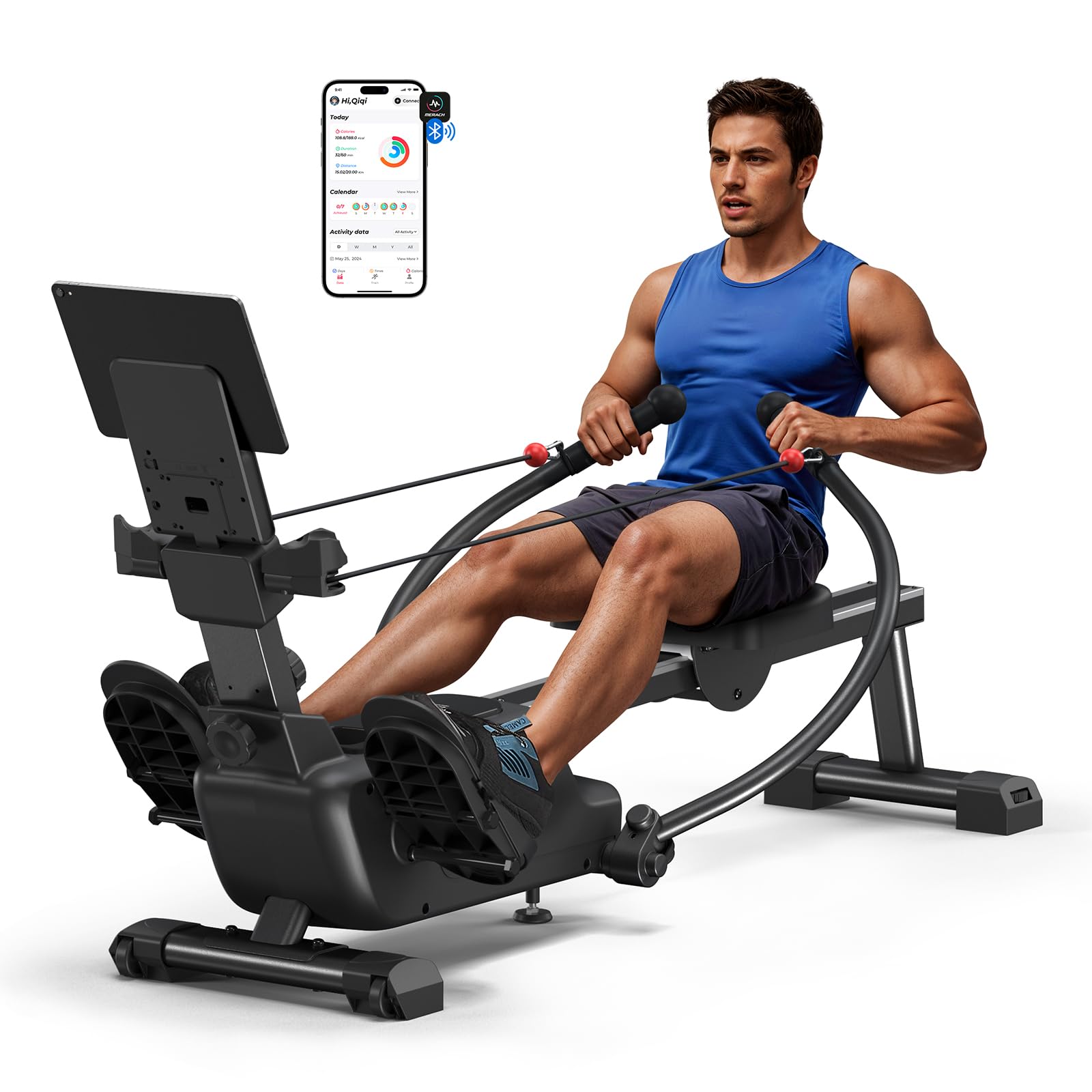
The MERACH Sculls R26 is built around a unique scull-style rowing motion where the arms move outward 120 degrees rather than pulling straight back. This engages the chest, shoulders, and upper back differently than a standard rower, and it supports one-arm rows, alternating strokes, and synchronized dual-arm pulls. The magnetic resistance delivers up to 80 pounds of peak resistance across 16 levels — sufficient for challenging interval work.
The Bluetooth connection pairs with the MERACH app, which offers over 1,000 interactive courses and games. The package includes 6 months of free premium membership with champion-coached workouts. The frame is alloy steel with a 350-pound weight capacity, and the unit is 85% pre-assembled for a 20-minute setup. The rail accommodates users up to 6’4”.
The scull arms are the main selling point, but they also introduce a limitation: the maximum resistance is capped lower than dedicated air rowers, and experienced rowers may find the top tension insufficient for peak power training. The non-backlit screen is hard to read in dim lighting, and the phone holder is too small for larger tablets. The build quality is solid for the price point, with smooth operation and quiet magnetic brakes. This is a niche machine for cross-training variety rather than raw performance tracking.
Why it’s great
- Scull-style arms for varied upper-body engagement
- 1,000+ app workouts with 6 months free premium
- Quiet magnetic resistance
- Easy 20-minute assembly
Good to know
- Maximum resistance may be too low for advanced athletes
- Non-backlit screen is hard to see
- Phone holder too small for larger tablets
8. MERACH Q1SE Magnetic Rower

The MERACH Q1SE is a compact magnetic rower that prioritizes a small footprint and silent operation. The dual slide rail design — inspired by wood rowers — provides better stability than a single rail and prevents seat wobble during the drive phase. The 16 levels of electromagnetic resistance are controlled by a twist knob and can be adjusted automatically through the MERACH app for hands-free transitions mid-workout.
The LCD monitor shows time, distance, speed, stroke count, and calories, and Bluetooth connectivity links to the free MERACH app for structured workouts. The Q1SE stores upright against a wall with the built-in base wheels, requiring only 1.6 by 2.1 feet of floor space when stored. The frame is aluminum with a 350-pound weight capacity, and assembly takes about 30 minutes.
This rower is quiet enough for apartment use — users report being able to hold a phone conversation while rowing. The foot straps are tricky to tighten securely, and the display is positioned low and has small icons that can be hard to read during a workout. Some users wish the resistance went higher for more advanced training. This rower is best for price-conscious buyers who need a quiet, space-saving machine for daily steady-state cardio and light intervals.
Why it’s great
- Whisper-quiet magnetic resistance for apartment use
- Dual slide rail for stable rowing motion
- Compact upright storage with transport wheels
- Free app with structured workouts
Good to know
- Foot straps are difficult to tighten securely
- Display is low and has small icons
- Resistance may not satisfy advanced users
9. WENOKER Magnetic Rower
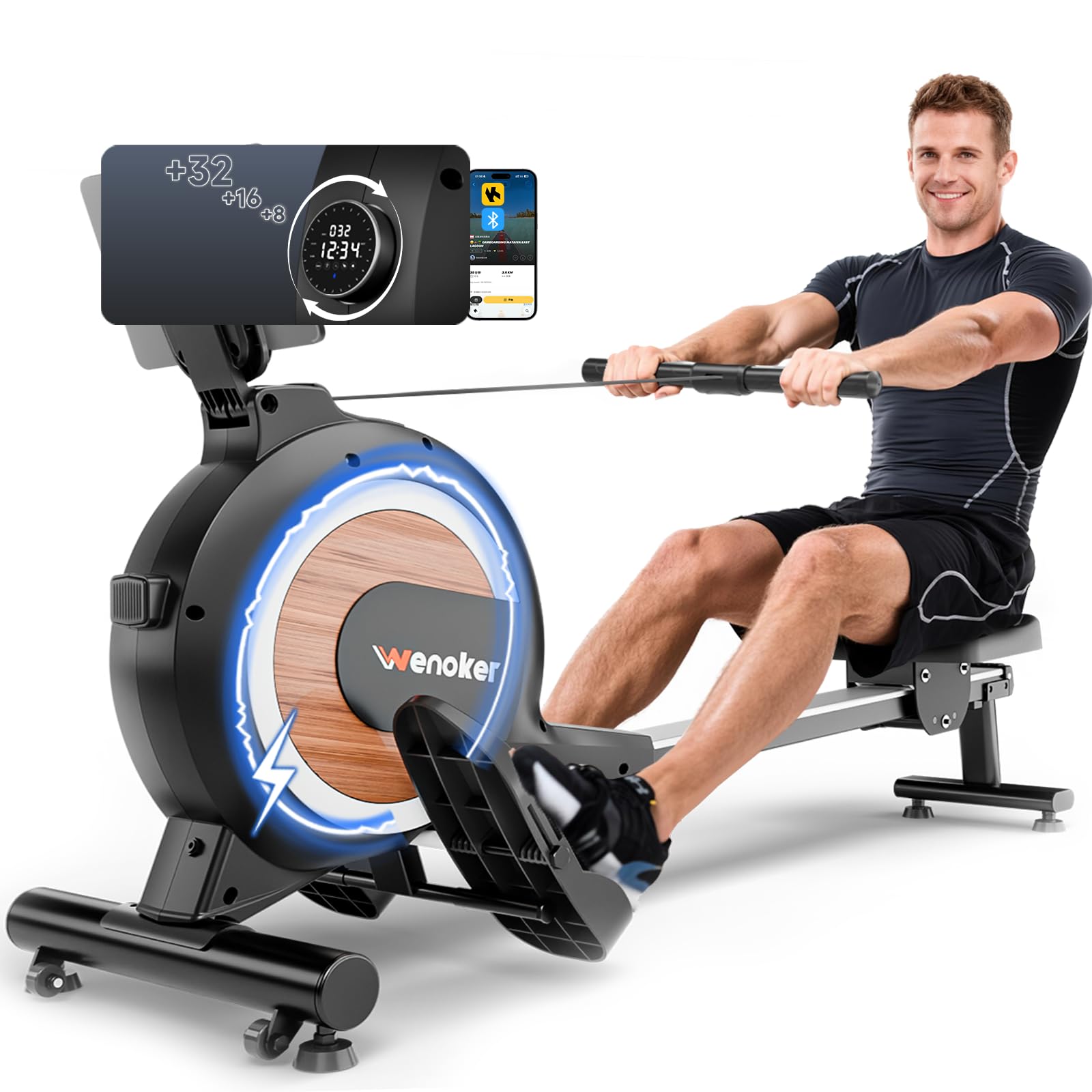
The WENOKER Magnetic Rower offers 32 resistance levels at an entry-level price, making it one of the most adjustable budget rowers available. The electromagnetic flywheel provides smoother resistance than cheaper felt-pad systems, and the aluminum alloy rail keeps the seat gliding quietly. The LCD resistance knob displays time, stroke rate, distance, speed, calories, and stroke count in real time.
Bluetooth connectivity supports the Kinomap app for virtual rowing courses, and the adjustable tablet stand holds phones or tablets securely. The frame has a 350-pound weight capacity and the unit stores vertically in just 3 square feet. Assembly is straightforward with clear video instructions, and the company offers a 1-year warranty with responsive customer support.
The seat is firm and lacks substantial cushioning for sessions over 30 minutes, and the handle can feel slippery for sweaty hands. The stroke rate reading on the display is not perfectly accurate — users note it can fluctuate — but time and distance metrics are reliable. The 32 levels provide a wide range, but even the highest setting will not match the resistance of a premium air or water rower. This is a solid pick for beginners who want a quiet, adjustable machine to build a habit without spending heavily.
Why it’s great
- 32 resistance levels for fine-tuning intensity
- Electromagnetic flywheel for smooth, quiet operation
- Vertically stores in 3 square feet
- Bluetooth app support for virtual rowing
Good to know
- Seat is firm and lacks padding for long sessions
- Handle gets slippery when sweaty
- Stroke rate display can be inaccurate
FAQ
How much space do I need for an at-home rower?
Is magnetic resistance too easy for advanced users?
Do water rowers require a lot of maintenance?
Can I use a rower if I have bad knees or a bad back?
How do I know which rail length fits my height?
Final Thoughts: The Verdict
For most users, the at home rower winner is the Concept2 RowErg because it delivers the most accurate data, the most durable build, and the most scalable resistance of any rower on the market. If you want a workout that feels like gliding on a river and looks beautiful in your living room, grab the WaterRower Club S4. And for a budget-friendly machine that folds, stays quiet, and gives you a solid daily row, nothing beats the YOSUDA Water Rower for the price.