Non-weight-bearing recovery traps you between your bed, the bathroom, and the couch. Standard underarm crutches turn every trip into an upper-body workout, leaving your hands aching and your armpits raw. The right mobility aid changes that equation — letting you move without pain in your good leg, your wrists, or your shoulders.
I’m Emma — the founder and writer behind Baby Bangs. I’ve analyzed hundreds of product specs for mobility and recovery gear, focusing on suspension systems, wheel materials, brake mechanisms, and frame geometry that define real-world usability for non-weight-bearing users.
Whether you need a seated knee scooter for long distances around the house or advanced ergonomic crutches for tight stairwells, this guide breaks down the only crutches for non weight bearing that deliver real stability and comfort without making recovery harder than it already is.
How To Choose The Best Crutches For Non Weight Bearing
Non-weight-bearing means exactly zero pounds on your injured foot or ankle. That constraint eliminates standard crutches for many people — the effort to swing your entire body forward with your arms alone is exhausting and unstable. The decision comes down to two main categories: seated knee scooters that carry your weight through your shin, and advanced forearm crutches with cushioning and ergonomic features that don’t rub under your arm. Each category has a trade-off between stability and maneuverability, and the right choice depends on your home layout, your upper body strength, and how much help you have around.
Wheel Size and Tire Type
For knee scooters, wheel diameter determines how easily you roll over thresholds, carpet, grass, or gravel. Smaller 7.5 to 8 inch wheels are fine for tile and hardwood, but they catch on sidewalk cracks and bumpy terrain. Larger 10 to 12 inch front wheels smooth out outdoor surfaces and reduce vibration. Solid rubber tires never go flat but transmit more road feel; pneumatic tires cushion but risk punctures. If you plan to step outside at all, bigger wheels with at least some shock absorption turn a bumpy ride into a manageable one.
Braking System
Every knee scooter needs brakes you can trust when you stop on a slope or need to park near a chair. Standard handbrakes with rear on-wheel brakes work for most indoor use but require consistent hand strength and can bind over time. Disc brakes, borrowed from bicycle engineering, provide faster stopping with less effort and stay reliable even after repeated use. Some walkers also include a parking brake lock — a feature that sounds minor but makes a real difference when you need to stand still without the scooter rolling away.
Frame Foldability and Portability
A non-weight-bearing recovery often means moving between rooms, cars, and medical appointments. A scooter that folds flat or has a quick-release handlebar collapses to fit in a sedan trunk without disassembly. Weight matters too — a 20-pound aluminum frame is manageable for most adults to lift into a car, while a 29-pound steel frame is sturdier but harder to heave. If you live in a multi-story home without an elevator, a lighter foldable model or advanced forearm crutches for stairs become essential.
Comfort Padding and Knee Rest
The knee pad on a scooter is where most of your body weight transfers. A contoured, thick foam pad distributes pressure over a larger surface area, preventing the sharp pain that comes from thin padding on a hard platform. Many users add a gel or lambs wool cover for extended wear. For forearm crutches, the hand grip design and cuff material determine whether you can hold them for more than ten minutes without numbness. Look for ergonomic handles that follow the natural curve of your palm and shock-absorbing springs in the shaft if you will use them on hard floors.
Quick Comparison
On smaller screens, swipe sideways to see the full table.
| Model | Category | Best For | Key Spec | Amazon |
|---|---|---|---|---|
| BlessReach Knee Scooter (Jet Black) | Mid-Range | Best Overall value and stability | 8″ wheels, shock absorption, 300 lb cap | Amazon |
| BlessReach Knee Scooter (Violet) | Mid-Range | Hands-free indoor cruising | 8″ wheels, dual locking handbrakes | Amazon |
| KneeRover Economy Steerable | Mid-Range | Budget-friendly simplicity | 7.5″ wheels, 20.3 lb, 300 lb cap | Amazon |
| BlessReach 350 lb All-Terrain | Premium | Outdoor rough terrain stability | 12″/10″ wheels, disc brakes | Amazon |
| PEPE Mobility Knee Scooter | Premium | Compact narrow indoor maneuverability | 4 wheels, folding, 21.6 lb | Amazon |
| BodyMed Premium Knee Walker | Premium | Sturdy build with metal basket | Alloy steel, 29 lb, dual rear brakes | Amazon |
| Ergobaum 7G Forearm Crutches | Premium | Stairs and narrow spaces | Shock absorption, LED, 360 lb cap | Amazon |
In‑Depth Reviews
1. BlessReach Knee Scooter (Jet Black)
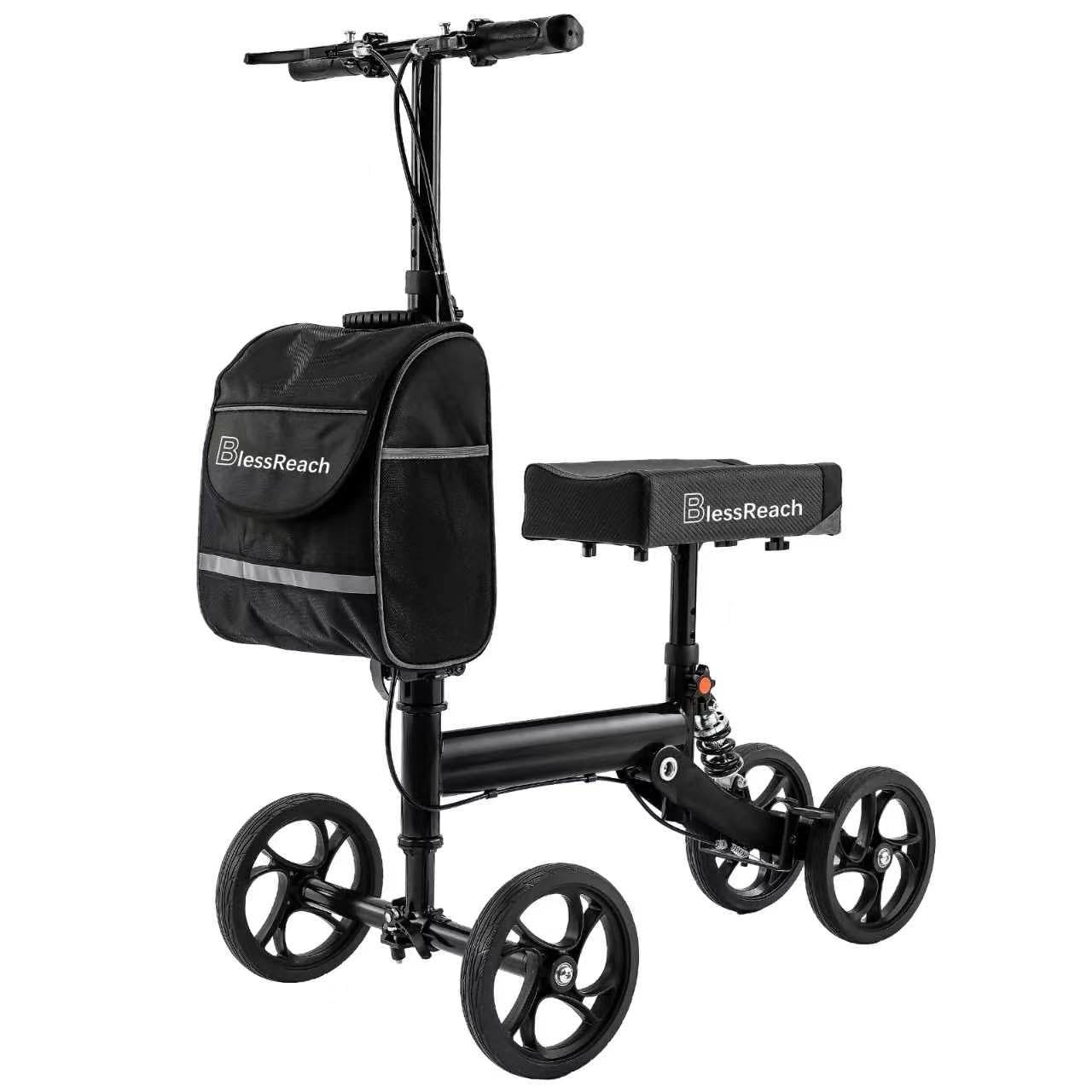
The BlessReach hits the sweet spot between comfort and cost for most non-weight-bearing recoveries. Its curved bottom frame and built-in shock absorption reduce the jolts you feel rolling over door thresholds and sidewalk cracks, which is the exact pain point that makes cheap scooters unusable after a few days. The 8-inch front and rear wheels offer a balanced ride indoors and on smooth outdoor paths, and the ergonomic locking handbrake gives you one-handed control when you need to stop fast.
The contoured padded knee rest cradles your shin without creating a pressure point at the top of the tibia, and the 300-pound weight capacity covers most adult users without the frame feeling flimsy. Assembly takes about 15 minutes with the included tools, and the detachable canvas bag holds a phone, keys, and a small water bottle — enough for moving from room to room without carrying anything in your hands. The folding mechanism reduces the scooter to a size that fits in most sedan trunks without removing the wheels.
Reviews consistently praise the stability and the fact that it works right out of the box with no squeaks or wobbly parts. A few users note that the bag netting is too small for larger drinks, and the brake lock requires pressing both handles simultaneously, which takes practice. For the price, this is the most balanced option for someone who wants a reliable knee scooter without jumping to the premium tier.
Why it’s great
- Smooth ride with integrated shock absorbers
- Stable curved frame doesn’t tip on uneven ground
- Folds easily for car transport
Good to know
- Bag netting too small for larger water bottles
- Brake lock requires two hands to engage
2. BlessReach Knee Scooter (Violet)
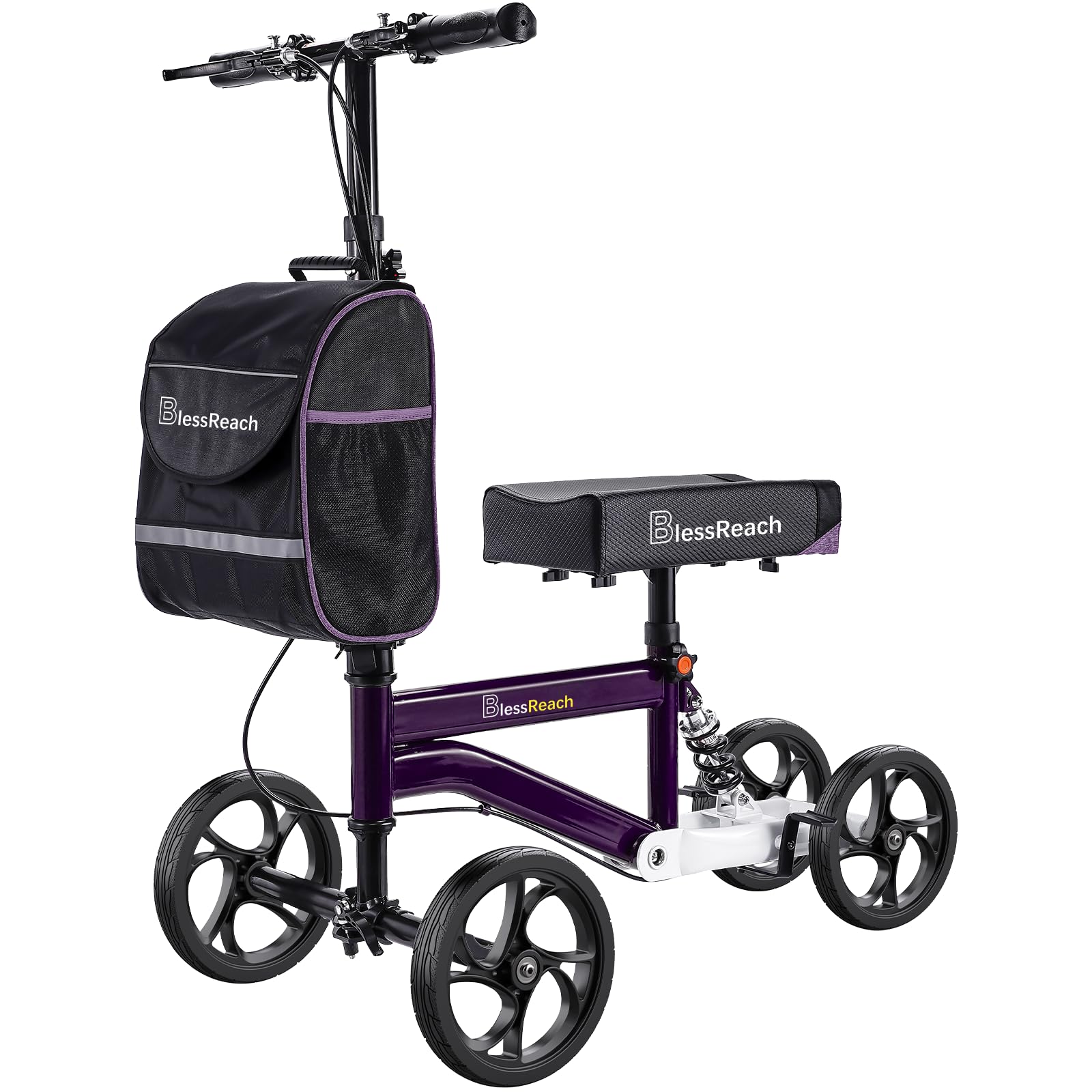
This violet model shares the same base platform as the black BlessReach but adds dual adjustable locking handbrakes and dual rear on-wheel brakes for finer speed control. The shock absorption and curved frame carry over, so the ride quality feels identical — which is a good thing for anyone who found the black version comfortable. The 23.2-pound frame sits right at the threshold where most adults can lift it into an SUV or crossover without straining.
Users report that the handlebar post detaches with a quick release, making it possible to stash the scooter in a sedan back seat without any disassembly. The padded knee rest feels thick enough for 30-minute continuous use, though some longer-term users recommend adding a gel cover for all-day wear. The detachable double-layer canvas bag is sturdy and holds a small purse or a tablet without sagging.
The steering radius is acceptable for hallways and doorways but not tight enough for sharp corners in small bathrooms. A few customers experienced squeaky springs after a few weeks, and the brake adjusters can strip if overtightened. For most indoor recovery scenarios, this scooter delivers reliable hands-free mobility at a mid-range price point that undercuts rental costs over a six-week recovery.
Why it’s great
- Dual locking brakes for confident stopping
- Quick-release handlebar for car storage
- Sturdy frame handles 250+ pounds easily
Good to know
- Steering radius too wide for tight corners
- Some units develop spring squeaks over time
3. KneeRover Economy Steerable Knee Scooter

The KneeRover Economy has been on the market since 2016 for a reason — it is a no-frills, well-built knee scooter that does exactly what it promises without any gimmicks. The 7.5-inch solid rubber wheels work best on indoor surfaces like tile and hardwood, where they roll smoothly and leave no marks. The adjustable locking handbrake provides reliable stopping power, and the rear on-wheel brakes add a secondary safety layer for parking on slight inclines.
At 20.3 pounds, this is one of the lightest scooters in its class, making it easy to carry up a few stairs or lift into a compact car. The handlebars fold with a quick-release mechanism, and the entire unit fits into a small footprint for storage. The knee pad is comfortable for shorter sessions, but multiple users note that it becomes firm after 45 minutes and benefits from an aftermarket gel pad. The absence of suspension means you feel every sidewalk crack and pebble outdoors.
The turning radius is wide by design to keep the platform stable, so you will need to make multi-point turns in narrow hallways. Solid rubber tires transmit vibration directly to the frame, so outdoor use on rough pavement or gravel is not recommended. For someone recovering at home on hard floors who wants a proven, affordable scooter from a brand with years of customer support, this is the safest entry-level choice.
Why it’s great
- Lightest scooter at 20.3 pounds for easy transport
- Proven design with years of positive reviews
- Non-marking wheels safe for wood and tile
Good to know
- No shock absorbers — feels every bump outdoors
- Wide turning radius requires practice indoors
4. BlessReach 350 lbs Capacity All-Terrain Knee Scooter
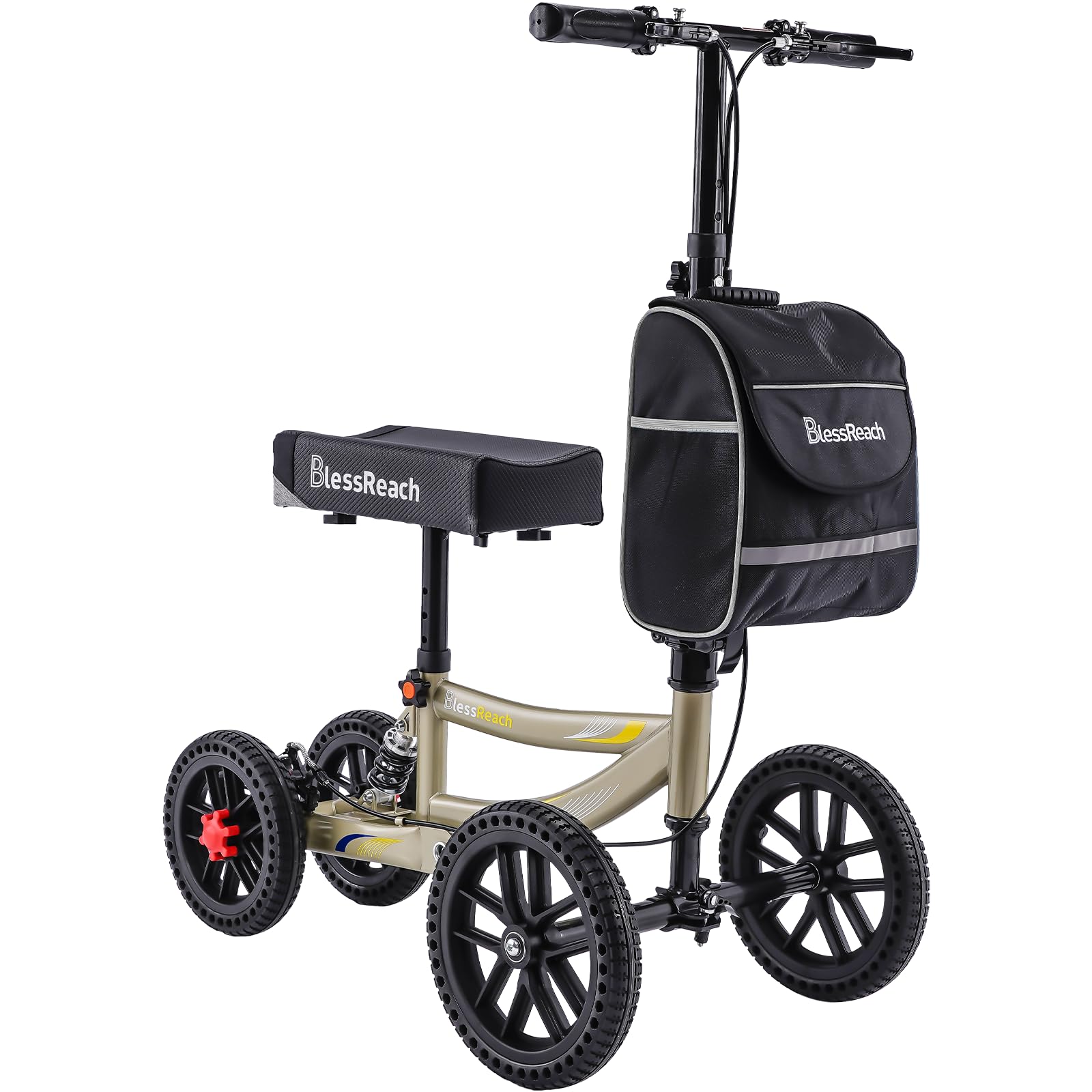
The BlessReach all-terrain model is the most engineered scooter in this lineup, built for people who need to navigate grass, gravel, and uneven sidewalks during recovery. The industry-first disc brakes stop 68 percent faster than standard handbrakes, and the low-friction rotor design extends tire life by a claimed 2.3 times. The front wheels are 12 inches and the rear wheels are 10 inches — both made from puncture-proof polyurethane that rides softer than solid PVC without requiring air inflation.
The military-grade aircraft aluminum frame keeps the weight at 26.65 pounds despite the larger wheels, and the custom shock absorbers reduce vibration by 41 percent compared to the standard BlessReach model. The six-level adjustable knee pad and handlebars accommodate users from 4 feet to 6 feet 6 inches tall. The folding mechanism uses a quick-release handlebar design that collapses the scooter for trunk storage without tools. A detachable front storage bag balances the load and keeps essentials within reach.
Some users report that the front wheels can warp slightly on uneven slate or cobblestones, and the cushion support may degrade after a month of daily use, requiring a towel or extra pad. The instructions are confusing — the lock washer is labeled as a gasket — but assembly is still possible in about 30 minutes. For anyone who needs to leave the house regularly during recovery, the extra investment for disc brakes and larger wheels pays off in stability you cannot get from a standard budget scooter.
Why it’s great
- Disc brakes provide superior stopping power on slopes
- Large PU wheels roll smoothly over grass and gravel
- Shock absorbers reduce vibration significantly outdoors
Good to know
- Knee pad may need replacement cushion after 30 days
- Front wheels can warp on very uneven stone surfaces
5. PEPE Mobility Knee Scooter
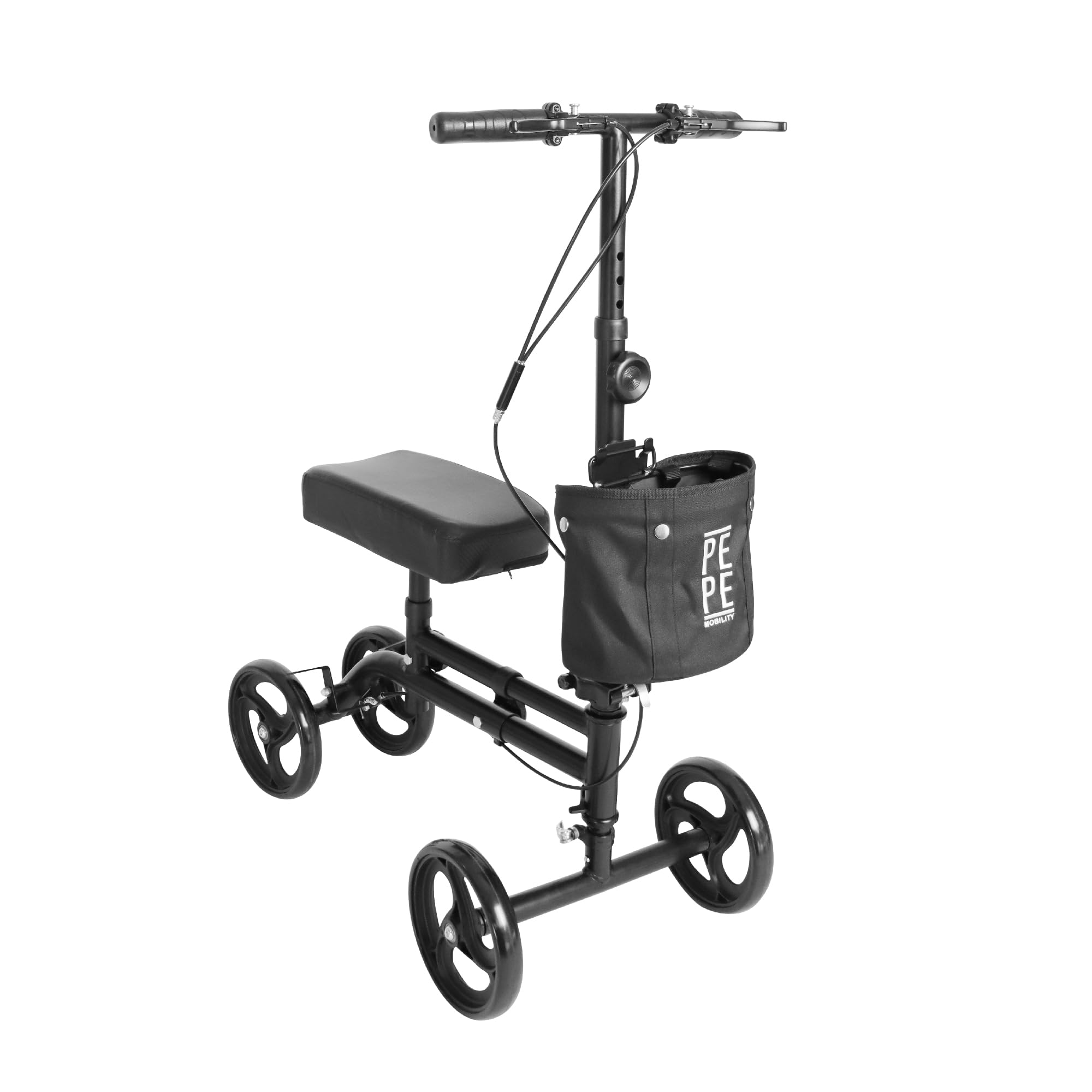
The PEPE Mobility scooter distinguishes itself with a four-wheel design that provides a wider base for users who feel unstable on three-wheeled or two-wheeled scooters. The wider front axle adds tipping resistance when you lean forward to reach something on a counter, which is a common failure point on narrower models. The padded knee support adjusts from 17 to 21 inches and the handlebars go from 33.7 to 41.7 inches, covering a wide height range for adults and taller teenagers.
At 21.6 pounds, it is light enough to carry up a short flight of stairs, and the folding system collapses it compactly for car storage. The double handbrake locks the rear wheels independently, giving you the option to brake on one side when turning in tight spaces. The included basket is actually usable — it holds a tablet, a book, and a small grocery bag without deforming. Users recovering from ankle fractures report that the scooter fits through standard doorways without scraping the walls.
The main trade-off is that the four smaller wheels and lack of suspension make this strictly an indoor scooter. On cobblestones or gravel, the jolts transmit directly to your knee and the scooter feels unstable. The knee pad is firm and several users add a gel cover for comfort beyond 20 minutes. For someone living in an apartment or single-story home who needs a narrow, stable scooter for moving between rooms, this is a solid premium pick that prioritizes indoor maneuverability over outdoor versatility.
Why it’s great
- Four wheels provide superior stability on level floors
- Fits through narrow doorways and tight hallways
- Lightweight folding design fits in small car trunks
Good to know
- No suspension means rough ride on any uneven surface
- Knee pad is firm for extended sessions
6. BodyMed Premium Knee Walker

The BodyMed Premium Knee Walker is built around a heavy-duty alloy steel frame that tips the scales at 29 pounds — the heaviest scooter in this guide, but also the one that feels most solid under a larger user. The dual rear braking system uses easy-grip handlebars to engage the locks, and the rear brakes are positioned to stop the wheels without the user needing to lean forward. The padded seat and comfortable hand grips are designed to reduce the fatigue that comes from gripping standard crutch handles all day.
The collapsible feature folds the handlebars down, and the scooter fits into the back of a CR-V or Prius without disassembly. The included metal basket is a real advantage over fabric bags — it holds heavier loads like a laptop or a bag of groceries without sagging or tearing. Users praise the non-marking wheels that leave no scuffs on hardwood floors or tile, and the overall construction feels premium enough for daily use over a six-to-eight-week recovery period.
The parking brake mechanism is the weak point — several users report that it is extremely hard to set and tends to release slightly, allowing the scooter to drift on mild slopes. The large turning radius, while providing stability at speed, makes multi-point turns necessary in tight bathrooms. For someone who values frame sturdiness and a heavy-duty basket over portability, the BodyMed delivers a reassuringly solid ride that feels like durable medical equipment rather than a disposable mobility aid.
Why it’s great
- Alloy steel frame handles heavy daily use without flexing
- Metal basket supports heavier loads than fabric bags
- Non-marking wheels safe for delicate flooring
Good to know
- Parking brake is unreliable and hard to lock
- Large turning radius requires space to maneuver
7. Ergobaum 7G Forearm Crutches

The Ergobaum 7G is not a knee scooter — it is an advanced forearm crutch designed specifically for people who need to navigate stairs, narrow hallways, and tight bathrooms where a scooter cannot go. The patented ErgoCap tip replicates a natural heel-flat-toe walking motion and maintains full ground contact on wet or uneven surfaces, which is critical when you cannot put weight on one foot and need maximum slip resistance. The integrated shock absorption in the shaft reduces the jarring impact that makes standard crutches so painful on hard floors.
These crutches fold flat for travel and fit in a car trunk or even a large carry-on bag. The built-in LED flashlight is useful for navigating dark hallways at night, and the integrated knee rest provides a place to comfortably stand when you need both hands free — a clever detail for non-weight-bearing users. The adjustable height range covers users from 5 feet to 6 feet 6 inches, and the 360-pound weight capacity is the highest in this guide. The ergonomic handles are wider and contoured, reducing pressure on the median nerve compared to standard straight grips.
Some plastic components — the cable ties, battery tabs, and arm bands — feel less durable than the aluminum shaft, and a few users report that the arm bands can be abrasive against bare skin. The alarm feature is too quiet to be useful outdoors. For anyone recovering in a multi-story home or needing to navigate stairs daily during a non-weight-bearing phase, these crutches are the only option in this guide that makes stairs safe without requiring you to sit and scoot.
Why it’s great
- Heel-flat-toe tip provides stable grip on all surfaces
- Shock absorption reduces arm fatigue on hard floors
- Folds flat and includes integrated knee rest and LED light
Good to know
- Plastic arm bands can be abrasive on bare skin
- Alarm feature is too quiet for outdoor use
FAQ
Can I use a knee scooter on stairs during non-weight-bearing recovery?
How do I know if a knee scooter is wide enough for my body?
What is the difference between a knee scooter and a rollator walker for non-weight-bearing?
Do I need a prescription or medical code to buy crutches or knee scooters?
Final Thoughts: The Verdict
For most users, the crutches for non weight bearing winner is the BlessReach Knee Scooter (Jet Black) because it combines shock absorption, stable curved frame geometry, and an accessible price point that outperforms rental costs over any recovery longer than two weeks. If you need all-terrain capability with disc brakes for outdoor confidence, grab the BlessReach All-Terrain. And for navigating stairs or living in a multi-story home, nothing beats the Ergobaum 7G Forearm Crutches for safe, ergonomic stair climbing during a non-weight-bearing recovery.