Cycling demands precision — knowing your speed, distance, cadence, and route with accuracy turns a good ride into a great training session. The right computer cuts out the guesswork and delivers data you can actually use to improve.
I’m Emma — the founder and writer behind Baby Bangs. I’ve tracked thousands of miles through GPS route analysis and compared battery drain rates across the most popular cycling computers on the market.
The choice comes down to satellite lock speed, battery endurance, and the metrics that matter to your riding style. This guide to the activity tracker for cycling breaks down the top contenders by real-world performance rather than retail hype.
How To Choose The Best Activity Tracker For Cycling
Cycling computers vary wildly in the sensors they pair with, the navigation tools they offer, and how long they hold a charge. Focus on these three criteria before you click buy.
Satellite Lock and Positioning Accuracy
A unit that supports multiple satellite constellations — GPS plus GLONASS, Galileo, Beidou, or QZSS — acquires a signal faster and maintains it under tree cover and near tall buildings. Multi-band GNSS technology, found on premium units, further improves accuracy by using two frequency bands simultaneously.
Battery Life That Matches Your Longest Ride
Battery ratings range from 20 hours to over 40 hours depending on the model and whether you use battery-saver mode. If you ride centuries or multi-day tours, look for a unit that can last at least 25 hours with GPS active. Recharge time is also relevant — Type-C charging cuts downtime significantly.
Sensor Ecosystem and Data Fields
Cycling-specific metrics like cadence, power, heart rate, and rear-radar proximity depend on ANT+ and Bluetooth compatibility. A unit that supports ANT+ connects to a wider range of sensors and accessories, including smart trainers, e-bike displays, and electronic shifters, without draining the phone battery.
Quick Comparison
On smaller screens, swipe sideways to see the full table.
| Model | Category | Best For | Key Spec | Amazon |
|---|---|---|---|---|
| Garmin Edge 540 | Premium | Training with adaptive coaching | Multi-band GNSS, 26h battery | Amazon |
| Wahoo ELEMNT ROAM V3 | Premium | Navigation and route sharing | Dual-band GPS, 2.8” color screen | Amazon |
| COOSPO CS600 | Mid-Range | Touchscreen navigation on a budget | 36h battery, IPX7, 2.4” touch | Amazon |
| iGPSPORT BSC300T | Mid-Range | Offline maps and group ride tracking | Touchscreen, 20h, 5 satellites | Amazon |
| iGPSPORT BSC200S | Mid-Range | Value navigation with radar support | 25h battery, IPX7, 2.4” color | Amazon |
| COOSPO BC200 + BK467 | Budget | Entry-level with cadence sensor bundle | 36h battery, 2.6” LCD, IP67 | Amazon |
| Wahoo TRACKR Heart Rate | Accessory | Accurate heart-rate data for training | 200h battery, ANT+/Bluetooth | Amazon |
In‑Depth Reviews
1. Garmin Edge 540

The Garmin Edge 540 delivers adaptive coaching that adjusts daily suggested workouts based on your recovery load and event calendar, using data from a compatible power meter and heart rate monitor. The multi-band GNSS technology provides enhanced positioning accuracy in dense forests and urban areas where standard GPS drifts.
Battery life reaches 26 hours in demanding use cases and stretches to 42 hours in battery-saver mode, making it viable for multi-day tours. The ClimbPro ascent planner now works on any ride — no course file required — showing remaining ascent and grade in real time so you can gauge effort on every climb.
Button controls are deliberate for riders who prefer tactile feedback over touchscreens, especially when hands are sweaty or gloved. The Power Guide feature recommends wattage targets throughout a course when paired with a power meter, and stamina insights show how much longer you can push before fatigue sets in.
Why it’s great
- Adaptive coaching personalizes training without manual input
- Multi-band GNSS holds lock where other units lose signal
- ClimbPro grade data works on every ride, not just imported routes
Good to know
- Setup instructions are sparse and the menu takes time to learn
- Rerouting logic can force illogical loops if you deviate from the planned course
2. Wahoo ELEMNT ROAM V3

The Wahoo ELEMNT ROAM V3 uses dual-band GPS to maintain accuracy in thick forests and urban density where signal obstructions are common. It supports six satellite constellations — GPS, GLONASS, Beidou, Galileo, QZSS, SBAS, and NavIC — giving it the widest positioning net in this roundup.
Navigation is the headline feature: the unit auto-generates turn-by-turn prompts for GPX and TCX files imported from Strava, Ride With GPS, Komoot, or any other routing source. Public Route Sharing lets nearby ELEMNT riders load your route directly from the companion app, which is useful for group rides.
Battery life is rated at 25 hours, and real-world reports show roughly 5 percent drain per hour outdoors. The 2.8-inch color LCD is readable in direct sunlight but can be hard to read in low light. Spoken turn directions — not just beeps — add a layer of safety when you don’t want to glance at the screen.
Why it’s great
- Dual-band GPS with six satellite systems locks fast and holds tight
- Public Route Sharing simplifies group ride logistics
- Spoken turn-by-turn directions reduce the need to look at the screen
Good to know
- Connectivity bugs have been reported, including sensor pairing drops
- Customization of data fields is only possible through the app, not on the unit itself
3. COOSPO CS600
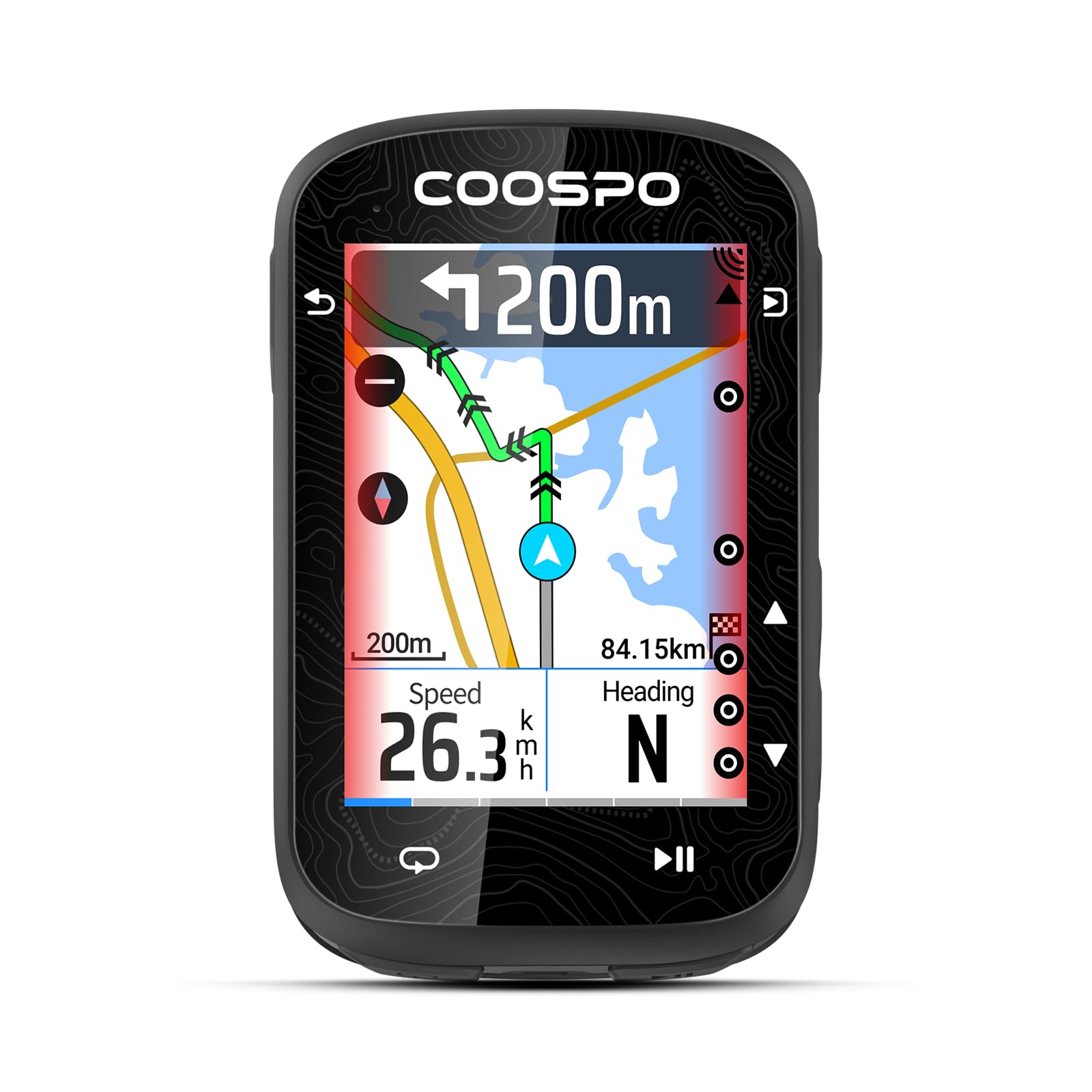
The COOSPO CS600 packs a 2.4-inch color touchscreen with auto-backlight adjustment and a 36-hour battery into a package that costs roughly the same as a mid-range Wahoo or Garmin but undercuts the premium tier significantly. The touchscreen is responsive, and the dual-button interface gives you an alternative when riding with gloves.
Route navigation uses breadcrumb trails and uploaded GPX/FIT files via the Coosporide app. The unit supports over 150 data fields, customizable into 7 screens with up to 8 fields per screen. It pairs with ANT+ and Bluetooth accessories, including rear radar lights, power meters, and smart trainers.
IPX7 waterproofing means you can ride through heavy rain without covering the unit. The mount uses a double rubber-band system that holds the computer securely on rough terrain. GPS signal can drop briefly under dense tree cover or long bridges, but the unit re-acquires quickly without data loss.
Why it’s great
- 36-hour battery covers multi-day rides without charging
- Color touchscreen with auto-backlight is clear in all conditions
- Works with Garmin Varia radar and other ANT+ sensors
Good to know
- No automatic rerouting if you stray from the planned course
- GPS can lose lock briefly under heavy tree canopy or long bridges
4. iGPSPORT BSC300T

The iGPSPORT BSC300T combines a 2.4-inch touchscreen with six physical buttons, giving you dual control methods for different riding conditions. It supports five satellite positioning systems — GPS, Beidou, GLONASS, Galileo, and QZSS — for fast and accurate location data even in remote areas.
Offline map download is the standout feature here: you can load full regional maps before a ride and navigate without any mobile signal. The unit also supports off-course warnings that buzz and display an alert until you return to the correct route. Real-time teammate tracking displays the position of friends in group rides, which helps avoid wrong turns or dropped riders.
Battery life is 20 hours, slightly less than some competitors, but the Type-C charging takes only two hours to top up. The BSC300T is e-bike compatible and will display power level and assist mode. The touchscreen can be sluggish in cold weather and difficult to operate with thick gloves, but the button controls compensate well.
Why it’s great
- Global offline maps eliminate the need for a phone connection
- Real-time teammate tracking is useful for group rides
- Off-course warnings prevent wrong turns without distracting navigation
Good to know
- Touchscreen responsiveness drops in cold weather
- Navigation does not recalculate a new route if you stay off course
5. iGPSPORT BSC200S

The iGPSPORT BSC200S offers a 2.4-inch semi-transparent semi-reflective color screen that stays readable in direct sunlight, a key advantage for daytime riders. The 25-hour battery life is competitive with the mid-range Wahoo and Garmin offerings, and Type-C charging fills the unit in about 90 minutes.
Route navigation supports one-touch destination routing from the iGPSPORT app, as well as “back to start” navigation and riding record navigation. The unit pairs with iGPSPORT front lights and radar tail lights, letting you control the light beam and monitor traffic proximity from the screen. Smart notifications for calls, SMS, and app alerts appear on the display.
Over 100 riding data fields are available, including FTP, grade, and temperature, with customizable display pages through the app. Seamless Strava sync is a frequent praise point in user reviews. The screen and fonts are relatively small, so reading detailed map navigation at speed requires a quick glance.
Why it’s great
- Reflective color screen is exceptionally clear in strong sunlight
- Competitive battery life with fast Type-C charging
- Seamless Strava sync and 100+ data fields cover training needs
Good to know
- Map navigation is low-resolution and labels are tiny at speed
- No Ride With GPS or Komoot integration outside of Strava sync
6. COOSPO BC200 + BK467

The 2.6-inch LCD display is the largest in this lineup, with auto-backlight that adjusts to ambient light and remains readable in both bright sun and low-light conditions.
Battery life is an impressive 36 hours from the 1200mAh lithium-polymer cell, which supports multi-day touring without a recharge. The unit offers over 70 cycling data fields including distance, time, altitude, slope, temperature, atmospheric pressure, and cycling power. Customizable pages let you display 2 to 9 data fields per screen.
Sync to Strava is supported both through the Coosporide app and via USB .FIT file transfer to a PC. The IP67 waterproof rating means the unit can be submerged briefly without damage. User reviews consistently note that setup instructions are poor and that the rubber mounting band can break over time, so an extra band is worth having.
Why it’s great
- Includes cadence/speed sensor — no separate purchase needed
- 36-hour battery eliminates range anxiety on long tours
- Large 2.6-inch LCD with auto-backlight is easy to read
Good to know
- Setup instructions are vague; video tutorials are recommended
- Rubber mounting band can snap over time; carry a spare
7. Wahoo TRACKR Heart Rate Monitor

The Wahoo TRACKR Heart Rate Monitor is a chest-strap sensor that delivers real-time heart rate data via ANT+ and Bluetooth to cycling computers, smartphones, and fitness equipment. The rechargeable battery lasts up to 200 hours active — roughly 6 to 8 weeks of daily riding — and charges via USB-C, eliminating the need for coin-cell replacements.
The strap uses a slim, soft, secure-fit design that keeps the sensor in place during intense efforts without chafing. Intuitive LED indicators confirm heart rate detection, battery status, and connectivity to paired devices. User reviews consistently report better accuracy than optical wrist sensors, especially during high-cadence or high-intensity intervals where wrist-based monitors tend to lag.
The TRACKR pairs seamlessly with Wahoo ELEMNT computers, Zwift, Cyclemeter, Apple Health, and Strava. One caveat: the included strap may not fit larger users comfortably, and some riders opt for a third-party replacement strap. The sensor pod itself is water-resistant and survives sweat and rain without issue.
Why it’s great
- 200-hour rechargeable battery replaces coin-cell headaches
- Chest-strap accuracy outperforms optical wrist sensors
- ANT+ and Bluetooth dual protocols work with almost every cycling computer
Good to know
- Included strap may be too small for larger chest sizes
- Sensor pod is water-resistant but not fully submersible
FAQ
Can I use any heart rate monitor with a Garmin or Wahoo cycling computer?
What is the difference between GPS and multi-band GNSS in cycling computers?
Do I need a power meter to get useful training data from a cycling computer?
Final Thoughts: The Verdict
For most users, the activity tracker for cycling winner is the Garmin Edge 540 because it combines multi-band GNSS accuracy with adaptive coaching that actually adjusts to your real fatigue levels. If you want the best navigation experience with turn-by-turn voice directions, grab the Wahoo ELEMNT ROAM V3. And for a touchscreen unit that costs less than half the premium alternatives with a 36-hour battery, nothing beats the COOSPO CS600.