Indoor air can be two to five times more polluted than outdoor air, yet most of us never think about it until headaches, fatigue, or allergy symptoms appear. An air quality monitor takes the guesswork out of your environment, giving you real-time data on the invisible particles and gases that affect your health, focus, and sleep.
I’m Emma — the founder and writer behind Baby Bangs. I’ve spent years analyzing sensor hardware, reading research on indoor pollutants, and comparing how different monitors handle the critical specs that actually matter for your home.
Whether you’re managing asthma, optimizing a home office, or just curious about your air, this guide will help you find the right tool. You’ll learn exactly what to look for and how the top models stack up in the search for the best air quality monitor for your specific situation.
How To Choose The Best Air Quality Monitor
With monitors ranging from simple CO₂ detectors to multi-sensor lab-grade units, it’s easy to overpay for features you don’t need or undershoot on the sensors that matter. Focus on these four factors to match the device to your actual indoor challenges.
Identify your core pollutant
Different environments create different problems. In a home office, rising CO₂ from your own breath causes drowsiness and brain fog — you need a monitor with a quality CO₂ sensor (NDIR or photoacoustic). In a home near a highway or wildfire zone, PM2.5 and PM10 particle counts are your priority. For new construction or recent furniture, TVOC and formaldehyde (HCHO) sensors become critical. No single monitor is best for every situation, so start by naming your specific concern.
Sensor accuracy and technology
Not all sensors are equal. True NDIR CO₂ sensors (like the Swiss-made unit in the SwitchBot) maintain accuracy over years without drift, whereas cheaper electrochemical CO₂ sensors degrade. For particulates, laser-based particle counters are the standard — look for monitors that report multiple PM sizes (PM1.0, PM2.5, PM10). Photoacoustic NDIR sensors, like the Sensirion SCD4x in the GoveeLife, offer excellent accuracy with built-in pressure compensation for altitude variations.
Display readability and alerts
A monitor you can’t read at a glance defeats its purpose. Large, color-coded displays with AQI indicators (green to red/purple) let you see problems instantly without navigating menus. Some units offer customizable thresholds with audible alarms, app push notifications, or both. If the monitor lives in a bedroom, make sure the display brightness can be dimmed or turned off at night — the GoveeLife’s programmable day/night brightness schedule is a standout feature for light-sensitive sleepers.
Data logging and smart integration
Real-time numbers are useful, but trends reveal patterns. Monitors that sync to an app and store historical data (the GoveeLife keeps up to two years) help you correlate high CO₂ with closed windows, or PM spikes with cooking. WiFi-connected units allow remote monitoring when you’re away, and voice control via Alexa/Google Assistant can trigger smart fans or humidifiers. Battery-powered units offer portability to test different rooms, while AC-powered models provide uninterrupted 24/7 tracking.
Quick Comparison
On smaller screens, swipe sideways to see the full table.
| Model | Category | Best For | Key Spec | Amazon |
|---|---|---|---|---|
| GoveeLife H5140 | CO₂ Focus | Home offices & sleep quality | Photoacoustic NDIR CO₂ sensor | Amazon |
| BREATHE Airmonitor Plus | Multi-Sensor | Comprehensive air insight | CO₂, PM1/2.5/10, TVOC, HCHO | Amazon |
| Bcetasy PV33 | 18-in-1 WiFi | Real-time WiFi monitoring | Dual chip, PM2.5 + CO₂ + TVOC + HCHO | Amazon |
| SwitchBot Meter Pro CO₂ | NDIR CO₂ | Portable CO₂ tracking | Swiss-made NDIR sensor (±50 ppm) | Amazon |
| YNAK AK22A 7″ | Large Display | Workshops & family rooms | 7″ LED, 9 parameters, 0.001 accuracy | Amazon |
| Langtao AK22A 12H | Extended Battery | All-day whole home monitoring | 3500mAh battery, 12-hour runtime | Amazon |
| KDWKD AK23CA | Broad Spectrum | Detailed particle & gas detection | CO, PM0.3–10, TVOC, HCHO, C6H6 | Amazon |
In‑Depth Reviews
1. GoveeLife Smart Air Quality Monitor H5140
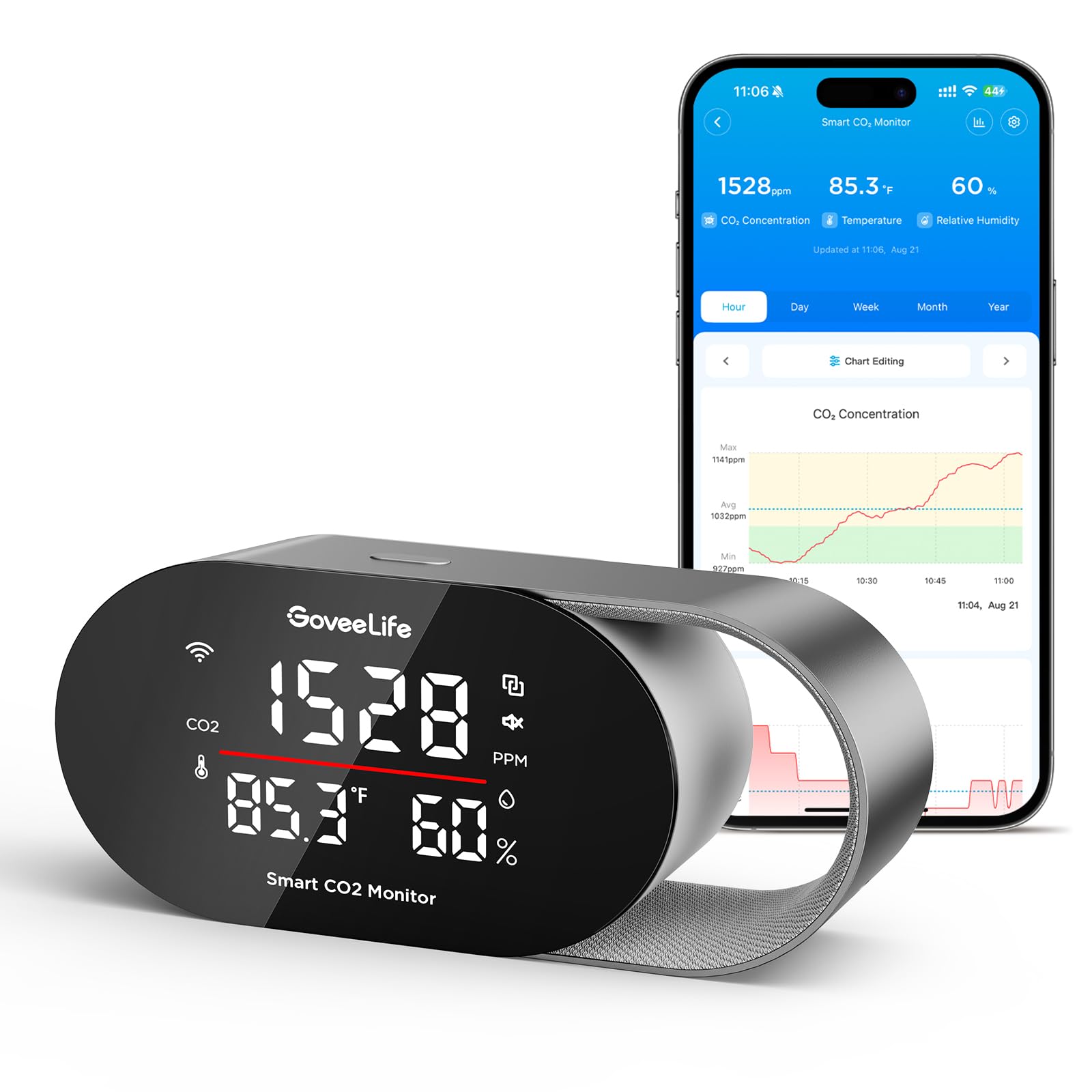
The GoveeLife H5140 is purpose-built for one of the most impactful problems in modern homes: CO₂ buildup in bedrooms and home offices. Its Sensirion SCD4x photoacoustic NDIR sensor delivers accuracy of ±(40 ppm + 5%) with a 5-second refresh rate and built-in pressure compensation, so altitude won’t throw off readings. You get CO₂, temperature, humidity, and a clock on a sharp color display — no particulate or VOC sensors here, just focused CO₂ tracking backed by 2-year data history exportable to CSV.
The triple-alert system (buzzer, app notification, email) is robust, but the standout feature is the programmable LED brightness that auto-dims at night — critical for nurseries or light-sensitive sleepers. AC power means zero battery anxiety, and the 4.82-inch screen shows real-time CO₂, temp, and humidity at a glance. Smart home integration with Alexa, Google Assistant, and IFTTT lets you trigger fans or humidifiers when CO₂ crosses your threshold.
Reviewers consistently praise its ability to reveal how quickly CO₂ spikes in a closed room, and how ventilation drops it back. Some wish it had PM2.5 sensing, but at this price point, the sensor quality and data depth are unmatched for CO₂-focused buyers. For anyone working from home or managing sleep quality, this is the monitor to beat.
Why it’s great
- Top-tier photoacoustic NDIR CO₂ sensor with altitude compensation
- Programmable day/night brightness eliminates sleep disruption
- 2-year historical data logging with CSV export
- Smart home integration with Alexa and Google Assistant
Good to know
- AC-powered only — no battery for portability
- No PM2.5, TVOC, or HCHO sensors
2. BREATHE Airmonitor Plus
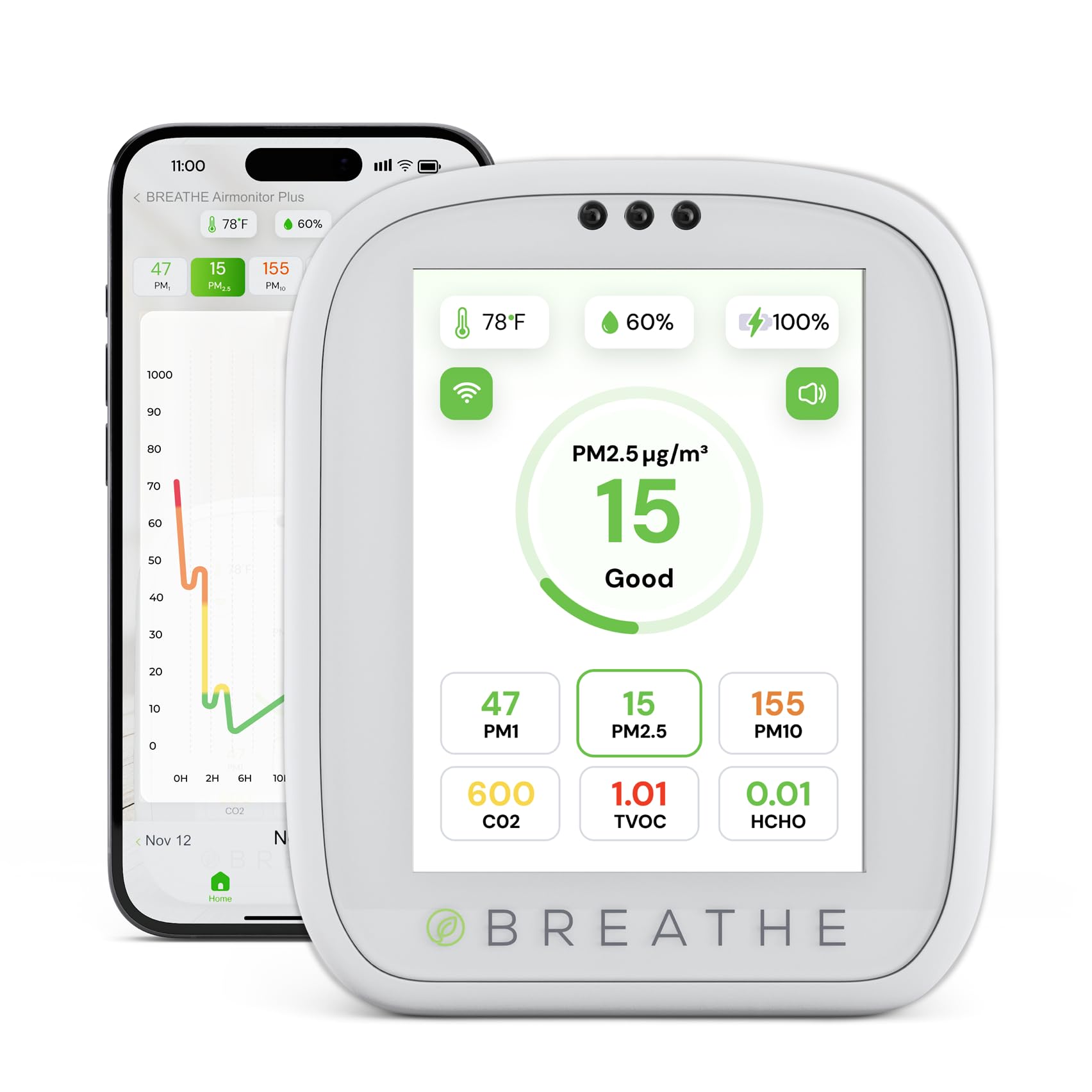
The BREATHE Airmonitor Plus goes beyond CO₂ to give you a complete picture of your indoor air: PM1, PM2.5, PM10, TVOC, formaldehyde (HCHO), temperature, and humidity. It uses advanced multi-sensor technology rather than basic electrochemistry, which means readings for VOCs and particles are reliable enough to act on. The compact white enclosure fits unobtrusively on a desk or nightstand, and the free Breathe Tech app provides 30-day data history with push alerts.
What sets this unit apart is its focus on actionable insight — it doesn’t just show numbers, it helps you correlate air changes with specific events like cooking, cleaning, or HVAC cycles. The CO₂ meter is precise enough to detect the difference between an empty room and one with a few people after 15 minutes, making it a practical tool for classrooms or shared offices. Breathe Tech backs the unit with a 2-year manufacturer warranty, which is rare at this level.
User feedback highlights easy setup and sensitive, accurate readings, though the display is on the smaller side and battery life is limited. Some reviewers note that the automatic background calibration (ABC) can drift downward in chronically high-CO₂ environments — a known limitation of many NDIR sensors — but manual recalibration is straightforward. If you want a single device that covers CO₂, particulates, and VOCs without compromise, this is your pick.
Why it’s great
- Comprehensive sensor suite: CO₂, PM1/2.5/10, TVOC, HCHO
- 2-year manufacturer warranty for peace of mind
- Free app with 30-day history and trend analysis
- Compact, modern design fits any room
Good to know
- Small display, not readable from across a room
- ABC calibration can drift in high-CO₂ homes
3. Bcetasy 18-in-1 Smart Air Quality Monitor PV33
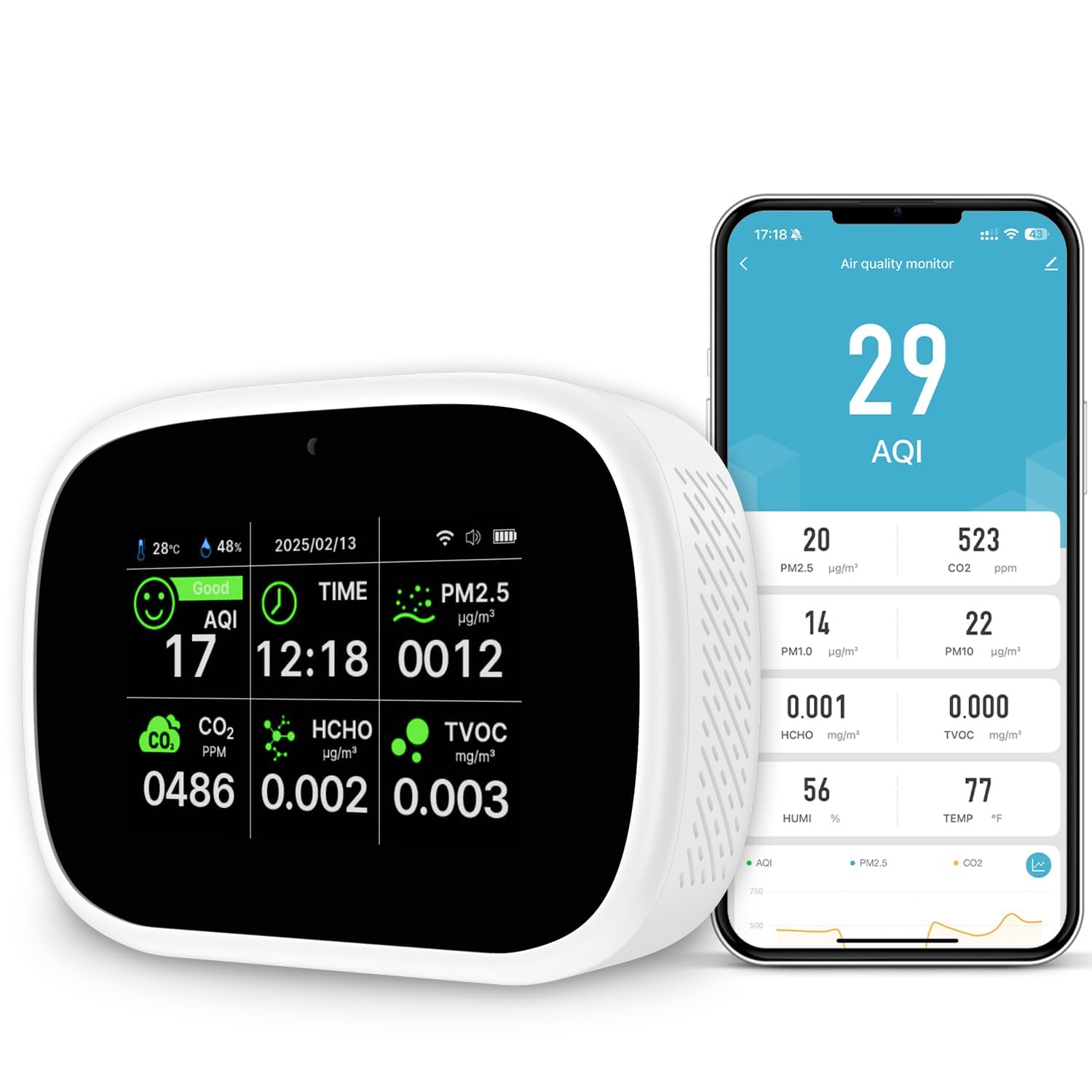
The Bcetasy PV33 uses a dual-chip architecture — one dedicated to rapid sensor data processing, another to managing the interface — to deliver fast, accurate readings for AQI, CO₂, PM2.5, PM1.0, PM10, TVOC, HCHO, temperature, and humidity. It connects to WiFi via the Smart Life or Tuya Smart app (2.4 GHz only) for real-time remote monitoring, data storage, and customizable alerts. The 3000mAh battery provides 7-15 hours of use depending on screen-on time, and the Type-C charging is convenient.
The HD LCD display is color-coded for instant AQI assessment and has auto-brightness, making it usable in both dark bedrooms and bright kitchens. Side buttons let you cycle through display modes without the app, and the unit is wall-mountable. Reviewers report that it responds within seconds to cigarette smoke or cooking fumes, turning from green to orange/red. The dual-chip design means the app interface stays responsive even during active monitoring.
On the downside, some users report inconsistent readings between units (400+ ppm CO₂ variance), and the app could use clearer definitions of the displayed acronyms. The device connects to only one smartphone at a time, so multiple users must reset WiFi settings. Still, for a mid-range unit with WiFi, app data storage, and a broad sensor array, the PV33 delivers strong value for tech-savvy households.
Why it’s great
- Dual-chip design for fast, responsive monitoring
- WiFi connectivity with app data storage and alerts
- Broad sensor suite including PM2.5, TVOC, and HCHO
- 3000mAh battery for portable use
Good to know
- Some units show inconsistent CO₂ readings
- App could use more descriptive pollutant definitions
4. SwitchBot Meter Pro CO₂

The SwitchBot Meter Pro CO₂ packs a Swiss-made NDIR sensor into a slim 92mm display that runs for up to 12 months on a single set of batteries. It simultaneously shows CO₂ (400-9000 ppm range, ±50 ppm accuracy), temperature, humidity, time, date, and a comfort level icon — all on a crisp, minimalist screen. At just 154g and with a wall-mount bracket, it’s the most portable and low-maintenance option here for CO₂ tracking.
Accuracy comparisons against the Aranet4 (a professional reference unit) show deviation of only 50-100 ppm, which is excellent for a monitor at this level. The three-alarm system (sound, visual screen alert, and app notification via the SwitchBot Hub) lets you set custom thresholds. Reviewers consistently note that the battery life is genuinely long, the Bluetooth connection works reliably across floors, and the design blends into any room.
The catch is that full smart features require the optional SwitchBot Hub, and some users report that when plugged in via USB, the CO₂ reading can freeze for hours — so running it on battery is actually more reliable. The app lags occasionally and graphs can be glitchy. But as a standalone, ultra-portable CO₂ detector with Swiss sensor accuracy, the SwitchBot delivers where it counts.
Why it’s great
- Swiss-made NDIR sensor with ±50 ppm accuracy
- 12-month battery life on a single charge
- Ultra-portable at 154g with wall-mount option
- Accurate to within 50-100 ppm of professional units
Good to know
- Smart features need the optional SwitchBot Hub
- USB power can cause freezing readings
5. YNAK 16-in-1 Air Quality Monitor AK22A
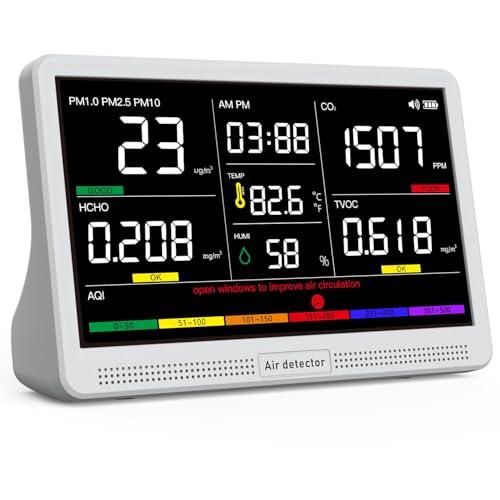
The YNAK AK22A is built around a massive 7-inch LED display that shows 9 key parameters — CO₂, PM2.5, PM1.0, PM10, HCHO, TVOC, temperature, humidity, and AQI — all simultaneously without needing to navigate menus. The external high-precision sensors claim 0.001 resolution, and the multi-sensor array with enhanced airflow design responds to environmental changes quickly. Reviewers report seeing CO₂ and PM spikes within 20-30 seconds of lighting a candle or turning off an air scrubber.
The seven-level AQI alert system with color coding (green to purple) makes it easy to read from across the room, and three brightness settings ensure visibility in any lighting. The 2500mAh battery provides up to 8 hours of cordless use, and the USB-C charging is standard. It doubles as a clock, which is a nice touch for desks or workshop benches. Users consistently praise the display clarity and how it turns invisible air problems into something the whole family can see and understand.
On the downside, WiFi and mirror display features mentioned in reviews aren’t documented in the manual, and some users found initial readings stayed green even when strong chemical cleaners were used nearby, raising questions about VOC sensitivity. It’s not lab-grade, but as an at-a-glance visual monitor for homes, workshops, and basements, it’s hard to beat for the display size alone.
Why it’s great
- 7-inch LED shows all 9 parameters at once
- 20-30 second response to air quality changes
- Color-coded AQI alerts readable from across a room
- Doubles as a clock with 8-hour battery life
Good to know
- WiFi features undocumented in the manual
- VOC sensitivity may be lower than expected
6. Langtao 16-in-1 AK22A 12-Hour
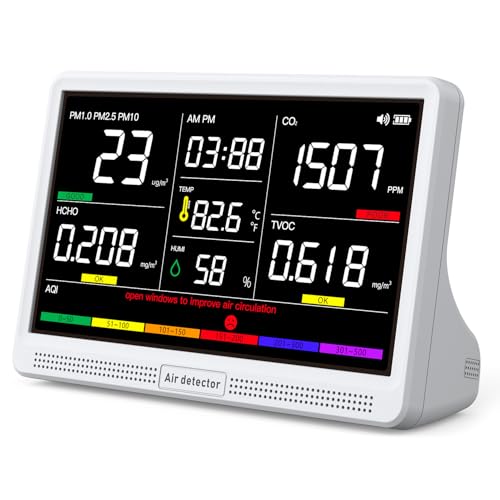
This is essentially the same 16-in-1 platform as the YNAK AK22A but with an upgraded 3500mAh battery that extends runtime to 12 hours — enough for a full day of whole-home monitoring without reaching for a charger. It covers the same 9 parameters (CO₂, PM2.5, PM1.0, PM10, HCHO, TVOC, temperature, humidity, and AQI) on the same large 7-inch display, with the same external high-precision sensors and 7-level AQI alert system.
The longer battery life makes a real difference if you plan to move the monitor between rooms or use it in spaces without convenient outlets — think basements, workshops, or rental apartments. The three brightness settings and mute button mean it works in a bedroom without light pollution, and the display is clear enough to read from across the room. Like its sibling, it responds within seconds to changes from cooking, opening windows, or occupancy.
The same caveats apply: WiFi and mirror display features are not documented, and some users question the VOC sensitivity after initial green readings in chemically strong environments. But if your priority is all-day portability with a large, easy-to-read screen, the 12-hour battery makes this the clear choice over the standard YNAK.
Why it’s great
- 3500mAh battery delivers 12 hours of continuous use
- Large 7-inch display with all parameters at once
- Fast response to cooking, smoking, and ventilation changes
- Three brightness settings for day and night use
Good to know
- Same undocumented WiFi features as the YNAK
- VOC sensor may underreport in some conditions
7. KDWKD AK23CA Air Quality Monitor
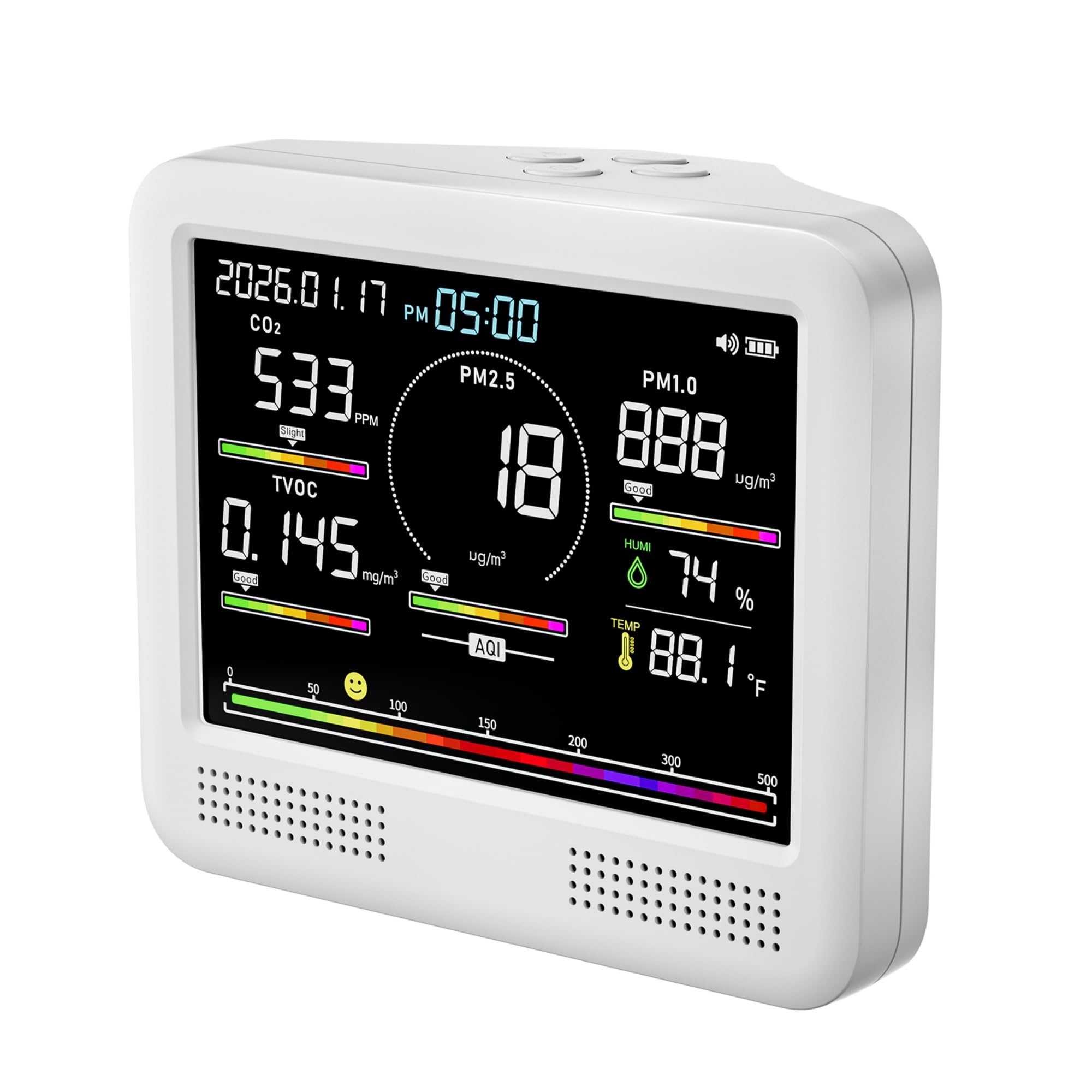
The KDWKD AK23CA stands out by adding carbon monoxide (CO) detection to the standard mix of CO₂, PM0.3, PM0.5, PM1.0, PM5.0, PM10, HCHO, TVOC, temperature, and humidity — plus benzene (C6H6) monitoring, which is rare in this range. The 7-level AQI display with color coding and optional audible alarm provides clear warnings when pollutants spike, and the built-in rechargeable battery lasts up to 9 hours for room-to-room testing.
This monitor is particularly well-suited for detecting the broadest range of particles (from PM0.3 ultrafine to PM10 coarse) and for identifying problems from cooking smoke, wildfire smoke, dust, paint fumes, and newly renovated furniture. The large color screen shows readings clearly from a desk or bedside table, and the compact size makes it easy to place in kitchens, offices, or RVs.
However, the customer reviews on Amazon are unusually mixed — several 5-star reviews describe using the product as deck cable railing wire, not an air quality monitor, which suggests listing contamination or unreliable review content. This makes it difficult to verify real-world performance. If you need CO monitoring and the widest particle size range, the AK23CA is worth considering, but weigh the review ambiguity against more established options above.
Why it’s great
- Includes carbon monoxide (CO) and benzene (C6H6) sensors
- Monitors 5 particle size ranges down to PM0.3
- 9-hour battery with large color display
- Compact and portable for room-to-room use
Good to know
- Many customer reviews appear unrelated to the product
- Real-world accuracy is difficult to verify
FAQ
What is the most important sensor for an air quality monitor?
Can an air quality monitor detect mold?
How often should I calibrate my CO₂ sensor?
Is a WiFi-connected monitor worth the extra cost?
What does the AQI color scale mean on these monitors?
Final Thoughts: The Verdict
For most users, the best air quality monitor winner is the GoveeLife H5140 because it focuses on the single most impactful indoor pollutant — CO₂ — with a top-tier sensor, excellent data tracking, and smart home integration that actually works. If you want comprehensive multi-sensor monitoring including particulates and VOCs, grab the BREATHE Airmonitor Plus. And for portable CO₂ tracking with Swiss sensor accuracy and a 12-month battery, nothing beats the SwitchBot Meter Pro CO₂.