The first year of stacking usually ends in a block to the forehead, followed by tears. For a one-year-old, the wrong block is either too hard to hold or too hard when it lands. The right block is squeezable, chewable, and built to tumble without causing a fuss. This guide focuses exclusively on blocks designed for that specific stage — where grip strength is emerging, everything goes in the mouth, and gravity always wins.
I’m Emma — the founder and writer behind Baby Bangs. I’ve spent years analyzing baby product safety certifications, material compositions for teething safety, and the ergonomic pinch points that separate toys a one-year-old can stack from ones they’ll just drop.
After sorting through dozens of sets by safety data, age ratings, and real parent feedback, these are the picks that meet the real criteria for safe, developmentally appropriate play. This is your complete guide to choosing the blocks for 1 year old that actually support how a toddler plays.
How To Choose The Best Blocks For 1 Year Old
A one-year-old interacts with blocks very differently than a three-year-old. The criteria shift from simple stacking potential to safety during mouthing, grip width, and the ability to withstand being thrown. These three factors determine whether a block set actually gets used or just sits in the toy bin.
Material Safety and Teething Compatibility
At 12 months, almost every block will end up in the mouth. Food-grade silicone is the safest material for this stage because it contains no BPA, phthalates, or lead, and it provides a soft surface for sore gums. Wooden blocks, while durable, should only be introduced once the child has stopped mouthing toys aggressively — typically closer to 18 months. Look for CPSIA and ASTM F963 certification as the minimum safety standard.
Block Size and Grip Ergonomics
Blocks that are too small create a choking hazard and frustrate a baby who cannot yet pinch. Blocks that are too heavy frustrate stacking attempts. The sweet spot for a one-year-old is a block width between 1.5 and 2 inches. Silicone blocks with a slight squish factor are easier to grip because the material deforms slightly under pressure, giving the baby more tactile feedback. Smooth, hard plastic blocks tend to slip out of wet or inexperienced hands.
Activity Variety and Developmental Range
A single set of identical cubes limits how a baby engages. The best block sets for this age include stacking rings, shape sorters, pull-string toys, or texture blocks that offer multiple ways to play. These multi-activity sets extend the toy’s useful life because the child can progress from chewing and shaking to stacking and sorting as their motor skills develop. A set that only stacks is outgrown quickly.
Quick Comparison
On smaller screens, swipe sideways to see the full table.
| Model | Category | Best For | Key Spec | Amazon |
|---|---|---|---|---|
| Plunack 4-in-1 | Multi-Activity Set | All-in-one developmental play | 6 blocks + 6 sensory shapes + pull string | Amazon |
| Wuzhineisn 4-in-1 | Montessori Sensory Set | Sensory exploration & teething | Crab pull-string + silicone stacking rings | Amazon |
| Infantino Super Soft | Soft Building Blocks | Gentle first stacking & throwing | BPA-free silicone, 3 sizes per set | Amazon |
| Gemileo Wooden ABC | Wooden Alphabet Blocks | Early alphabet & stacking at 18+ months | 36 blocks, 1.7-inch natural wood cubes | Amazon |
| Burlap Baby Shower Boxes | Party Decor Blocks | Baby shower centerpiece backdrop | Cardboard burlap-print, not play blocks | Amazon |
In‑Depth Reviews
1. Plunack 4-in-1 Montessori Soft Stacking Blocks

This 4-in-1 set combines stacking blocks, sensory shape blocks, stacking rings, and a pull-string activity toy into a single package that covers nearly every developmental need for a one-year-old. The six building blocks are made from food-grade silicone with embossed animals, shapes, and numerals, giving the baby tactile variety while also providing a safe surface for teething. The pull-string toy features six silicone cords of different colors and textures, which encourages grip strength development and doubles as a chewable travel toy.
The sensory cube with elastic bands adds an extra layer of engagement — the baby pushes the chunky blocks through the bands, which builds spatial awareness and fine motor control. When shaken, the blocks produce a gentle ringing sound, adding an auditory reward. The entire set passes CPSIA and ASTM F963 certification, so every component meets US safety standards for infant toys. Parents report that the variety keeps their child engaged significantly longer than a standard block-only set.
One minor note is that the ABS plastic components in the shape sorter are harder than the silicone blocks, so supervision is advised if the baby is an aggressive chewer. The silicone parts rinse clean easily, which is essential for a toy that travels between the floor and the mouth multiple times per session.
Why it’s great
- Four distinct play modes prevent boredom and extend developmental range
- Food-grade silicone is safe for aggressive teething and easy to sanitize
- Pull-string toy builds grip strength with varied cord textures
Good to know
- ABS shape sorter pieces are hard plastic, not for chewing
- Some parents found the block size slightly smaller than expected
2. Wuzhineisn Montessori 4-in-1 Baby Toys
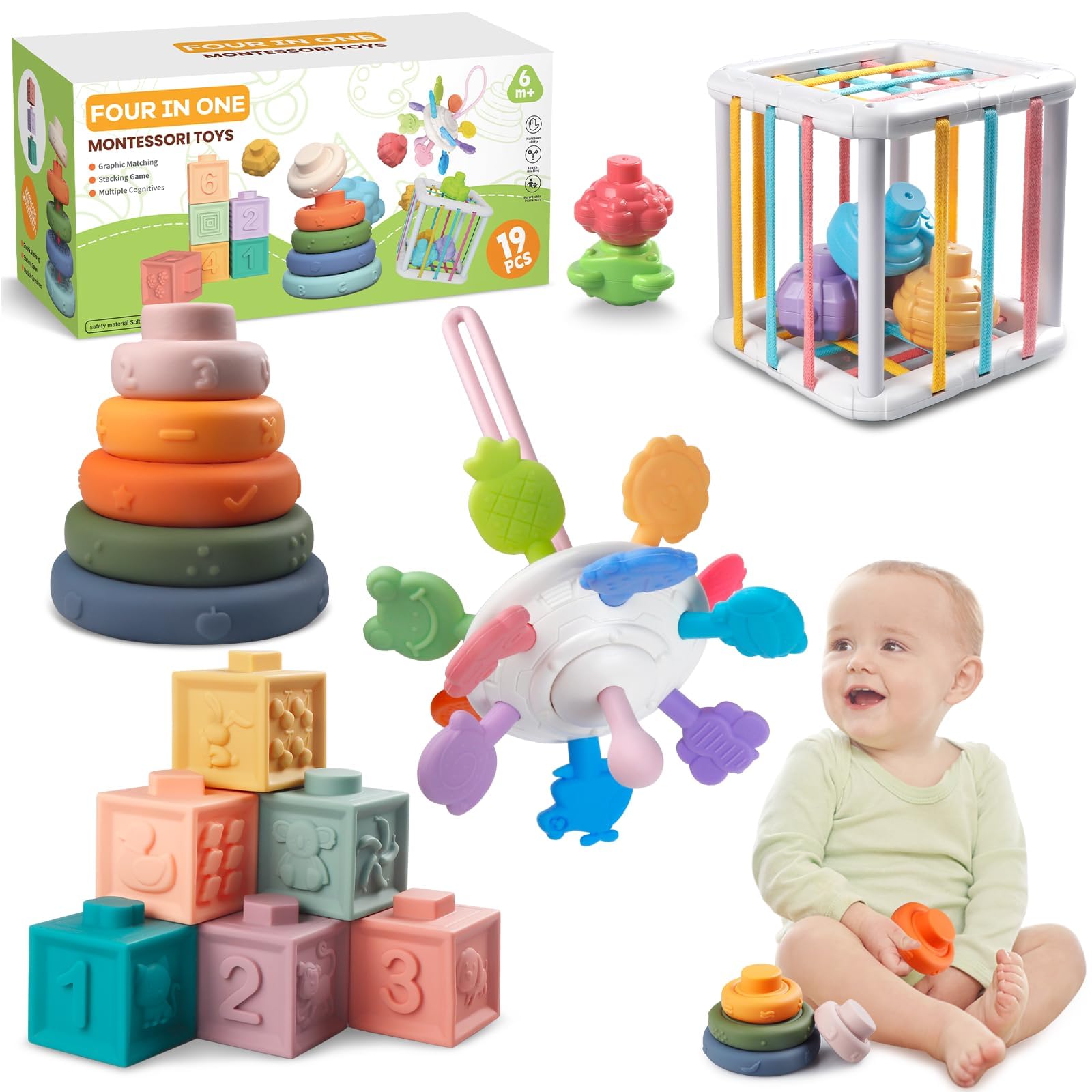
This set shares the same 4-in-1 structure as the Plunack but leans harder into sensory stimulation with a crab-shaped pull-string teether that features six silicone cords of varying thicknesses. The crab body also includes a button ball and bubble popper surface, giving the baby multiple tactile targets on a single toy. The stacking rings are soft silicone with engraved numbers and letters, making them safe for mouthing while introducing early literacy concepts through texture.
The sensory bin component uses a cube with elastic bands and five chunky blocks in different colors, textures, and shapes. These blocks double as bath toys and produce a ringing sound when shaken. The muted color palette is intentionally less visually overwhelming than primary-bright sets, which some babies and parents find more calming during play. Reviews consistently highlight that the pull-string crab is the most-used component, especially during car rides and stroller outings.
Like the Plunack, this set uses silicone for the soft components and harder ABS for the shape sorter. The blocks are slightly smaller than standard wooden cubes, which may frustrate a baby accustomed to larger grips. The carry-friendly design makes it a strong travel companion, but parents should verify that all pieces are accounted for after outings, as the smaller blocks can roll under seats easily.
Why it’s great
- Crab pull-string toy is a standout favorite for grip practice and teething
- Muted color palette reduces visual overstimulation during focused play
- Bath-friendly blocks add water-play versatility
Good to know
- Blocks are on the smaller side compared to classic stacking cubes
- ABS components require supervision during mouthing
3. Infantino Super Soft Building Blocks

This 12-piece set is the simplest option on the list — pure soft blocks with no extra components, no complex assembly, and no small parts. The BPA-free silicone material is uniformly soft across all blocks, meaning a thrown block is completely harmless and a stepped-on block is painless. Parents repeatedly mention this as the set that survives the aggressive throwing phase that peaks around 12 to 15 months.
The blocks come in three different sizes, which introduces babies to the concept of small, medium, and large without needing verbal labels. This size variation also makes stacking slightly more forgiving because the larger blocks provide a wider base. The blocks are hollow with enough squish to compress slightly under grip pressure, making them easier for a baby with developing fine motor control to hold and lift. Customer reports note that the silicone surface attracts dust and lint, but a quick rinse under running water restores the tacky grip.
The downside is limited developmental range. There are no numbers, letters, textures, or sound elements — just stacking and squishing. For a baby who quickly masters basic stacking, this set may lose appeal faster than a multi-activity option. But for the first few months of block exploration, the simplicity is actually a strength rather than a weakness.
Why it’s great
- Completely soft and BPA-free — safe for throwing, chewing, and stepping on
- Three distinct block sizes teach relative scale naturally
- Extremely easy to clean with just water
Good to know
- Limited to stacking only — no sensory variety or sound features
- Silicone material attracts lint and dust between washes
4. Gemileo Wooden ABC Building Blocks

These wooden blocks represent the traditional end of the spectrum. Each 1.7-inch cube features thermal-transfer printed uppercase and lowercase letters on opposite sides, alongside colorful illustrations of animals, fruits, and vegetables. The blocks come in a sturdy carry bag, making storage and transport straightforward. The natural wood construction is sanded smooth with rounded edges, which eliminates splinter risks while keeping the blocks comfortable for small hands to grasp.
For a one-year-old, these blocks are best suited for supervised stacking sessions where the primary activity is building towers and knocking them down. The thermal-transfer printing holds up well against surface wiping but will not survive submersion or aggressive scrubbing. Parents report that the blocks stack cleanly and the 1.7-inch size is large enough to avoid choking concerns while still being manageable for a toddler’s grip. The set includes 36 blocks, which gives enough quantity for early counting practice and name spelling as the child grows.
The key limitation for a 12-month-old is mouth safety. Wooden blocks do not offer the same teething relief as silicone, and the printed surface can degrade with repeated chewing. This set is best introduced around 18 months or when the baby has mostly stopped mouthing toys. Some parents noted that the lowercase “l” block resembles the number “1,” which caused brief confusion during initial sorting.
Why it’s great
- Generous 36-block count supports building, counting, and name spelling
- Smooth, sanded edges with rounded corners prevent splinters
- Thermal-transfer printing is durable and visually clear
Good to know
- Not ideal for aggressive teething — printed surface can degrade with chewing
- Lowercase “l” block can be confused with the number “1”
5. Burlap Baby Shower Decorative Boxes

This product is included here primarily to clarify a common confusion: cardboard boxes printed with a burlap-style pattern are not play blocks. The listing clearly states that these are decorative paper boxes designed for baby shower centerpieces and gender reveal backdrops. They are pre-folded cardboard cubes that unfold into box shapes, and they are not intended to support heavy weight or repeated handling.
The boxes measure approximately 12 inches per side, which gives them a large footprint that works well as photo props or party table decor. The burlap-print pattern mimics natural fabric texture visually, though up close the print is clearly ink on cardboard. Assembly involves simply unfolding the pre-creased cardboard, which takes about 30 seconds per box. The material is lightweight and can be stored flat for reuse, though the cardboard will crease and show wear after multiple assemblies.
For a one-year-old, these boxes pose several risks: the cardboard edges can cut, the boxes collapse under weight, and the surface is not sanitizable. They are not a toy and should not be placed within reach of a baby during play. If you are shopping for an actual block set for a toddler, skip this item. If you are organizing a baby shower and need decorative cube props, these serve that purpose adequately.
Why it’s great
- Quick assembly — unfolds in under 30 seconds per box
- Large 12-inch size works well for backdrop photos
Good to know
- Cardboard construction is not safe for infant play or teething
- Collapses under weight — not intended for stacking by children
FAQ
Are wooden blocks safe for a 1 year old who still mouths toys?
How many blocks does a 1 year old actually need?
Final Thoughts: The Verdict
For most users, the blocks for 1 year old winner is the Plunack 4-in-1 Montessori Set because it combines silicone safety with four distinct play modes that grow with the child from 6 to 36 months. If you want a pure teething and throwing set with no small parts, grab the Infantino Super Soft Blocks. And for a classic alphabet set that will last into preschool, nothing beats the Gemileo Wooden ABC Blocks once the mouthing phase has passed.