A poorly fitted camping pack turns a scenic ridge into a miserable death march. Shoulder pain, hip bruising, and that awful swaying sensation as your load fights every step you take are the real cost of grabbing the wrong bag. The difference between a great trip and a painful one hinges on one piece of gear: the frame and suspension system that actually transfers weight to your hips.
I’m Emma — the founder and writer behind Baby Bangs. I’ve spent countless hours analyzing load-transfer geometry, torso adjustment ranges, and fabric denier ratings to separate marketing fluff from genuine trail-ready hardware.
After sifting through real buyer experiences and spec sheets, this guide delivers the honest breakdown you need to find the very best backpack for camping that matches your body type, trip length, and gear volume without the guesswork.
How To Choose The Best Backpack For Camping
Choosing a camping backpack isn’t about color or brand hype — it’s about matching a suspension system to your torso length, trip duration, and typical gear weight. Get the torso fit wrong and no amount of padding will save your shoulders on day three.
Volume: 40L, 50L, or 65L?
Volume dictates how many days you can roam without a resupply. A 40L pack works for overnight trips with ultralight gear. The 50L sweet spot handles 3–5 days including a tent and cook kit. Go to 65L when you need room for a bear canister, winter layers, or a week’s worth of food. Oversizing encourages overpacking — and a heavier pack punishes every mile.
Torso Length and Hip Belt Fit
Shoulder straps are not the primary load bearers — your hips are. A pack that sits too high or low on your iliac crest will chafe and sag. Measure the distance from your C7 vertebra (the bony bump at the base of your neck) to the top of your hip bones. Most quality packs cover a 14–20 inch range, but some offer adjustable torso systems that fine-tune on the fly.
Suspension and Ventilation
A stiff internal frame (aluminum stays or wire frames) transfers weight efficiently. Mesh tensioned back panels create an air gap that reduces sweat buildup on warm climbs. Less expensive packs often rely on foam panels that trap heat — manageable for cool weather but sticky in summer.
Quick Comparison
On smaller screens, swipe sideways to see the full table.
| Model | Category | Best For | Key Spec | Amazon |
|---|---|---|---|---|
| Osprey Aura AG 65L | Premium | Extended treks with heavy loads | Anti-Gravity suspension & 4.6 lb | Amazon |
| Osprey Renn 65L Women’s | Premium | Multi-day trips with adjustable torso | AirSpeed suspension & 3.6 lb | Amazon |
| Osprey Renn 50L Women’s | Mid-Range | Weekend backpacking, shorter torsos | LightWire frame & 3.5 lb | Amazon |
| Kelty Redwing 50 Women’s | Mid-Range | Budget-friendly ventilated carry | AMP-Flow back panel & 3.1 lb | Amazon |
| Naturehike Rock 60+5L | Budget | Ultralight trips on a tight budget | 420D nylon & 2.88 lb | Amazon |
| Tripole Walker Pro 60L | Budget | Heavy loads on a low budget | Dual aluminum stays & 4.6 lb | Amazon |
In‑Depth Reviews
1. Osprey Aura AG 65L Women’s

The Aura AG 65L is Osprey’s top-tier women’s suspension system, using the Anti-Gravity mesh that wraps from the lumbar pad all the way up the backpanel. This design creates a continuous, body-hugging surface that eliminates pressure points and distributes heavy loads across the full back. The result is a pack that makes 40-mile trips feel remarkably manageable, even when you’re carrying a full load of gear and food for a week.
The Fit-on-the-Fly harness and hip belt allow micro-adjustments while the pack is on your back, which is a huge advantage when switching between a heavy base weight and a lighter summit day. The large curved side zip accesses the main compartment without unloading everything, and the integrated rain cover is always stowed and ready. Testers report the AG frame keeps loads feeling almost weightless, though the hip belt can cause tenderness on the iliac crest if not adjusted carefully.
At 4.6 pounds, this is not an ultralight pack — but the weight is justified by the suspension engineering. The internal hydration sleeve and removable sleeping bag divider add convenience. Buyers consistently praise it for AT thru-hikes and week-long expeditions where comfort under load matters more than shaving ounces.
Why it’s great
- Anti-Gravity mesh backpanel eliminates hotspots and improves airflow
- Curved side zippers let you grab gear mid-layer without unpacking
- On-the-fly fit adjustments for changing layers and load weights
Good to know
- Heavier than comparable 65L packs at 4.6 pounds
- Hip belt may cause tenderness if not dialed in precisely
- Top lid compartment is small and can be fiddly to access
2. Osprey Renn 65L Women’s

The Renn 65L is Osprey’s streamlined approach to a full-featured women’s pack — it keeps the adjustable AirSpeed tensioned mesh backpanel while shedding some complexity from the Aura’s AG design. The LightWire frame transfers load to the hip belt effectively, and the 3.6-pound weight is competitive for a pack with this much support. The mesh backpanel creates a solid air gap that keeps your back noticeably drier on warm ascents.
The torso adjusts from 15 to 18 inches, which covers the majority of women but may not suit very petite frames. The zippered sleeping bag compartment with a floating divider lets you separate dirty gear from clean layers, and the integrated rain cover stows in its own pocket. Buyers report the pack carries 25–30 pounds with no shoulder strain, and the side pockets fit collapsible trekking poles securely.
Where the Renn 65L differs from the Aura is in the hip belt — it’s simpler and less sculpted but still comfortable for multi-day use. The top lid is functional but a bit cramped, and accessing the main compartment requires going through the top or the sleeping bag zipper. For women who want premium airflow and reliable load transfer without the full AG price tag, this is a strong contender.
Why it’s great
- Excellent back ventilation reduces sweat on long, hot days
- LightWire frame keeps weight manageable at 3.6 pounds
- Integrated rain cover is always ready and easy to deploy
Good to know
- Torso range may not accommodate very short or very tall hikers
- Top lid pocket is small and can be awkward to access
- No side zip access to main compartment without unloading
3. Osprey Renn 50L Women’s

The 50L version of the Renn shares the same AirSpeed suspension and LightWire frame as its 65L sibling but trims the volume for weekend and short multi-day trips. The 3.5-pound weight makes it feel nimble on the trail, and the tensioned mesh backpanel keeps you cool even when you’re pushing a hard pace. The torso adjustment covers 15–18 inches, and the hip belt is well-padded for loads up to about 30 pounds.
Fit reviews from shorter women (5’1″–5’3″) report that the shoulder straps tighten adequately and the hip belt sits properly on the iliac crest — a common pain point with unisex packs. The removable rain cover adds confidence for unpredictable weather, and the zippered sleeping bag compartment keeps gear organized. The main compartment fits 2–3 days of gear including a tent and cooking system.
The Renn 50L lacks the side zip access that some competitors offer, so you’ll need to top-load or access from the sleeping bag compartment. The side pockets are generously sized but shallow — water bottles can eject if you bend over significantly. For women who prioritize ventilation and a dialed fit over absolute volume, this is a refined choice.
Why it’s great
- Best-in-class back ventilation through the AirSpeed mesh tension
- Lightweight enough for fast-paced weekend trips
- Adjustable torso accommodates a range of body types well
Good to know
- No side zip access makes mid-hike gear retrieval slow
- Side water bottle pockets are shallow and can lose bottles
- Top lid is small and not ideal for stashing a jacket
4. Kelty Redwing 50 Women’s

The Kelty Redwing 50 women’s pack is a decades-old design that keeps getting better. The latest version features the FIT-Pro torso adjustment system that lets you dial in the length in seconds without tools — ideal for sharing the pack between different users. The AMP-Flow ventilated back panel uses a honeycomb mesh to keep air moving, and the aluminum perimeter frame offers good load transfer for a pack in this tier.
At 3.1 pounds, the Redwing 50 is lighter than the Osprey Renn 50L while still providing a proper internal frame. The women’s specific fit narrows the shoulder straps and curves the hip belt to match female anatomy, and buyers consistently note that even 25+ pounds feel balanced and comfortable. The signature wing pockets on the sides are surprisingly roomy for water bottles or snack bars.
The construction uses quality zippers and fabric, though some users report that the elastic components in the compression system lose tension after about a year of heavy use. The front panel access is convenient, but the U-zipper top opening can be a bit stiff when new. For the price, this pack delivers a premium suspension feel without the premium price floor.
Why it’s great
- FIT-Pro system adjusts torso length easily and quickly
- Lightweight frame design at just 3.1 pounds
- Women’s specific hip belt and shoulder straps for better fit
Good to know
- Elastic components may lose tension after extended use
- U-zipper top can feel stiff and sticky when new
- Side pockets are short and don’t secure tall bottles well
5. Naturehike Rock 60+5L
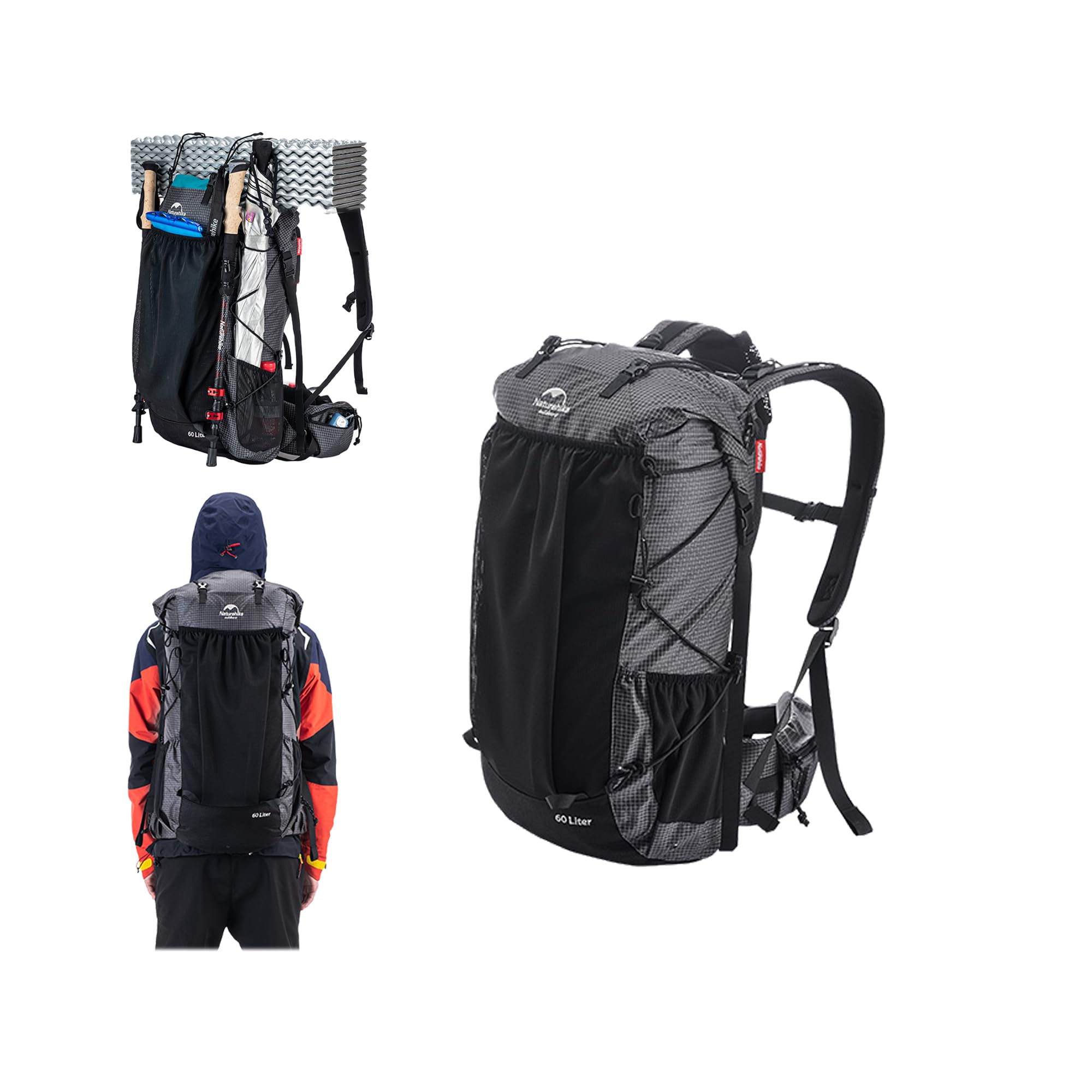
The Naturehike Rock 60+5L is the lightest pack in this lineup at just 2.88 pounds, yet it offers a 60-liter main volume plus a 5-liter extension collar. The updated version uses a polymer fabric that includes high molecular weight polyethylene fibers, making it more abrasion-resistant than standard 420D nylon. For budget-conscious hikers who want to keep base weight low, this pack hits a compelling spec point.
The internal frame uses a contoured foam stay sewn into the backpanel, which provides decent structure for loads under 30 pounds. The dual-layer EVA shoulder straps and two-way tension waist belt help distribute weight, though the fit is not as dialed as packs with adjustable torso systems. Users report that the stretchy mesh side pockets tore on the first multi-day trip, so treating them gently is advisable.
The multiple pockets include a large open mesh back pocket for quick-access items and compression straps for lashing trekking poles or a sleeping pad. The included rain cover is functional, but the pack’s waterproofing is limited to a water-repellent coating. For weekend trips with light gear where weight savings are the priority, this is a solid entry-level option.
Why it’s great
- Very lightweight for the volume at under 3 pounds
- Abrasion-resistant polymer fabric in updated version
- Includes rain cover and multiple compression strap points
Good to know
- No torso adjustment — fit is fixed and may not suit all body types
- Stretchy side pockets are fragile and can tear under load
- Frame is less supportive than aluminum-stay designs for heavy loads
6. Tripole Walker Pro 60L

The Tripole Walker Pro 60L is a heavy-duty internal frame pack built around dual cast aluminum rods and a solid fiber frame. This combination creates a stiff backbone that can handle exceptional loads — buyers report carrying up to 95 pounds without strap failures or seam tears. The torso adjustment mechanism slides to fit different heights, and the thick padding across the lumbar and shoulders provides a platform for serious weight hauling.
The pack opens from the top (drawstring with extension), the front (full panel access), and the bottom (separate compartment with a removable divider). This triple-access design is rare at this price point and makes organizing gear significantly easier than a pure top-loader. The rain cover stows in a dedicated velcro pocket at the base, and the water-repellent rugged polyester fabric sheds light rain well.
The downsides are real: the pack weighs 4.6 pounds, the side water bottle pockets are short, and the aluminum stays are not fully enclosed in a sleeve, which could cause snagging. Some users report chest strap clips popping off under tension and tie-down straps being too short for bulky items. For budget-focused hikers who need to carry a very heavy load without spending on premium brands, this pack delivers raw structure at a low cost.
Why it’s great
- Dual aluminum stays provide exceptional load-bearing capacity
- Triple-access design (top, front, bottom) for easy organization
- Torso adjustment mechanism accommodates different heights
Good to know
- Heavy at 4.6 pounds — not ideal for ultralight trips
- Side water bottle pockets are too short for tall bottles
- Chest strap and tie-down strap quality could be better
FAQ
Should I get a 50L or 65L backpack for a week-long camping trip?
How do I measure my torso length for a backpack?
How much should a loaded camping backpack weigh?
Final Thoughts: The Verdict
For most users, the best backpack for camping winner is the Osprey Aura AG 65L because the Anti-Gravity suspension makes heavy loads feel almost weightless and the women’s specific fit reduces chafing on long trips. If you want a lighter pack with excellent ventilation at a lower price point, grab the Kelty Redwing 50 Women’s. And for an ultralight weekend option that won’t bust your budget, nothing beats the Naturehike Rock 60+5L.