Every step you take on a treadmill or stomp on a stair climber sends a shockwave straight through your kneecap. For the millions dealing with chronic knee pain, meniscus tears, or post-surgery recovery, standard cardio equipment is a direct path to more inflammation and less mobility. The right machine flips that equation — delivering a meaningful heart-rate spike and calorie burn while the knee joint stays in a safe, supported, non-impact zone.
I’m Emma — the founder and writer behind Baby Bangs. Over the past decade, I have analyzed hundreds of fitness machines specifically through the lens of joint mechanics, studying stride patterns, resistance curves, and seat-to-pedal geometry to separate the true knee-friendly designs from the marketing fluff.
This guide dissects each machine by how it manages motion and load through the knee.
How To Choose The Best Cardio Machine For Bad Knees
Not every low-impact machine is actually low-load on the knees. Some bikes and ellipticals create shear forces or force your hips to rock, which transfers strain directly to the patellar tendon. The decision points below isolate the specific engineering elements that determine whether a machine helps or hurts your knees over time.
Seat-to-Pedal Geometry and Q-Factor
The Q-factor is the horizontal distance between the center of the left pedal and the center of the right pedal. On recumbent bikes and ellipticals, a Q-factor that is too wide forces your knees to splay outward, creating torque on the medial collateral ligament. Machines with a narrow Q-factor allow your knees to track in a straight line over your feet, which is the biomechanically safe position. Look for stated Q-factor data or frames where the pedal arms sit close to the centerline of the machine. The 3G Cardio Elite RB example demonstrates how a narrow stance directly improves comfort for pre- and post-surgery users.
Resistance Type: Magnetic vs. Friction vs. Air
Magnetic resistance is the gold standard for bad knees because it delivers smooth, consistent tension with no friction pads that create jerky starts or resistance spikes. Any sudden change in pedal resistance can cause your knee to compensate with a sharp muscle contraction, aggravating an injured joint. Friction-based systems (felt pads pressing against a wheel) degrade over time, creating inconsistent spots during each revolution. Air resistance (fan bikes) varies with your speed, making it hard to maintain a controlled cadence. A magnetically braked flywheel, especially one with electronic or push-button control, gives you predictable, repeatable resistance that lets you focus on form rather than fighting the machine.
Recumbent Position vs. Upright Elliptical Stride
A recumbent position shifts your weight posteriorly, reducing the compressive load through the knee joint compared to an upright posture. This is critical for users with patellofemoral pain syndrome or meniscus issues, where even body weight pressing through the femur onto the tibia causes pain. Recumbent bikes and recumbent cross-trainers (like the Teeter FreeStep or Sunny Elite) support the lower back and hips, preventing the hip flexion that tilts the pelvis and changes knee alignment. Upright ellipticals with power-adjustable stride lengths, such as the Sole E95S, can be set to a shorter, more circular motion that also reduces knee flexion angle — but the user must be disciplined about not locking the knees or overstriding.
Stride Path: Fixed Circular vs. Adjustable Natural Motion
Fixed circular stride machines (standard spinning bikes and basic under-desk pedals) keep your feet moving in a perfect circle. This is fine for gentle movement but can cause anterior knee pain if the circle forces your ankle into dorsiflexion at the top of the stroke. Recumbent cross-trainers with a patented physical therapy stride — like the Teeter FreeStep — mimic a stepping motion where the foot flattens and the leg moves more like walking, reducing the sharp knee bend at the top of the revolution. For ellipticals, a power-adjustable stride lets you shorten the motion to avoid over-extending the knee, which is especially useful during early rehab phases.
Quick Comparison
On smaller screens, swipe sideways to see the full table.
| Model | Category | Best For | Key Spec | Amazon |
|---|---|---|---|---|
| Cubii Total Body | Seated Elliptical | Desk-bound seniors | 12 Resistance Levels | Amazon |
| pooboo W216 | Recumbent Bike | Family use with arm workout | 400 lb capacity, belt drive | Amazon |
| XVGVSV W241 | Recumbent Bike | 2-in-1 recumbent/elliptical | 16 Resistance Levels | Amazon |
| MERACH S19 | Recumbent Bike | Bluetooth smart training | Car-style resistance lever | Amazon |
| VANSWE RB607 | Recumbent Bike | Heavy-duty infinite seat slide | 450 lb capacity, 19 programs | Amazon |
| Sunny Elite SF-RBE4886SMART | Recumbent Cross-Trainer | Full-body low-impact blend | 16 electromagnetic resistance | Amazon |
| Teeter FreeStep LT7 | Recumbent Stepper | PT-inspired zero-impact stride | Natural stride, 20-level magnetic | Amazon |
| 3G Cardio Elite RB | Recumbent Bike | Commercial-grade knee rehab | Narrow Q-factor, 350 lb. | Amazon |
| Sole E95S | Elliptical Machine | Power-adjustable stride runners | 24″ max stride, 20 resistance | Amazon |
In‑Depth Reviews
1. Cubii Total Body Under Desk Elliptical
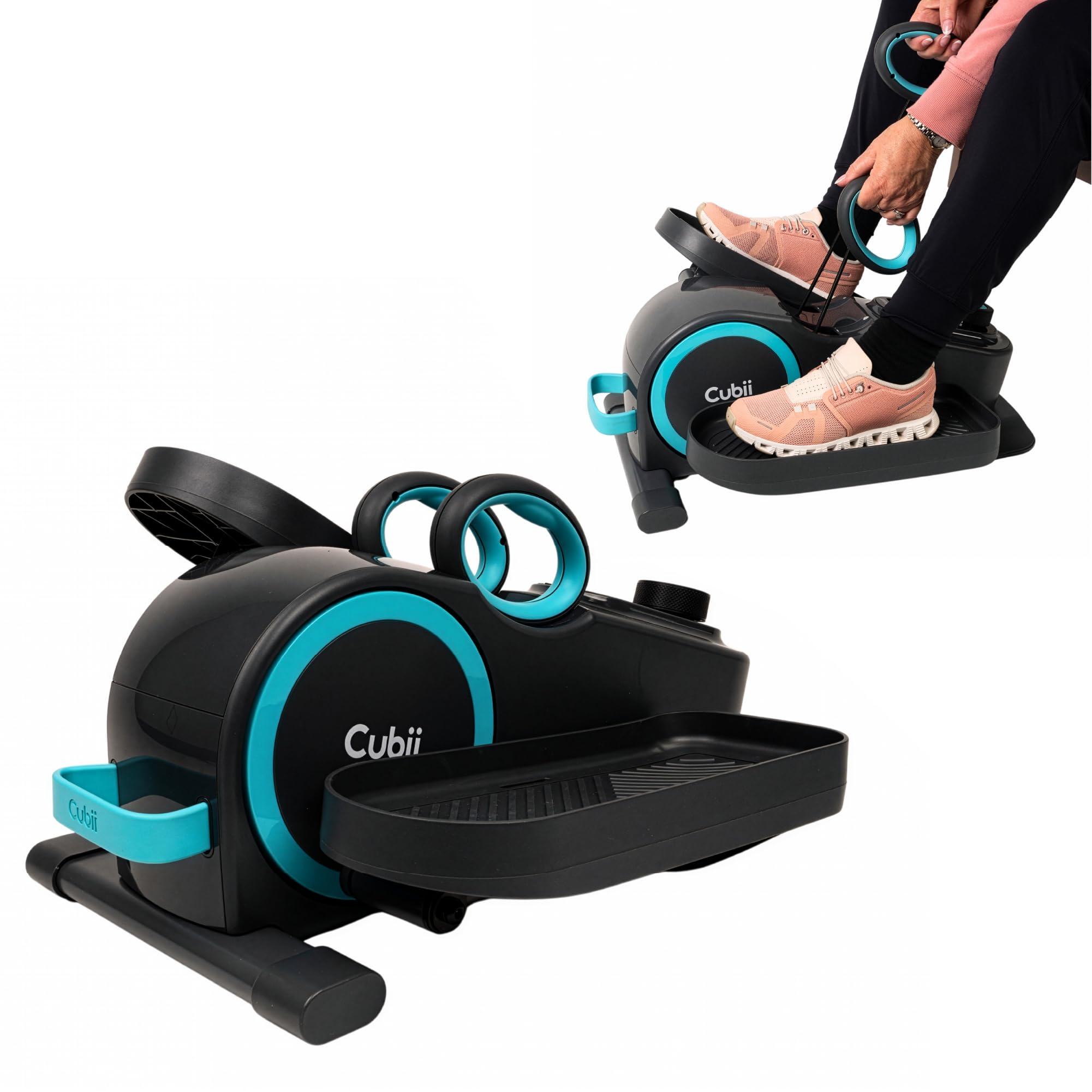
The Cubii Total Body tackles the most overlooked problem in knee-friendly fitness: you cannot move your knees if you are glued to a chair all day. This machine is a seated under-desk elliptical that lets you pedal while working, watching television, or reading. The magnetic resistance system across 12 levels is exceptionally quiet — measured well below typical desk noise — and the 12-inch stride length keeps the knee range of motion shallow enough to avoid irritation while still elevating heart rate over a 30-minute session. The included upper body bands with ergonomic pulleys add an arm and shoulder component without forcing you to stand or shift your weight.
One of the most compelling use cases comes from a reviewer who bought this for her 80-year-old mother recovering from extended hospital stays; the seated position gave her the confidence to start moving again without fear of falling or joint pain. The pedal motion is smooth both forward and backward, which helps users with patellar tracking issues alternate the load pattern on the knee. The LCD display tracks time, distance, and resistance level, and the profile remembers settings for two different users. At 22.2 inches deep, it fits under most standard-height desks without jamming into chair wheels.
The trade-off is that this is not a machine for high-intensity cardio. The stride length is fixed, and the resistance, while well-calibrated from 1 to 12, tops out at a moderate challenge. Users above 250 pounds may feel the frame flex under aggressive motion, though the stated 300-pound weight capacity holds up fine for steady-state pedaling. The right-side click reported by some users after several months of use suggests that the internal belt mechanism may need occasional lubrication. For anyone with mobility limitations who needs to reintroduce consistent knee movement into a sedentary routine, this is the most accessible device on the list.
Why it’s great
- Extremely quiet magnetic resistance — no one in the next room will hear it.
- Seated position with short stride eliminates all knee impact.
- Includes upper body bands for a full-body circuit without standing.
- Fits under most office desks for movement during screen time.
Good to know
- Maximum resistance may feel light for users accustomed to gym-level intensity.
- Some units develop a clicking sound from the pedal mechanism over extended use.
2. pooboo Recumbent Exercise Bike W216
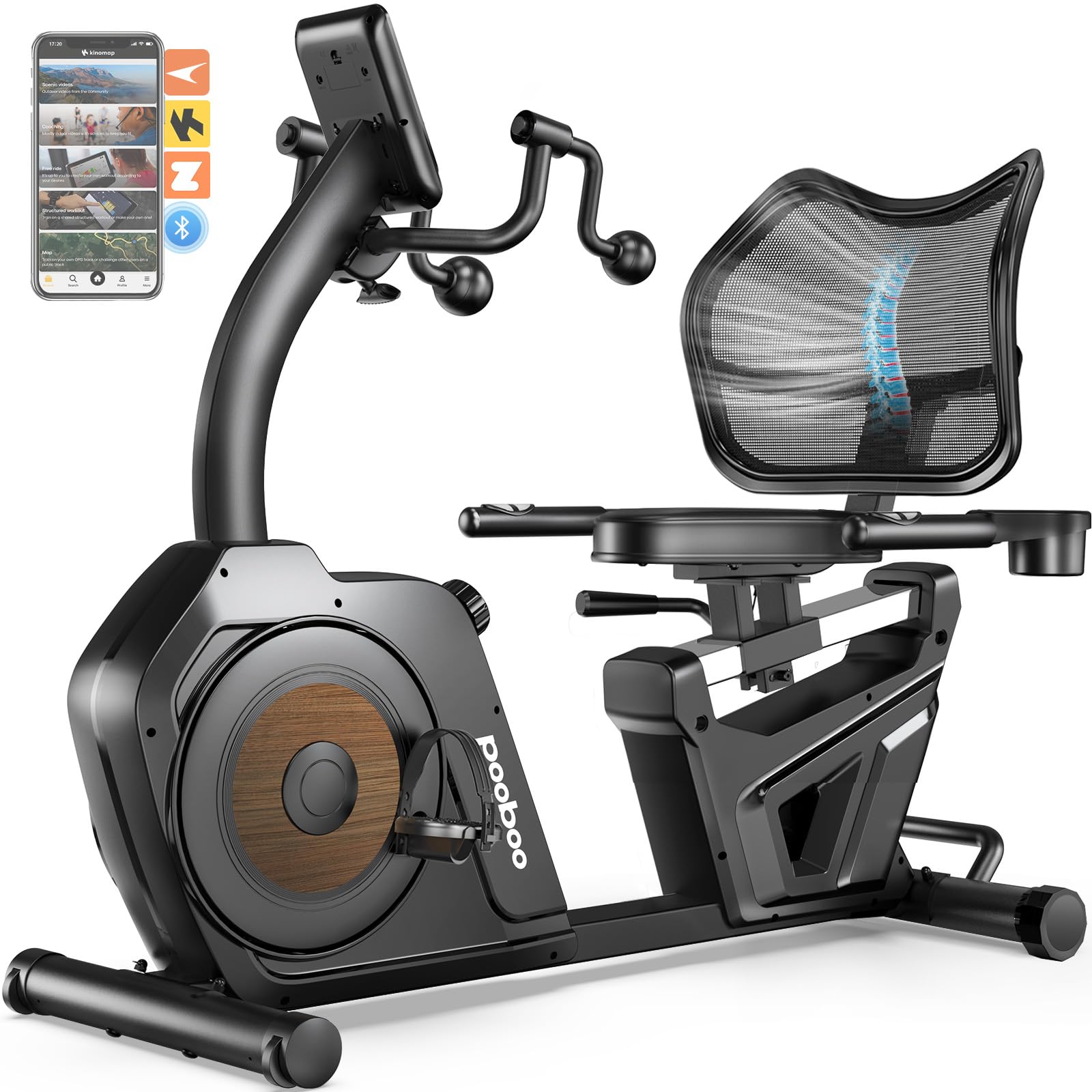
The pooboo W216 stands out for its heavy-duty one-piece frame that supports up to 400 pounds without wobble. For users with bad knees who also carry extra body weight, this stability is non-negotiable — a rocking frame forces the hip and knee to micro-adjust with every pedal stroke, aggravating already sensitive joints. The belt drive system paired with a 15-pound flywheel keeps the motion smooth and whisper-quiet, with noise levels hovering around 20 decibels. The forward and reverse pedal function allows you to vary muscle activation, working the hamstrings in reverse while keeping the quadriceps relaxed — useful for balancing out muscle tension around the knee.
The ergonomic mesh backrest is the defining feature here because it follows the natural curve of the spine, preventing the lower back from rounding, which would tilt the pelvis and change the angle at which the knee flexes and extends. The seats slide adjusts up to 18.5 inches, accommodating users as tall as 6 feet 3 inches without forcing the knee into an overly bent position. The arm exerciser adds an upper body component that can be used independently of the legs, allowing someone to train cardio with arms only during a day when the knee feels inflamed.
The eight resistance levels are controlled via a knob, which is simple but less precise than electronic push-button control. The first two levels are truly gentle, making this machine safe for someone who is only weeks out of knee surgery. The LCD monitor is functional but not backlit, meaning it can be hard to read if the room lighting is dim. The tablet holder is a nice addition for following physical therapy videos or watching shows during longer sessions. At 80 pounds, the unit is stable enough to stay planted, and the built-in transport wheels make it straightforward to roll into a corner when not in use.
Why it’s great
- Rock-solid one-piece frame eliminates wobble.
- Ergonomic mesh backrest prevents lower back rounding that affects knee angle.
- Forward and reverse pedal motion for varied muscle engagement.
- Arm exerciser allows for exclusive upper body cardio when needed.
Good to know
- Eight resistance levels offer limited progression for advanced users.
- LCD display is not backlit, making it harder to see in low light.
3. XVGVSV W241 Recumbent Bike
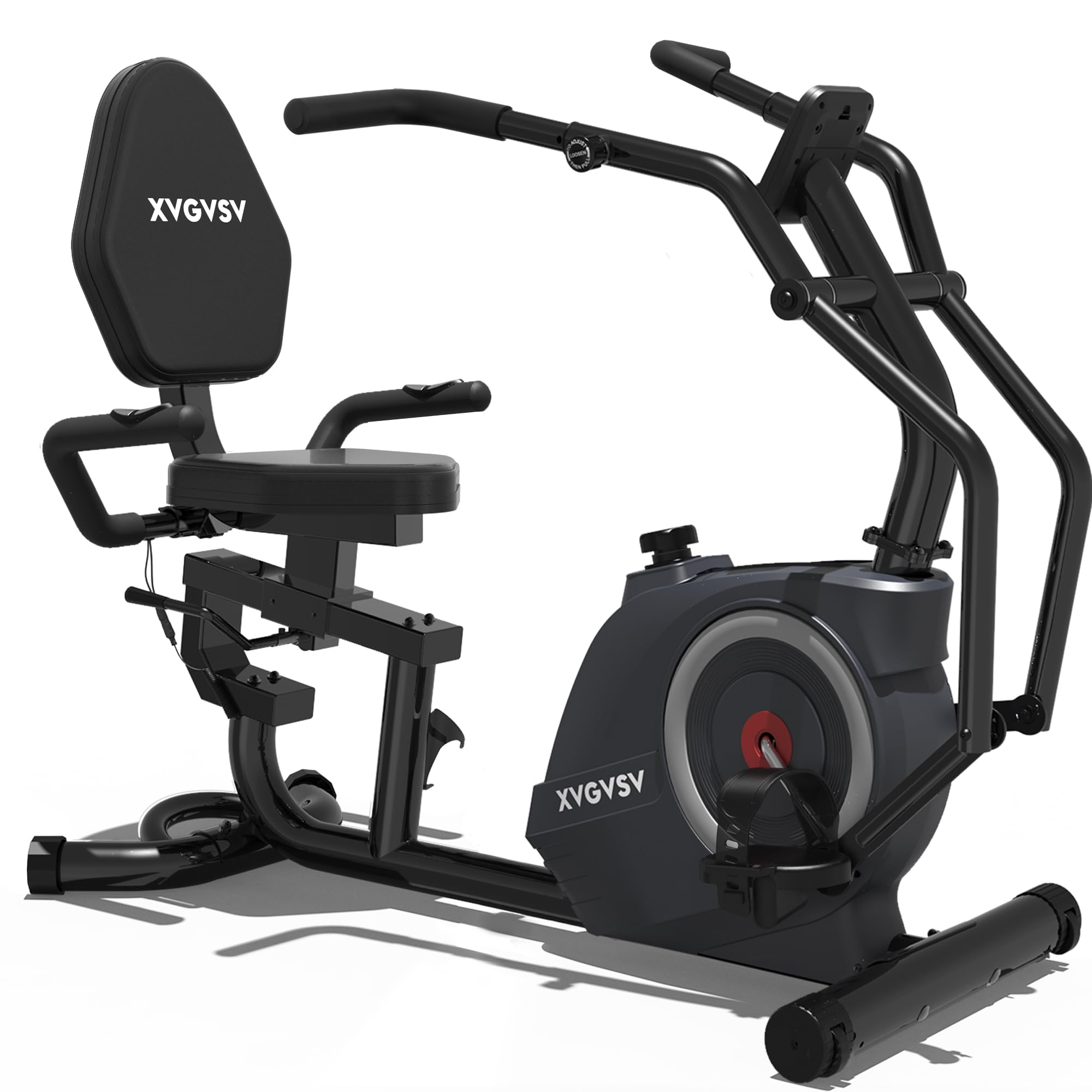
The XVGVSV W241 distinguishes itself with a 2-in-1 design that switches between recumbent cycling and elliptical motion. This matters for bad knees because the elliptical stride elicits a more natural walking pattern compared to the fixed circular motion of a standard bike. When you engage the elliptical mode, the foot pedals follow a longer, flatter path that keeps the knee from bending past a safe angle at the top of the stroke — a common cause of patellofemoral pain on conventional recumbent bikes. The 16 resistance levels provide a wide enough range for someone to start at a nearly free-spinning level and gradually work up to a challenging plateau.
The heavy-duty steel frame supports up to 400 pounds, and users report that after thousands of pedal revolutions the machine remains silent. The breathable mesh backrest combined with a padded seat reduces sweat buildup, which matters during longer sessions when moisture can cause skin irritation under the knee brace or support sleeve. The lever-based seat adjustment system allows you to change the distance without dismounting, making it easy to micro-adjust if you feel a pinch in the knee mid-workout. The included arm exercise handles allow for simultaneous upper and lower body work, which distributes the cardiac load and takes some of the pressure off the legs.
Assembly arrives between 70% and 85% complete, and some users noted that the remaining steps took up to three hours. The packaging has been solid, with no reports of damage in transit. A few observations point out that the left pedal uses reverse threading, which is standard for left-side pedals but can trip up someone unfamiliar with bike assembly. The pulse sensors on the handlebars give a rough heart rate reading but are not accurate enough for zone-based training. For its price tier, the dual motion capability and high weight capacity make this one of the more versatile recovery machines.
Why it’s great
- Recumbent and elliptical modes in one machine reduce knee bend at top of stroke.
- 16 resistance levels allow fine-tuned progression from rehab to moderate intensity.
- Lever-based seat adjustment means no dismounting to change position.
- High weight capacity of 400 pounds with a sturdy steel frame.
Good to know
- Assembly can take up to three hours and requires attention to pedal threading.
- Heart rate pulse sensors provide only approximate readings.
4. MERACH Recumbent Exercise Bike S19
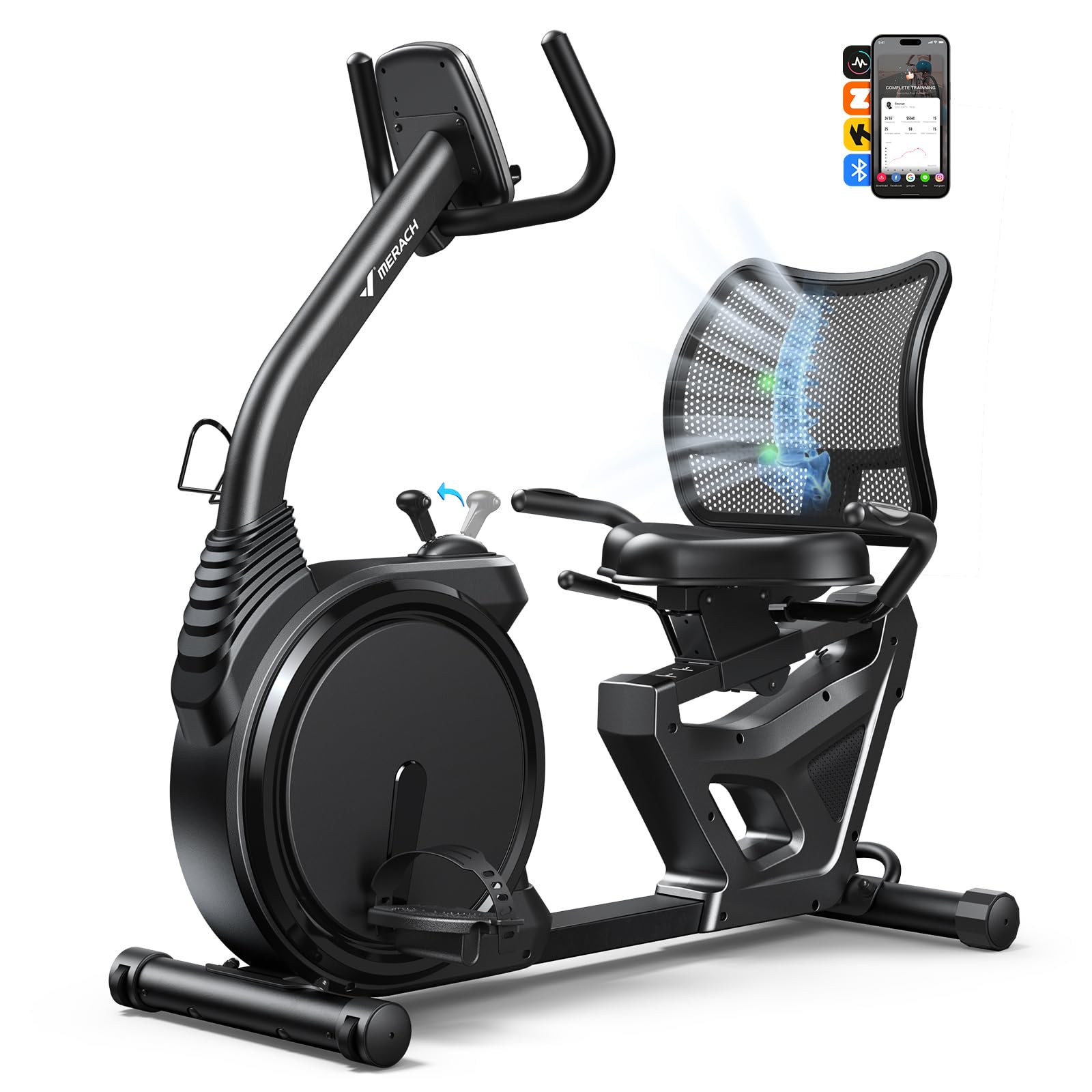
The MERACH S19 focuses on simplicity in the middle of a recovery journey. The car-style resistance lever lets you shift through eight levels without breaking your pedaling rhythm — no reaching for a knob or tapping a screen. This is meaningful for someone with limited knee mobility who needs to adjust resistance mid-stroke without losing concentration on form. The 6.6-pound perimeter-weighted flywheel paired with a dual-belt drive system delivers incredibly smooth pedal rotation, with zero of the stuttering that can happen on lower-cost chain-drive bikes. The seat moves across eight positions, and the breathable mesh backrest keeps your spine aligned, preventing the hip from tilting and loading the knee unevenly.
The integration with the MERACH app and FantomFite turns a stationary session into an interactive game, which helps with adherence during the monotony of rehab. The frosted handlebars provide a non-slip grip, which is important when your hands get sweaty and you are relying on the handles to support some of your weight during the pedal stroke. The LCD display shows time, distance, speed, calories, and heart rate from the pulse sensors built into the handlebars. One reviewer who used this bike after knee surgery described it as an absolute joy to ride and therapeutic for recovery, specifically praising the lumbar support that kept their lower back from fatiguing and causing them to slouch.
The main limitation is the 330-pound weight capacity, which is lower than several other machines on this list. The seat has been described as rock-hard by multiple users, and adding a gel cushion is almost necessary for sessions longer than 20 minutes. The heart rate handlebars are designed to swing down but do not stay in a fixed upward position, which can be awkward for taller users. At 84.9 pounds, the machine is stable but not impossible to move, and the assembly is rated at 80% pre-assembled. For someone who wants Bluetooth feedback and a straightforward resistance adjustment system, this is a solid mid-range choice.
Why it’s great
- Car-style lever allows effortless resistance changes without breaking pedal rhythm.
- Dual-belt drive and flywheel produce exceptionally smooth, stutter-free motion.
- MERACH app integration makes rehab sessions more engaging.
- Frosted handlebars provide a secure grip even with sweaty hands.
Good to know
- Seat padding is firm — most users will want an additional gel cover.
- Weight capacity of 330 pounds is the lower end of the mid-range tier.
5. VANSWE Recumbent Exercise Bike RB607
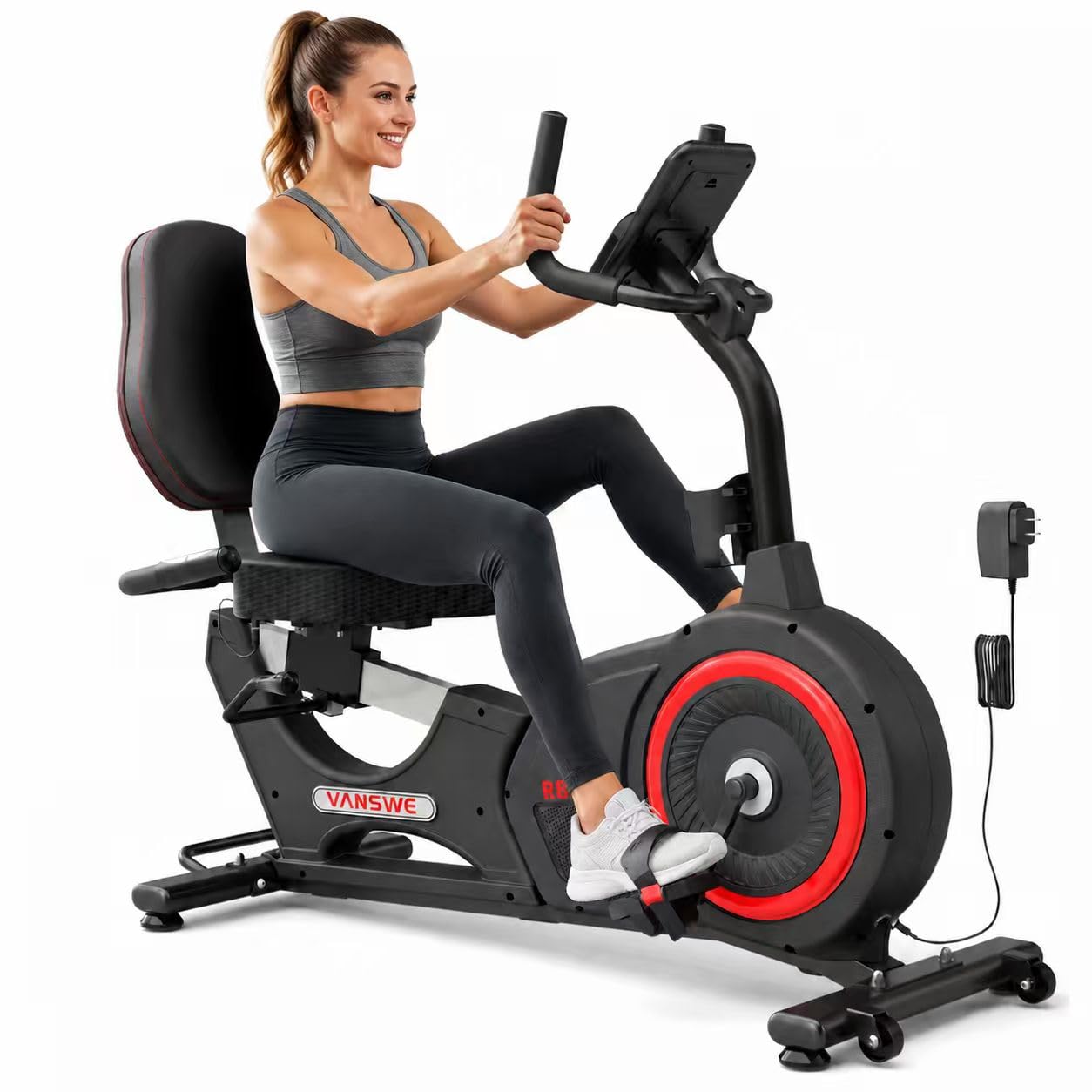
The VANSWE RB607 addresses the most common frustration for tall or long-legged users with bad knees: the seat cannot slide far enough back, forcing the knee into hyperflexion at the top of the pedal stroke. The Infinite Slider Seat System uses a continuous rail mechanism instead of pre-drilled holes, allowing adjustment that matches leg lengths from 29 inches to 40 inches — accommodating users from 5 feet 1 inch up to 6 feet 4 inches. A correctly positioned seat keeps the knee angle between 25-35 degrees at the pedal’s farthest point, which is the sweet spot for minimizing patellar pressure.
The 16-level electronically controlled magnetic resistance system adjusts via push-button on the console, giving you precise control without taking your hands off the grips. The 11-pound flywheel maintains momentum between pedal strokes, so there is no dead spot that forces your knee to restart the motion from a stop. The backlit LED monitor includes 19 built-in workout programs, which removes the guesswork from structuring a session — you can select a program that includes gentle resistance changes at intervals that mimic outdoor terrain without sudden spikes. The 3.4-inch thick padded cushion is among the thickest on any recumbent bike in this price range, and it shows in the user reports: multiple people describe being able to ride for 45 minutes without buttock or lower back discomfort.
At 75 pounds with a 450-pound capacity, the frame is built from thick-gauge alloy steel, and the unit does not rock even during aggressive pedaling. The electronic console requires a corded electric connection, which means the placement is limited to within reach of an outlet — it cannot run on batteries alone. Some users have reported that the pedals sit close to the crank arms, causing their shoes to rub against the metal if they have wide feet. The Bluetooth app connectivity syncs with Kinomap and Zwift, adding a virtual cycling element that can make indoor training more engaging. For larger users or anyone who needs a seat that truly matches their leg length, this is the most accommodating recumbent bike available.
Why it’s great
- Infinite seat slide prevents hyperflexion for tall users up to 6’4″.
- 19 built-in programs provide structured, knee-safe interval workouts.
- 3.4-inch thick seat cushion is one of the most comfortable in its category.
- 450-pound weight capacity with an ultra-stable steel frame.
Good to know
- Requires a wall outlet — battery-only mode is not supported.
- Pedal crank arms sit close to the foot platform, may rub wide shoes.
6. Sunny Health & Fitness Elite Recumbent Cross Trainer SF-RBE4886SMART

The Sunny Elite takes the recumbent design and crossbreeds it with an elliptical, creating a machine where the foot pedals move along a longer, flatter ellipse rather than a tight circle. This reduces the knee flexion angle compared to a standard recumbent bike, making it a better choice for someone with patellofemoral pain who cannot tolerate the sharp bend at the top of a bike stroke. The electromagnetic resistance system is powered by a cord, providing 16 levels of tension that are controlled through the console — this allows for precise 1-level increments rather than the vague quarter-turn between knob settings on cheaper machines. The 12 pre-programmed elliptical workouts automatically vary the resistance throughout the session, which helps prevent the knee from settling into a single repetitive motion pattern that could cause overuse irritation.
The easy on-off design is a practical consideration for anyone with limited knee flexion: you step through between the handlebars and the seat rather than swinging your leg over a top bar. The handlebar allows you to hold on while lowering yourself into the seat, reducing the load on the knee during the transition. The padded seat with contoured mesh back support is adjustable via a side lever that you can engage while seated, so you can shift your position without standing up — a critical feature when your knee is stiff from the first few minutes of pedaling. The SunnyFit app provides over 1,000 trainer-led workouts and 10,000 virtual routes, which adds variety that helps with adherence during long rehab phases.
The machine weighs 113 pounds and has a 300-pound weight capacity, which is somewhat limiting for larger users. The stride path, while more gentle than a pure recumbent bike, is fixed — you cannot shorten it, so users with limited knee range of motion may find the arc too long. A few users reported that the seat could feel flat and needed a slight tilt forward for optimal comfort. The pulse meter requires consistent contact on the fixed handles to give reliable data, and the hand sensor is not responsive enough for interval training where you need to check heart rate quickly. Still, for someone who wants the comfort of a recumbent seat with a motion that resembles walking, this cross-trainer fills a unique niche.
Why it’s great
- Elliptical stride path reduces knee bend compared to standard recumbent bikes.
- Easy step-through design minimizes knee strain during mounting and dismounting.
- 28 pre-programmed and user-customizable workouts add variety.
- Free SunnyFit app with trainer-led classes and virtual routes.
Good to know
- 300-pound weight capacity is lower than many recumbent competitors.
- Stride length is fixed and may be too long for users with limited knee range.
7. Teeter FreeStep LT7 Recumbent Cross Trainer

The Teeter FreeStep LT7 is the most biomechanically sophisticated machine on this list. Its patented natural stride is licensed from commercial physical therapy steppers used in outpatient clinics, and the difference is immediately apparent: instead of a fixed circular path, the foot pedals move through a stride that mimics walking, with the foot flattening out at the bottom and lifting in a straight line at the top. This eliminates the sharp knee flexion that causes pain in the retropatellar surface. The seated position, combined with the stepper motion, distributes your body weight across the glutes and thighs rather than concentrating it through the patellofemoral joint.
The 20-level magnetic resistance system is controlled through quick-keys on the 9-inch color LCD screen, offering a range from zero load up to 105 pounds of resistance. The UltraGlide Bearings keep the motion fluid from the very first pedal push — there is no break-in period where the mechanism feels sticky. The Extra-Large ComfortMax Seat provides more positioning options than standard recumbent seats, and the Electronic Step Lock makes entry and exit safe by holding the pedals in place while you sit down. The Teeter Move app includes a library of trainer-led classes that are specifically designed for low-impact movement, which takes the guesswork out of structuring a knee-safe workout.
The unit is heavy at around 110 pounds and has a large footprint (59 inches long by 32.7 inches wide), so it requires dedicated floor space. The seat adjustment mechanism, while robust, can be difficult to operate for shorter users — a reviewer at 5 feet 4 inches needed help lowering the seat into position. The overall compact feel of the step path has been noted; it does not provide the full recumbent bike reach for very tall users. The build quality, however, is exceptional, with a 3-year structural frame warranty and user reports of zero mechanical issues after months of daily use. For anyone who wants the closest thing to physical therapy equipment in their home, the FreeStep is the gold standard.
Why it’s great
- Patented natural stride from PT clinics eliminates sharp knee flexion.
- 20 magnetic resistance levels with precise console quick-keys.
- Electronic Step Lock ensures safe entry and exit for unstable knees.
- 3-year structural frame warranty signals premium build confidence.
Good to know
- Significant footprint — needs about 5 feet of clear floor length.
- Seat adjustment can be difficult for users under 5’5″.
8. 3G Cardio Elite RB X Recumbent Exercise Bike

The 3G Cardio Elite RB X is a machine built by people who understand knee biomechanics at a deep level. The narrow Q-factor — the horizontal distance between the pedals — is one of the tightest in the recumbent bike market, allowing your knees to track directly over your feet in a straight line. This prevents the valgus collapse (knees caving inward) that commonly aggravates MCL and patellar issues on wider-stance machines. The oversized 4-way adjustable seat lets you dial in forward-back, tilt, and backrest angle independently, so you can find the exact seat position that keeps your knee angle at 25 degrees at full extension. The Airflow Mesh Flex backrest conforms to your spinal curve without trapping heat, which makes longer rehab sessions more bearable.
The 16 levels of magnetic resistance are geared realistically — level 1 is genuinely easy, allowing someone with acute knee pain to move the pedals through a full range without any resistance fighting back. The FreeSync FTMS Bluetooth connectivity works with third-party fitness apps like Zwift and Kinomap, and the included wireless heart rate strap provides accurate chest-based HR data rather than the unreliable hand pulse sensors found on cheaper bikes. The compact footprint of 49 inches long by 27 inches wide means it fits through standard doorways, and the 115-pound weight keeps it planted during use while the built-in handle and wheels make relocation manageable. The lifetime frame warranty, 7-year parts warranty, and 1-year in-home labor warranty are the best in the industry and reflect the commercial-grade construction.
The price reflects the fact that this is a commercial-quality machine intended for daily heavy use, not a weekend machine. There is no built-in entertainment screen — the tablet holder assumes you will bring your own device. Assembly requires two people and about two hours, though the main frame comes largely pre-assembled. Multiple reviewers who used this machine before and after total knee replacement surgery reported that it was the only piece of equipment that let them work up a cardio sweat without triggering knee pain. The customer service from 3G Cardio, based in Arizona, is consistently described as responsive and knowledgeable, with one reviewer noting that the owner personally followed up on a shipping issue. If you want a recumbent bike that will still be functioning perfectly a decade from now, this is the one.
Why it’s great
- Narrow Q-factor keeps knee tracking straight over the foot, preventing valgus stress.
- 4-way adjustable seat with tilt, forward/back, and backrest angle customization.
- Commercial-grade construction with the best warranty in the category.
- Chest-strap heart rate monitor included for accurate zone tracking.
Good to know
- Significant investment — this is a long-term purchase, not a budget machine.
- No built-in entertainment screen; you must use your own tablet.
9. Sole Fitness E95S Elliptical Machine

The Sole E95S is the only upright elliptical on this list, and it earns its spot through a power-adjustable stride that ranges from 18 inches to 24 inches. This adjustability is the critical knee-protection feature: you can shorten the stride to 18 inches, which keeps the knee from overextending at the back of the stroke and over-flexing at the front. For someone with bad knees who still wants a running-like motion without impact, a shorter stride on an ellipse is significantly safer than a longer stride that forces the joint into extreme ranges of motion. The 20 resistance levels are controlled via console buttons, and level 1 through 10 have a notably gentle curve that is appropriate for post-surgery reintroduction to exercise.
The 13.3-inch color touchscreen with wifi connectivity and screen mirroring is the most advanced display on this list, and it integrates with the free Sole+ app for guided workout classes. The multi-position rubber-coated hand grips include pulse sensors, though reviewers have noted that the sensors on the moving handles are not consistently accurate. The aluminum construction keeps the machine relatively light for its size at roughly 200 pounds, and the 400-pound weight capacity is generous. The power-adjustable stride is controlled both from the console and from hand-grip controls, so you can change the stride length mid-workout without reaching for the screen — useful when you feel a twinge in the knee and need to shorten the motion immediately.
The main downfalls are the assembly complexity and the delivery process. The unit ships via freight with curbside delivery only, meaning you must bring it inside yourself, and the box is large and heavy enough that this is a multi-person job. Some reviewers who paid for assembly services reported that the technician was not affiliated with Sole and the experience was inconsistent. A few units developed a squeaking noise from the foot platforms after about two weeks of use, which required tightening of bolts. The cooling fan is described as ineffective by multiple users. For someone who wants an elliptical specifically because they prefer upright motion and need a customizable stride length, the E95S delivers a premium experience, but the logistical friction is real.
Why it’s great
- Power-adjustable stride from 18 to 24 inches allows knee-safe motion tuning.
- 13.3-inch color touchscreen with wifi and Sole+ app integration.
- 20 resistance levels with a gentle curve at the low end for rehab.
- 400-pound weight capacity with a durable aluminum frame.
Good to know
- Curbside delivery requires you to manage a very heavy box alone.
- Some units develop foot platform squeaks that need bolt tightening.
- Heart rate sensors on moving handles are not consistently accurate.
FAQ
Should I get a recumbent bike or an elliptical for bad knees?
How much resistance should I use for bad knees?
What is a safe knee angle on a recumbent bike?
Can I use a spin bike with bad knees?
Final Thoughts: The Verdict
For most users, the cardio machine for bad knees winner is the 3G Cardio Elite RB X because it combines a narrow Q-factor for proper knee tracking, commercial-grade magnetic resistance, and the most comprehensive seat adjustability available — all backed by a lifetime frame warranty. If you want physical therapy-grade motion that mimics walking without knee impact, grab the Teeter FreeStep LT7. And for someone who needs to start moving from a sedentary position without leaving their desk, nothing beats the Cubii Total Body for introducing low-risk, consistent knee movement into daily life.