The first block a baby picks up isn’t just a toy—it’s a first lesson in grip, gravity, and cause-and-effect. But not all blocks are created equal: the wrong material can be a choking risk, a teething hazard, or simply too frustrating for small hands to stack. The right set, however, builds fine motor control, sparks spatial reasoning, and doubles as a soothing tool during the oral exploration phase.
I’m Emma — the founder and writer behind Baby Bangs. I analyze infant toy safety standards, developmental milestones, and sensory design principles to separate functional playthings from marketing fluff.
Every baby develops at their own pace, but the right tools give them a head start. This guide breaks down the safest, most engaging blocks for infants by examining material safety, grip ergonomics, and developmental range.
How To Choose The Best Blocks For Infants
Infant blocks serve two distinct jobs: they must be safe enough to chew and sturdy enough to stack. Most parents focus on piece count, but the real decision hinges on material composition, edge smoothness, and the size-to-grip ratio for a 6- to 12-month-old’s hand span. Here are the three specs that separate a winner from a dust collector.
Material Safety and Chewability
Infants explore every toy with their mouth first. Food-grade silicone is the gold standard because it withstands gumming without off-gassing, and it can be boiled or dishwashed for sterilization. Wooden blocks must use water-based, non-toxic paint and be free of splintering edges. Hard plastic blocks should be BPA-free and pass the choke tube test—any block smaller than 1.25 inches in diameter is an automatic no-go for babies under 12 months.
Grip Geometry and Stacking Success
A block that slides out of a baby’s hand creates frustration, not learning. Look for blocks with textured surfaces, raised embossing, or slight indentations that give tiny fingers purchase. The ideal weight is light enough to lift but heavy enough to feel substantial. Silicone blocks with a slight squish offer the best tactile feedback because they compress slightly when gripped, which also helps with teething relief.
Developmental Shelf Life
The best infant blocks grow with the child. A set that starts as a teether at 4 months should transition into a stacking toy by 9 months and a color/shape recognition tool by 12 months. Multi-functional sets—those that combine blocks with stacking rings, shape sorters, or pull strings—extend the play window significantly. Avoid single-function toys that become boring after the baby learns to knock down a tower.
Quick Comparison
On smaller screens, swipe sideways to see the full table.
| Model | Category | Best For | Key Spec | Amazon |
|---|---|---|---|---|
| Plunack 6-in-1 | Premium Multi-Set | All-in-one developmental play | 27 pieces, silicone + ABS plastic | Amazon |
| Plunack 3-in-1 Silicone | Silicone Teether Stacker | Teething and stacking combo | Food-grade silicone, squeak sound | Amazon |
| Atoylink ABC Wooden | Educational Wood Set | Letter/number learning with pull toy | 30 wood blocks, water-based paint | Amazon |
| MEGA BLOKS 80-Piece | Classic Plastic Blocks | High piece count for building variety | 60 blocks in 10 shapes, 2.5 lbs | Amazon |
| Jyusmile Sensory Bundle | Soft Starter Set | First sensory and teething play | 6 soft blocks, 6 rings, vinyl teether | Amazon |
In‑Depth Reviews
1. Plunack 6 in 1 Montessori Baby Toys
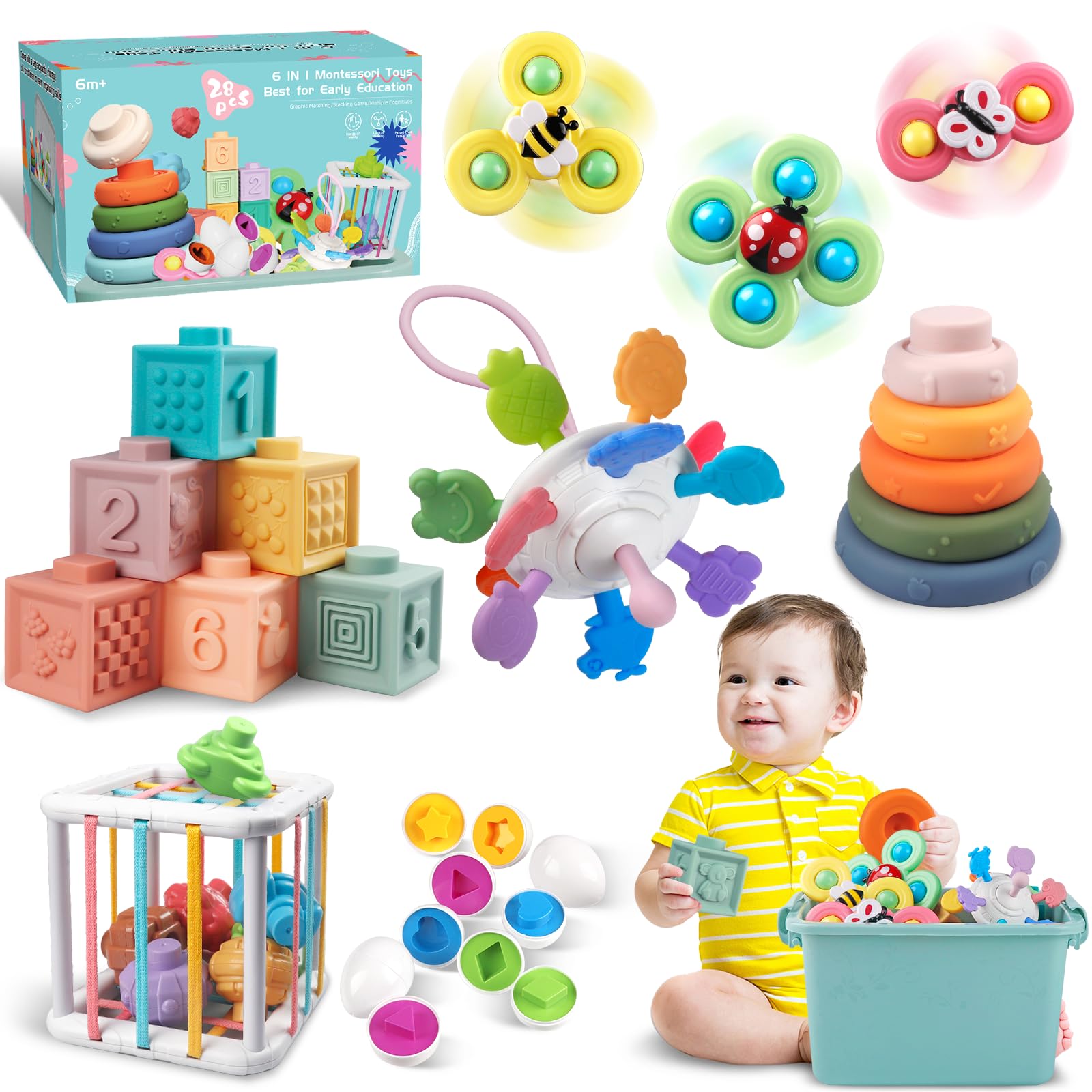
This is the most comprehensive infant block system I’ve seen at this tier. The set includes 12 matching eggs, 6 soft silicone blocks, 5 stacking rings, 3 suction cup spinners, a pull string sensory toy, and an exploration bin—all crafted from food-grade silicone and BPA-free ABS plastic. What sets this apart is the intentional milestone mapping: each toy targets a specific developmental window from 6 to 12+ months, and the blocks pass the choke tube test while remaining large enough to soothe teething gums.
Real parents report that the suction cup spinners stick firmly to highchair trays and car windows, making mealtime and road trips genuinely less chaotic. The pull string toy is particularly effective at developing the pincer grasp—a skill pediatric occupational therapists prioritize starting at 6 months. The entire set stores neatly inside the included sensory bin, which doubles as a travel organizer. One reviewer noted their son “loves every single toy” and that cleanup is effortless.
The only minor gripe is that the teething ball has flat ends that some babies find less engaging than round alternatives. Still, with 27 pieces covering stacking, sorting, pulling, and spinning, this set replaces six separate toys and offers a longer developmental runway than almost any single-function block set.
Why it’s great
- Six distinct toy types in one box—covers stacking, sorting, pulling, and spinning
- Food-grade silicone and BPA-free plastic pass CPSIA/ASTM F963 safety standards
- Large storage bin makes travel and cleanup simple
Good to know
- Teething ball’s flat ends may be less appealing to some babies
- Slightly higher piece count may overwhelm a minimalist play space
2. Plunack 3 in 1 Montessori Soft Baby Blocks
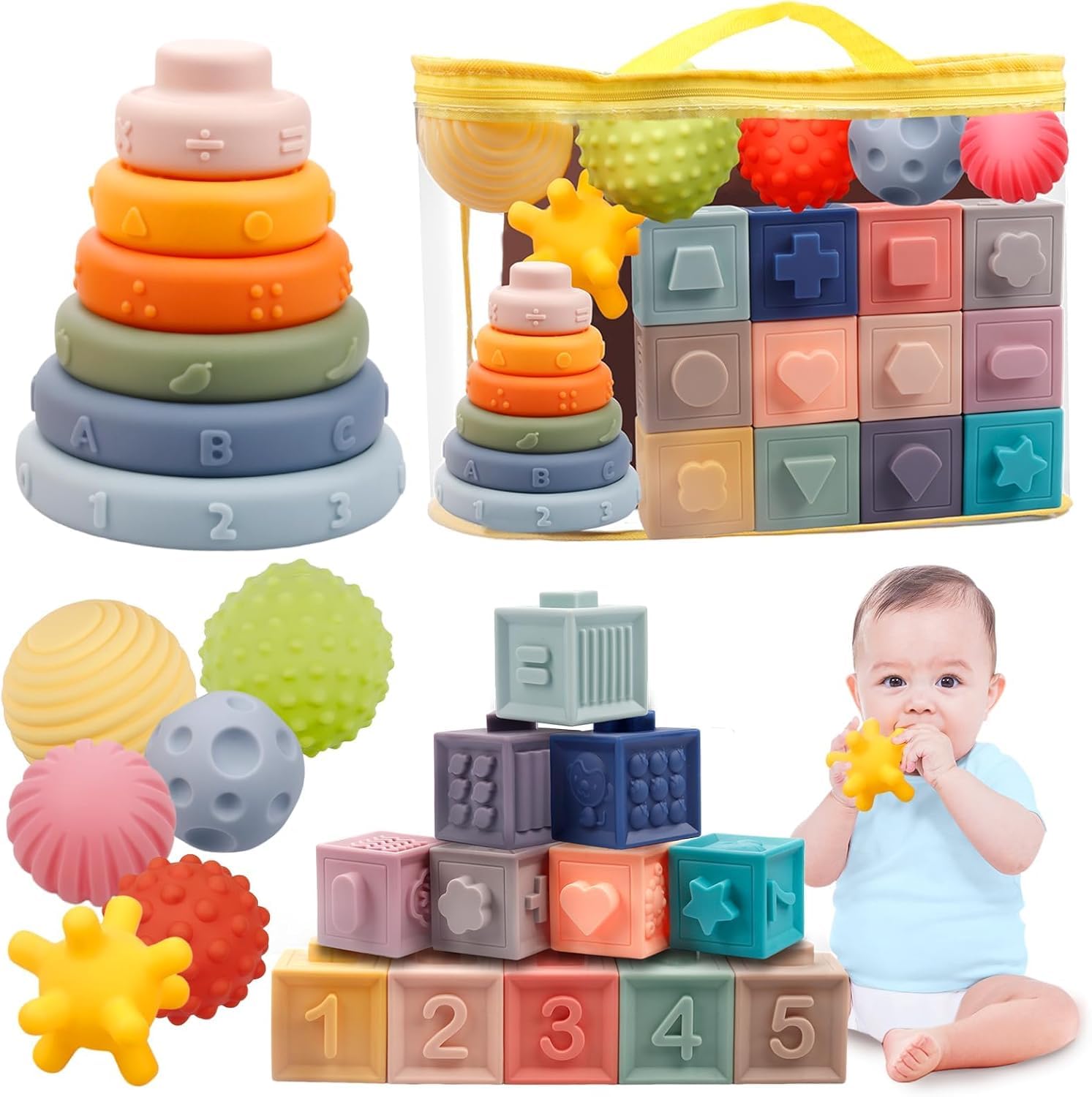
If you want a dedicated teething block that also stacks, this 3-in-1 set hits a sweet spot between simplicity and sensory stimulation. The set includes soft silicone stacking blocks, a ring stacker with letters and numbers, and nesting toys—each block features embossed animals, shapes, fruits, and numbers on every side. The silicone is food-grade, safe for gumming, and easily washable, making it ideal for bath time or post-meal cleanup. The blocks produce a gentle squeaky sound when squeezed, which babies find captivating and which supports auditory development.
Parents particularly appreciate the embossed textures that give tiny fingers something to grip—reviewers consistently note the blocks are “soft and durable” and “perfect for teething babies.” The set comes with a storage bag, so organizing the six blocks and ring stacker is straightforward. One reviewer calls it “the perfect travel toy” because it’s easy to wipe clean and packs compactly. The blocks stay bright even after repeated dishwasher cycles, which isn’t true of all silicone toys.
The main limitation is piece count: with only six blocks and one ring stacker, it doesn’t provide the variety that a larger set like the Plunack 6-in-1 offers. For families who prioritize a focused teething experience with stacking practice, this is a strong mid-range pick. But if your baby quickly masters stacking six blocks, you may want to supplement with additional shapes.
Why it’s great
- Food-grade silicone withstands gumming and dishwasher cleaning
- Embossed textures and squeaky sounds engage multiple senses
- Compact storage bag fits in a diaper bag for travel
Good to know
- Only six blocks—limited variety compared to multi-set options
- No shape sorter or pull-string components for older infants
3. Atoylink ABC Wooden Building Blocks

For parents who prefer natural materials, this wooden block set offers a tactile, eco-friendly alternative to plastic. The 30 blocks are crafted from natural wood treated with water-based paint, polished to a smooth finish with no sharp edges. Each block side displays a different element: uppercase and lowercase letters, numbers, symbols, shapes, animals, fruits, and everyday objects—180 unique printed surfaces total. The pull-along storage car turns cleanup into a game, encouraging toddlers to load and unload blocks themselves.
Parents report that grandchildren “love building houses, stacking them, then knocking them down” and that the blocks withstand repeated play without chipping. The pull car’s string is short—several reviewers noted the string length is too short for comfortable pulling—but attaching a longer string is a simple fix. The water-based paint holds up well against saliva and light scrubbing, though soaking is not recommended. At 30 pieces, this set offers more variety than the silicone options above, but the blocks are smaller than standard Mega Bloks, so they require more precise stacking coordination.
The educational value is strong for the 12-to-24-month crowd, as the alphabet and number sides support early literacy and numeracy exposure. However, the wood material means these blocks are not teething toys—babies in the 6-to-9-month oral phase may find the hard edges unsatisfying. This is best suited for infants who have moved past the mouth-everything stage and are ready for intentional stacking and letter recognition.
Why it’s great
- Natural wood with water-based paint—no off-gassing or BPA concerns
- 180 printed surfaces support alphabet, number, and animal recognition
- Pull-along storage car encourages independent cleanup habits
Good to know
- Smaller block size requires more precise stacking—not for early teethers
- Pull string is too short for young toddlers; may need replacement
4. MEGA BLOKS First Builders 80-Piece Set
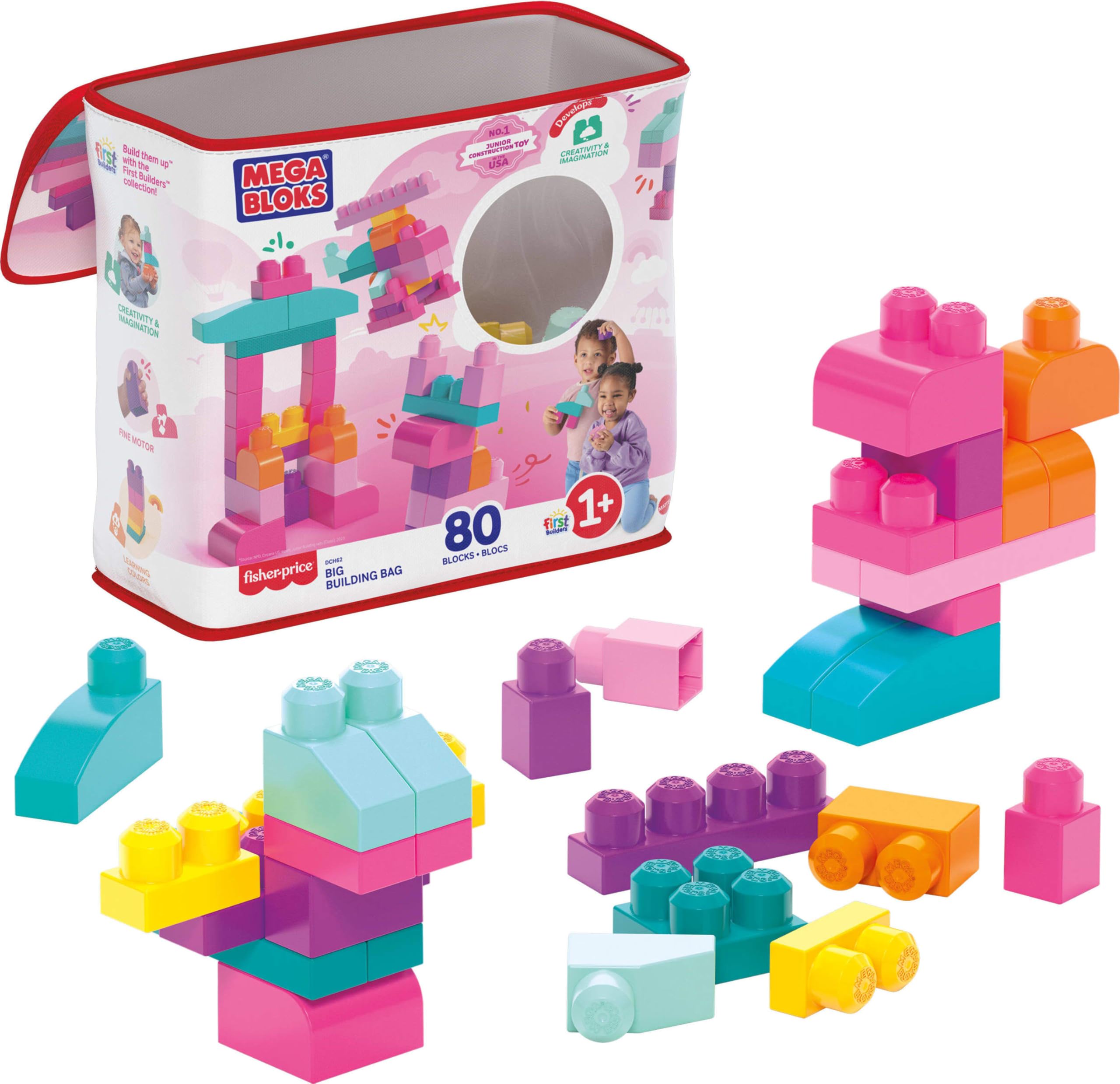
MEGA BLOKS is a household name for a reason: these large plastic blocks are specifically sized for toddler hands, and the 80-piece set offers the highest piece count in this lineup. The blocks snap together with a satisfying click but separate easily enough that a 12-month-old can pull them apart with moderate effort. The set includes 60 blocks in 10 shapes and 9 vibrant colors, plus a storage bag that keeps everything contained. At 2.5 pounds total, the bag is light enough for a toddler to carry.
Parents consistently praise the bright colors and durability—one reviewer called it “one of our toddler’s first favorites” and noted the blocks hold up to daily use. The plastic is BPA-free and smooth, with no sharp edges. The storage bag is a real convenience: multiple reviews highlight that cleanup is faster than with wooden block sets because you can just toss everything into the bag rather than stacking neatly into a box. The blocks interlock securely, but the fit is not tight enough for tall towers; multi-story structures tend to wobble and collapse.
The main limitation is that these are single-function building blocks—no teething, squeaking, or sensory elements. For a baby who already enjoys stacking and wants to build larger structures, this is the best value per block. But for a younger infant who needs multi-sensory input, a silicone or wooden set with textures and prints will provide more developmental variety. This is a solid mid-range choice for the 12-to-24-month construction enthusiast.
Why it’s great
- Largest piece count—60 blocks for expansive building freedom
- Blocks sized specifically for toddler grip ergonomics
- Included storage bag makes cleanup fast and portable
Good to know
- Blocks don’t interlock tightly; tall towers collapse easily
- No sensory or teething features—purely a building toy
5. Jyusmile Baby Sensory Teething Toys Set

This entry-level bundle packs remarkable variety for its position in this list. The set includes one rattle teether with 12 textured chew points, 6 connectable building blocks, and 6 soft stacking rings—all made from BPA-free, non-toxic food-grade vinyl. The atomic-shaped teether features a twisting clicking ball and rotating ball that engage auditory and tactile senses simultaneously. The blocks are soft enough to squeeze but structured enough to stack in short towers, and the rings offer a classic nesting activity that many 6-month-olds master quickly.
Parents note that “the weight and size of each toy were ideal” and that the materials are easy to clean. The vinyl construction is noticeably softer than the silicone used in the Plunack sets, which means less teething resistance but also a higher likelihood of bite marks over time. The blocks are slightly smaller than expected—several reviewers mentioned they were surprised by the compact size—but this actually helps small hands grip them more securely. The rattle teether is the standout piece: the 12 chew points provide varied texture that massages gums effectively.
The drawbacks are mostly about long-term durability. The vinyl material is not as heat-resistant as silicone, so dishwasher sterilization isn’t recommended. The blocks also lack the embossed educational elements (letters, numbers, animals) that the Plunack and Atoylink sets offer. For a budget-conscious parent who wants a multi-sensory starter set for a 3-to-9-month-old, this is a perfectly capable option. Just plan to replace it sooner than you would a silicone or wood alternative.
Why it’s great
- Three toy types in one box: teether, blocks, and stacking rings
- BPA-free food-grade vinyl is safe for oral exploration
- 12-texture teether provides more chew variety than flat silicone blocks
Good to know
- Vinyl material is less durable than silicone—bite marks appear faster
- Blocks are compact; some parents expected larger pieces
FAQ
Can my 6-month-old choke on soft silicone blocks?
Are wooden blocks safe for a baby who still mouths everything?
How many blocks does an infant actually need?
Final Thoughts: The Verdict
For most users, the blocks for infants winner is the Plunack 6-in-1 Montessori Baby Toys because it covers stacking, sorting, pulling, spinning, and teething in one safety-certified package with a useful storage bin. If you want a focused teething experience with stackable silicone blocks, grab the Plunack 3-in-1 Soft Baby Blocks. And for an eco-friendly alphabet and number learning set that doubles as a pull toy, nothing beats the Atoylink ABC Wooden Building Blocks.