That first morning step off the bed shouldn’t feel like a knife lodged in your heel. For runners with plantar fasciitis, every stride is a negotiation between the desire to train and the searing reality of inflamed fascia. The right insole changes that equation — providing targeted arch cradle, shock absorption, and gait alignment that lets you log miles without the flinch.
I’m Emma — the founder and writer behind Baby Bangs. I’ve spent the last four months dissecting heel-cup depths, foam densities, and arch profiles across seven leading models to find the insole that keeps runners running.
This guide breaks down the specific construction differences, materials, and fit characteristics that define the best insoles for plantar fasciitis runners in 2025. Each insole reviewed here was evaluated for its ability to absorb impact, support the arch dynamically, and fit securely inside performance footwear without slipping or crowding the toes.
How To Choose The Best Insoles For Plantar Fasciitis Runners
Plantar fasciitis is a repetitive-stress injury of the thick band of tissue running from heel to toes. For runners, the wrong insole can worsen the micro-tears; the right one offloads tension at the heel attachment and supports the arch through the gait cycle. Choosing well comes down to three non-negotiable factors.
Arch Height: Low, Medium, or High
Your arch type dictates which insole profile will restore proper foot mechanics. Low arches need a broader, flatter support platform to prevent over-pronation. High arches require a more aggressive cradle that fills the space without causing pressure points. Medium arches are the most forgiving, but still need to match the insole’s contour to the foot’s natural position. Brands like CURREX and Superfeet offer multi-profile options that let you dial in the exact height.
Heel Cup Depth and Stability
A deep, decoupled heel cup locks the calcaneus (heel bone) in place, limiting excessive rotation that yanks on the plantar fascia. Insoles with a shallow heel cup allow the heel to slide, which can aggravate the condition during the toe-off phase of a stride. Look for a heel cup that wraps at least 10–12 mm deep and features a structured outer edge that resists deformation under load.
Shock Absorption vs. Responsiveness
Runners need a balance — too much soft foam collapses under the force of a 6-minute mile, and a rigid carbon plate feels unforgiving on longer runs. The best insoles for plantar fasciitis runners use a dual-layer construction: a firm polypropylene or EVA base to control alignment, topped with a viscoelastic or gel layer to dampen ground impact. This combination prevents the heel strike from transmitting shock directly through the inflamed tissue.
Quick Comparison
On smaller screens, swipe sideways to see the full table.
| Model | Category | Best For | Key Spec | Amazon |
|---|---|---|---|---|
| PowerStep Pinnacle | Orthotic Insole | Runners needing semi-rigid arch control | Semi-rigid polypropylene shell | Amazon |
| Move Game Day | Performance Insole | High-impact sports and jumping | Composite heel with reactive stability | Amazon |
| CURREX ActivePro | Dynamic Arch Insole | Multi-profile, custom-like fit | Decoupled heel cup in 3 arch heights | Amazon |
| Superfeet Run Cushion Low Arch | Trim-to-Fit Insole | Low arches needing heel-to-toe turnover | Adaptive Comfort Technology (flexible arch) | Amazon |
| VALSOLE Heavy Duty Support | Heavy-Duty Orthotic | Runners over 220 lbs or on concrete | High-rigidity arch shell for shock absorption | Amazon |
| Welnove Running Insoles | Cushioned Insole | Budget-friendly daily training | Polyurethane foam + moisture-wicking top cloth | Amazon |
| CRUVHEAL Sport Shock Absorbing | Gel Cushion Insole | Multi-sport with heel-strike impact | Gel heel pad with deep heel cup | Amazon |
In‑Depth Reviews
1. PowerStep Pinnacle Insoles

The PowerStep Pinnacle sits at the intersection of podiatrist-grade correction and runner-friendly cushioning. Its semi-rigid polypropylene support shell provides the stable arch cradle that plantar fasciitis requires during the toe-off phase, while the dual-layer EVA foam absorbs heel-strike shock without feeling like a brick underfoot. Runners logging 8,000+ steps daily in these report significant PF pain reduction within 10 to 14 days, which aligns with the shell’s ability to limit over-pronation and offload tension from the medial fascial band.
What sets the Pinnacle apart from softer alternatives is its no-trim, true-to-size fit. The heel cup offers moderate depth — not as enveloping as some high-end orthotics but sufficient to stabilize the calcaneus for steady-state running. The top fabric is a moisture-wicking knit that stays breathable during 10-mile sessions. Users coming from Superfeet note the PowerStep feels less rigid and more forgiving on long runs, making it a stronger daily trainer for the PF runner who doesn’t want to sacrifice comfort for correction.
For the runner who needs a built-in arch correction that works immediately out of the box — no adaptation period required — the Pinnacle delivers. Its primary trade-off is that the semi-rigid support is not ideal for sprinting or explosive movements where a fully flexible insole is preferred. But for steady-state training, tempo runs, and recovery jogs, this is the most reliable PF fighter in this list.
Why it’s great
- Podiatrist-recommended semi-rigid shell corrects pronation instantly
- No trimming needed — true-to-size fit
- Dual-layer cushion absorbs heel-strike without bottoming out
Good to know
- Semi-rigid feel may be too firm for runners used to full-soft foam
- Not designed for sprinting or cutting motions
2. Move Game Day Performance Insoles

The Move Game Day insole was co-founded by NBA All-Pro Damian Lillard and it carries a bias toward explosive, multi-directional sports. For the runner with plantar fasciitis, the standout feature is the composite heel unit that includes a pressure-relief structure designed to minimize shock to the heel spur attachment point. The forefoot is molded for a contoured fit inside basketball and running shoes alike, and the arch support is aggressive — replicating the feel of a custom orthotic without the two-week wait.
Runners who have suffered from shin splints alongside their PF will appreciate the reactive stability layer under the midfoot. Reviews confirm that 5+ years of shin pain disappeared within the first mile of use, which suggests the insole’s arch profile effectively loads the kinetic chain correctly. The heel cup depth is generous — deeper than the PowerStep — and it locks the calcaneus firmly during lateral cuts and heel strikes. The trade-off is thickness: these insoles add noticeable volume, so you may need to half-size up in your running shoes, especially if you wear low-profile trainers like the ASICS Metaspeed or Nike Vaporfly.
The Game Day excels for the runner whose PF co-exists with other overuse injuries (shin splints, runners knee) and who needs a performance-oriented orthotic that won’t collapse under high-intensity intervals. It is less suited for casual walking or all-day standing due to its firm, structured feel. For speed days and track work, this is the premium option.
Why it’s great
- Composite heel technology absorbs shock at the PF attachment point
- Deep heel cup locks the foot for lateral stability
- Proven to eliminate shin splints alongside PF relief
Good to know
- Thick build may require sizing up in low-volume running shoes
- Firm support not ideal for all-day standing or walking
3. CURREX ActivePro Insoles

CURREX takes a precision-fit approach that is rare at this price point. The ActivePro is available in low, medium, and high arch profiles — a triage system that lets you match your specific foot type rather than forcing a one-shape-fits-all design. The decoupled heel cup is the key differentiator: it wraps separately from the arch support, allowing the heel to move naturally while still providing a deep cradle that limits excessive pronation. This design is especially beneficial for runners whose PF stems from a hypermobile or over-pronated foot.
The foam cushioning is on the firmer side of medium — not as soft as the Welnove foam but more forgiving than the rigid PowerStep shell. This makes it an ideal middle-ground for runners who want alignment correction without the hard edge. Runners logging 13-hour hospital shifts or 10-mile long runs report significantly reduced foot fatigue and zero morning heel pain after switching. The slim profile is a clever design choice: the ActivePro fits comfortably inside low-profile shoes like the Hoka Clifton or Saucony Kinvara without crowding the toes or requiring a half-size up.
For the runner who has tried generic insoles and felt the arch support was either too aggressive or nonexistent, the CURREX ActivePro offers the closest thing to a podiatrist-molded orthotic without a prescription. The trade-off is that the medium arch version is the most versatile, so you must correctly identify your arch type before purchasing — choose wrong, and the support will feel off.
Why it’s great
- Three arch profiles (low/medium/high) for a truly custom fit
- Decoupled heel cup allows natural motion while stabilizing
- Slim profile fits low-volume running shoes without sizing up
Good to know
- Arch selection must be correct — no one-size option
- Firmer foam not ideal for runners who prefer plush step-in feel
4. Superfeet Run Cushion Low Arch Insoles

Superfeet has been a staple in the running orthotic world for decades, and the Run Cushion Low Arch model is specifically tailored for runners with flat or fallen arches who struggle with plantar fasciitis. The patented Adaptive Comfort Technology uses a flexible arch that moves with the foot during gait rather than forcing a static correction, which results in a more natural heel-to-toe turnover. The insole is trim-to-fit, so you can fine-tune the length to match your specific shoe, and the moisture-wicking top layer prevents the sweat build-up that often exacerbates blisters and friction over distance.
What sets the Superfeet apart from the CURREX and PowerStep is its deliberate targeting of low arches only. The profile is wider in the midfoot to accommodate a collapsed arch, and the heel cup is medium-depth — enough to stabilize without feeling restrictive. Runners with flat feet who have tried other insoles only to feel the arch pushing uncomfortably into their arch will find the Superfeet design more accommodating. The base is firm but not rigid; it provides enough structure to prevent over-pronation while still allowing some natural foot splay on landing.
Users report that the Superfeet Run Cushion eliminates outer hip and knee pain associated with fallen arches, and it achieves this without the stiff, molded feel of a full orthotic. The trade-off is that the flexible arch may not provide enough support for severe, chronic PF cases that require a rigid semi-shell. For low-arched runners with moderate to mild PF, this is a precise, high-quality fit.
Why it’s great
- Flexible arch technology adapts to foot movement for natural gait
- Designed specifically for low arches — wider midfoot platform
- Moisture-wicking top fabric reduces blister risk on long runs
Good to know
- Trim-to-fit design requires careful sizing and cutting
- Flexible arch may not be sufficient for severe PF cases
5. VALSOLE Heavy Duty Support Pain Relief Orthotics

The VALSOLE Heavy Duty Support orthotic is engineered for larger-frame runners and those who train predominantly on concrete surfaces. The key spec here is the rating for users above 220 pounds — a segment often underserved by standard insoles that compress under higher body weight. The arch support is aggressive and high, providing a firm cradle that prevents the foot from collapsing on impact. Runners who have struggled with chronic heel pain for years report that the VALSOLE eliminates it within a single shift or run, and multiple reviews note that back and knee pain also resolve as the kinetic chain aligns.
The construction uses a rigid EVA base topped with a spongier layer that provides some give without sacrificing the structural integrity needed to distribute load. The heel cup depth is substantial — comparable to the Move Game Day — and it locks the heel securely, which is critical for runners who over-pronate heavily. The insole does add noticeable weight to the shoe, and some users note that it requires a break-in period of 2–5 hours to let the foot adjust. The fit is trim-to-fit, so you will need to cut the insole to match your shoe size precisely.
The VALSOLE is the right choice for the heavier runner or the runner who logs 10+ miles on unforgiving pavement and needs an orthotic that won’t bottom out by mile three. It is less suitable for smaller runners or those with low arches, as the aggressive arch profile may feel intrusive on a naturally flat foot. For its target audience, it is the most effective shock-absorption tool here.
Why it’s great
- Specifically engineered for users over 220 lbs — no foam collapse
- High, rigid arch eliminates heel and back pain on concrete
- Deep heel cup locks the calcaneus for stability
Good to know
- Aggressive arch may feel excessive for low-arched feet
- Requires a 2-5 hour break-in period
6. Welnove Running Insoles
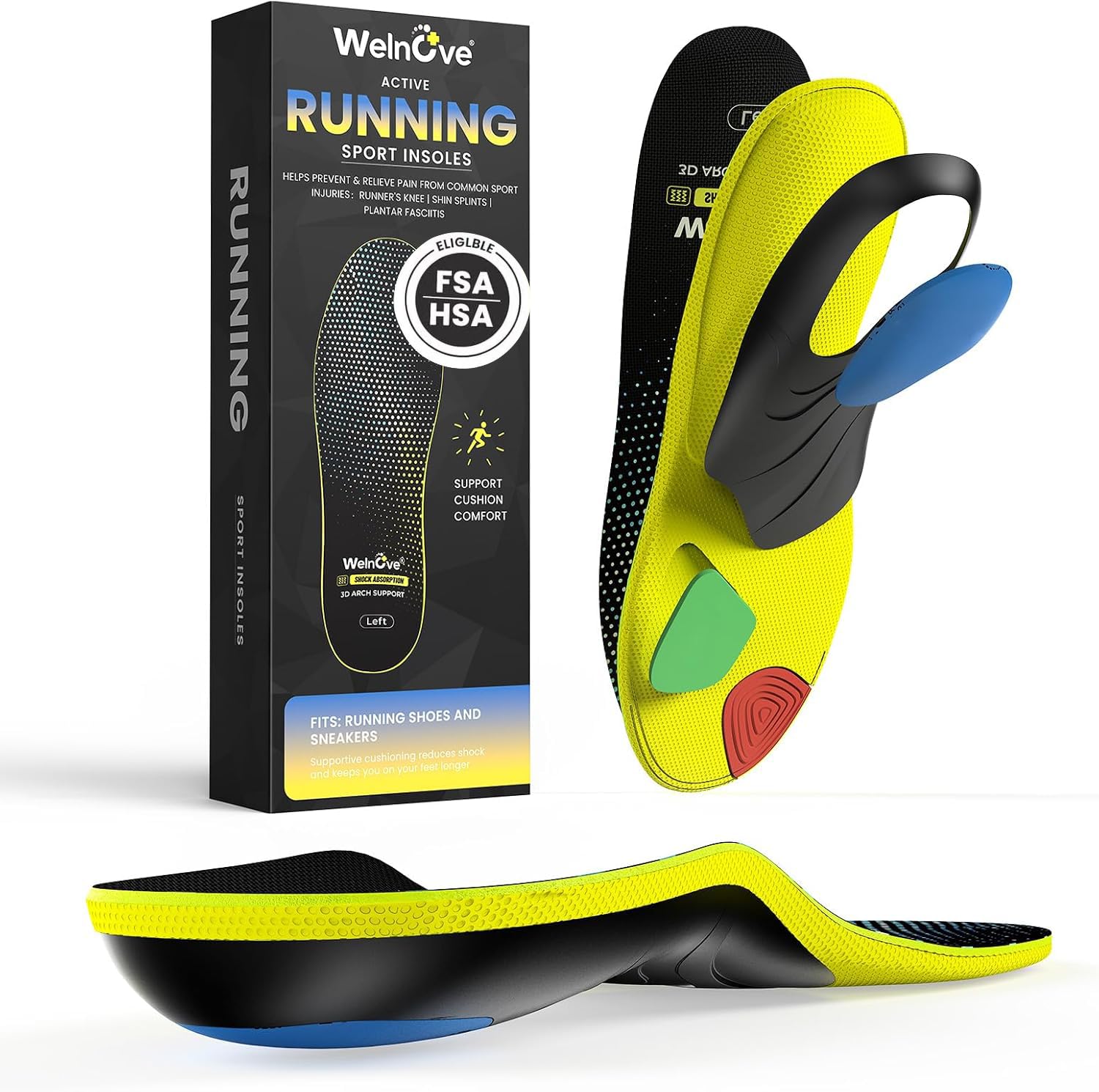
The Welnove Running Insole is the budget-friendly entry point that punches above its tier. Its polyurethane foam base provides a plush, cloud-like feel underfoot — noticeably softer than the PowerStep or VALSOLE — which can be a relief for runners whose PF pain is exacerbated by hard surfaces. The arch support is medium-profile, making it a solid fit for runners with normal to slightly low arches who don’t need aggressive correction. The moisture-wicking mesh top layer does a good job of keeping the foot dry during 5–10 mile runs, preventing the dampness that can soften skin and create friction points.
What the Welnove lacks in rigidity it makes up for in repeat adoption. Multiple reviewers have bought 4 to 6 pairs to outfit all their running shoes, which suggests the comfort-to-price ratio is high enough to justify stocking up. The insole is trim-to-fit, and users report the cutting is straightforward. The breathability is better than the CRUVHEAL’s gel design, but the foam will compress faster than a semi-rigid orthotic — expect to replace these after 300–400 miles rather than the 500+ mile lifespan of a Currex or Superfeet.
The Welnove is best for the runner who wants immediate soft-step relief without the financial outlay of premium orthotics. It is not suitable for severe PF where a rigid shell is required, but for maintenance miles and daily commuting, it’s the strongest value proposition on this list.
Why it’s great
- Plush polyurethane foam provides immediate comfort
- Breathable mesh reduces moisture and blister risk
- Very low price point makes it easy to outfit all shoes
Good to know
- Foam compresses faster than rigid orthotics — shorter lifespan
- Medium arch not aggressive enough for severe over-pronation
7. CRUVHEAL Sport Shock Absorbing Insoles

The CRUVHEAL Sport insole distinguishes itself with a targeted gel pad placed under the heel — a feature designed specifically to absorb the impact of hard heel strikes associated with running and jumping. The gel is pliable enough to deform on contact but springs back quickly, which provides a noticeable bounce during toe-off. The deep heel cup is another strong point: it wraps the calcaneus with a non-slip gel perimeter that keeps the insole locked in place during vigorous movement, preventing the sliding that can irritate the plantar fascia insertion point.
Runners who have used these for soccer refereeing, lacrosse, and 5k training report that the insoles are durable, supportive, and provide a springy feel that enhances acceleration. The arch support is neutral to medium — less aggressive than the PowerStep or VALSOLE — which makes these a good choice for runners whose PF is mild or in maintenance phase. The adaptation period is 3–7 days, during which you gradually increase wear from 2–5 hours, which is similar to the VALSOLE break-in. The insoles are slightly heavier than the Welnove or Superfeet due to the gel layer, and they fit best in shoes with medium to wide volume; they can feel bulky in low-profile or highly snug performance runners.
The CRUVHEAL is the ideal pick for the multi-sport runner who needs impact protection that carries over from running to basketball or tennis. For pure running-based PF with a need for structured arch control, the PowerStep or CURREX delivers more targeted correction. But if your primary complaint is heel-sting and you want a bouncy, responsive ride, this insole delivers.
Why it’s great
- Gel heel pad absorbs hard impact for heel-strike runners
- Deep, non-slip heel cup prevents sliding during dynamic movement
- Springy feel enhances acceleration and toe-off power
Good to know
- Requires a 3-7 day adaptation period
- Bulky fit may not suit low-volume or snug performance shoes
FAQ
Can I use these insoles for both running and walking throughout the day?
How often should I replace insoles for plantar fasciitis runners?
Do I need a break-in period for firm plantar fasciitis insoles?
Will these insoles fit inside my performance running shoes like Hoka or Nike Vaporfly?
Can I use these insoles if I have high arches instead of flat feet?
Final Thoughts: The Verdict
For most runners, the best insoles for plantar fasciitis runners is the PowerStep Pinnacle because it delivers podiatrist-grade semi-rigid correction in a no-fuss, trim-free package that works from step one. If you want a custom-like fit with adjustable arch height, grab the CURREX ActivePro. And for high-impact training where heel-sting is the main enemy, nothing beats the Move Game Day.