If you have flat feet and spend your days on unforgiving concrete in heavy work boots, you know the exact moment the ache starts—a dull throb in the arch that radiates up through the knee and into the lower back. The right insole doesn’t just add a layer of foam; it physically repositions your foot to stop the collapse that causes that pain.
I’m Emma — the founder and writer behind Baby Bangs. I’ve spent hundreds of hours analyzing load-bearing orthotic materials, arch height profiles, and the real-world durability tests that separate a six-month insole from a three-week flop.
After reviewing dozens of models across every price tier, I’ve narrowed the market down to the seven most effective options. This is the definitive guide to choosing the insoles for flat feet work boots that actually hold up to a full shift without turning your feet into a source of chronic pain.
How To Choose The Best Insoles For Flat Feet Work Boots
Flat feet lack the natural arch that acts as a shock-absorbing spring. In a work boot, that missing arch forces your knee, hip, and spine to absorb forces they weren’t designed for. A good insole replaces that missing spring. But not every “support” insole can handle the weight of a 12-hour shift in steel toes.
Don’t Confuse Cushion with Support
The biggest mistake flat-foot buyers make is grabbing the softest insole on the shelf. Memory foam feels great in the store but compresses to a pancake within a week under a heavy load. You need a firm, semi-rigid material—typically TPU or a dense polypropylene shell—that physically prevents your arch from dropping. Cushion is the top layer; support is the foundation.
Match the Insole Volume to Your Boot
Work boots, especially steel-toes, have notoriously cramped interiors. An insole that is too thick will raise your heel above the boot’s heel counter, causing blisters and instability. Look for insoles with a total thickness of 3–5mm at the toe and gradually increasing to 6–8mm at the heel. If a reviewer says “I had to re-lace my boots loose,” that insole is probably too tall for your specific pair.
Your Body Weight Determines Your Insole’s Lifespan
Manufacturers now explicitly categorize insoles for users over 220 pounds. If you weigh more than 200, a standard drugstore insole will break down in weeks. Heavy-duty models use firmer foams, thicker TPU plates, and deeper heel cups designed to distribute a heavier load without deforming. Ignoring this spec means buying twice as often.
Quick Comparison
On smaller screens, swipe sideways to see the full table.
| Model | Category | Best For | Key Spec | Amazon |
|---|---|---|---|---|
| VALSOLE Heavy Duty Support | Premium | Heavy users over 220 lbs | High arch TPU frame | Amazon |
| PowerStep Pinnacle Maxx | Premium | Maximum stability & control | Firm angled heel cup | Amazon |
| Ailaka Work Boot Insoles | Mid-Range | All-day standing comfort | PU foam + GEL cushion | Amazon |
| Fit Geno Orthotics | Mid-Range | Heavy duty over 220 lbs | Rigid arch + Poron foam | Amazon |
| Timberland PRO Anti-Fatigue | Mid-Range | Long shifts on hard floors | Hexagonal pillar design | Amazon |
| Welnove Work Orthotics | Mid-Range | Transition from cheap insoles | 3D dynamic TPU arch | Amazon |
| DONQE Plantar Fasciitis Relief | Budget-Friendly | Isolated arch support | Memory foam + GEL pads | Amazon |
In‑Depth Reviews
1. VALSOLE Heavy Duty Support Orthotics

The VALSOLE Heavy Duty Support Orthotics sit at the top of this list because they deliver exactly what a flat-footed worker needs: a rigid, high-arch TPU frame that refuses to collapse under sustained pressure. Warehousemen and construction workers on concrete floors report complete elimination of foot and back pain after the first shift, which is an extraordinary claim for any insole. The arch hits the correct anatomical position instantly—no break-in period required for most users.
The construction uses a thick, semi-rigid shell that provides total ground contact, creating a stable platform that prevents overpronation. At 235 to 370 pounds, reviewers consistently report the VALSOLE maintains its shape and doesn’t bottom out, even after weeks of 12-hour shifts. The deep heel cup locks the calcaneus in place, which is critical for flat feet that tend to roll inward.
One minor trade-off: the insole is thick enough that you’ll need to loosen your boot laces by a notch or two, especially in tighter-fitting steel toes. A few users noted a slight audible noise during the first few steps, which fades as the material conforms. But for raw, unrelenting support that tackles flat feet, back pain, and heel pain in one package, this is the standard-setter.
Why it’s great
- Incredible arch height and rigidity that doesn’t flatten for heavy users
- No break-in period—immediate pain relief for knees and lower back
- Deep heel cup corrects overpronation on hard surfaces
Good to know
- Thick profile may require loosening laces in tight work boots
- Firm feel may be too aggressive for users who prefer soft cushioning
2. PowerStep Pinnacle Maxx Orthotic Insoles

PowerStep’s Pinnacle Maxx is the doctor-recommended choice for flat feet and overpronation, and it earns that reputation through a unique “firm and flexible” angled heel that actively controls rearfoot motion. Users recovering from posterior tibial tendonitis and post-surgical neuropathy report dramatic pain reduction within days. The insole is stiff out of the box but breaks in quickly to match your foot’s natural motion without losing structural integrity.
The key differentiator here is the angled heel design, which provides maximum stability without feeling like you’re standing on a block of wood. It works exceptionally well in work boots because the semi-rigid shell doesn’t rob the boot of its intended fit—you’ll need to remove the factory insole to accommodate the thickness, but it sits flush once installed. The insole is also podiatrist-designed and manufactured in the USA, which adds a quality control layer that budget brands skip.
If you have extremely high arches or need metatarsal pad support, PowerStep makes a specific high-arch version as well. The main caution is sizing: the insole is sized to your arch length, not your shoe size, so measure carefully. It also takes up enough volume that many users go up half a size or opt for a wide toe box. But for precision biomechanical control that actually treats the root cause of flat-foot pain, this is the premium pick.
Why it’s great
- Angled heel design actively controls overpronation and rearfoot motion
- Podiatrist-designed, USA manufacturing ensures consistent quality
- Effective for complex conditions like posterior tibial tendonitis
Good to know
- Sizing is based on arch length, not shoe size—measure carefully
- Adds noticeable volume; may require sizing up in tight boots
3. Ailaka Work Boot Insoles
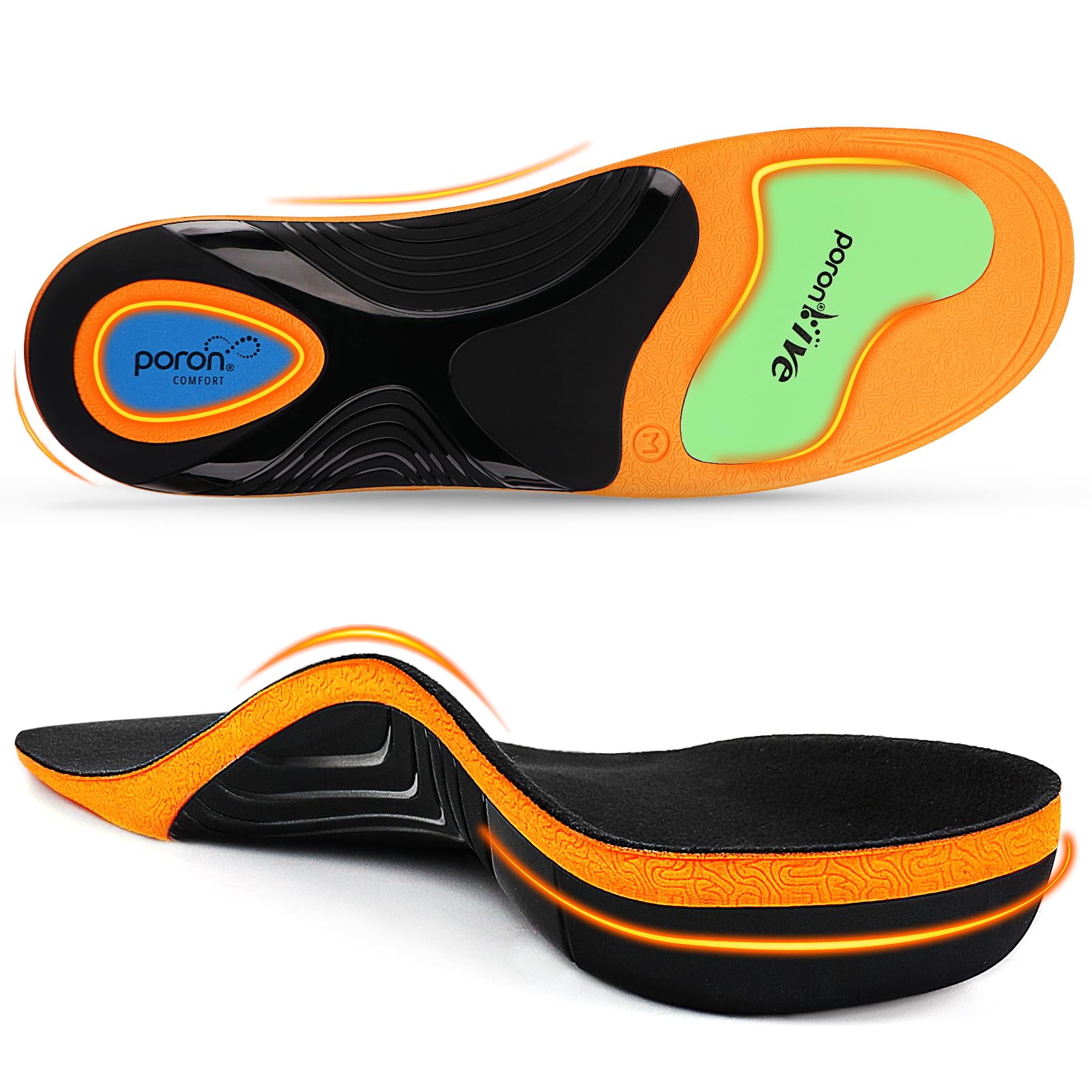
The Ailaka Work Boot Insoles strike a rare balance: they provide the firm arch support that flat feet need without the hard, plank-like feel of premium orthotics. The secret is a layered construction that uses soft PU foam for shock absorption over a premium TPU support frame. Users who have tried custom orthotics and cheaper drugstore brands consistently report that Ailaka eliminates foot pain where nothing else worked, including a 78-year-old user who avoided knee surgery after switching.
The GEL cushioning pads under the heel and forefoot absorb the initial impact of each step, while the deep U-shaped heel cup keeps the foot vertical and balanced. The breathable velvet fabric top layer prevents the sweaty-foot problem common to all-day boot wear. The insole is also trimmable to fit any boot size, and the material bounces back in milliseconds—it won’t stay compressed overnight like cheaper memory foam does.
Some users noted the fit could be slightly better in narrower boots, and the transition period of 2–3 days of short wear is real for feet not used to proper arch support. But for the price, the combination of support, cushion, and durability is hard to beat. If you’re moving up from a flat insole and want something that actually holds your arch, this is the sweet spot.
Why it’s great
- Combines firm TPU support with soft PU and GEL comfort layers
- Proven to eliminate foot, knee, and lower back pain in heavy users
- Breathable fabric and rapid rebound prevent odor and flattening
Good to know
- Requires 2-3 days of gradual wear for foot adjustment
- Fit may feel slightly loose in very narrow boot profiles
4. Fit Geno Orthotics Insoles
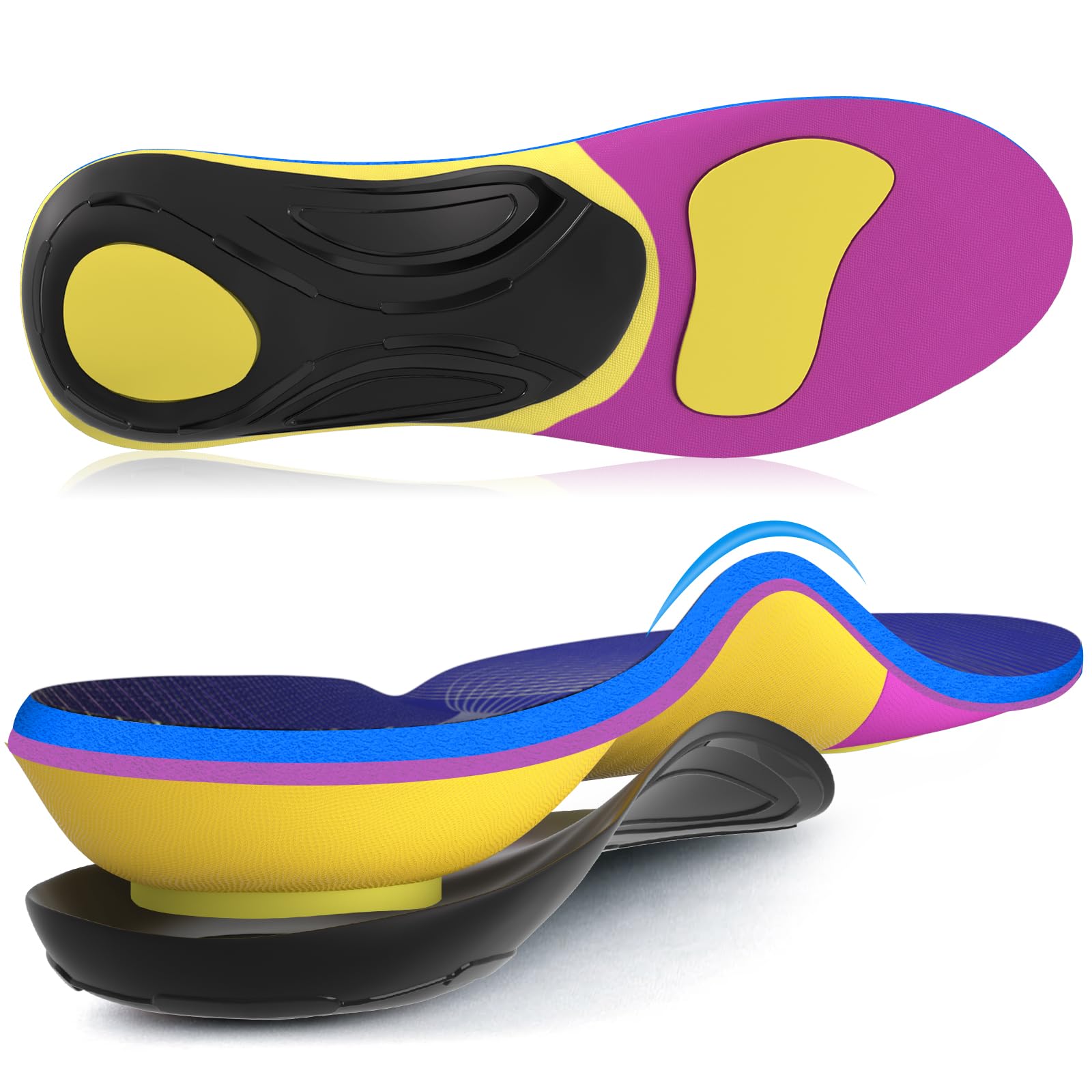
Fit Geno built this insole specifically for bodies over 220 pounds, and the engineering reflects that focus. The arch is rigid and high, designed to lift the plantar fascia out of the overstretched position that causes flares. The deep heel cup and shock guard work together to transfer load away from the foot and up through the leg, which is exactly what flat feet need in a work boot. Users who stand for entire shifts report a noticeable reduction in fatigue by the end of week one.
The standout material here is Poron foam lining the heel and ball of the foot—this is a premium cushioning compound commonly used in medical orthotics, not generic EVA. It absorbs impact without taking a permanent set, meaning the insole maintains its thickness far longer than budget alternatives. The TPU arch plate is also removable, giving you the option of a lower profile if your boot is particularly cramped.
A few reviewers noted slower shipping times, but the product itself earned near-universal praise for fit and function. The breathable fabric helps control odor, and the 1-count unit is a single pair. If you’re a heavier worker who has accepted foot pain as inevitable, the Fit Geno is a targeted solution that directly addresses the load-bearing failure of standard insoles.
Why it’s great
- Built specifically for 220+ lb users with a rigid, high arch
- Medical-grade Poron foam maintains thickness under heavy load
- Removable TPU arch plate offers profile flexibility
Good to know
- Some users reported slow delivery times
- Arch may feel too high for those with medium arches
5. Timberland PRO Anti-Fatigue Replacement Insole

Timberland PRO’s Anti-Fatigue insole uses a distinctive hexagonal pillar geometry that compresses and rebounds with each step, creating a dynamic energy return that reduces leg fatigue during 12-hour shifts. It is not a high-arch orthotic in the traditional sense—the arch support is moderate—but it excels at absorbing ground impact during continuous walking and standing on hard surfaces. Garbage truck drivers jumping in and out of cabs 450 times per shift and warehouse workers on concrete both report eliminated knee and joint pain.
The low profile is a major advantage for steel-toe boots where every millimeter of internal height matters. It fits easily under the foot without raising the heel uncomfortably, and it’s easy to trim to any size. The durability is solid: users report 6 months of daily heavy use before the pillars begin to break through the top layer, and many keep a backup pair on hand. The material also resists odor better than standard foam inserts.
This insole is not designed for severe overpronation or high-arch support needs. If your primary problem is collapsed arches, the Timberland PRO will feel too flat. But if your pain stems from ground impact during long shifts on concrete, the anti-fatigue geometry solves that specific problem without the bulk of a full orthotic.
Why it’s great
- Unique hexagonal pillars absorb shock and return energy with each step
- Very low profile fits easily in tight steel-toe boots
- Proven durability with 6-month lifespan in heavy use conditions
Good to know
- Moderate arch support—not suitable for severe flat feet or overpronation
- Pillars may eventually break through the top layer after extended use
6. Welnove Work Orthotic Insoles
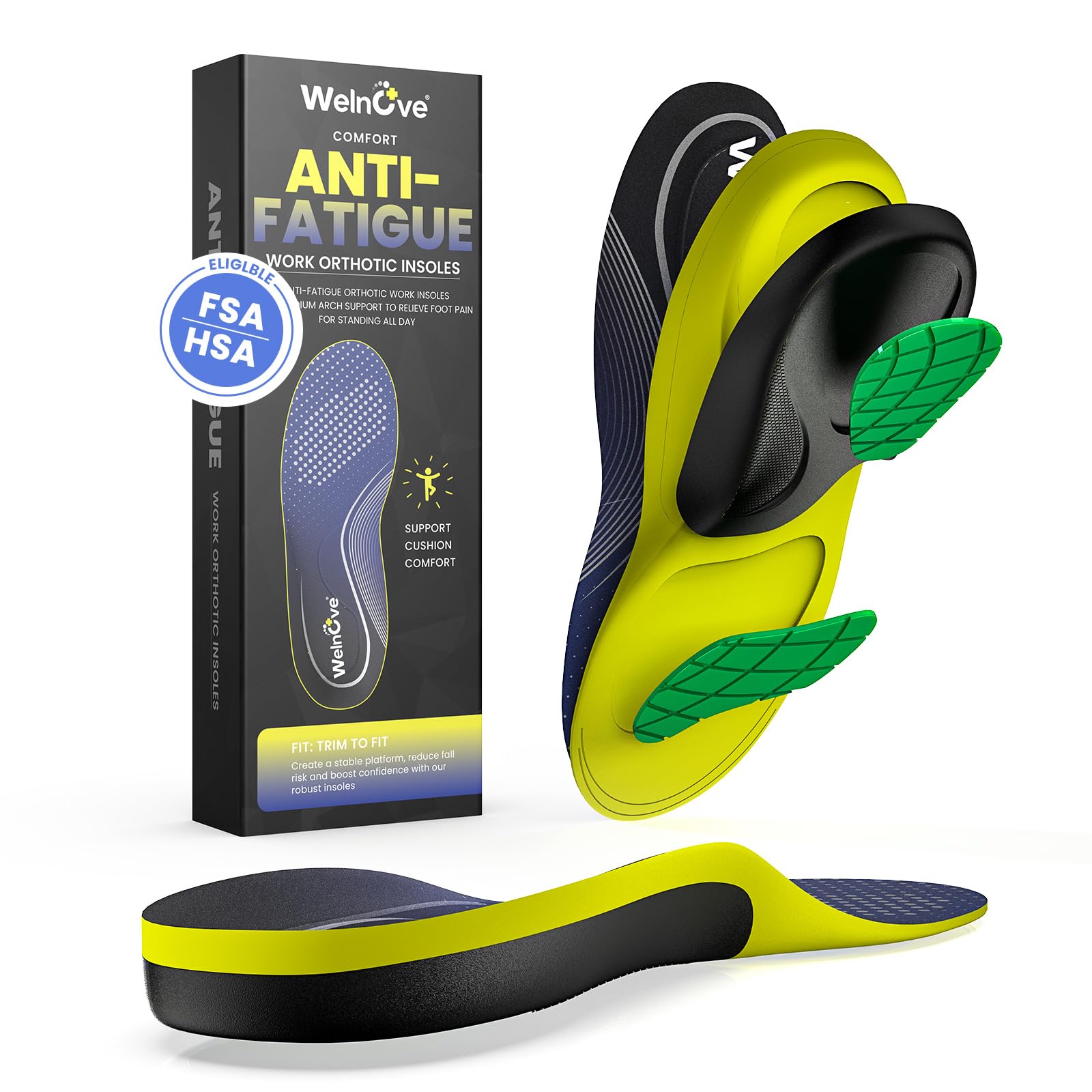
The Welnove Work Orthotic Insole is designed as a bridge between budget foam slabs and full medical orthotics. It combines a 3D dynamic TPU arch support layer with a PU foam cushioning core and GEL pads at the heel and ball of the foot. The result is an insole that provides genuine arch support—enough to prevent the burning foot sensation that ends shifts early—without the intimidating rigidity of a max-support product.
Users transitioning from cheap drugstore insoles report that Welnove extends their comfortable standing time from 3–4 hours to a full 8–10 hour shift. The deep U-cup heel provides noticeable stability for overpronation, and the three-layer construction distributes pressure across the entire foot instead of concentrating it on the arch. It works particularly well in steel-toe boots where the added volume is manageable.
A small but notable issue: the product listing can be slightly misleading about packaging (one pair, not two pairs). And while most users see dramatic improvement, one user reported increased fatigue and worse plantar fasciitis symptoms after a month, suggesting that very high-arched or sensitive feet may need a more customizable solution. For the majority of flat-foot workers looking for a big step up from basic foam, this is a solid mid-range contender.
Why it’s great
- Three-layer TPU/PU/GEL construction offers genuine arch support
- Extends comfortable standing time from 4 hours to a full shift
- Deep heel cup effectively controls overpronation in boots
Good to know
- Listing may imply two pairs but ships as one pair
- Not ideal for very high arches or sensitive feet
7. DONQE Plantar Fasciitis Relief Insoles

DONQE’s insoles are the most budget-friendly entry in this roundup, and they target a specific buyer: someone who needs immediate arch support without the investment cost of a premium orthotic. The insole uses a sturdy TPU base for structural arch support, topped with memory foam for comfort and separate GEL pads under the heel and forefoot for targeted shock absorption. For a teacher on their feet 8 hours or a lightweight worker, the pain relief is immediate and effective.
The design is straightforward: the arch hits the correct spot for most flat-footed users, the deep heel cup helps correct pronation, and the materials are durable enough to withstand several months of daily wear. Users up to 370 pounds report that the arch support holds up without flattening, which is an impressive feat for this price tier. The insoles are also trimmable and come with a satisfaction guarantee that covers even trimmed units.
The trade-offs are real. The materials create an audible squeaking sound when walking across hard floors—a consistent complaint across multiple reviews. The memory foam layer, while comfortable initially, will compress faster than the denser foams in mid-range products. And the arch support, while present, is not as aggressive as the VALSOLE or PowerStep models. If your budget is tight and you need immediate relief, DONQE works. Just know you may need to upgrade within 3–6 months if you’re running heavy use.
Why it’s great
- Effective arch and heel pain relief at a budget-friendly price point
- Sturdy TPU base holds up for heavy users up to 370 lbs
- Trimmable with a generous satisfaction guarantee
Good to know
- Audible squeaking sound when walking on hard surfaces
- Memory foam layer compresses faster than premium alternatives
FAQ
Should I remove the factory insole from my work boots before inserting an orthotic?
How long does it take to adjust to wearing arch support insoles for flat feet?
Can I use the same insoles in my work boots and my sneakers?
Final Thoughts: The Verdict
For most users, the insoles for flat feet work boots winner is the VALSOLE Heavy Duty Support because it combines uncompromising arch rigidity with the durability needed for shifts over 220 pounds. If you want maximum biomechanical control and a podiatrist-approved design, grab the PowerStep Pinnacle Maxx. And for a balanced all-day option that won’t break your budget, nothing beats the Ailaka Work Boot Insoles.