After eight hours walking on concrete, your knees ache, your lower back throbs, and even your favorite sneakers feel like they’ve turned to stone. That nagging fatigue isn’t your shoes — it’s the flimsy slab of foam the manufacturer shoved under your foot. The right pair of insoles transforms sneakers from basic footwear into a genuine support system, absorbing impact and shoring up your arch where it matters most.
I’m Emma — the founder and writer behind Baby Bangs. I’ve spent over a year digging into orthopedic foam densities, arch height mappings, and pressure-point distribution data to separate the inserts that actually change your step from the ones that just feel squishy for a week.
Whether you’re logging miles on pavement, standing a double shift, or battling plantar fasciitis, the right insole makes the difference between dreading your next step and walking pain-free. This guide breaks down the insoles for sneakers that deliver real, lasting support without the podiatrist price tag.
How To Choose The Best Insoles For Sneakers
Not all insoles fit the same sneaker profile. Sneakers have low-profile heel cups and snug toe boxes, so a work-boot insole that’s too thick will make your shoe feel tight and your foot slide forward. Focus on three factors to get a match that actually works inside your Nike, Brooks, or New Balance.
Arch Type and Support Level
Low arches need rigid support to prevent overpronation — look for a pronounced medial post or firm foam. Neutral arches can handle cushioned orthotics that don’t force a correction. High arches require soft metatarsal padding to offload the ball of the foot. Pick an insole that matches your arch, not one that claims to fix every foot.
Trim-to-Fit Tolerance
Sneaker insoles are rarely a direct drop-in. Most require trimming along the forefoot to match your shoe’s shape. Check whether the insole’s cutting line follows the natural curve of a sneaker toe box or is shaped for a dress shoe. A bad trim causes bunching under the toes, which is worse than no insole at all.
Heel Cup Depth and Cushioning Density
A deep U-shaped heel cup cradles the calcaneus and prevents side slippage during lateral movement — critical for gym sneakers. The cushioning should be firm enough to resist bottoming out over a long shift but pliable enough to absorb heel strike impact. Dual-layer inserts with PORON or memory foam on top of a stiff base usually strike the best balance.
Quick Comparison
On smaller screens, swipe sideways to see the full table.
| Model | Category | Best For | Key Spec | Amazon |
|---|---|---|---|---|
| Dr. Scholl’s Heavy Duty Support | Premium | Big & tall / wide feet | Shock-absorbing foam for 200+ lbs | Amazon |
| Superfeet Run Cushion Low Arch | Premium | Low arches / running gait | Adaptive Comfort Technology | Amazon |
| New Balance Casual Flex Orthotic | Mid-Range | Casual wear / athletic walk | Full-length cushion insole | Amazon |
| Psveb Heavy Duty Orthotic | Mid-Range | Heavy users / plantar fasciitis | Dual PORON cushion layers | Amazon |
| Sof Sole Athlete Performance Gel | Budget | Neutral arch / everyday runs | Gel heel pad + moisture-wick top | Amazon |
In‑Depth Reviews
1. Dr. Scholl’s Heavy Duty Support Insole Orthotics
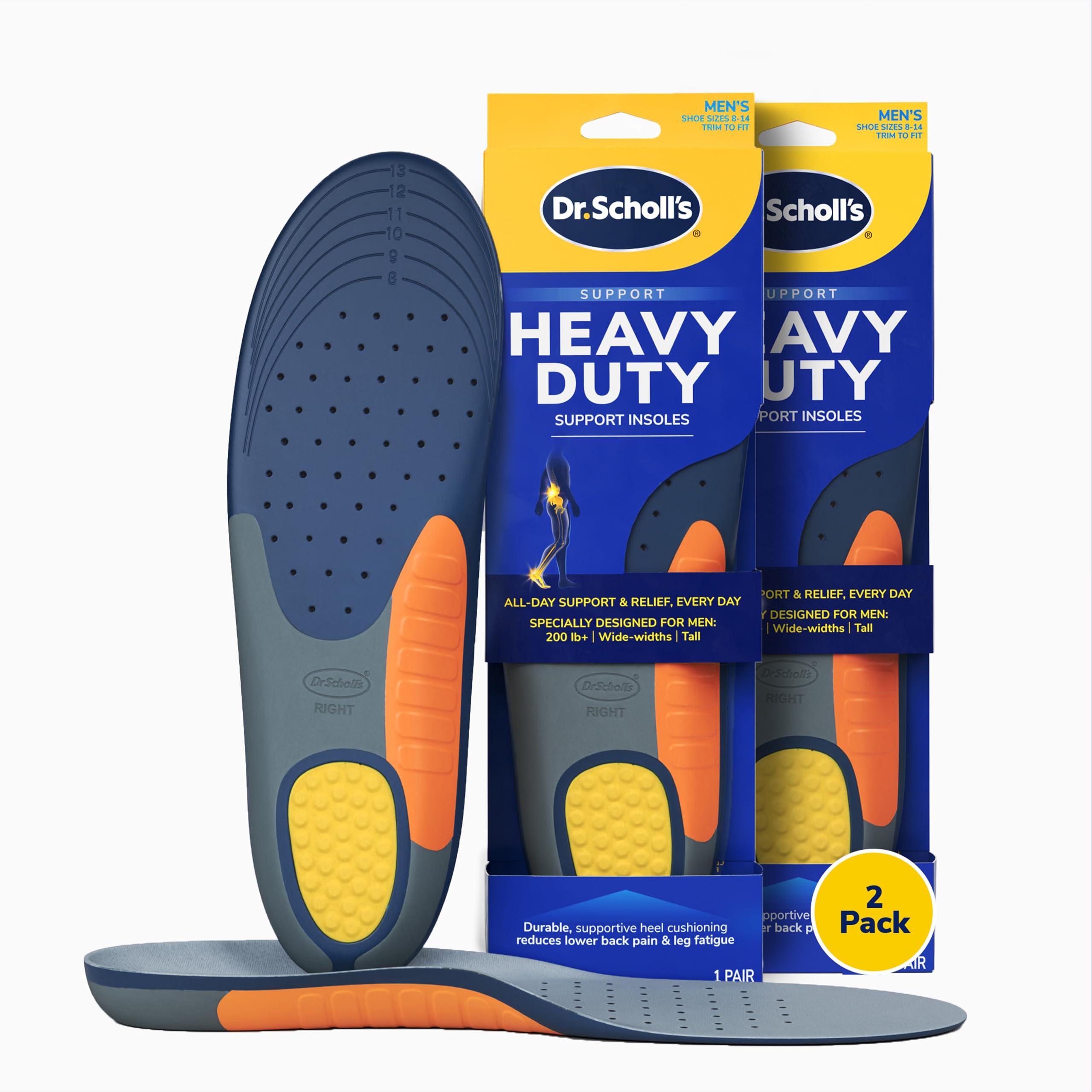
Dr. Scholl’s built this insole specifically for the 200-plus-pound crowd, and the difference is obvious the second you step down. The shock-absorbing foam doesn’t compress to a pancake halfway through the day — it maintains its rebound even under heavy vertical load, which directly translates to less lower back and knee fatigue after a full shift on hard floors.
The arch support sits high and firm, making it an excellent match for flat feet or fallen arches that need aggressive correction. Users report that the heel cup cradles securely without slipping during lateral cuts in gym sneakers or work boots. The trade-off is a thicker profile that may require loosening laces or sizing up a half-step in low-volume sneakers.
Trimming is the only real friction point — the foam is dense enough that standard scissors won’t cut cleanly, and reviewers recommend utility shears or a sharp blade. Once shaped, the insole stays put and the moisture-wicking top layer keeps feet dry even during 10-hour wear.
Why it’s great
- Exceptional shock absorption for heavy users
- Firm, high arch support reduces back and knee pain
- Deep heel cup stops side slippage in boots and sneakers
Good to know
- Very difficult to trim without heavy-duty shears
- Thick build may crowd low-profile sneakers
2. Superfeet Run Cushion Low Arch Insoles

Superfeet’s Run Cushion is engineered around the low-arch runner’s gait cycle. The patented Adaptive Comfort Technology uses a semi-rigid shell that flexes with your foot strike rather than fighting it, promoting efficient heel-to-toe turnover without the stiff plank feeling of traditional orthotics. This is the insole for runners who pronate but still want ground feel in their Brooks or ASICS.
The moisture-wicking top cover does more than just manage sweat — it reduces friction that leads to hot spots on long runs. Users report that hip flexor and outer hip pain, often caused by a falling arch, resolves within a week of swapping these in. The medium heel cup depth keeps the foot stable without digging into the Achilles tendon.
These run true to size for the length but are wide enough that most sneaker toe boxes accommodate them without trimming the width. The firmness level sits right at the sweet spot — supportive enough for plantar fasciitis sufferers but not so hard that it creates new pressure points on the metatarsal heads.
Why it’s great
- Adaptive shell promotes natural gait for low arches
- Eliminates hip and outer knee pain from overpronation
- Moisture-wick cover prevents blisters on long runs
Good to know
- Can cause sole burning sensation initially in some users
- Premium pricing is an investment for casual walkers
3. New Balance Casual Flex Orthotic Inserts

New Balance’s take on the casual orthotic is a full-length cushion insert designed for daily walking and light athletic use rather than high-impact running. The foam density is softer than the Superfeet or Dr. Scholl’s options, making it a great pick for someone whose main complaint is general foot fatigue rather than diagnosed overpronation or plantar fasciitis.
The sizing out of the box runs long and wide, so expect to trim using your old insole as a template. Once cut, the cushioning revives sneakers that have lost their spring — reviewers report that a pair of worn New Balance shoes felt like new after swapping inserts. The 6-month replacement cycle aligns with typical sneaker lifespan, keeping support consistent.
Where these fall short is arch support. They provide a gentle lift rather than a corrective structure, so flat-footed users or heavy walkers may find the foam bottoms out after a few months. This is an excellent mid-range option for neutral-arch feet that just need a refresh, not a rebuild.
Why it’s great
- Soft cushioning revives worn sneaker interiors
- Full-length design reduces pressure on metatarsals
- Easy to trim with household scissors
Good to know
- Arch support is mild, not corrective
- Foam compresses faster under 200+ lb users
4. Psveb Heavy Duty Support Pain Relief Orthotics

Psveb packs two layers of PORON cushioning into a single medium-arch insole, creating a dual-density feel that absorbs heel strike while keeping the forefoot responsive. The “Golden Triangle” design distributes support across three points — forefoot, arch, and heel — which stabilizes the foot during long standing periods without forcing a rigid correction.
The deep U-shaped heel cup is the standout feature here. It wraps the calcaneus tightly enough to eliminate heel slip in sneakers, which is rare in this tier. Users weighing over 230 pounds report that the insole holds its shape after months of daily wear in work boots and gym shoes, and that plantar fasciitis pain drops noticeably within the first week.
The fit runs large — the size 10-11 men’s version fits up to a 13 without trimming, but the width requires cutting for most sneaker toe boxes. The breathable top fabric resists odor buildup, though the foam does run warm on hot days. For the price, this is the strongest mid-range option for heavy-duty daily use.
Why it’s great
- Dual PORON layers provide lasting shock absorption
- Deep heel cup eliminates side slip in sneakers
- Holds shape under 230+ lb users
Good to know
- Runs long and wide — expect to trim
- Foam runs warm during high-temperature wear
5. Sof Sole Insoles Women’s Athlete Performance Full-Length Gel Insert

Sof Sole’s Athlete Performance insole focuses on cushioning and moisture management rather than aggressive arch correction, making it a strong entry-level option for neutral-arch runners or walkers. The gel heel pad absorbs impact at strike, and the full-length EVA base provides uniform support that doesn’t change the shoe’s natural fit.
The moisture-wicking top layer is noticeably effective — nurses and runners report that feet stay dry during 12-hour shifts, and the fabric doesn’t hold odor like basic foam. The flexible build makes it an easy swap between multiple pairs of sneakers without feeling stiff or brittle after repeated bends. The .78-inch thickness adds minimal volume, so it fits into low-profile sneakers like On-Cloud without pressure on the instep.
Where this insole falls short is long-term durability under heavy loads. The gel pad compresses faster than dual-density foam, and users who weigh over 200 pounds may need to replace them every 4-6 months. For the price, it’s an excellent budget-friendly refresh for runners who want shock absorption without a structural orthotic.
Why it’s great
- Gel heel pad absorbs impact without adding bulk
- Top fabric keeps feet dry during long shifts
- Low profile fits in tight sneaker toe boxes
Good to know
- Gel compresses quicker under heavier users
- Minimal arch support — not for overpronation
FAQ
Should I remove the original insole before adding an orthotic insert?
How often should I replace insoles for sneakers?
Can thick insoles fit in low-profile sneakers like On-Cloud or Nike Free?
Final Thoughts: The Verdict
For most users, the insoles for sneakers winner is the Dr. Scholl’s Heavy Duty Support Insole because it combines high-density shock absorption with aggressive arch support that actually holds up for heavy users across 10-hour days. If you have low arches and run regularly, grab the Superfeet Run Cushion Low Arch for its adaptive shell that works with your gait cycle. And for a budget-friendly refresh that keeps feet dry during long shifts, nothing beats the Sof Sole Athlete Performance Gel Insert.