Most “heating pads” only scorch your skin’s surface while your aching muscles stay cold. An infrared mat works differently — it sends therapeutic wavelengths past your skin into deep tissue, joints, and fascia where real healing happens. The difference isn’t marketing hype; it’s measurable physics involving specific nanometer wavelengths that your body absorbs for cellular repair.
I’m Emma — the founder and writer behind Baby Bangs. I’ve spent months analyzing the engineering behind these mats, from LED chip density and wavelength accuracy to material safety certifications that separate effective home therapy from expensive disappointments.
Whether you’re recovering from an injury, managing chronic pain, or simply upgrading your self-care routine, selecting the best infrared mat comes down to understanding power output, wavelength precision, and build quality that actually fits your life.
How To Choose The Best Infrared Mat
Infrared mats are durable health investments, not disposable accessories. The wrong choice leaves you with a surface that gets warm but never penetrates — essentially an overpriced blanket. These four criteria separate devices that deliver measurable relief from those that just glow red.
Wavelength Precision: Surface Glow or Deep Reach
Two wavelengths matter in this category: 660nm (visible red light) targets skin surface, collagen production, and superficial inflammation. 850nm (invisible near-infrared) passes through skin into muscles, joints, and deeper tissue. Quality mats combine both in dual-chip or tri-chip LED configurations. Avoid any mat that doesn’t clearly specify both wavelengths — single-wavelength units severely limit therapeutic range.
LED Density and Power Output
More LEDs aren’t automatically better — the spacing, chip quality, and total wattage matter. Look for at least 200 LEDs for a pad sized around 24″ x 12″. For full-body coverage (35″ x 27″ or larger), 400+ LEDs with a power draw of 60W or higher indicate sufficient irradiance for meaningful sessions under 30 minutes. Low-density mats require significantly longer exposure to compensate.
Material Safety and Skin Contact
You’ll be pressing this mat against your body for extended periods. Medical-grade TPU is odorless, hypoallergenic, and easy to clean — essential for post-workout recovery. Some mats use neoprene or polyester blends that trap heat and sweat, creating hygiene concerns over months of daily use. Jade and tourmaline stone mats (like the UTK) add weight for better contact but require more careful handling.
Timer, Modes, and Heat Management
Automatic shut-off is a safety baseline — 20-minute cycles prevent overheating and force consistent therapy habits. Pulse modes at 10Hz and 40Hz offer different stimulation: 10Hz supports relaxation and sleep, 40Hz targets deeper tissue activation. Digital temperature control with a range starting below 110°F ensures the mat stays comfortable for sensitive areas like the neck or abdomen.
Quick Comparison
On smaller screens, swipe sideways to see the full table.
| Model | Category | Best For | Key Spec | Amazon |
|---|---|---|---|---|
| BestQool Red Light Therapy Mat | Premium | Full-body recovery sessions | 400 LEDs, 63W, 38″ x 23″ | Amazon |
| UTK Far Infrared Heating Pad | Premium | Deep therapeutic heat with stones | 149°F max, Jade & Tourmaline | Amazon |
| 72″ Medical-Grade TPU Mat | Premium | Full-body wrap coverage | 1400 LEDs, 72″ x 33.3″ | Amazon |
| Cosytime 35″ x 17″ Mat | Mid-Range | High-density targeted relief | 1536 LEDs, 72W output | Amazon |
| Fyovuv 31.5″ x 24″ Pad | Mid-Range | Budget-friendly large coverage | 420 LEDs, remote control | Amazon |
| Pure Enrichment PureRelief Pro | Mid-Range | Deep far-infrared body wrap | 35″ x 27″, ceramic beads | Amazon |
| Comfytemp Red Light Pad | Entry-Level | Affordable introduction to therapy | 242 dual-chip LEDs | Amazon |
In‑Depth Reviews
1. BestQool Red Light Therapy Mat
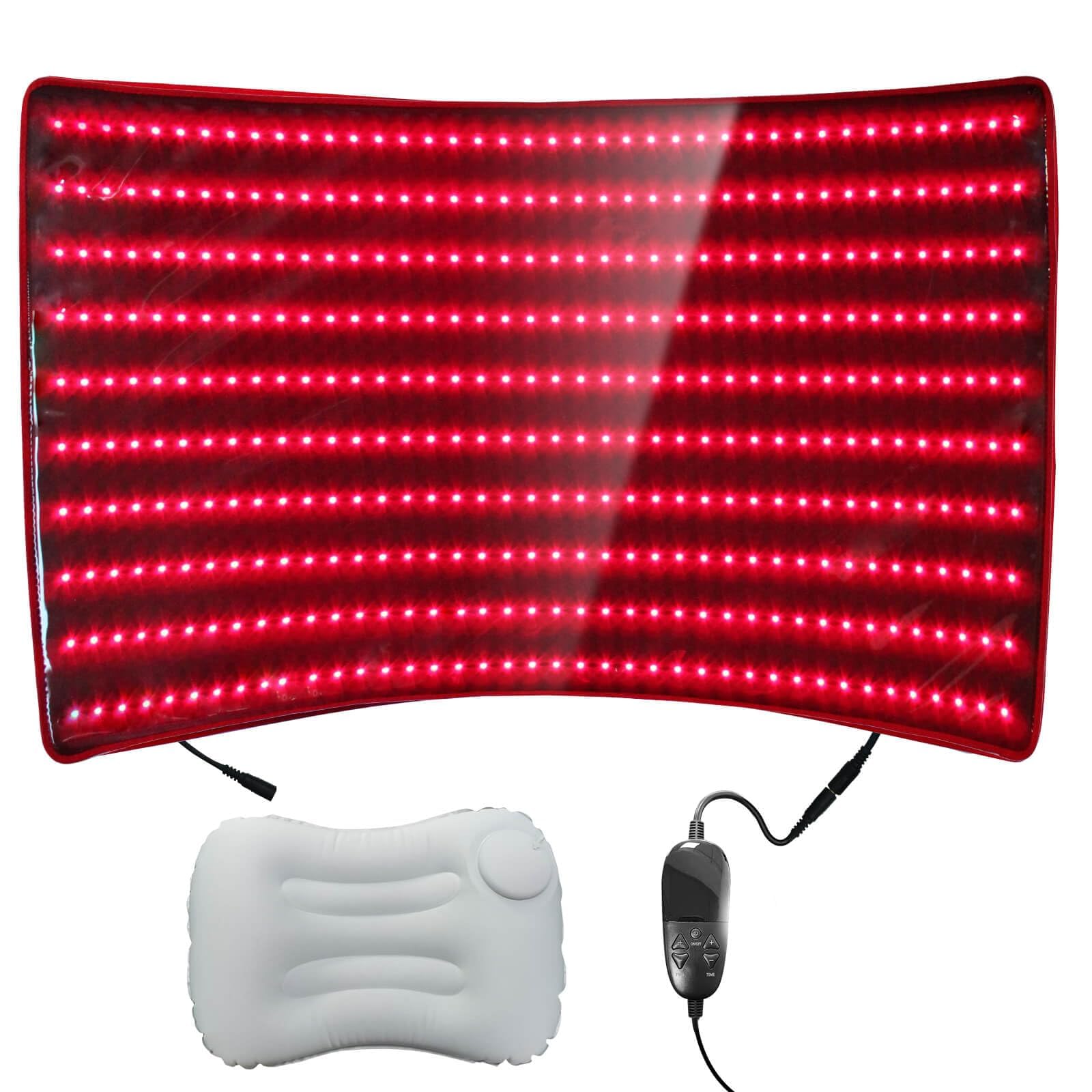
The BestQool hits the sweet spot between clinical-grade irradiance and home-use practicality. Its 400 triple-chip LEDs (660nm and 850nm) spread across a 38″ x 23″ surface deliver enough power to cover your entire back or legs in a single session, with a 63W draw that keeps sessions under 30 minutes effective. Users report noticeable pain relief from knee inflammation and hip stiffness within a week of consistent daily use, which tracks with the irradiance levels this power output supports.
The splice design deserves special attention — you can buy a second unit to create a full therapy bed, something no other mat in this class offers. The temperature stays between 104°F and 122°F even at maximum power, so you won’t burn sensitive skin during longer sessions. Pulse modes at 10Hz and 40Hz give you two distinct therapeutic options: one for relaxation before sleep, the other for deeper tissue activation after workouts.
Some users noted the side pouch for portable charging can disconnect the light if the battery pack shifts, but the unit performs flawlessly when plugged into a wall outlet. The mat rolls up for compact storage and includes a 30-day return window, making it a low-risk entry into serious home red light therapy.
Why it’s great
- Full-body coverage with high LED density that reduces session times
- Splice design allows expansion into a therapy bed configuration
- Safe operating temperature range prevents skin burns during extended use
Good to know
- Portable charger side pouch can cause intermittent connection loss
- No included strap for securing to awkward body positions
2. UTK Far Infrared Heating Pad
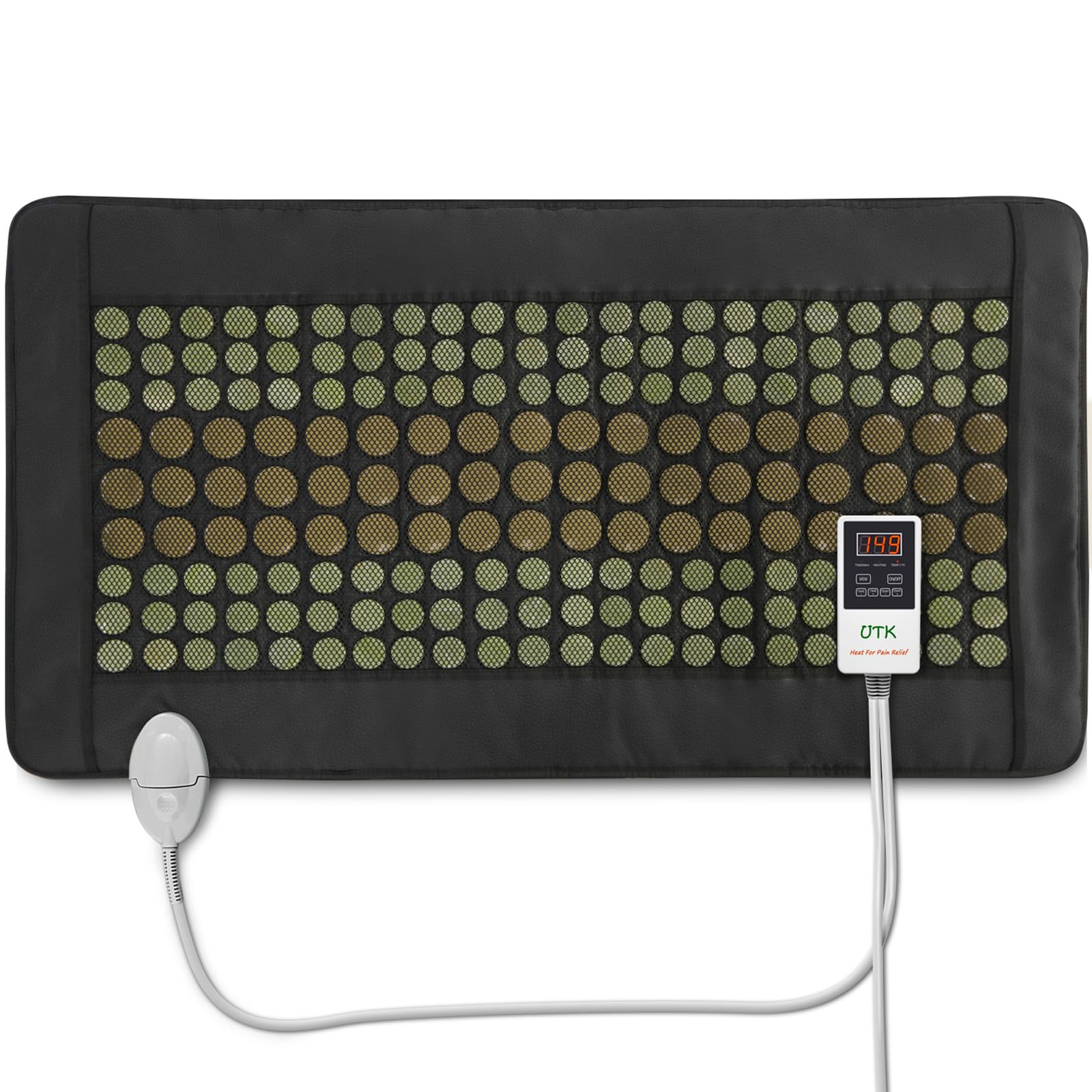
The UTK takes a completely different approach from LED mats — instead of light, it uses carbon fiber heating wires combined with 132 jade and 54 tourmaline stones to generate far-infrared heat that peaks at 149°F. That’s 10-15°F higher than most electric heating pads, and the stone construction creates a weighted, snug fit that presses the heat deep into muscle tissue. Users recovering from chronic back pain and arthritis consistently report that this mat penetrates far deeper than standard electric pads or lower-temperature infrared options.
The 21.6″ x 39.4″ size covers the entire back of even tall users, and the 11.6-foot power cord gives you freedom to use it on a bed, couch, or floor without being tethered to a wall outlet. The digital thermostat offers precise 1°F temperature adjustments from 103°F to 149°F and a timer that can run up to 240 minutes — far longer than the standard 20-90 minute limits on most mats. The auto-memory function remembers your last setting, which is convenient for daily use.
Some long-term users reported that the faux leather border can flake after several years of daily use, but the heating elements themselves remain functional for 4+ years with consistent use. The mat requires a 5-minute warm-up before reaching full temperature, so it’s not instant-on. At nearly 4.5 pounds from the stones, it’s heavier than LED mats, but that weight is what makes the contact so effective for deep tissue penetration.
Why it’s great
- True far-infrared heat with stone-weighted contact for deeper penetration
- Adjustable up to 149°F for intense therapeutic sessions
- Extra-long timer up to 240 minutes and temperature memory
Good to know
- Faux leather border may flake after years of daily folding
- Requires 5+ minute warm-up before reaching full temperature
3. 72″ Medical-Grade TPU Red Light Therapy Mat
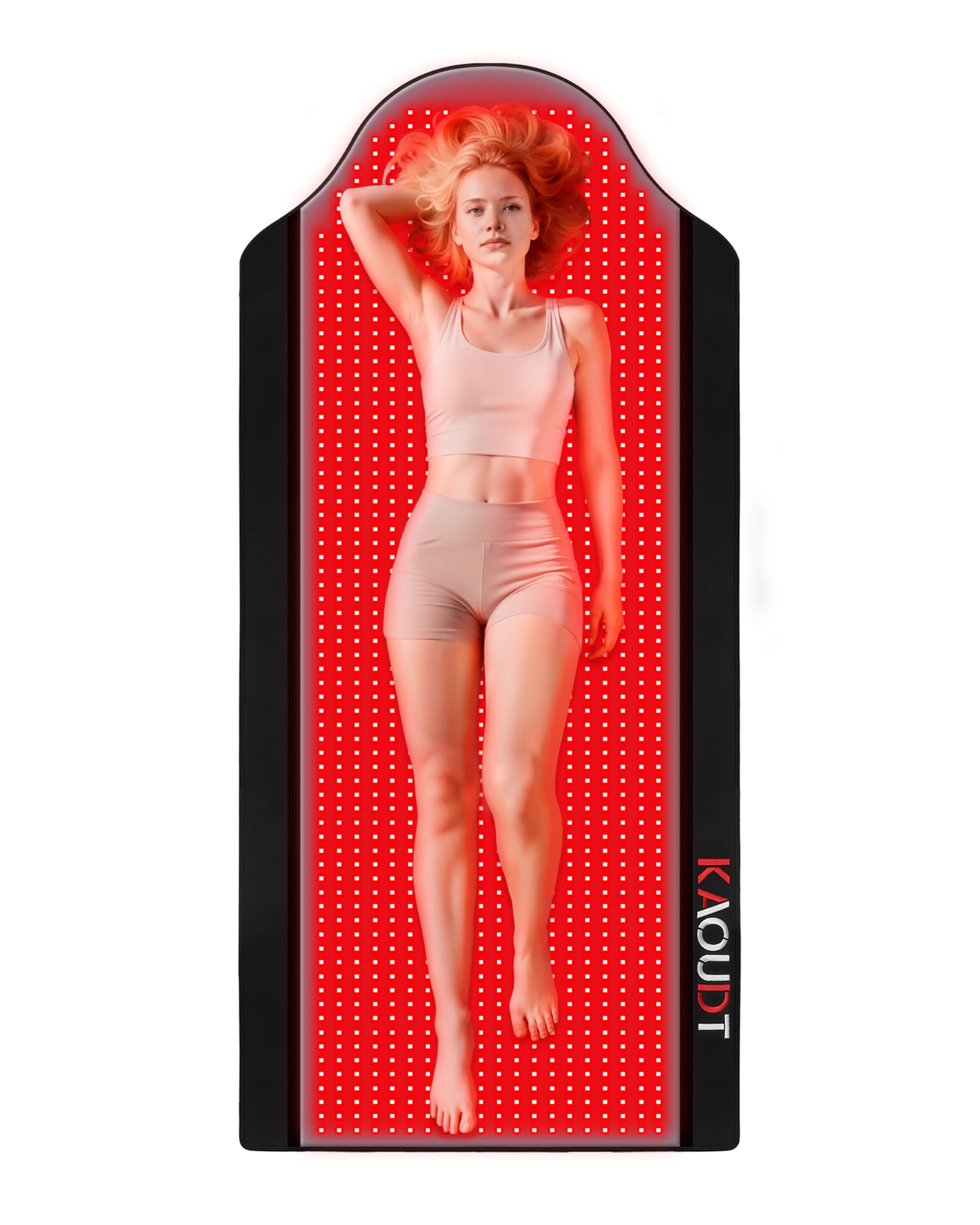
At 72 inches long and 33.3 inches wide, this mat is designed to cover your entire body from shoulders to calves in one session — no repositioning, no folding. The medical-grade TPU construction is a standout feature in this category: it’s hypoallergenic, odor-free (after an initial off-gassing period), and easy to wipe clean after sweaty recovery sessions. The 1400 tri-chip LEDs (660nm and 850nm) deliver significant power across this large surface, with three therapy modes including constant-on, 10Hz pulse, and 40Hz pulse.
The included smart controller lets you adjust 5 brightness levels (P1-P5), and the timer can be set from 10 to 90 minutes in 10-minute increments. Users wrapping the mat around their midsection for digestive support report feeling internal warmth that persists for hours after a 20-minute session — a sign of effective near-infrared penetration. The package also includes red light goggles, a storage pouch, and a comprehensive manual that helps you find the right settings for different body areas.
The mat is heavy at 8.6 pounds, which makes moving it around difficult for users with arthritic hands or limited mobility. Some buyers noted a strong tire-like smell during the first few uses that dissipates over several days with ventilation. The size also means you need a large flat surface to lay it out fully — it doesn’t work well in tight spaces or on small beds.
Why it’s great
- Full-body coverage eliminates need for multiple sessions on different areas
- Medical-grade TPU is hypoallergenic and easy to sanitize
- Three therapy modes with 5 brightness levels for customized treatment
Good to know
- Initial strong off-gassing odor that requires ventilation
- Heavy build (8.6 lbs) makes repositioning difficult for some users
4. Cosytime 35″ x 17″ Red Light Therapy Mat
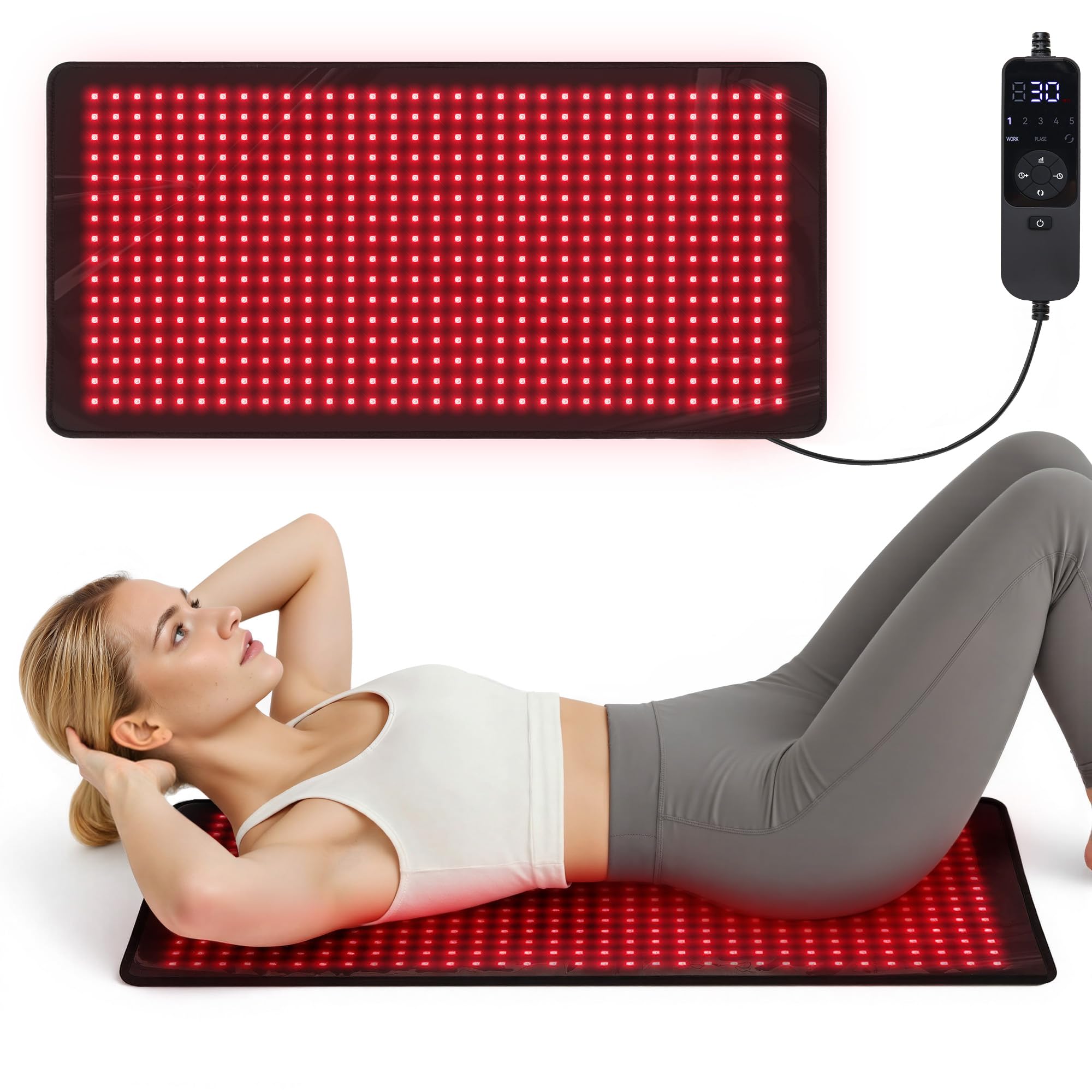
The Cosytime mat packs 1536 LEDs into a 35″ x 17″ surface, giving it the highest LED density in this lineup. The tri-chip configuration means 512 red chips at 660nm and 1024 near-infrared chips at 850nm, driven by a 72W power supply that delivers up to 100 mW/cm² at the highest intensity. For users who need powerful, concentrated therapy for specific problem areas — knees, hips, lower back — this density translates to measurable results in fewer sessions than lower-wattage alternatives.
The neoprene and TPU material construction balances flexibility with durability. Four operating modes let you cycle through red-only, near-infrared-only, 10Hz pulse, and all-on steady, while 5 intensity levels give fine-grained control over how much energy hits your skin. Post-surgical users reported significant improvement in scar healing after just 5 sessions following spinal fusion, and long-term users noted elimination of leg muscle pain that OTC medications failed to address.
Some customers noted a packaging typo on earlier batches, though the product specifications remain unchanged. The mat lacks a securing strap for keeping it in place on curved body areas like shoulders, which means you may need to lie on it or hold it in position for best contact. The 30-day return window and one-year warranty provide reasonable coverage for a mid-range investment.
Why it’s great
- Highest LED density (1536) in its size class for concentrated therapy
- 72W power output delivers measurable irradiance up to 100 mW/cm²
- Four operating modes including specialized pulse settings
Good to know
- No included strap for securing to curved body areas
- Earlier batches had packaging printing errors to verify
5. Fyovuv 31.5″ x 24″ Red Light Therapy Pad
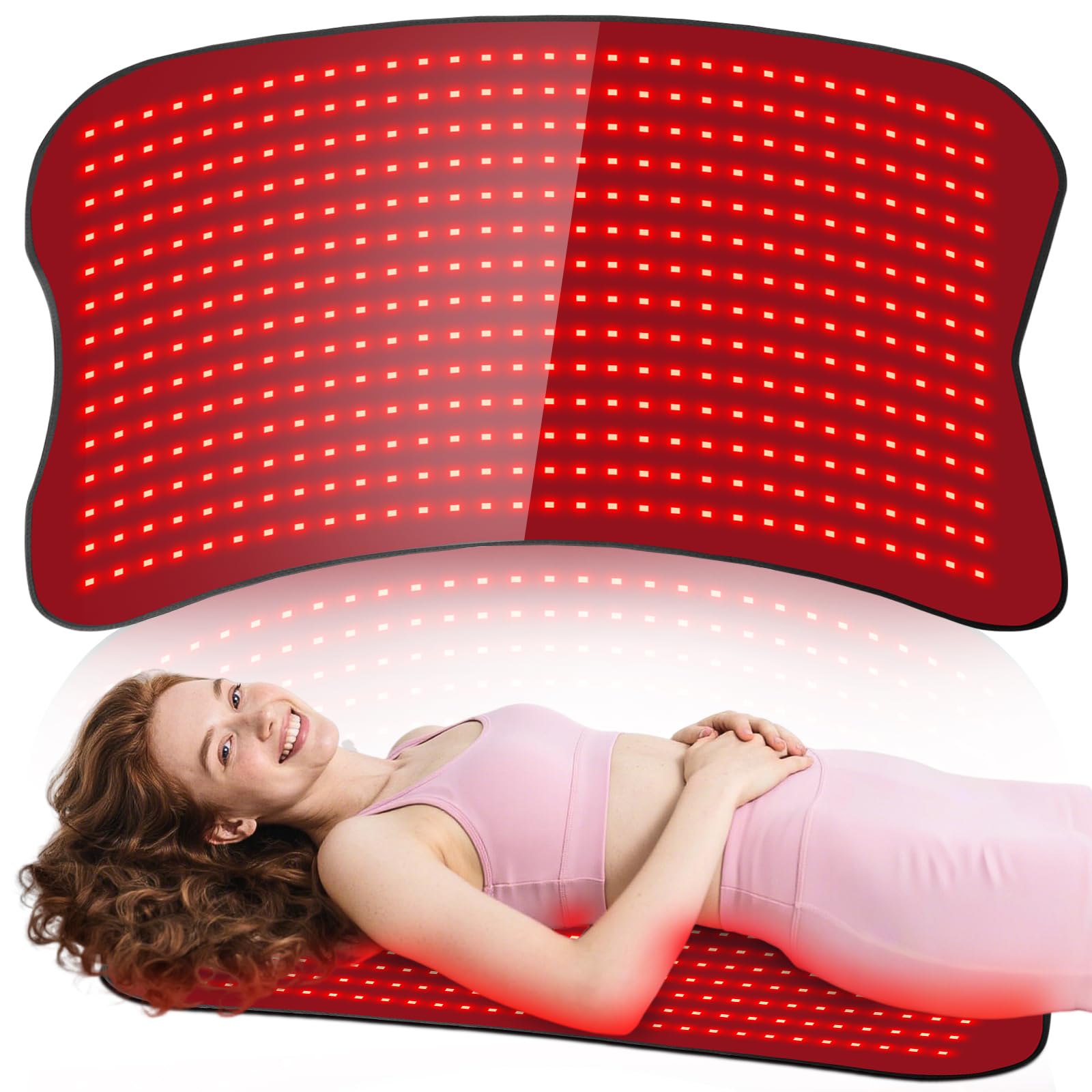
The Fyovuv pad delivers 420 tri-chip LEDs (660nm and 850nm) across a 31.5″ x 24″ surface at a mid-range cost that undercuts most comparable-sized competitors. The remote control is a genuine convenience — it manages power, pulse mode (10Hz or 40Hz), timer settings from 10 to 90 minutes, and 5 brightness levels without requiring you to reach behind your back to adjust settings mid-session. For sciatica and general muscle tension, users report consistent relief that justifies the investment.
The soft fabric exterior feels comfortable against skin, and the included elastic strap lets you secure the pad around your waist or over your shoulder for hands-free use during work or household activities. The pulse modes offer genuine therapeutic variety: 10Hz for calming before sleep, 40Hz for more active stimulation on sore muscles. The warm-up is nearly instant, with heat becoming noticeable within seconds of power-on.
Several reliability concerns appear in user feedback — some units stopped functioning after one to three months of daily use, with the timer and power interface being the most common failure point. The included strap is functional but not heavily padded, which can create pressure points during extended wear. Customer service responsiveness has been mixed based on available reports, so testing within the return window is advisable.
Why it’s great
- Large coverage area at a competitive mid-range price point
- Remote control for convenient settings adjustment during use
- Fast warm-up with dual pulse modes for varied therapy
Good to know
- Some units show power failure after 1-3 months of daily use
- Strap design lacks padding for extended wear comfort
6. Pure Enrichment PureRelief Pro Far Infrared Body Wrap

The PureRelief Pro uses a different technology than LED-based mats — ceramic beads embedded in the fabric absorb and re-emit far-infrared wavelengths, creating a gentler, more uniform heat distribution. The 35″ x 27″ oversized design wraps around your entire back, chest, or legs, and the micromink fabric feels noticeably softer against skin than the neoprene or polyester used in most LED mats. Users recovering from kidney stone pain or caring for disabled family members consistently mention the even, non-burning heat as a standout feature.
InstaHeat Technology brings the pad to temperature in about half the time of standard heating pads — useful when you need relief quickly. Four heat settings range from 110°F to 140°F, and the auto shut-off timer runs up to 2 hours, which is generous for this type of far-infrared wrap. The weighted feel of the ceramic beads helps the pad stay in place without constant adjustment, and the detachable LED controller makes the pad fully machine-washable.
Several users reported controller or cord failures after 4-6 months, with some struggling to get warranty support despite the advertised 5-year coverage. The soft fabric also attracts pet hair and lint, requiring frequent cleaning. The lowest setting (110°F) is still too warm for some users with sensitive skin or those using the pad on delicate areas like the neck.
Why it’s great
- Ultra-soft micromink fabric with ceramic beads for even heat distribution
- Fast heating with four temperature settings from 110°F to 140°F
- Oversized design covers entire back or multiple body areas at once
Good to know
- Cord and controller failures reported within the first year
- Lowest heat setting still too warm for some sensitive users
7. Comfytemp Red Light Therapy Pad

The Comfytemp pad is the most accessible entry point into infrared therapy, with 242 dual-chip LEDs (660nm and 850nm) packed into a 24″ x 12″ pad that’s small enough to drape over a single body area. The cotton and fleece exterior feels comfortable against bare skin, and the included 35-inch strap lets you secure it hands-free around your waist, shoulder, or thigh. Users recovering from tummy tuck surgery and those managing general back pain both report noticeable swelling reduction and muscle relaxation within the first week of use.
Operation is deliberately simple — one button cycles through 3 power levels, and the “M” button switches between 4 modes. There’s no remote or digital display, which makes it accessible for elderly users who don’t want complex controls. The auto shut-off activates every 20 minutes as a safety measure, though some users find this interrupts longer relaxation sessions. A 30-minute timer would better align with standard therapy protocols.
The plastic-like backing can feel less breathable against the skin during longer sessions, and the 20-minute auto shut-off cycles mean you need to reset it for full 20-minute therapy protocols. The lower LED count and lower power output compared to larger mats mean treatment sessions may need to be longer to achieve similar results. For someone testing whether red light therapy works for their specific condition, this represents a low-commitment starting point.
Why it’s great
- Lowest cost entry point for testing infrared therapy effectiveness
- Simple one-button operation suitable for elderly or tech-averse users
- Includes strap for hands-free positioning on various body areas
Good to know
- Auto shut-off at 20 minutes disrupts standard therapy protocols
- Lower LED density requires longer sessions for equivalent results
FAQ
How long should I use an infrared mat per session?
Can I use an infrared mat while sleeping?
Is red light therapy the same as far-infrared heat?
Why does my infrared mat smell when first used?
Can I use an infrared mat on my face?
Final Thoughts: The Verdict
For most users, the best infrared mat winner is the BestQool Red Light Therapy Mat because it balances high LED density, expandable dual-mat design, and safe operating temperatures at a cost that undercuts comparable premium options. If you want deeper far-infrared heat with the weighted therapeutic feel of natural stones, grab the UTK Far Infrared Heating Pad. And for total full-body coverage without repositioning, nothing beats the 72″ Medical-Grade TPU Mat with its massive 1400-LED surface and hypoallergenic materials.