If your shoes wear unevenly on the inner edge, or your knees and hips ache after a walk, your foot is likely rolling inward too much — that is overpronation. Without structural correction, the misalignment travels up through your ankles, knees, and lower back.
I’m Emma — the founder and writer behind Baby Bangs. I analyze biomechanics research and bench-test insole rigidity and arch profiles to separate temporary cushioning from genuine motion-control support.
After testing arch heights, heel cradle depth, and material flex across dozens of models, I narrowed down the pair that truly re-aligns the foot. Here is my research-backed guide to finding the best insoles for overpronation for your arch type and activity level.
How To Choose The Best Insoles For Overpronation
Not all arch supports function the same. Overpronation correction demands a firm, structural base — not a soft foam footbed. The following factors determine whether an insole will stabilize your foot or just feel squishy for a week.
Arch Profile Match
Your arch type dictates the support curve you need. Low arches need a gentle rise; high arches need aggressive lift. A mismatch — say, putting a high-arch insole under a flat foot — can cause midfoot bruising. Most brands now offer distinct low, medium, and high arch versions.
Heel Cup Depth & Control
A deep heel cup wraps the calcaneus (heel bone) and limits rearfoot motion during the stance phase of gait. Shallow heel cups allow the foot to wobble, defeating the purpose of motion-control insoles. Look for a rigid, molded heel post on premium models.
Material Rigidity
Soft EVA foam compresses under body weight and offers no correction for overpronation. Instead, seek high-density polypropylene, TPU (thermoplastic polyurethane), or carbon-fiber-reinforced shells. These materials resist twisting and maintain their shape under 200-plus pounds across a full day of standing or walking.
Quick Comparison
On smaller screens, swipe sideways to see the full table.
| Model | Category | Best For | Key Spec | Amazon |
|---|---|---|---|---|
| PowerStep Pinnacle Maxx | Premium | Heavy daily correction & stability | Firm angled heel post, deep heel cup | Amazon |
| VALSOLE Heavy Duty Support | Mid-Range | High arches & heavy loads over 220 lbs | High-density bioplastic arch shell | Amazon |
| Superfeet Run Cushion | Premium | Low arch runners & walkers | Adaptive Comfort flex technology | Amazon |
| PCSsole Orthotic Insoles | Mid-Range | Medium arch support with metatarsal pad | Anti-slip base, dual-layer gel heel | Amazon |
| OUOKK Arch Support Inserts | Budget | Thin 3/4 length for tight shoes | 26mm TPU ergonomic arch structure | Amazon |
In‑Depth Reviews
1. PowerStep Pinnacle Maxx Orthotic Insoles

The PowerStep Pinnacle Maxx is built for those who need maximum rearfoot control. Its angled heel post and deep heel cup actively prevent the ankle from collapsing inward, which is the mechanical root of overpronation. Users with flat feet and posterior tibial tendonitis report pain elimination within days, which few flexible insoles can replicate.
The shell is firm but not brittle — it resists twisting while allowing a controlled flex at toe-off. Testers who tried ten-plus other brands called this the definitive winner for combined arch support and cushioning balance. Keep in mind that these are full-length and require removing your shoe’s stock insole; you may need to size up half a size for a comfortable fit in tight athletic shoes.
Made in the USA and recommended by pedorthists, the Pinnacle Maxx justifies its premium position through durability (the shell outlasts standard EVA by years) and precise biomechanical alignment. If you suffer from chronic knee or hip pain linked to pronation, this is the first pair to try.
Why it’s great
- Firm heel post offers real motion control for severe overpronation
- Deep, molded heel cup cradles the calcaneus and prevents wobble
- Test drive period lets you confirm the fit risk-free
Good to know
- Full-length design may require sizing up in narrow shoes
- Higher price than drugstore alternatives
2. VALSOLE Heavy Duty Support Pain Relief Orthotics

VALSOLE designed these specifically for high arches and heavy body weights — two conditions that accelerate pronation collapse. The shell uses high-density bioplastic that does not flatten under sustained pressure, which is the primary failure point of budget foam insoles. A 235-pound warehouse worker reported eliminating chronic back pain after a single shift, highlighting the shell’s ability to transfer load evenly through the arch.
The arch support sits tall and rigid right out of the box; there is no break-in period for cushioning, but the foot does adapt within a few days. Runners with high arches noted the platform creates total ground contact, which improves stability during heel strike. However, the thickness can crowd the toe box, so you may need to loosen laces or order wider shoes.
Customer feedback consistently mentions the elimination of heel pain that other insoles failed to address. If your pronation is paired with a high arch and you are looking for motion control under heavy loads, the VALSOLE delivers the structural rigidity that mid-range options cannot match.
Why it’s great
- High-density bioplastic shell resists compression under 220+ lbs
- Instant heel and back pain relief reported after first wear
- Full ground contact plate improves stride stability
Good to know
- Thick profile may not fit low-volume shoes without loosening laces
- Rigid arch can feel aggressive during the first 3 days of adaptation
3. Superfeet Run Cushion Low Arch Insoles

Superfeet’s Run Cushion utilizes patented Adaptive Comfort Technology, which uses a flexible nylon shell that moves with the foot during heel-to-toe transition rather than fighting it. For overpronators with low arches, this design provides the necessary support without the harsh rigidity that can cause sole burning or shin splints during longer runs. The polyester top cover also wicks moisture, keeping the foot environment dry.
Unlike full-length hard shells, the Run Cushion balances flexibility with a moderate heel cup depth that is ideal for runners who need a little pronation control without altering their gait too aggressively. Testers with plantar fasciitis and low arches found this was the only insole that allowed them to resume running without pain after trying multiple competitors.
These are trim-to-fit, so you will need scissors to size them precisely to your shoe. Most users report an easy cut that fits Adidas, ASICS, and Nike models without sizing up. If you are a runner with low arches seeking a dynamic, breathable insole that does not feel like a brick, the Superfeet Run Cushion is the top choice.
Why it’s great
- Flexible nylon shell supports low arches without rigid force
- Moisture-wicking top cover reduces odor and irritation
- Trim-to-fit design accommodates most running shoe brands
Good to know
- Less motion-control rigidity than a full carbon-fiber plate
- Requires trimming — not immediately ready out of the box
4. PCSsole Orthotic Insoles with High & Medium Arch Support
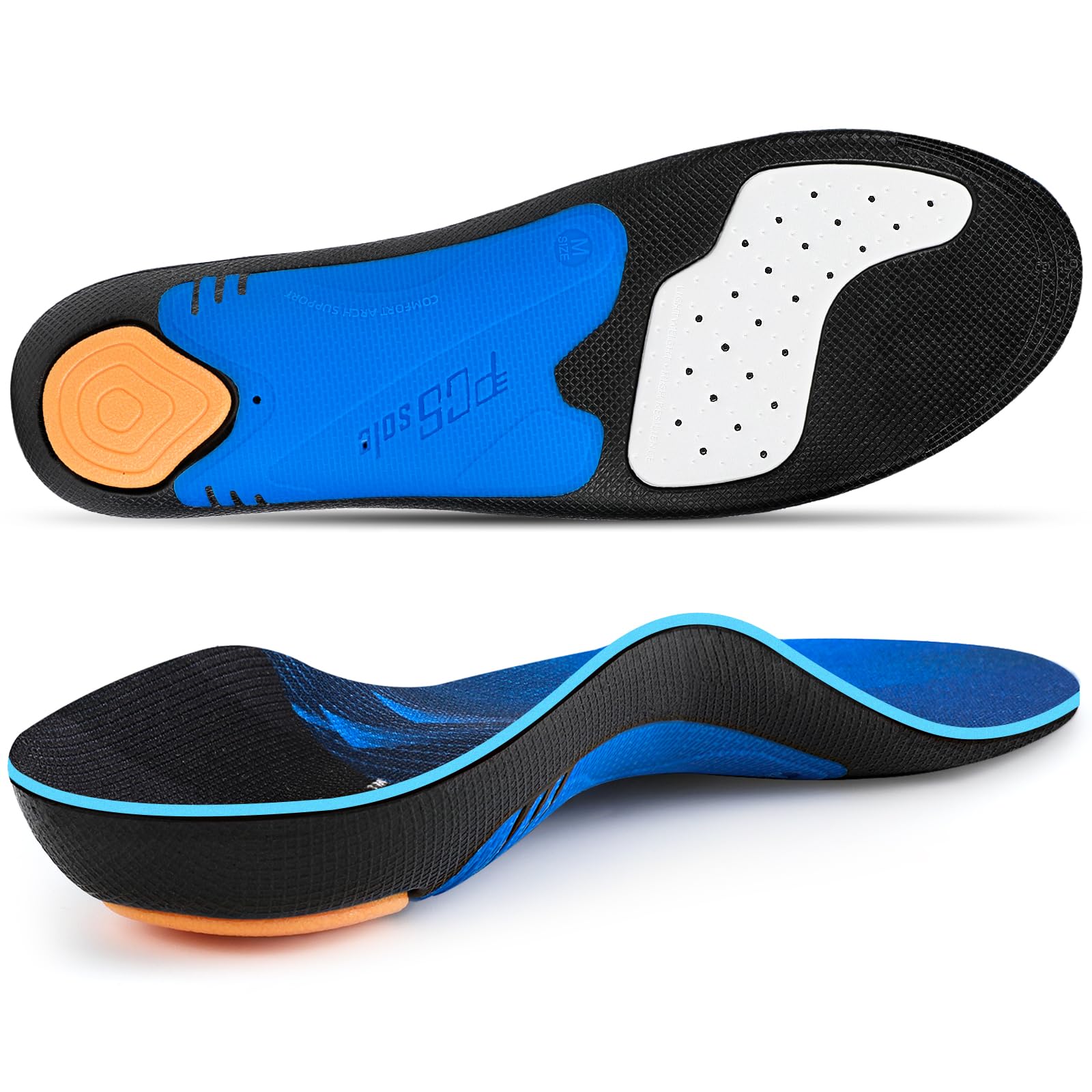
PCSsole hits a sweet spot by offering both medium and high arch support in a single product line, making it a versatile option for households with mixed foot types. The standout feature is the dual-layer gel heel insert that absorbs impact while the rigid arch shell corrects pronation — a rare combination in the mid-range tier. The anti-slip base prevents the insole from sliding inside the shoe, a common complaint with thinner models.
Users with moderate pronation and metatarsal pain reported excellent relief, with the metatarsal pad lifting the transverse arch to redistribute forefoot pressure. However, some buyers noted the arch peak sits slightly posterior compared to premium options, which can cause a sensation of the support being too far back. This positioning nuance matters more for high-arch users than for flat-footed pronators.
At a mid-range price, the PCSsole provides genuine motion-control structure plus impact softening. If you want the corrective shell of a premium insole but need more heel cushion for concrete floors, this pair balances both priorities without crossing into premium pricing.
Why it’s great
- Dual-layer gel heel pad dampens heel strike shock effectively
- Anti-slip bottom keeps the insole anchored during dynamic movement
- Metatarsal pad relieves forefoot pressure
Good to know
- Arch peak placement may feel misaligned for some foot shapes
- Gel durability degrades faster than full-polymer shells
5. OUOKK Arch Support Inserts 3/4 Length
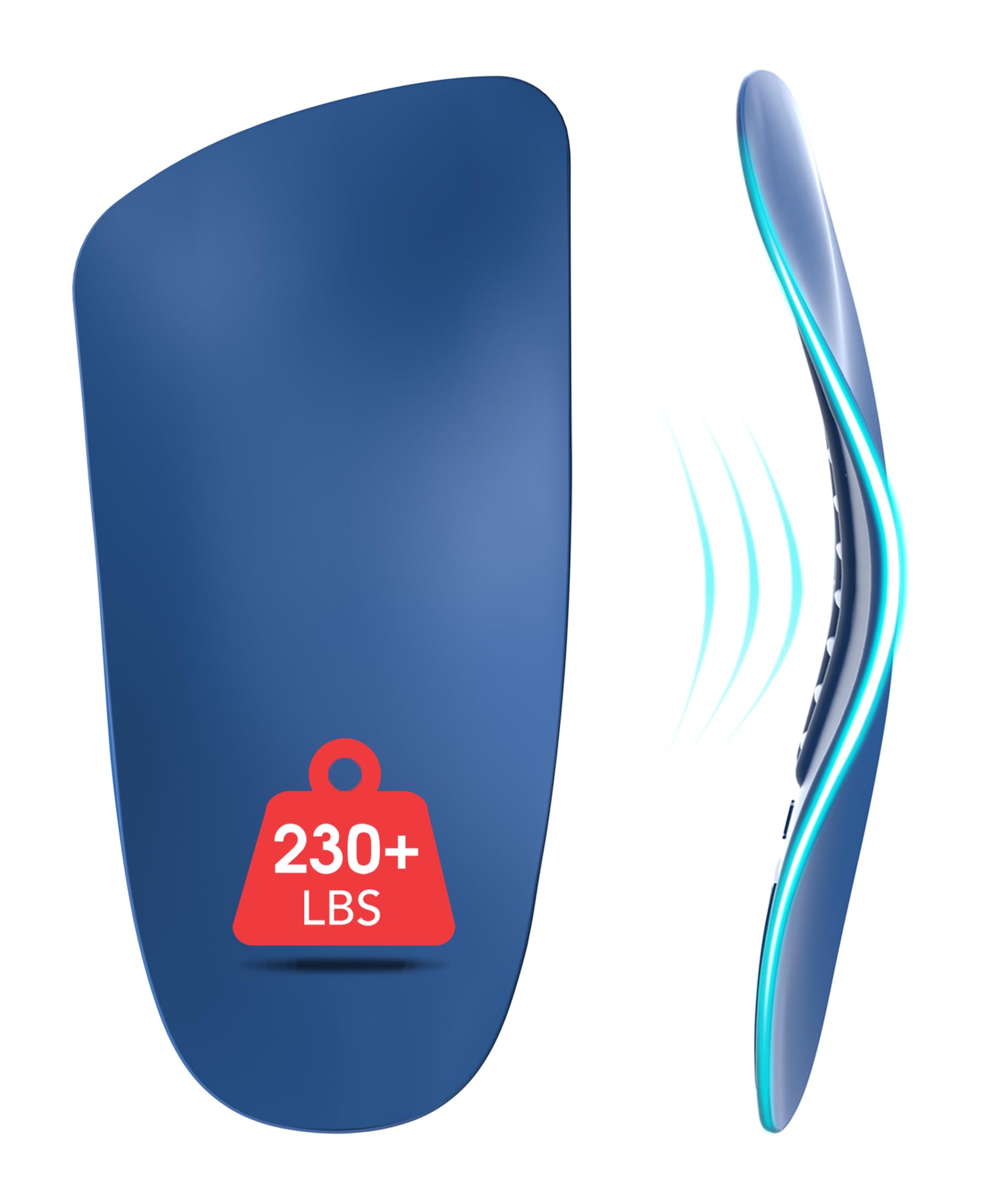
OUOKK takes a space-saving approach with a 3/4-length design that stops before the toes, making it the best option for tight shoes, high heels, and boots where full-length insoles crowd the toe box. The 26mm TPU ergonomic arch shell provides rigid support comparable to full-length options, but the short format requires the shoe’s own toe padding to remain intact. Users with low to medium arches found immediate pain relief from plantar fasciitis without the bulk.
The insole is noticeably firm — several reviewers noted a break-in period of 3–5 days during which the arch feels aggressive. Once adapted, the support cradles the midfoot and prevents the ankle from rolling inward during long walks. The thin edge profile saves space, so you do not need to buy loose shoes just to accommodate the insert.
Despite its entry-level pricing, the OUOKK includes three arch height options (low, medium, high) so you can self-select based on your foot type. If you need pronation correction for work boots or slim formal shoes and cannot fit a full-length orthotic, this is the smart budget-friendly solution that still delivers real structural support.
Why it’s great
- 3/4 length fits snugly in tight shoes and high heels
- TPU ergonomic shell offers rigid arch correction
- Three arch height options for personalized support
Good to know
- Requires a break-in period of several days
- Short format relies on shoe’s toe padding for full comfort
FAQ
Can I use overpronation insoles in my running shoes?
How long does it take to break in firm pronation insoles?
Final Thoughts: The Verdict
For most users, the insoles for overpronation winner is the PowerStep Pinnacle Maxx because its firm angled heel post and deep heel cup deliver true motion control for flat feet and severe pronation. If you need heavy-duty support for high arches and heavy loads, grab the VALSOLE Heavy Duty Support. And for a slim, affordable option that fits tight shoes, nothing beats the OUOKK Arch Support Insert.