Managing scoliosis-related back pain often leads people to explore spinal decompression at home, and inversion therapy is one of the more direct mechanical approaches available. The challenge is finding a table that supports a curved spine safely without forcing the body into an unnatural straight line.
I’m Emma — the founder and writer behind Baby Bangs. I’ve spent years analyzing therapeutic equipment specifications, focusing on how frame geometry, lumbar support design, and ankle locking mechanisms interact with spinal curvature during inversion.
After sorting through the available models on the market, I’ve built a focused guide to help you find the right inversion table for scoliosis based on backrest flexibility, weight capacity, and adjustability range.
How To Choose The Best Inversion Table For Scoliosis
Standard inversion tables are designed for symmetrical bodies. Scoliosis introduces a lateral curve that changes how weight distributes across the backrest and ankle cuffs. Without the right adjustments, inversion can actually strain the tighter side of the spine rather than decompress it. The key is to look for features that accommodate asymmetry rather than fight it.
Backrest Design and Flexibility
A rigid flat backrest forces the spine into a straight line, which can aggravate the rotated vertebrae common in scoliosis. Look for tables with a flexible or segmented backrest — the Teeter ComforTrak and FlexTech beds are engineered to allow slight lateral movement so the spine can settle into its natural curve during inversion. Avoid cheap flat foam pads that offer zero contour adaptation.
Ankle Lock System and Foot Platform
Inversion safety starts at the ankles. Scoliosis can create a leg length discrepancy or uneven weight distribution, so you need a locking mechanism that secures both feet independently without pinching. Wrap-around ankle cups with easy-dial platforms let you adjust each side individually. Avoid tables with fixed heel holders that rely on a single clamping force — these can dig into the higher-riding ankle or slip off the shorter one.
Angle Control and Gradual Inversion
Full 180-degree inversion is not the goal for most scoliosis users. The ability to lock the table at 20, 60, or 90 degrees is critical so you can control how much gravitational pull your curve experiences. Look for multi-position pin systems or adjustable tethers that let you set a hard stop. Tables that only offer a single locking pin at full inversion are unsuitable for therapeutic use with spinal curvature.
Quick Comparison
On smaller screens, swipe sideways to see the full table.
| Model | Category | Best For | Key Spec | Amazon |
|---|---|---|---|---|
| TEETER EP-560 | Premium | Flexible backrest decompression | ComforTrak backrest, FDA-registered | Amazon |
| Teeter FitSpine X2 | Premium | Full-body stretch with 8-point suspension | FlexTech Bed, 8-point floating suspension | Amazon |
| HARISON HR-407 | Premium | Heavy-duty 350 lb capacity | 3D memory foam backrest, steel frame | Amazon |
| Innova ITM6000 | Mid-Range | Heat and massage therapy | Dual heat pad for neck and back | Amazon |
| Body Vision IT 9695-G | Mid-Range | Heavy-duty therapeutic use | 300 lb capacity, reinforced steel frame | Amazon |
| Innova Power Tower | Mid-Range | Versatile strength + inversion combo | Pull-up bar and dip station integrated | Amazon |
| ITM5850 Advanced Heat | Mid-Range | Heat and massage targeted relief | Back and neck heat with massage | Amazon |
| YOLEO Foldable | Budget | Compact storage and portability | Foldable frame, removable lumbar pad | Amazon |
| Stamina InLine Traction | Budget | Portable lower body stretching | Compact design, traction control system | Amazon |
In‑Depth Reviews
1. TEETER EP-560 Inversion Table

The TEETER EP-560 is the only table on this list registered with the FDA as a 510(k) medical device for back pain, muscle tension, and spinal curvature due to tight muscles — a credential that matters when you are managing a diagnosed condition like scoliosis. The ComforTrak backrest is not a flat slab; it flexes to allow your spine to settle into its natural curve during inversion, which is the single most important mechanical feature for asymmetrical backs. The wrap-around ankle cups and 2-position dial foot platform let you adjust each side individually, accommodating any subtle leg length differences that often accompany scoliosis.
Eight integrated acupressure nodes at varied heights provide trigger-point release along the paraspinal muscles, which tend to be tighter on the concave side of the curve. The Lumbar Bridge attachment with adjustable arch lets you focus traction specifically on the lower back region, where scoliotic curves often create the most compression. The angle tether lets you preset your maximum inversion angle — critical for gradual decompression without forcing your curve into full gravity too quickly.
The frame uses heat-treated steel with UL safety certification, and the design folds for storage without disassembly. The free Teeter Move app provides guided inversion programs that help you progress in controlled increments rather than guessing angles. The 5-year warranty backs the durability, and the 300 lb capacity with a height range of 4 ft 8 in to 6 ft 6 in covers most adult body types.
Why it’s great
- Flexible backrest allows spinal curve accommodation
- FDA-registered for spinal curvature indications
- Integrated acupressure nodes for targeted muscle release
- Folds flat for storage with no tools needed
Good to know
- Lumbar Bridge accessory adds cost for lower back focus
- 65 lb unit weight requires two-person setup out of box
2. Teeter FitSpine X2 Inversion Table
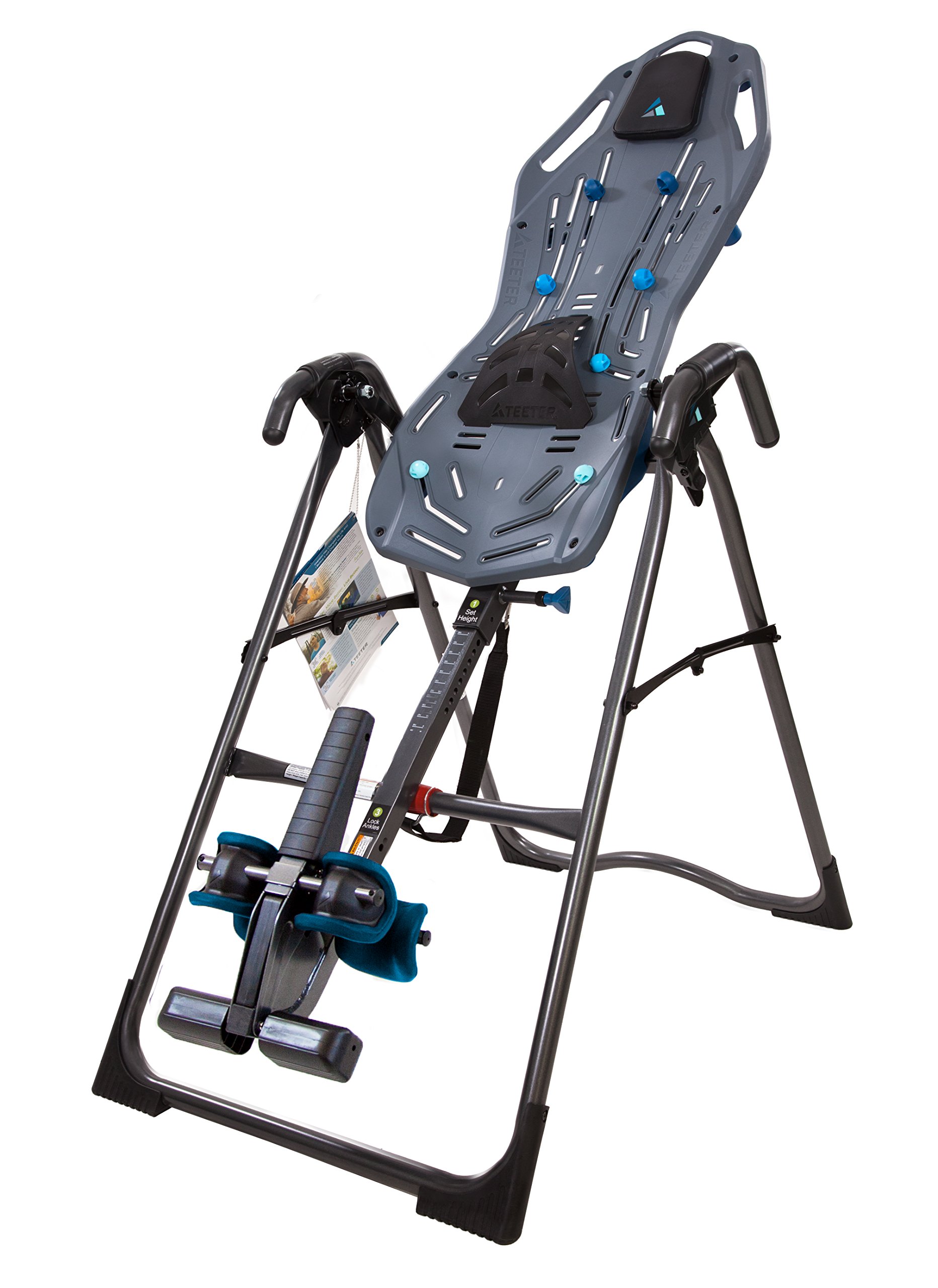
The FitSpine X2 represents the top end of Teeter’s engineering with its FlexTech Bed and 8-point floating suspension system. Unlike standard rigid backrests, the FlexTech Bed is designed with a segmented surface that moves with you as you invert, reducing pressure points along the spine — a significant advantage for scoliosis users whose curve creates uneven load distribution. The 8-point suspension lets the bed flex in multiple directions, which helps the vertebrae find a more neutral position rather than being forced against a flat plane.
The extended ankle lock handle makes securing your feet easier when you are already on the table, and the patented wrap-around ankle cups distribute pressure evenly around the joint rather than pinching at the heel. The integrated acupressure nodes and Lumbar Bridge are included, so you do not need to buy accessories separately. Grip-and-Stretch Handholds built into the bed and frame add stretching options that target the thoracic region where scoliotic curves often rotate the rib cage.
This particular listing is a renewed unit, meaning it may show superficial cosmetic wear but the structural integrity is inspected. The 5-year manufacturer warranty still applies, and the 66 lb weight ensures stability during inversion. Height range accommodates users from 4 ft 8 in to 6 ft 6 in with a 300 lb capacity. The precision rotation control lets you lock out at any angle using the tether system.
Why it’s great
- FlexTech bed adapts to spinal curvature during inversion
- 8-point suspension reduces rigid pressure points
- Acupressure nodes and Lumbar Bridge included
- Extended ankle lock for easier self-securing
Good to know
- Renewed model may have minor cosmetic blemishes
- Higher price point than the EP-560
3. HARISON Inversion Table HR-407
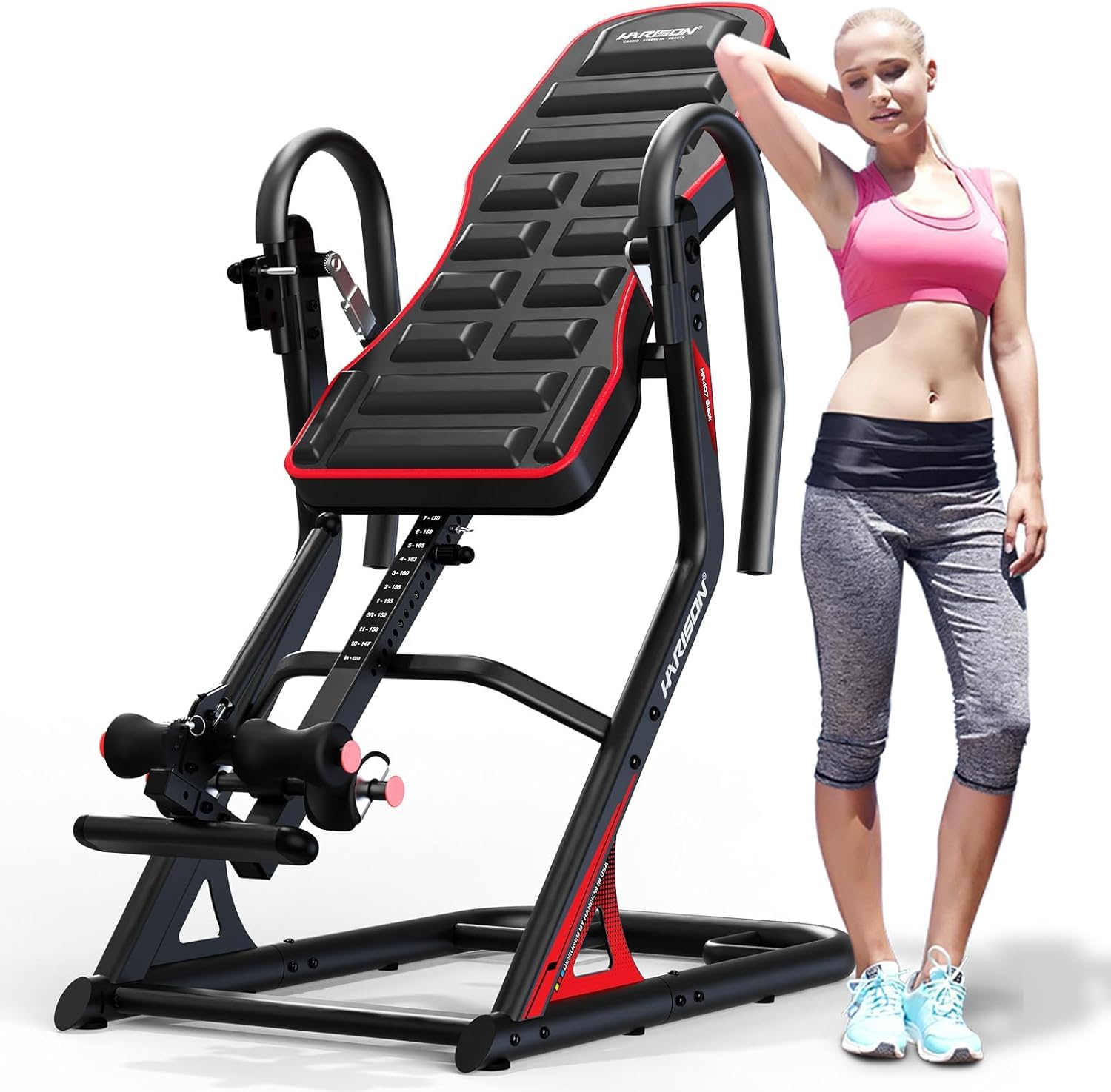
The HARISON HR-407 stands out with a 350 lb weight capacity and a 3D memory foam backrest that contours to your spine’s shape rather than fighting it. For scoliosis users, the memory foam is a practical feature — it compresses more on the convex side of the curve and less on the concave side, creating a custom fit that a standard flat foam pad cannot provide. The integrated steel frame with true balance design gives you the smoothest rotation, which is important when your body weight is not distributed symmetrically.
Safety features include a belt, non-slip nuts and mat, protective pedal cover, and sponge foot cover — four layers of security that matter when your ankle lock needs to remain stable throughout the inversion. The 4-position side pin lets you select 20, 90, 130, or 180 degrees, so you can progress incrementally rather than jumping into full inversion. The unit ships 80% pre-assembled and can be set up in under 20 minutes using the included video guide.
The LED display is a unique addition among inversion tables, giving you a visual readout during your session. The memory foam backrest is thicker than most competitors, measuring several inches of padding that reduces the hard surface feel against the vertebrae. HARISON offers a 30-day trial and 1-year warranty with free replacement of spare parts during that period.
Why it’s great
- 3D memory foam backrest molds to curved spine shape
- 350 lb capacity for larger body types
- Quadruple safety system including belt and ankle holders
- 80% pre-assembled for quick setup
Good to know
- 55 x 28 x 55 inch footprint requires dedicated floor space
- Memory foam may compress faster than dense foam over years
4. Innova ITM6000 Advanced Heat and Massage

The Innova ITM6000 brings dual heat and massage pads to the inversion experience — one pad for the neck area and one for the back. For scoliosis, the heat component is particularly useful because the concave side of the curve tends to have tighter, shorter muscles that respond well to heat therapy before decompression. Massage vibration helps relax the paraspinal muscles along the curve, making inversion less jarring on the unevenly loaded spine.
The True Balance System is designed to make inversion feel smooth even if your center of gravity is shifted by your spinal curve. The 6-position adjustable pin system allows you to lock at different angles, from a slight tilt to full inversion. The patented VCC-Tech U-shape ankle holders are designed to prevent pinching, which is critical when your ankle alignment may be slightly off due to pelvic tilt associated with scoliosis. The longer ankle holding knob makes release easier when you are upside down.
Accommodates users from 4 ft 10 in to 6 ft 6 in with a 300 lb weight capacity. The polyurethane material on the backrest is more durable than standard foam and resists absorbing sweat over repeated use. Assembly is required, but the included hardware and instructions are straightforward.
Why it’s great
- Dual heat pads target neck and back tightness
- VCC-Tech ankle holders prevent pinching
- 6-position pin system for gradual angle progression
- True Balance System smooths rotation
Good to know
- Heat pads require power outlet proximity
- 31.3 kg package weight is heavy for solo setup
5. Body Vision IT 9695-G Deluxe Heavy Duty

The Body Vision IT 9695-G is built around a reinforced steel frame that provides a stable base for users up to 300 lb. The extra width of the bed is a practical consideration for scoliosis users — wider beds allow the shoulders and hips to settle into a more natural position rather than being forced into a narrow channel that can compress the curve. The ankle locking system uses a quick-release mechanism that keeps both feet secured evenly.
The backrest padding is thicker than entry-level models, which reduces the hard surface pressure against the spinous processes during inversion. The adjustable angle system lets you choose from multiple positions, and the tether strap provides an additional safety stop at your desired angle. The foam roller on the main frame acts as a lumbar support that can be repositioned to match the apex of your lower back curve.
The unit folds for storage with a simple pin release, though it remains fairly large even when folded. Assembly takes about 45 minutes with two people due to the steel frame weight. The overall build quality feels more industrial than consumer-grade, which suits users who plan to use it daily rather than occasionally.
Why it’s great
- Wider bed accommodates asymmetrical shoulder/hip positioning
- Reinforced steel frame for daily heavy use
- Adjustable foam roller lumbar support
- Quick-release ankle lock for even foot pressure
Good to know
- Folded size still requires substantial storage space
- Assembly takes two people due to frame weight
6. Innova Inversion Table with Power Tower

The Innova Power Tower combines an inversion table with a pull-up bar and dip station, creating a multi-use unit that can serve both decompression and strengthening. For scoliosis, strengthening the back muscles on the convex side of the curve is part of a comprehensive management strategy, so having pull-up and dip capability in the same frame saves floor space. The inversion bed itself is standard width with a flat foam pad, adequate for mild curves but less accommodating for more pronounced scoliosis.
The ankle lock uses a contoured foam roller that clamps both feet together, which works fine for symmetrical bodies but may feel uneven if one leg is slightly longer than the other due to pelvic tilt. The angle adjustment is pin-based with multiple positions, allowing you to start at a low angle and progress. The pull-up bar height is adjustable, accommodating users of different heights without compromising the dip station function.
The steel frame is sturdy enough to support the pull-up motion without wobbling, and the inversion table portion can be folded up when not in use so you can still access the dip station. Assembly is more complex than a standalone table due to the additional components, and the overall footprint is larger than dedicated inversion tables. Weight capacity is 300 lb for the inversion function.
Why it’s great
- Combines inversion with strength training in one unit
- Adjustable pull-up bar height
- Space-saving design for home gyms
- Multi-position pin for gradual inversion angles
Good to know
- Flat foam pad lacks contour for curved spines
- Ankle clamp may feel uneven for leg length differences
7. ITM5850 Advanced Heat and Massage Inversion Table

The ITM5850 is another heat-and-massage equipped model, similar to the ITM6000 but at a more accessible price point. The massage pad targets the back and neck regions with vibration, helping to loosen the tight paraspinal muscles that typically run along the concave side of a scoliotic curve. The heat function can be used before inversion to increase blood flow to the tighter muscle groups, making the stretch more effective.
The ankle holders use a rotating mechanism that clamps both feet with a single adjustment lever. While functional, this system does not offer independent adjustment for each foot, which can be a limitation if your scoliosis is accompanied by a functional leg length discrepancy. The angle tether is adjustable, allowing you to set a maximum inversion angle to avoid going too deep too quickly. The backrest foam is medium density with a smooth vinyl cover that is easy to wipe down.
The frame is built with steel tubing that feels solid during inversion, though the overall finish is less refined than premium models. Assembly is moderate, with clear instructions for mounting the heat pads and ankle cradle. The unit is not foldable, so it requires permanent floor space in your workout area.
Why it’s great
- Heat and massage help relax tight curve-side muscles
- Adjustable angle tether for controlled progression
- Easy-clean vinyl backrest cover
- More affordable heat-and-massage option
Good to know
- Single ankle clamp lacks independent foot adjustment
- Non-foldable design requires permanent floor space
8. YOLEO Inversion Table Foldable
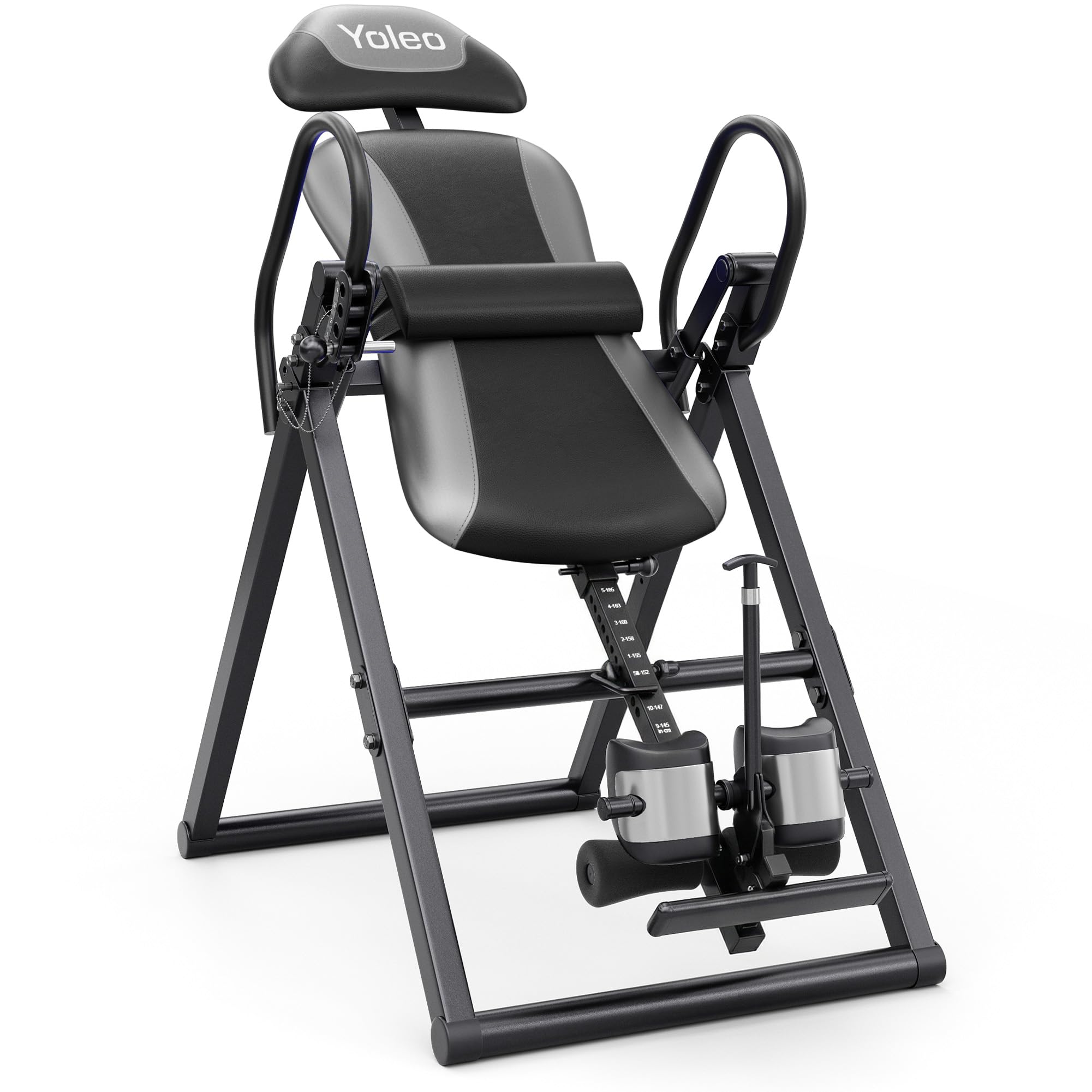
The YOLEO Foldable Inversion Table prioritizes compact storage and easy assembly, making it a practical choice for users with limited floor space. The folding mechanism lets the table collapse down without tools, which is convenient for storing under a bed or in a closet. The removable lumbar pad is a nice touch for scoliosis users because you can position it directly under the apex of your lower curve for extra support during inversion.
The reversible ankle holders allow you to adjust the angle of the foot platform, which can help if your scoliosis causes one hip to sit higher than the other — you can tilt the platform slightly to find a more natural foot position. The backrest foam is standard density with a padded cover, adequate for mild curves but lacking the contour adaptation of memory foam models. The height adjustment range covers most users, and the assembly process is designed to be completed by one person in under 30 minutes.
The frame is lighter than premium steel models, which makes it easier to move but also means it may feel less planted during aggressive inversion sessions. The angle lock uses a pin system with preset positions rather than a continuous tether, which limits fine-tuning but keeps the mechanism simple and reliable. Weight capacity is lower than heavy-duty models, so larger users should verify compatibility.
Why it’s great
- Folds flat for easy storage in small spaces
- Removable lumbar pad for curve-specific support
- Reversible ankle holders for foot angle adjustment
- Single-person assembly in under 30 minutes
Good to know
- Lighter frame feels less stable than heavier duty models
- Preset pin angles limit fine-tuning compared to tethers
9. Stamina InLine Traction Control System

The Stamina InLine Traction Control System is not a traditional full-body inversion table — it is a portable lower body stretcher that uses a different mechanical approach to spinal decompression. Rather than hanging upside down, you lie on your back with your legs elevated into the traction system, which gently pulls the lower spine into elongation. This design is significantly less intimidating for scoliosis beginners who may be nervous about full inversion, and it places no stress on the ankles or feet.
For scoliosis, the traction control system allows you to adjust the pulling angle to target specific segments of the lumbar curve. The compact design means it can be used on a bed or floor, and it folds down to a very small footprint for storage. The portable nature makes it easy to take to physical therapy sessions or use in multiple rooms. The traction mechanism uses a smooth ratcheting system that lets you control the intensity precisely.
The limitation is that this unit primarily targets the lower back and does not provide the full spinal decompression that a vertical inversion table offers. Users with high thoracic curves or cervical involvement may find the traction insufficient. The weight capacity is lower than full tables, and the plastic components feel less durable than the steel frames of dedicated inversion tables. It works best as a supplementary tool or an entry point for those unsure about inversion therapy.
Why it’s great
- No ankle stress or fear of full inversion
- Adjustable traction angle targets lumbar curve segments
- Ultra-portable and compact for easy storage
- Can be used on bed or floor for convenience
Good to know
- Limited to lower spine traction only
- Less durable plastic components compared to steel frames
FAQ
Is inversion therapy safe for scoliosis?
How long should I use an inversion table for scoliosis per session?
Will inversion straighten my scoliosis curve?
Final Thoughts: The Verdict
For most users, the inversion table for scoliosis winner is the TEETER EP-560 because its ComforTrak backrest flexes to accommodate spinal curvature while the FDA-registered medical device status gives you confidence in its therapeutic claims. If you want heat and massage therapy to relax tight curve-side muscles, grab the Innova ITM6000. And for heavy-duty use with a memory foam backrest that molds to your unique curve, nothing beats the HARISON HR-407.