That buckling sensation when you pivot on the court or step off a curb is more than unnerving — it’s a signal that your knee needs lateral reinforcement. A stability brace tackles the specific problem of medial and lateral ligament slop, using rigid side supports to prevent the joint from collapsing sideways while still allowing full flexion and extension.
I’m Emma — the founder and writer behind Baby Bangs. I’ve spent years analyzing support gear, poring over peer-reviewed orthopaedic data on bracing mechanics, and comparing stiffness ratings, hinge articulation, and compression gradient across dozens of models to separate effective stabilizers from flimsy sleeves.
Whether you are recovering from a grade II MCL sprain or managing chronic instability from an old meniscal tear, the right brace changes how confidently you move. This breakdown of the best knee stability brace options delivers the specific hinge design and strap geometry that actually stop unwanted shear forces.
How To Choose The Best Knee Stability Brace
Selecting a knee stability brace isn’t about picking the stiffest option. You need a balance of medial/lateral control, comfortable compression that doesn’t cut off circulation, and a hinge system that tracks with your natural knee rotation. Here are the three factors that separate a therapeutic brace from a generic sleeve.
Hinge Articulation: Polycentric vs. Single-Axis
Your knee doesn’t bend on a fixed pin — it has a subtle rotational glide called the screw-home mechanism. A polycentric hinge mimics this motion with two pivot points, reducing skin pinching and improving gait efficiency. Single-axis hinges are simpler and cheaper, but they force your knee into a mechanical arc that can cause discomfort over longer wear periods.
Stabilizer Rigidity and Placement
Look for bilateral metal or high-density polymer stabilizers — aluminum alloy or carbon fiber composite offers the best strength-to-weight ratio. The stays should be removable for washing and adjustable in positioning. Stays that are too short (under 10 inches) won’t provide adequate lever arm length to control femur-on-tibia translation during lateral cuts.
Compression and Breathability for Sustained Wear
A stability brace relies on a compressive sleeve to hold the hinges flush against the leg. Three-dimensional spacer fabric with open-cell structure wicks moisture and prevents heat buildup, especially important if you plan to wear the brace for four hours or more. A brace that slips via silicone grippers or insufficient knit tension defeats the stabilizers entirely.
Quick Comparison
On smaller screens, swipe sideways to see the full table.
| Model | Category | Best For | Key Spec | Amazon |
|---|---|---|---|---|
| Bauerfeind GenuTrain | Premium | Medical-grade daily stability | Integrated Omega+ pad | Amazon |
| McDavid 429RX | Premium | Sport performance | Bilateral geared polycentric hinges | Amazon |
| Shock Doctor Maximum Support | Mid-Range | High-impact sports | Adjustable dual aluminum hinges | Amazon |
| T TIMTAKBO 16in Tall Brace | Mid-Range | All-day rehab wear | 1/8-inch thick dual metal hinges | Amazon |
| NEENCA Professional Brace | Mid-Range | Joint pain and arthritis | Removable aluminum side stabilizers | Amazon |
| Hinged ROM Knee Brace (Basic) | Budget | Post-op immobilization | Adjustable ROM limiter | Amazon |
| Komzer Professional ACL Brace | Premium | ACL reconstruction recovery | Adjustable ROM limiter | Amazon |
In‑Depth Reviews
1. Bauerfeind GenuTrain

The Bauerfeind GenuTrain takes a fundamentally different approach to stability: instead of rigid metal hinges bolted to a sleeve, it uses an integrated knit construction with a contoured Omega+ pad that guides the patella and a compression gradient that actively reduces swelling. The meniscus wings and Hoffa pads deliver targeted massage to the joint line, which makes this brace feel more like dynamic support than a restraint.
Because the stabilizers are knitted into the fabric rather than inserted as separate stays, the GenuTrain sits flush under clothing and won’t catch on furniture. The medical-grade compression is calibrated for circulation, not just squeeze — you get support that actually reduces muscle fatigue over long periods of standing or walking.
This is not a brace for high-impact cutting sports. The lack of bilateral metal hinges means it provides moderate varus/valgus control, making it ideal for daily instability, mild osteoarthritis, and post-activity recovery rather than contact-sport protection.
Why it’s great
- Integrated pad anchors the kneecap without bulky hardware
- Compression gradient improves proprioception and reduces swelling
- Can be worn all day under regular clothing
Good to know
- Moderate stability — not sufficient for heavy lateral loading
- Requires precise measurement of thigh and calf circumference
2. McDavid 429RX Hinged Knee Brace

The McDavid 429RX is engineered for athletes who need high-level medial and lateral stability without sacrificing range of motion. Its bilateral geared polycentric hinges track the knee’s natural rotation, and the cross-strap system adds an extra layer of compression that locks the stabilizers in place during lateral cuts and deceleration.
An open 360-degree padded buttress isolates the patella, which prevents the brace from migrating north during dynamic movement — a common failure point on simpler designs. The perforated back panel manages moisture and heat, critical for games that go into overtime or training sessions that push past an hour.
This brace fits either left or right knee thanks to symmetric reinforcement, but the reinforced pull tabs make donning and doffing straightforward even with sweaty hands. HSA and FSA eligibility sweetens the proposition for athletes managing chronic instability.
Why it’s great
- Geared polycentric hinges match knee mechanics precisely
- Patellar buttress prevents slipping during high-intensity movement
- Breathable back panel for heat management
Good to know
- Can feel bulky under slim-fit athletic pants
- Strap tension requires periodic readjustment during play
3. Shock Doctor Maximum Support Knee Brace

The Shock Doctor Maximum Support brace brings a no-compromise approach to lateral stability with adjustable dual aluminum hinges that can withstand serious mechanical stress. The hinges are dialed in via a tool-less adjustment system, letting you fine-tune the range of motion without removing the brace — a feature recovery patients appreciate when transitioning between immobilization and active therapy.
Compression comes from a four-way stretch neoprene blend that provides firm support without the overheating you expect from thicker materials. The open-patella design relieves direct pressure on the kneecap while maintaining a wide footprint for the side stabilizers, improving leverage against varus and valgus forces.
This is the brace you want if you are returning to basketball, soccer, or football after an MCL injury. The trade-off is stiffness — the hinge mechanism adds noticeable bulk, and the brace tends to shift during deep knee bends if the straps are not cinched properly.
Why it’s great
- Adjustable dual aluminum hinges for customizable protection
- Tool-less ROM adjustment simplifies rehab transitions
- Four-way stretch neoprene reduces heat buildup
Good to know
- Bulkier than sleeved designs, may bind under pants
- Straps need consistent tightening during extended wear
4. T TIMTAKBO 16-Inch Tall Hinged Knee Brace

The T TIMTAKBO brace delivers the most stabilizer surface area in the mid-range tier: 16-inch overall height with dual removable 1/8-inch thick metal hinges made from alloy steel with gear technology. The front-opening wrap-around design makes application simple even for post-op patients with limited mobility, and the four adjustable compression straps include silicone inner strips to prevent slippage.
The 3D air spacer fabric material stands out for breathability. Unlike neoprene, this spacer knit allows continuous air flow while maintaining compression, meaning you can wear it for an entire workday or a long hike without the sweat-drenched feeling common to cheaper braces. The material is also sweat-absorbent, reducing skin irritation risk.
Measure twice before ordering — the sizing chart requires thigh circumference 8 inches above the knee center and calf circumference 6 inches below. The X-Large fits well for 22-to-24 inch thighs, but the brace’s tall profile can cause edge-rolling on shorter legs.
Why it’s great
- Tall profile with 1/8-inch thick alloy steel hinges provide strong lateral control
- Wrap-around design fits left or right knee easily
- 3D spacer fabric breathes better than standard neoprene
Good to know
- Tall frame may roll at edges on shorter users
- Requires careful sizing — err on the larger side
5. NEENCA Professional Knee Brace

The NEENCA Professional brace positions itself as a versatile option for anyone managing arthritis, meniscus tears, or general joint instability. The removable aluminum side stabilizers provide a good stiffness-to-weight ratio — rigid enough to resist lateral collapse but light enough that you forget you are wearing them during daily errands or light jogging.
Adjustable straps at quad, mid-brace, and calf levels allow for fine-tuned compression. This segmented tensioning system prevents the brace from acting like a tourniquet while still delivering targeted support exactly where needed. The open-patella design relieves pressure on the kneecap, which is a significant advantage for users with patellofemoral pain syndrome.
The fabric is a neoprene blend with an inner lining designed to reduce chafing. It does not breathe as well as the spacer fabric options, so expect some moisture accumulation during extended wear. The brace fits both knees, but the hinge articulation is single-axis, which can feel restrictive during deep knee flexion.
Why it’s great
- Lightweight aluminum stays offer solid lateral control without added weight
- Segmented strap system lets you tailor compression at multiple points
- Open patella design reduces kneecap pressure
Good to know
- Single-axis hinge may feel restrictive at full flexion
- Neoprene lining absorbs sweat during prolonged activity
6. Hinged ROM Knee Brace Adjustable Immobilizer

This brace prioritizes post-operative immobilization and early-phase rehabilitation over active sports. The adjustable ROM limiter allows clinicians to set specific extension and flexion stops — usually locked at 0° extension immediately after surgery, then gradually opened up as the graft heals. The hinged side stabilizers are basic but functional, preventing medial/lateral collapse while the knee is in a fixed plane.
Velcro closures at four points provide a secure fit, and the foam padding along the interior frame reduces pressure points on the incisions. The design is straightforward without extra features like gel pads or compression sleeves, which keeps the cost accessible for short-term recovery periods.
This is not built for dynamic activity. The basic version lacks breathable spacer fabric and the hinge geometry is single-axis, making it uncomfortable for walking. Reserve this brace for the immediate post-op window when the priority is preventing accidental hyperextension or lateral loading.
Why it’s great
- Adjustable ROM limiter essential for rehab protocols
- Foam padding protects surgical sites
- Four-point velcro system provides secure immobilization
Good to know
- Single-axis hinge and minimal breathability limit comfort for walking
- Best used strictly for post-op immobilization, not daily activity
7. Komzer Professional ACL Knee Brace
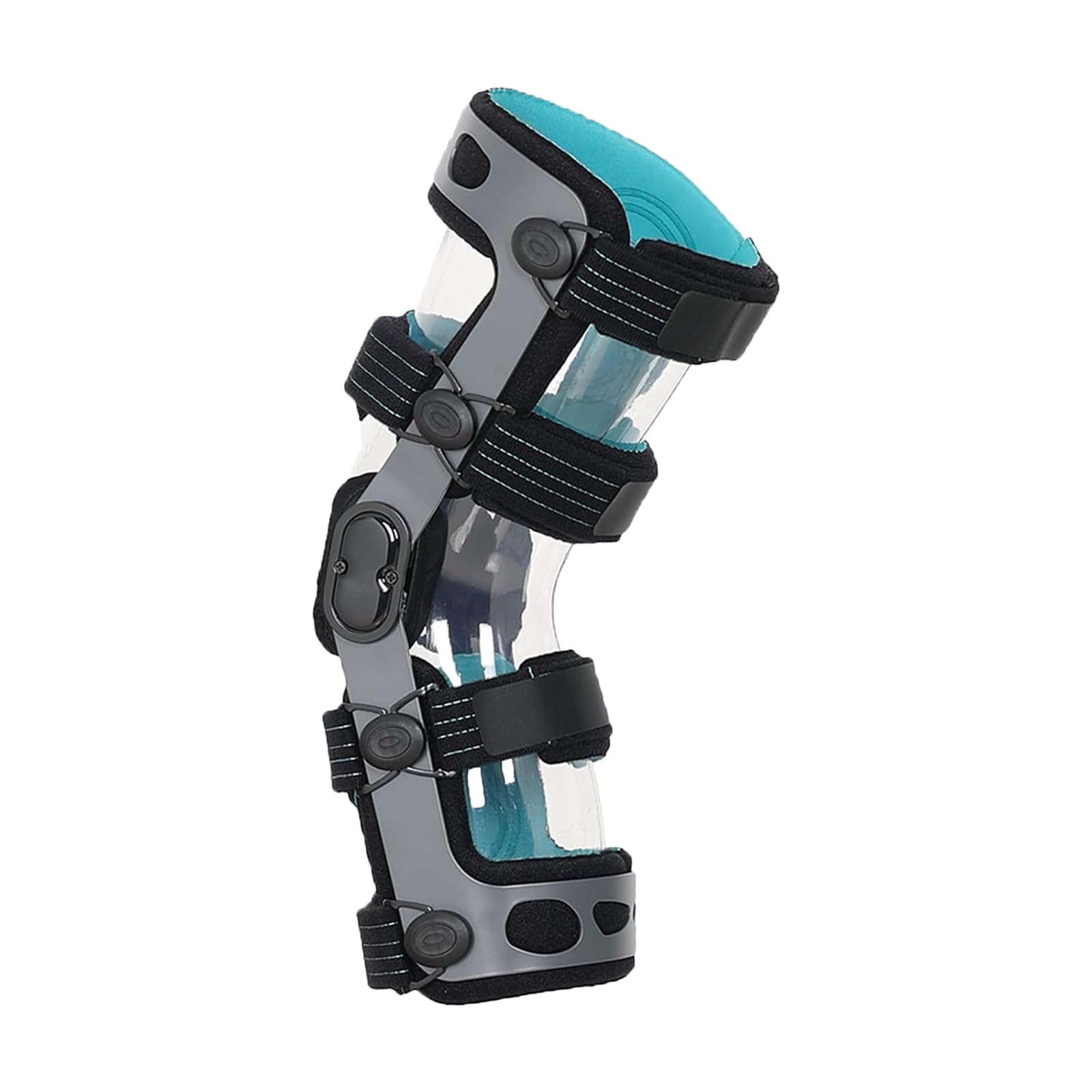
The Komzer Professional ACL brace is the most specialized stabilizer in this lineup, built specifically for post-surgical recovery from ACL reconstruction. Its defining feature is the adjustable ROM limiter that locks extension at precise angles — critical during the first six weeks of graft healing when even a few degrees of hyperextension can stretch the new ligament. The frame is taller and wider than standard braces, distributing forces across the entire thigh and calf to prevent rotation of the brace itself.
The hinge mechanism uses a geared polycentric design with a locking pin for ROM control. This is not a brace you slip on casually — it requires setup with a screwdriver to dial in the extension and flexion stops, and the fit is optimized for left or right knee individually, not universal. The additional straps at the tibial crest prevent the brace from sliding down, a common problem with heavier stabilizers.
For non-surgical users or those with mild instability, this brace is overkill. The rigid frame and multiple straps add significant bulk, and the price reflects the surgical-grade engineering. If you are recovering from an ACL repair and your surgeon recommends a hinged brace with precise ROM control, this is exactly that tool.
Why it’s great
- Geared polycentric hinge with pin-lock ROM control for surgical rehab
- Tall frame distributes forces to prevent brace rotation
- Tibial crest strap prevents migration during walking
Good to know
- Overbuilt for anyone not in post-op ACL recovery
- Requires tool-based setup and individual left/right fit
FAQ
How tight should a knee stability brace be during exercise?
Can I wear a hinged stability brace under pants?
How do I clean a knee brace with metal side stabilizers?
Does a knee stability brace weaken leg muscles over time?
Final Thoughts: The Verdict
For most users, the best knee stability brace winner is the McDavid 429RX because its bilateral geared polycentric hinges deliver the ideal blend of natural gait and lateral control for active users. If you want medical-grade daily stability that disappears under clothing, grab the Bauerfeind GenuTrain. And for post-op ACL recovery where precise ROM control is non-negotiable, nothing beats the Komzer Professional ACL Brace.