The wobble of a first bike is a rite of passage, but a frame that is too heavy or a seat that sits too high turns excitement into frustration before the first push on the pedal. A kids bike with training wheels lives or dies on the fit between the child’s inseam and the saddle height range, not on flashy decals or a matching basket.
I’m Emma — the founder and writer behind Baby Bangs. I have spent years comparing child-proportioned geometry, minimum seat heights, and brake lever reach across every major wheel size so parents can skip the assembly headaches and get straight to the first confident glide.
This guide breaks down the seven most reliable models on the market right now, sorting them by frame build, wheel diameter, and realistic age range so you land on the perfect kids bike with training wheels for your rider’s height and skill level.
How To Choose The Best Kids Bike With Training Wheels
Three factors determine whether a training-wheel bike builds confidence or collects dust in the garage: proper fit, brake type suited to the child’s hand strength, and the sturdiness of the training wheel bracket. Ignore the colorful marketing and start with a tape measure.
Inseam Before Age
Every wheel size (12, 14, 16, 18, 20 inches) has a minimum saddle height. A 4-year-old with a 16-inch inseam needs a 14-inch wheel, while a 5-year-old with an 18-inch inseam can manage a 16-inch frame. Always measure the child’s inseam from floor to crotch and compare it to the bike’s lowest seat position — their feet must rest flat on the ground with both training wheels down.
Coaster Brake Versus Handbrake
Beginners under five years old often lack the finger strength to squeeze a handbrake lever effectively. A coaster brake (pedal backward to stop) is intuitive and reliable for the earliest riders. Once the child has mastered steering, a handbrake offers more progressive control — but only if the lever reach is adjustable for small palms.
Training Wheel Bracket Durability
The plastic or steel bracket that holds each training wheel takes the hardest abuse during curbs and driveway transitions. A single-bolt bracket bends after a few hard drops, causing the training wheel to tilt and the bike to wobble. Look for a two-bolt steel bracket that keeps the wheel vertical under repeated impact. Removable brackets are a bonus when the child is ready to balance independently.
Quick Comparison
On smaller screens, swipe sideways to see the full table.
| Model | Category | Best For | Key Spec | Amazon |
|---|---|---|---|---|
| WEIZE Girls Bike 14-Inch | Mid-Range | Girls ages 3–5 who want styling extras | 14-inch wheel / 35-inch min height | Amazon |
| WEIZE Kids Bike 16-Inch | Mid-Range | Building confidence with wide tires | 16-inch wheel / 2.125″ wide tires | Amazon |
| COSTWAY Kids Bike | Mid-Range | Slow-growing kids needing size longevity | Multi-size 12–20 inch options | Amazon |
| BODIOO Kids Bike 12-Inch | Entry-Level | Toddlers taking first pedal strokes | 12-inch wheel / coaster + handbrake | Amazon |
| BABY JOY Kids Bike | Premium | Sporty look for active 3–8 year olds | Multiple sizes (12–20 inch) / basket | Amazon |
| bicystar Girls Bike | Premium | Preschool girls who love pink & extras | 12–18 inch sizes / streamers & basket | Amazon |
| cubsala BMX Style Bike | Premium | Rough-and-tumble riders who like BMX | 12–18 inch / steel frame / coaster brake | Amazon |
In‑Depth Reviews
1. WEIZE Girls Bike 14-Inch

The WEIZE 14-inch girls bike hits the sweet spot for riders between 35 and 47 inches tall, which covers the average 3-to-5-year-old range. The frame uses high-carbon steel to handle the inevitable tip-overs without adding so much weight that a small child struggles to steer. The full coverage chain guard protects little legs and shoelaces from getting caught on drivetrain components, a detail that matters more after the first month of daily rides.
The included wicker basket, doll seat, streamers, and bell add tangible play value that motivates a hesitant child to climb onto the saddle. The coaster brake keeps stopping simple — just pedal backward — which removes the frustration of learning two controls at once. The training wheel brackets on this model use a two-bolt design that stays vertical after repeated curb bumps, unlike cheaper single-bolt units that bend and create a persistent wobble.
The bike arrives 85 percent pre-assembled, and the remaining work (handlebar, seat, front wheel, training wheels) takes about 20 minutes with the included tools. The instruction manual includes clear diagrams, and the brand offers an assembly video on the product page. For families who want a complete package that actually gets ridden, this is the most balanced pick in the mid-range tier.
Why it’s great
- Two-bolt steel training wheel brackets resist bending on curbs
- Full coverage chain guard prevents clothing snags
- Basket and doll seat create immediate emotional buy-in from the child
Good to know
- Handbrake lever is small but still stiff for very young fingers
- Adjustable seat max height may be too low for tall 5-year-olds
2. WEIZE Kids Bike 16-Inch
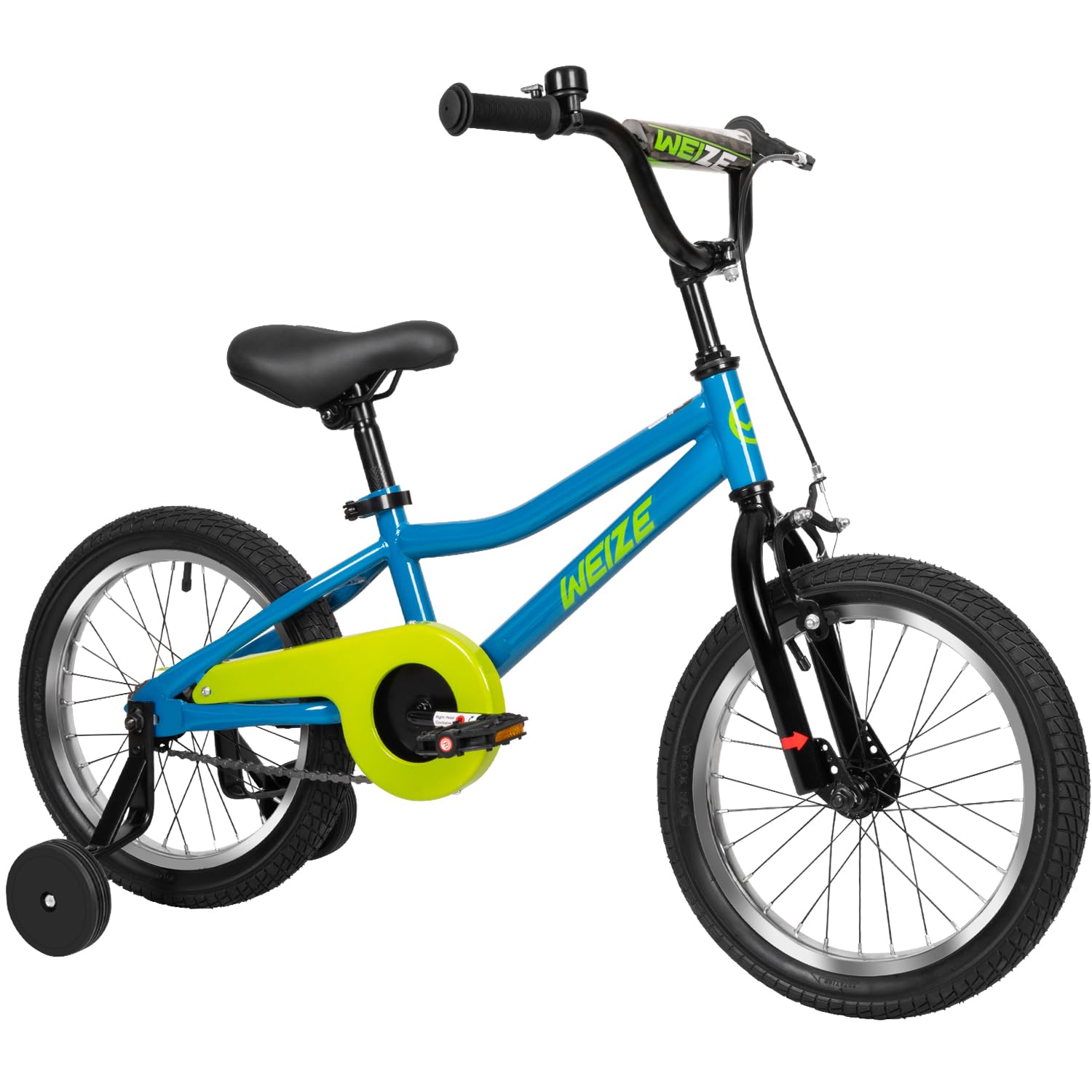
The 16-inch WEIZE bike targets riders aged 4 to 6 with a minimum height of 41 inches, and the key differentiator here is the 2.125-inch wide tires. Those extra millimeters of rubber provide noticeably better grip on loose sidewalk grit and light trail surfaces compared to standard 1.95-inch tires. The bike feels planted during turns, which matters when a beginner is still learning to lean into a corner rather than overcorrect and tip.
The frame is high-carbon steel with the same durable construction as the smaller WEIZE model, but the geometry is proportioned for older kids — smaller grips, a lower top tube for easier foot clearance, and a seat that adjusts higher to accommodate growing legs. The detachable training wheels are made with a reinforced bracket that handles the extra weight of a larger child without bending. The coaster brake alone handles speed control well, and the 85-percent pre-assembled state keeps the build process under 20 minutes.
This model comes in a dark blue finish that avoids overly juvenile graphics, so kids who feel too big for “baby” bikes still want to ride it. The assembly tools and instruction manual are included, and the brand provides an assembly video. For a growing child who is ready for a bigger wheel but still needs training-wheel support, this is the strongest option in the 16-inch segment.
Why it’s great
- Wide 2.125-inch tires provide superior grip on pavement and light trails
- Reinforced training wheel brackets handle larger child weight without bending
- Neutral dark blue finish appeals to older beginners
Good to know
- No handbrake — coaster brake only, which limits progressive braking practice
- Seat may feel firm for longer rides on bumpy paths
3. COSTWAY Kids Bike 12–20 Inch
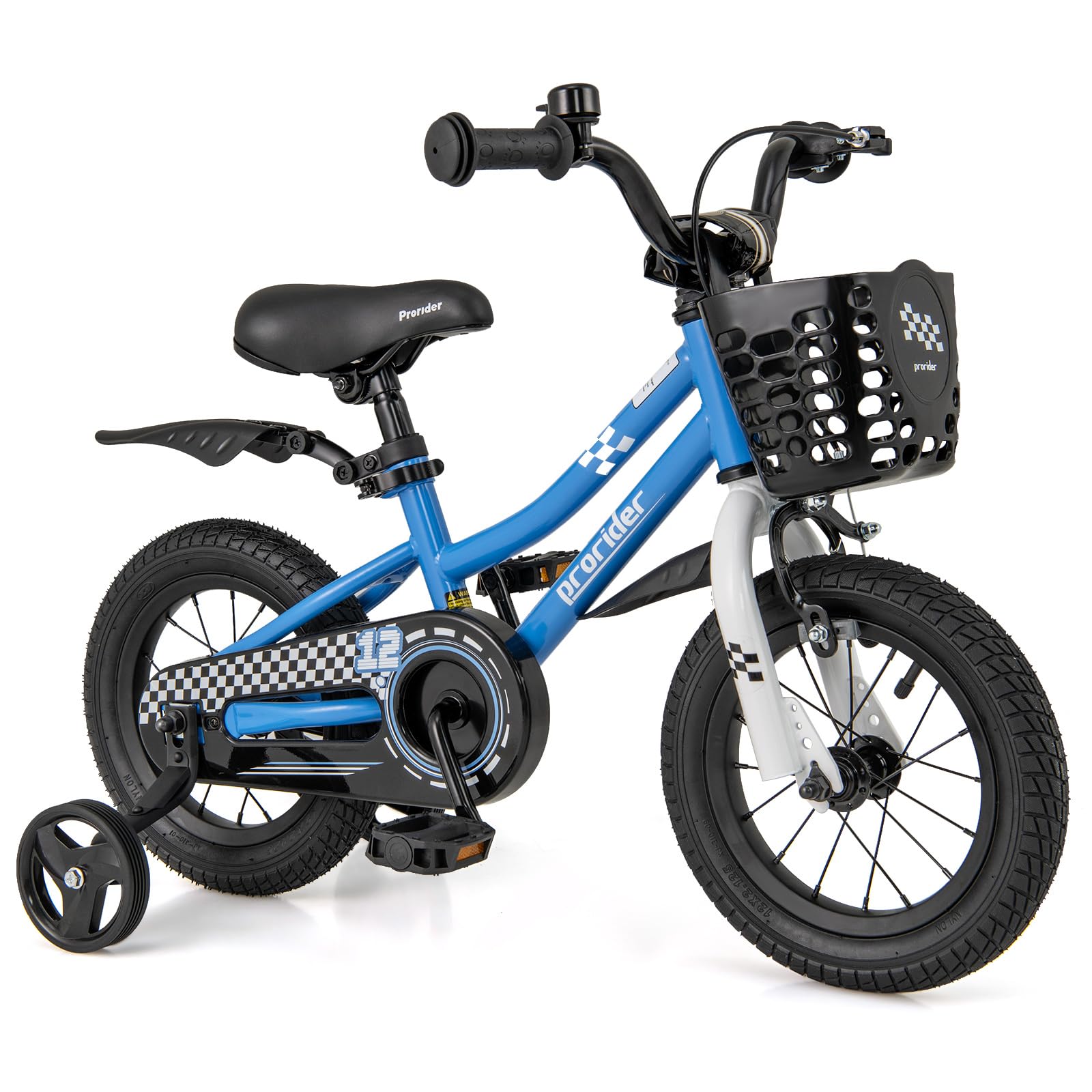
The COSTWAY bike stands out because it offers five wheel sizes (12, 14, 16, 18, and 20 inches), which means a single purchase can be sized to the child’s exact current height rather than forcing a compromise between “a little too big” and “outgrown in six months.” The frame uses high-carbon steel, and each size includes both a coaster brake and a handbrake. Having both brake types on day one lets parents gradually introduce hand braking as the child’s grip strength develops.
Every COSTWAY model includes a removable front basket and a bell, plus the training wheels are detachable with a simple Allen wrench when the child is ready to balance solo. The assembly requirement is typical — around 30 minutes for someone comfortable with bike tools — and the instruction manual is clear about torque specifications for the training wheel bolts, which prevents the common problem of wheels loosening mid-ride. The saddle is padded with a slightly wider profile that supports children who spend extended time riding rather than just circling the driveway.
The biggest advantage for budget-conscious families is that the 18-inch and 20-inch sizes extend the bike’s usable life into the early elementary years without requiring an upgrade. The handbrake lever reach is fixed, so test the child’s ability to squeeze it before purchasing — some smaller hands may only use the coaster brake for the first few months. Overall, this is the most versatile option for families with multiple children who will grow through different sizes.
Why it’s great
- Five wheel sizes match exact child height without guesswork
- Coaster brake plus handbrake allows gradual skill progression
- Removable basket and training wheels simplify the transition to two-wheel riding
Good to know
- Handbrake lever reach is not adjustable for very small hands
- Assembly time is slightly longer than average due to dual brake cables
4. BODIOO Kids Bike 12-Inch
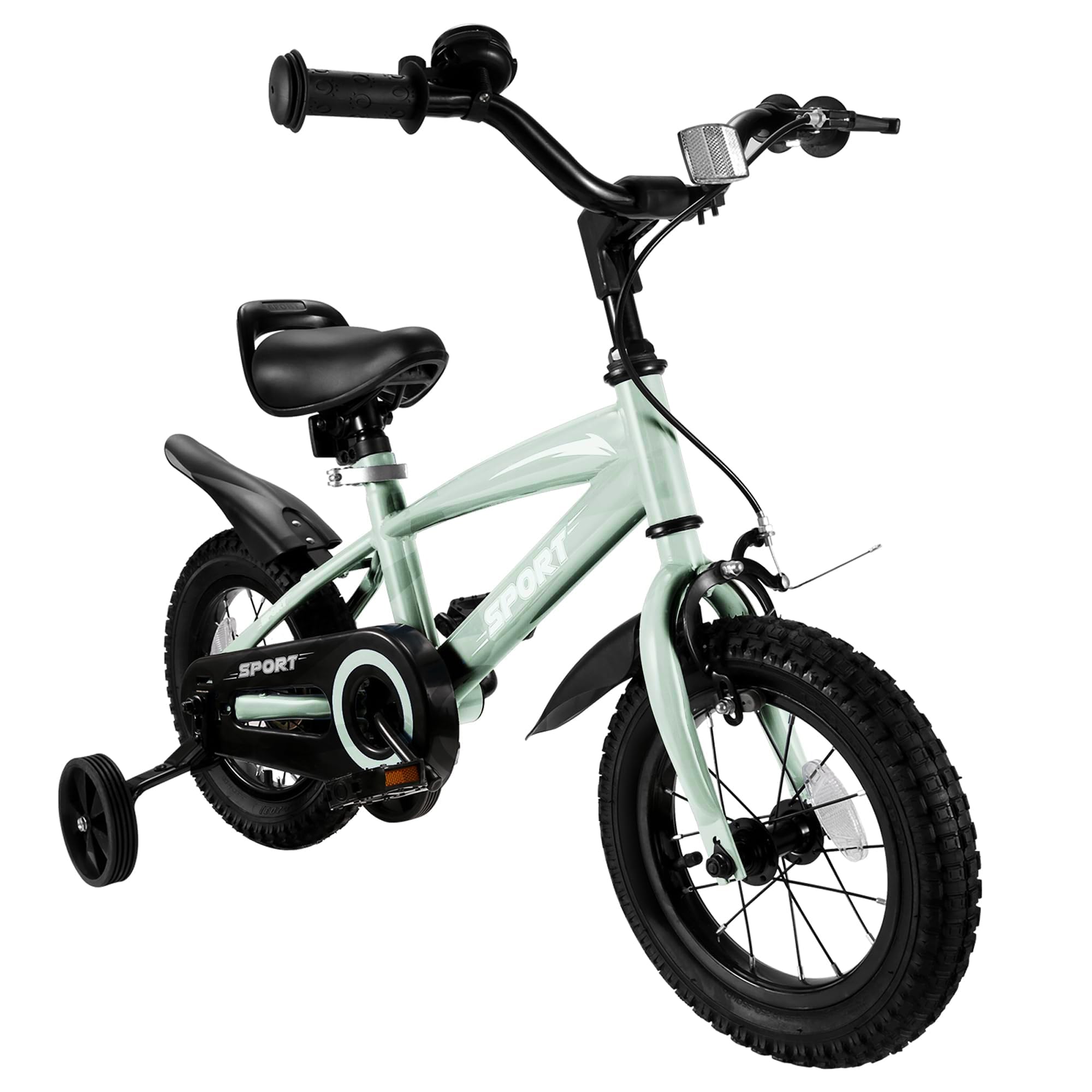
The BODIOO 12-inch model is the most accessible entry point for toddlers who are ready to move from a balance bike to pedals. The frame is designed with a low standover height that makes it easy for a 2-to-4-year-old to straddle the bike without fear, and the training wheels are attached with a steel bracket that holds alignment better than the plastic brackets found on many budget 12-inch bikes. Both a coaster brake and a handbrake are present, though the handbrake lever is small enough for tiny fingers to reach.
The saddle and handlebars are adjustable with a quick-release clamp, which is a rare convenience at this price level — no tools needed to raise the seat as the child gains a few inches of height. The bike weighs approximately 16 pounds, which makes it light enough for a 3-year-old to maneuver independently. The chain guard is full-coverage, and the pedals have a textured surface to prevent little feet from slipping off during the initial push-and-wobble phase.
Assembly is straightforward, with the frame arriving roughly 80 percent assembled. The included tools are basic but sufficient, and the instruction sheet uses labeled diagrams rather than relying on text translation. The trade-off for the low entry cost is that the paint finish is thinner than premium models and may chip after a few hard drops on concrete. For a first pedal bike that the child will outgrow within two seasons, this is a smart, low-risk choice.
Why it’s great
- Quick-release seat and handlebar clamp for easy height adjustments
- Light 16-pound frame helps toddlers steer without fatigue
- Steel training wheel brackets hold alignment better than plastic alternatives
Good to know
- Paint finish chips faster than mid-range and premium models
- Handbrake is present but only usable once child develops finger strength
5. BABY JOY Kids Bike 12–20 Inch

The BABY JOY bike uses a sporty geometry that mimics a BMX-style frame, with a slightly longer wheelbase that provides more stability at speed than the compact frames found on many 12-to-20-inch kids bikes. The frame is high-carbon steel, and the training wheels use a reinforced bracket that extends far enough from the rear axle to provide a wide stability triangle. This design is especially helpful for children who tend to tip during tight turns on sidewalks.
The bike comes with both a coaster brake and a handbrake, plus a kickstand and a removable front basket. The handbrake lever is proportioned for smaller hands, with a reach that doesn’t require the child to stretch their fingers unnaturally. The training wheels are detachable via two bolts, and the bracket itself leaves no sharp edges exposed when removed. The saddle is padded with a dual-density foam that stays comfortable during longer neighborhood rides.
Color options include bright metallic finishes that resist fading better than matte paint. The assembly process takes about 25 minutes, and the brand provides a tool kit that includes Allen wrenches and a wrench for the pedal bolts. The biggest consideration is the price — it sits at the higher end of the mid-range tier — but the build quality justifies the investment for families who plan to hand the bike down to a younger sibling after the first child outgrows it.
Why it’s great
- Longer wheelbase adds stability during turns compared to compact frames
- Reinforced training wheel brackets extend wide for a secure stability triangle
- Removable basket and kickstand add practical daily features
Good to know
- Higher price point than comparable 12-inch entry-level models
- Larger 20-inch version may feel heavy for smaller 8-year-olds
6. bicystar Girls Bike 12–18 Inch
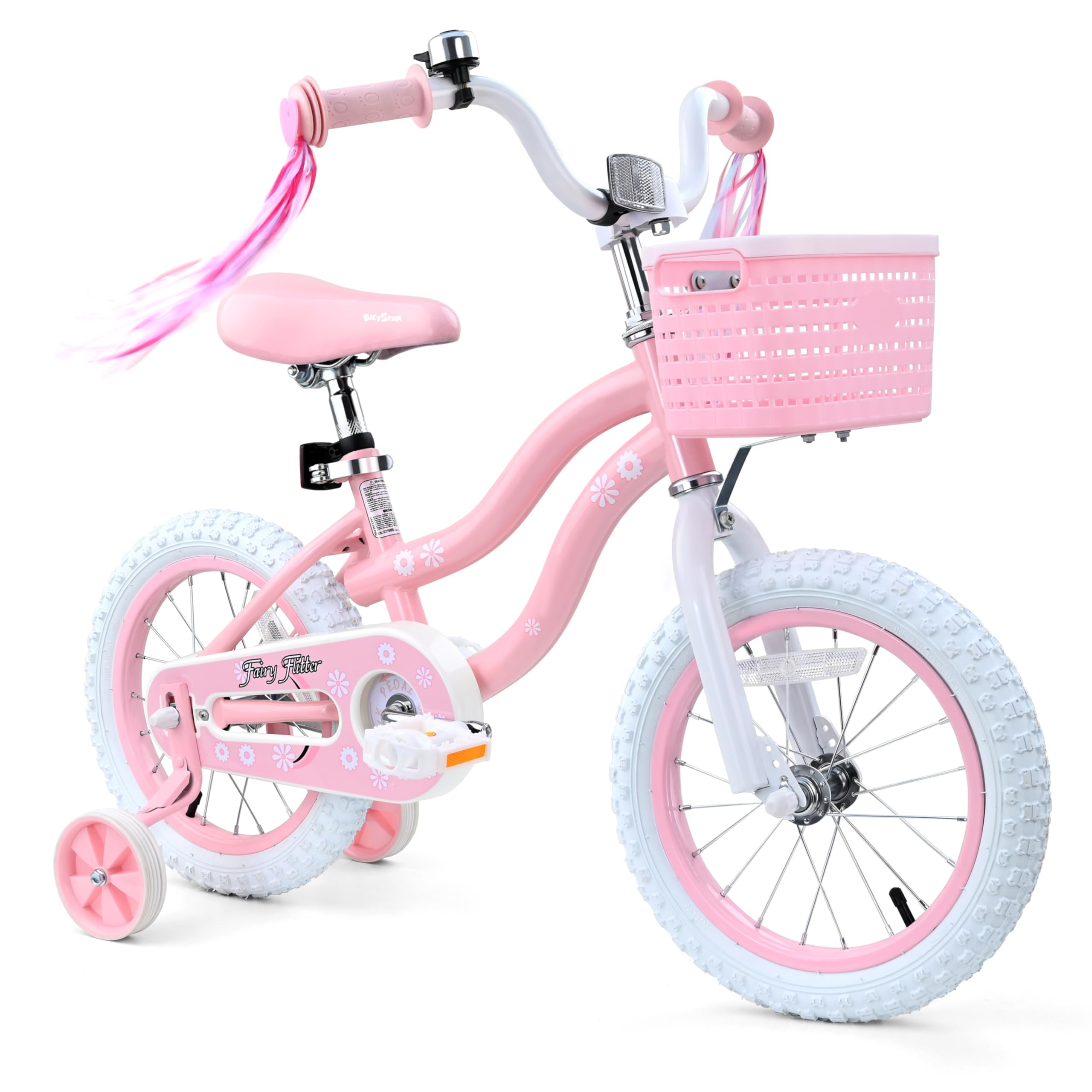
The bicystar girls bike leans into the aesthetic side of the purchase with a pink frame, matching streamers that trail from the handlebar grips, a front basket, and a doll seat mounted behind the saddle. But underneath the decorative touches, the bike uses a high-carbon steel frame and a coaster brake system that is simple enough for a 3-year-old to operate intuitively. The training wheels attach with a two-bolt steel bracket that keeps the tires parallel to the ground even after the child runs over a curb.
Available in 12, 14, 16, and 18-inch wheel sizes, the bicystar covers ages 2 through 8 with the same frame geometry scaled appropriately for each wheel diameter. The saddle is wider than many competitors, which provides extra stability for a child who shifts their weight while looking around. The basket is wicker-style and large enough to hold a stuffed animal or a small water bottle, which makes the bike a vehicle for imaginative play as much as physical exercise.
Assembly is typical for this category — around 25 minutes with the included tools. The streamers are pre-attached to the grips, which saves a fiddly step. The biggest limitation is the coaster brake only; there is no handbrake for progressive braking practice. For a child who primarily rides on flat sidewalks and driveways, that is rarely an issue, but parents who plan to take the bike on gentle downhill slopes should consider a model with both brake types.
Why it’s great
- Wicker basket and doll seat encourage imaginative play during rides
- Two-bolt steel training wheel brackets stay aligned on rough surfaces
- Wider saddle provides extra stability for shifting weight
Good to know
- Coaster brake only — no handbrake for progressive braking control
- Doll seat is fixed and may interfere with older child’s leg position
7. cubsala 12–18 Inch BMX Style Bike
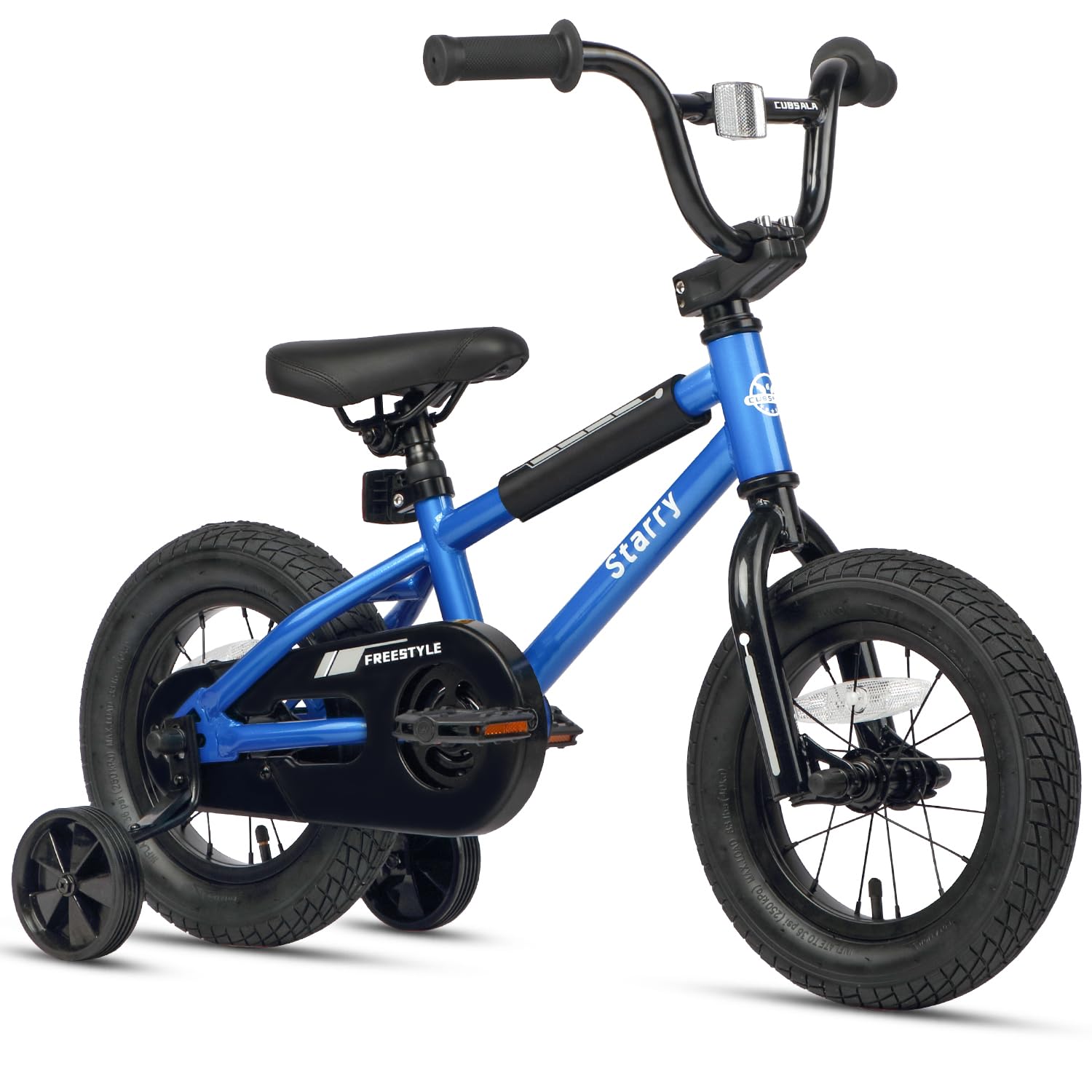
The cubsala BMX-style bike is built for kids who treat every driveway crack as a jump ramp. The frame uses a thick-wall high-carbon steel tubing that resists denting better than the thinner tubes found on budget bikes, and the training wheels are mounted on a steel bracket with two bolts at the attachment point. The coaster brake is the sole braking system, which is appropriate for the aggressive riding style — fewer cables to snag on branches or playground equipment.
The bike is available in 12, 14, 16, and 18-inch wheel sizes, with the smallest size starting at a 12-inch wheel for 2-to-4-year-olds and the 18-inch version fitting kids up to around 10 years old. The handlebar grips are textured rubber with a slightly larger diameter than typical kids grips, which gives better purchase for gloved hands during cooler weather rides. The saddle is padded with a medium-density foam that balances comfort with the durability needed for rough use.
Assembly is on the longer side at around 30 minutes because the handlebar stem requires careful alignment to ensure the training wheels sit level. The instruction manual is printed in multiple languages with clear exploded diagrams. The paint finish is glossier than most competitors and shows fewer scratches after repeated spills. For parents who expect their child to ride hard and keep this bike for more than one season, the cubsala offers the most durable construction in the premium tier.
Why it’s great
- Thick-wall high-carbon steel frame resists dents during rough play
- Dual-bolt steel training wheel bracket maintains alignment on impacts
- Gloss paint finish hides scratches better than matte alternatives
Good to know
- Coaster brake only — no handbrake for progressive braking
- Assembly takes longer due to precise handlebar stem alignment
FAQ
What is the minimum inseam for a 14-inch bike with training wheels?
Should I remove the training wheels when my child starts balancing?
Final Thoughts: The Verdict
For most families, the kids bike with training wheels winner is the WEIZE Girls Bike 14-Inch because it combines the most durable two-bolt training wheel brackets with the highest-value accessories (basket, doll seat, streamers) at a mid-range investment that doesn’t break the budget. If you want wide tires for extra grip on mixed surfaces, grab the WEIZE Kids Bike 16-Inch. And for a sporty build that handles aggressive riding and hand-me-down longevity, nothing beats the cubsala BMX Style Bike.