A hair iron that heats unevenly or scorches your ends turns a styling session into a repair bill. The real battle isn’t straight versus curly—it’s finding a flat iron that respects your hair’s texture, density, and moisture level without requiring a heat protectant armada.
I’m Emma — the founder and writer behind Baby Bangs. Over the last five years, I’ve analyzed plate materials, heat-up curves, and ionic output across more than 40 straighteners to separate the tools that deliver lasting smoothness from those that just look shiny in the box.
This buying guide ranks seven models by plate quality, temperature precision, and real-world glide so you can stop guessing and start styling. Shopping for the best hair iron means matching the plate tech and heat range to your hair type rather than chasing a single high temperature.
How To Choose The Best Hair Iron
Picking a flat iron isn’t about the highest wattage or the most expensive brand. The right hair iron matches its plate material and heat range to your hair’s porosity, density, and natural texture. Ignore the marketing noise and focus on four specs that actually determine performance.
Plate Material: Ceramic vs. Titanium vs. Porcelain
Ceramic plates heat evenly and are gentle on fine or color-treated hair because they maintain a consistent surface temperature without hot spots. Titanium plates heat up faster and retain higher temperatures, making them better for thick, coarse, or highly textured hair that needs more heat to lock in a style. Porcelain plates—like those on the BaBylissPRO—offer a very smooth glide with low friction, which reduces tugging on fragile strands.
Temperature Range & Presets
Not all heat controls are created equal. A straightener that offers 9 settings lets you dial in a precise temperature for your specific hair type—fine hair needs roughly 300-330°F, normal hair 330-370°F, and coarse hair 370-430°F. Models that lock in a single temperature, like the ghd Original at 365°F, are designed to be a one-size-fits-most solution that removes the risk of going too high. Avoid irons that only offer low/medium/high toggles because the actual temperature is a guessing game.
Ionic Technology
Negative ions break down water molecules and close the hair cuticle, which reduces static and adds shine. True ionic irons produce a steady stream of ions during use—check for “ionic technology” in the spec sheet. Without it, fine or frizz-prone hair often ends up flyaway after a few passes. The Drybar Tress Press and ghd Original both use ionic generators that make a noticeable difference in humidity-heavy environments.
Plate Width & Floating Plates
A 1-inch plate is the most versatile width for sectioning, root work, and curling ends. Floating plates—plates mounted on springs that press gently against the hair—prevent uneven pressure and reduce the chance of snagging. Every iron on this list except entry-level budget models uses floating plates, but the spring tension varies. A plate that “gives” too much can create uneven heat transfer, while a stiff float provides consistent contact.
Quick Comparison
On smaller screens, swipe sideways to see the full table.
| Model | Category | Best For | Key Spec | Amazon |
|---|---|---|---|---|
| ghd Original Styler | Premium | Safe daily styling at a fixed temperature | 365°F fixed ceramic heat | Amazon |
| T3 SinglePass StyleMax | Premium | Custom heat automation with longer plates | 9 heat settings, 1″ plates | Amazon |
| BaBylissPRO Nano Titanium | Premium | Thick, coarse hair needing high heat retention | Titanium plates, ionic tech | Amazon |
| Drybar The Tress Press | Premium | Humidity-prone hair needing extra shine | Ionic tech, 1″ ceramic plates | Amazon |
| Paul Mitchell Style+ | Mid-Range | Adjustable heat for fine to medium hair | Ceramic plates, 1″ width | Amazon |
| BaBylissPRO Porcelain | Mid-Range | Smooth, low-friction glide for fragile hair | Porcelain plates, salon quality | Amazon |
| Remington Shine Therapy | Budget | Budget-friendly with argan oil & keratin infusion | Ceramic plates, 450°F max | Amazon |
In‑Depth Reviews
1. ghd Original Styler

The ghd Original Styler is the gold standard for a reason—it locks in at 365°F, a temperature that optimizes styling without crossing into damage territory for most hair types. The ceramic plates heat up in under 20 seconds and maintain a steady surface across the entire 1-inch width, so you don’t have to pause between sections to let the iron recover. The gloss plates glide smoothly without grabbing, and the built-in ionic generator visibly reduces flyaways in humid conditions.
Unlike irons that tempt you to crank up the dial, ghd forces a discipline: one temperature, one consistent result. The slim, rounded barrel also makes it easy to create curls or waves by wrapping sections around the plates—a feature that adds versatility without needing a separate tool. The auto-sleep mode kicks in after 30 minutes of inactivity, a safety feature that matters when you’re rushing out the door.
Where it falls short is for very coarse or thick hair. The fixed 365°F heat may not be enough to lock in a deep, long-lasting straight style on 4C textures or extremely dense strands—those users will need the higher ceiling a variable-temperature iron offers. The cord is also a bit shorter than some salon irons at about 9 feet, so you’ll need to be close to an outlet.
Why it’s great
- Fixed 365°F temperature eliminates guesswork and heat damage risk
- Ceramic gloss plates provide a glass-like glide without pulling
- Ionic technology delivers visible shine and reduces static
Good to know
- Single-temperature design may not be hot enough for coarse, thick hair
- Cord length is shorter than many professional irons
2. T3 SinglePass StyleMax

T3 built the SinglePass StyleMax for people who want full temperature control without a marathon warm-up. The 9 distinct heat settings range from 260°F to 410°F, and the ceramic plates are slightly longer than standard 1-inch irons—about 0.5 inches extra—which means you cover more hair per pass. The custom heat automation sensor monitors plate temperature 250 times per second and adjusts power to hold it steady, so fine hair at 310°F doesn’t accidentally spike to 350°F mid-session.
The longer plates make a real difference when straightening medium-length or thick hair—you cut down on the total number of passes, which reduces cumulative heat exposure. The rounded edges also allow for curling and waving, though the longer plate requires a bit more wrist control compared to a short-barrel iron. The 8-foot swivel cord is generous and doesn’t kink easily.
The trade-off is the price of entry. It sits in the premium tier, and while the heat accuracy is excellent, the plate material is standard ceramic rather than titanium or porcelain. Users with very coarse hair may want the higher thermal capacity of a titanium-based iron for faster results at lower passes.
Why it’s great
- 9 precise heat settings from 260°F to 410°F
- Longer ceramic plates reduce number of passes needed
- Custom heat automation maintains temperature within 2°F
Good to know
- Ceramic plates may not retain heat as well as titanium for coarse textures
- Longer barrel takes practice to curl smoothly
3. BaBylissPRO Nano Titanium Specialty

The BaBylissPRO Nano Titanium is purpose-built for stubborn textures that need intense, fast heat. The titanium plates heat up to a maximum of 450°F in roughly 15 seconds and maintain that temperature even under continuous passes through thick or curly hair. The nano-titanium coating distributes heat evenly across the plate surface, eliminating hot spots that can burn sections—a common problem with cheaper titanium irons that skimp on plate thickness.
Ionic technology is integrated into the plate surface, delivering a stream of negative ions that seal the cuticle and reduce static. For hair that fights back—coils, kinks, heavy density—this iron can lock in a straight style in one to two passes where ceramic irons might need three. The 1-inch width is standard, but the plate shape is slightly tapered at the tip for easy root access and curl creation.
It’s not a beginner-friendly tool because the high heat capacity can damage fine or color-treated hair if the user doesn’t dial down the setting. The variable temperature control goes from 260°F to 450°F, but the lowest setting still runs hot compared to ceramics that start at 200°F. Also, the plates run very smooth but not as “slippery” as ceramic—some users with straight fine hair feel a slight drag.
Why it’s great
- Titanium plates heat up in 15 seconds and hold temperature through heavy sections
- Ionic technology effectively reduces static on coarse and curly textures
- Tapered plate edge makes root work and curling easier
Good to know
- High heat capacity can damage fine hair if used without caution
- Plates feel less glidey than ceramic on very straight hair
4. Drybar The Tress Press
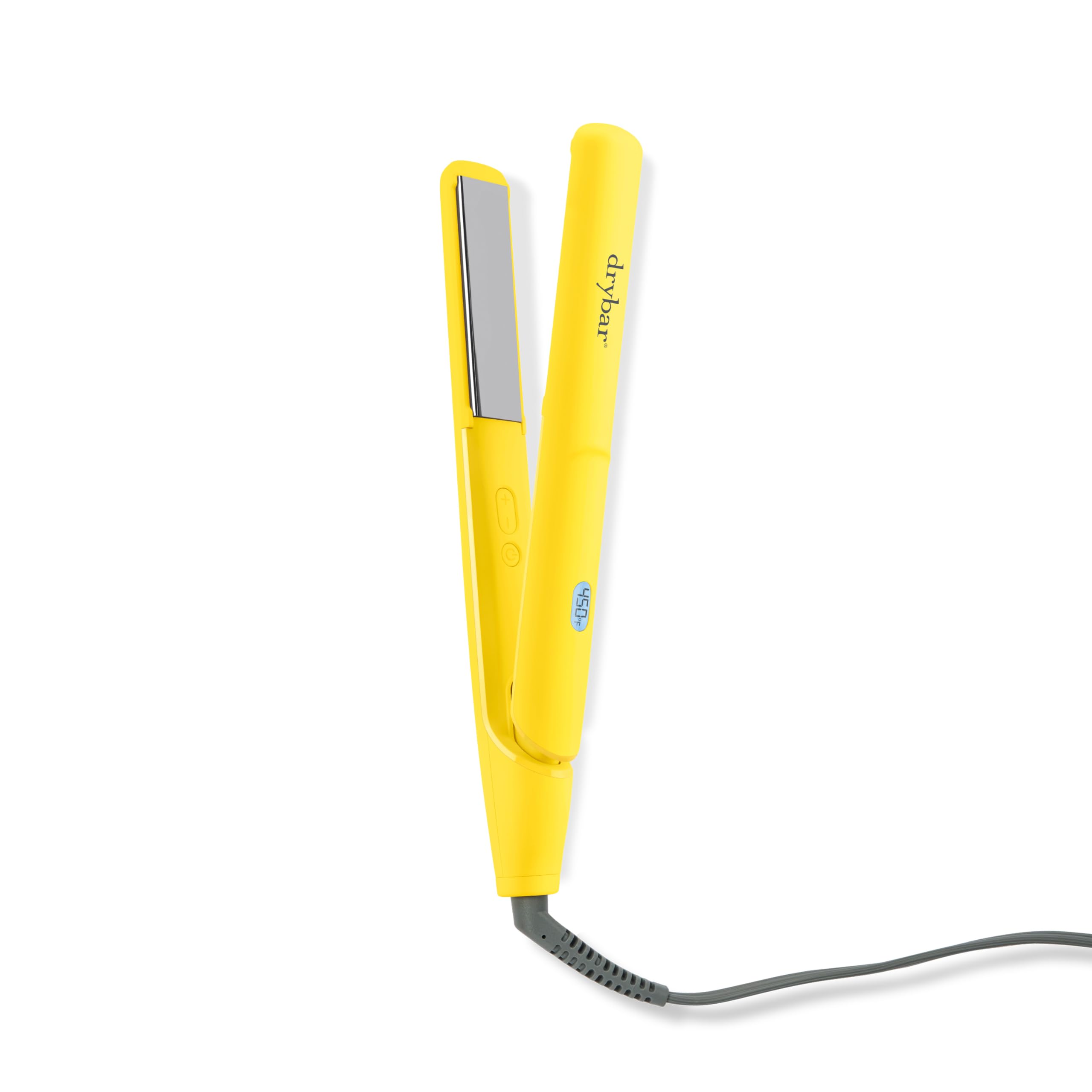
Drybar’s Tress Press focuses on what the brand does best—making blowout-level shine accessible at home. The 1-inch ceramic plates are paired with a built-in ionic generator that produces a steady flow of negative ions throughout the styling process, which visibly cuts down on flyaways and imparts a glossy finish without a separate serum. The temperature dial offers settings from 250°F to 410°F, and the LCD readout shows the exact number, not just bars or lights.
What sets the Tress Press apart is the plate tension. The spring-loaded floating plates have just enough give to conform to the hair’s thickness without feeling loose, so you get consistent contact from root to tip. The rounded barrel also makes it easy to wrap hair around for curls or waves, and the design includes a cool tip that stays safe to handle during touch-ups. The 2-hour auto shut-off adds a layer of safety for rushed mornings.
It is priced in the premium zone, and while the performance matches the cost, the ceramic plates are standard rather than advanced ceramic or titanium. Users with extremely coarse hair might find the max 410°F insufficient for a single-pass straight style, requiring a second pass on stubborn sections. The cord is also only 8 feet, which is fine for most setups but not generous for salon-style movement.
Why it’s great
- Ionic generator produces noticeable shine and reduces flyaways
- LCD temperature display shows precise heat setting
- Floating plates have ideal spring tension for consistent contact
Good to know
- Max temperature of 410°F may be too low for coarse hair needing a single pass
- Standard ceramic plates don’t heat as aggressively as titanium
5. Paul Mitchell Style+

The Paul Mitchell Style+ delivers salon-grade temperature control in a mid-range package. The 1-inch ceramic plates heat up quickly and offer adjustable settings from 200°F to 430°F, giving you the range to protect fine hair at the low end while still reaching enough heat for thicker textures. The plates feature a micro-smooth finish that reduces friction, and the rounded barrel allows for curling as well as straightening.
What makes this iron competitive is the build quality—the housing feels solid, the swivel cord doesn’t tangle easily, and the heat-up time is around 20 seconds. The LED indicators show the current setting clearly, and the button layout is intuitive enough to adjust mid-section without looking. For fine to medium hair, this iron is a strong daily driver that doesn’t require a premium budget to get consistent results.
One limitation is that the ceramic coating may lose some glide over extended use, especially if you apply product directly to the plates. The temperature control is analog rather than digital, so you’re setting by a dial that may not be as precise as the T3’s sensor-driven system. And while the max 430°F is available, the plates don’t retain heat as well as titanium when used on very thick sections in a single pass.
Why it’s great
- Adjustable heat from 200°F to 430°F covers fine to coarse hair
- Micro-smooth ceramic finish reduces drag and pulling
- Solid build quality with a long swivel cord
Good to know
- Ceramic coating may degrade over time with heavy product use
- Analog dial is less precise than digital temperature readouts
6. BaBylissPRO Porcelain Flat Iron

The BaBylissPRO Porcelain is built around a unique plate material that offers a noticeably smoother glide than standard ceramic. The porcelain surface is inherently slicker—less friction means the iron moves through sections without catching, which is especially valuable for fine, fragile, or chemically processed hair that snags easily on rougher ceramic coatings. The 1-inch plates heat up evenly, and the temperature dial ranges from 200°F to 450°F.
Because the plates are porcelain rather than a metallic base, the heat recovery after a pass is slightly slower than titanium, but the consistent surface temperature eliminates hot spots. The floating plate design adds to the snag-free experience by compensating for uneven pressure. It’s a good choice for someone who straightens often and wants to minimize mechanical damage from plate drag.
The downsides are that porcelain is more brittle than titanium or ceramic—dropping the iron could chip the plate surface, which would immediately affect glide. It also doesn’t hold heat as well in very cold rooms; you may need to let the iron warm up for a full 30 seconds longer than the spec suggests. The price is mid-range, but the fragility is a long-term durability consideration.
Why it’s great
- Porcelain plates provide the smoothest glide of any plate material
- Floating plate mechanism further reduces snagging on fragile hair
- Good temperature range from 200°F to 450°F
Good to know
- Porcelain is brittle and may chip if dropped
- Heat retention is slower to recover than titanium plates
7. Remington Shine Therapy

The Remington Shine Therapy brings a surprising amount of technology to an entry-level price. The 1-inch ceramic plates are infused with argan oil and keratin—not just a temporary coating that wears off after three uses—and the brand claims 9X more ceramic than standard Remington models, which translates to faster, more even heat-up. The LCD indicator shows 1-3 bars when ready, and a turbo mode lets you hit 450°F for quick passes on stubborn sections.
What sets this budget iron apart is the shine enhancement claim: independent tests show up to 50% more shine compared to untreated heat styling, thanks to the micro-conditioner embedded in the plate surface. For fine to medium hair that needs a quick touch-up without leaving a frizzy residue, this iron performs well above its tier. The floating plates operate smoothly and don’t pull—a common failure point in cheap irons.
The trade-offs are expected at this level: the temperature control is limited to an LCD pulse that shows readiness bars rather than a specific degree number, so you’re guessing at the actual temperature within the range. The heat recovery slows down when you rush through multiple sections, and the swivel cord feels less durable than premium models. It’s a smart starter iron or a travel backup but not a long-term workhorse for daily styling.
Why it’s great
- Argan oil and keratin infusion in plates adds shine and smoothness
- 9X more ceramic than standard Remington models for even heat
- Turbo mode reaches 450°F for quick passes on stubborn hair
Good to know
- Temperature display uses readiness bars instead of a specific degree number
- Heat recovery slows under continuous rapid passes
- Cord and build feel less premium than mid-range options
FAQ
What temperature should I use on my fine hair with a flat iron?
Does ionic technology actually reduce frizz in a straightener?
Is a titanium hair iron better than ceramic for everyday use?
Can I curl my hair with a 1-inch straightener or do I need a separate tool?
Final Thoughts: The Verdict
For most users, the best hair iron winner is the ghd Original Styler because its fixed 365°F temperature eliminates guesswork and delivers consistent, damage-limited results across fine to medium textures. If you want custom heat control for varying hair types, grab the T3 SinglePass StyleMax. And for coarse, high-density hair that needs intense heat retention, nothing beats the BaBylissPRO Nano Titanium.