The gap between a toy your two-year-old plays with for two minutes and one they explore for twenty minutes often comes down to one thing: how much “thinking” the toy asks them to do. At this age, every game is a physics lesson, a vocabulary drill, or a fine-motor workout — you just need the right tools to make it feel like pure fun.
I’m Emma — the founder and writer behind Baby Bangs. I’ve spent years digging through toddler toy specs, comparing wood quality, battery safety, and tactile design to separate genuine learning tools from short-lived clutter.
After checking materials, age ratings, and real-world skill targets, I’ve narrowed down the best learning games for 2 year olds that actually hold their attention while building coordination, language, and logic.
How To Choose The Best Learning Games For 2 Year Olds
A two-year-old’s brain is a sponge, but their attention span is a teaspoon. The best games for this age balance tactile satisfaction with a tiny cognitive challenge — not so hard they get frustrated, not so simple they get bored.
Material Safety & Durability
Two-year-olds explore with their mouths as much as their hands. Untreated wood, thick cardboard, and non-toxic water-based paints are the baseline. Avoid anything with small parts that could become a choking hazard — any piece that fits inside a toilet paper tube is too small. Natural wood edges should be hand-sanded splinter-free, and any stickers should be tightly sealed to prevent peeling.
Skill Target: Fine Motor vs. Cognitive
Some games focus on physical coordination — peg puzzles, stacking blocks, spoons for scooping. Others target naming, matching, and turn-taking. A strong learning game for this age combines both: the child has to physically manipulate a piece while mentally deciding where it goes. Look for “hand-eye coordination” and “color recognition” in the educational objective.
Portability & Storage
Toddler toys migrate. A game that comes with a storage board, a compact box, or a bag will survive longer in your home. If it’s travel-friendly (around 7 x 5 inches or smaller), it doubles as a car-seat or restaurant distraction. Consider whether the pieces scatter easily — a playboard with a raised edge or a box with a lid keeps the set together.
Quick Comparison
On smaller screens, swipe sideways to see the full table.
| Model | Category | Best For | Key Spec | Amazon |
|---|---|---|---|---|
| Peaceable Kingdom Acorn Soup | Mid-Range | Turn-taking & Vocabulary | 8 Recipe Cards, 24 Wooden Ingredients | Amazon |
| Fisher-Price Castle Block Set | Premium | Stacking & Pretend Play | FSC-Certified Wood, 27 Blocks | Amazon |
| TOYVENTIVE Learning Set | Premium | Alphabet & Number Recognition | 4 Books, Flash Cards, 2-Sided Puzzle | Amazon |
| HarVow LED Busy Board | Mid-Range | Sensory Exploration & Cause-Effect | 13 Switches, 24 LED Lights, Wood Back | Amazon |
| Peacurh Wooden Peg Puzzles 4-Pack | Budget-Friendly | Shape, Letter & Animal Matching | 49 Pieces, Chunky Peg Knobs | Amazon |
In‑Depth Reviews
1. Peaceable Kingdom Acorn Soup Game

This game introduces turn-taking without pressure. Your child follows recipe cards to drop wooden ingredients into a bowl using a child-sized spoon — simple enough for a two-year-old to succeed on the first try, but structured enough to teach rule-following and vocabulary like “in,” “out,” “stir,” and the names of each food piece. The 24 wooden ingredients are chunky and easy to grip, and the spoon requires real balancing control, making it a solid fine-motor workout.
The parent guide explains how to adjust rules as your child grows — start by ignoring the die and just following recipes, then later add the die for turn-sequencing. The wooden spoon and bowl feel substantial, and the recipe cards use clear pictures so pre-readers can “read” what to add next. At roughly 7 inches square, the box stores everything neatly.
Two-year-olds love the pretend-play element of “cooking,” and parents appreciate that the game actually ends (after eight recipes) rather than dragging on. The only downside is that the wooden pieces can be chewed — supervise closely if your child is still mouthing objects.
Why it’s great
- Teaches turn-taking and following simple rules in a low-pressure, cooperative format
- Real wooden spoon and ingredients provide authentic sensory feedback
- Parent guide offers adaptation strategies for different skill levels
Good to know
- Wooden pieces are small enough to be a chewing risk for aggressive mouthing
- Die is not needed for youngest players — you may skip it initially
2. Fisher-Price Wood Toddler Toy Castle Block Set
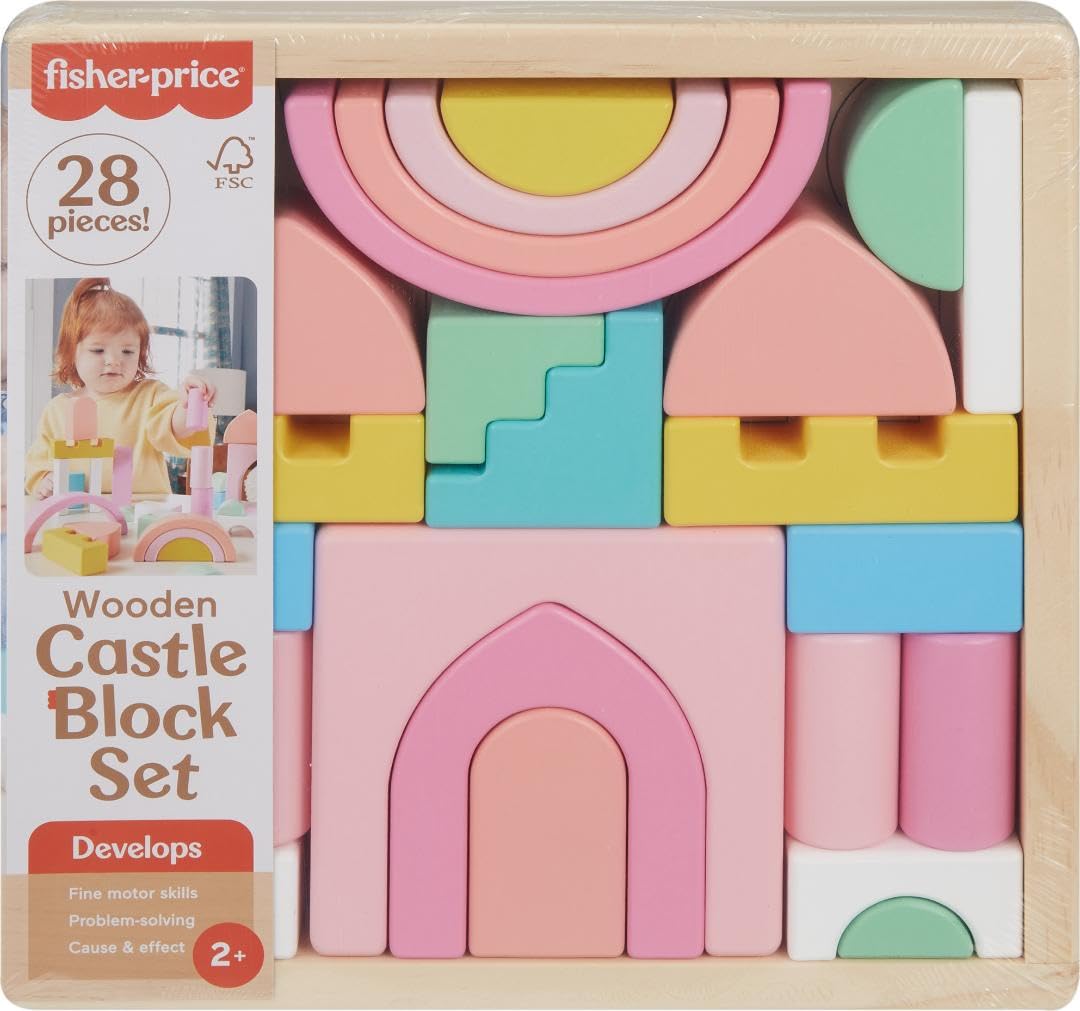
Fisher-Price brings wood blocks into the castle era with a 28-piece set (27 blocks plus a printed playboard) made from FSC-certified wood. The water-based paint finish is non-toxic and smooth, and the blocks feature arches, turrets, and window shapes that turn ordinary stacking into castle-building. The playboard has grooved borders that keep blocks from sliding off — a small detail that reduces frustration for unsteady little hands.
At just over 10 inches square, the set is compact enough for a small playroom shelf. The blocks vary in shape, so your child naturally practices shape recognition and spatial reasoning as they figure out which piece fits where. The castle theme also sparks imaginative play — after stacking, you can pretend knights and dragons live there, extending the learning into storytelling.
A two-year-old will mostly stack and knock down, which is developmentally appropriate. The blocks are light enough to avoid injury when toppled, but some parents report the paint can chip slightly if blocks are thrown repeatedly. The board’s raised edges also make it easy to carry the whole set as a single unit during cleanup.
Why it’s great
- FSC-certified wood and water-based paints meet rigorous safety standards
- Playboard with raised borders keeps blocks contained and reduces frustration
- Castle shapes inspire imaginative narrative-building beyond simple stacking
Good to know
- Paint may show wear if blocks are thrown or chewed aggressively
- Younger 2-year-olds may need help balancing irregular shapes initially
3. TOYVENTIVE Educational Books, Flash Cards, and Puzzles

This compact “Smart Box” bundles four board books, two sets of flashcards, a two-sided puzzle, two matching boards, and a pair of pretend glasses — all inside a storage box. The books cover ABCs and 1-20 using realistic images (not cartoons), which helps with concrete object identification. The matching boards use velcro-style attachments that toddlers love to peel and stick, training fine motor precision while reinforcing color and shape recognition.
The set is made from thick cardboard that holds up to moderate handling, and the puzzle pieces are large enough to avoid choking hazards. The content is designed to grow with the child: a 1-year-old might just look at pictures, a 2-year-old can match cards to boards, and a 3-year-old can work through the puzzle independently. The pretend glasses add a playful prop element that makes “learning time” feel special.
The only real limitation is that the bulk of the set is paper-based — it won’t survive spills or aggressive chewing as well as wood. The box is essential for keeping the pieces organized, and some parents find the sheer number of components overwhelming at first. Dedicate 10 minutes to sorting everything once, and you have a rotating activity station that stays fresh for weeks.
Why it’s great
- Multiple activity types (books, cards, puzzles, matching) prevent boredom
- Realistic photography aids concrete vocabulary building for early talkers
- Velcro-style matching boards provide satisfying tactile feedback
Good to know
- Paper and cardboard components not suitable for heavy chewing or wet play
- Box storage required — loose pieces scatter quickly without the container
4. HarVow Busy Board with LED Light Switches
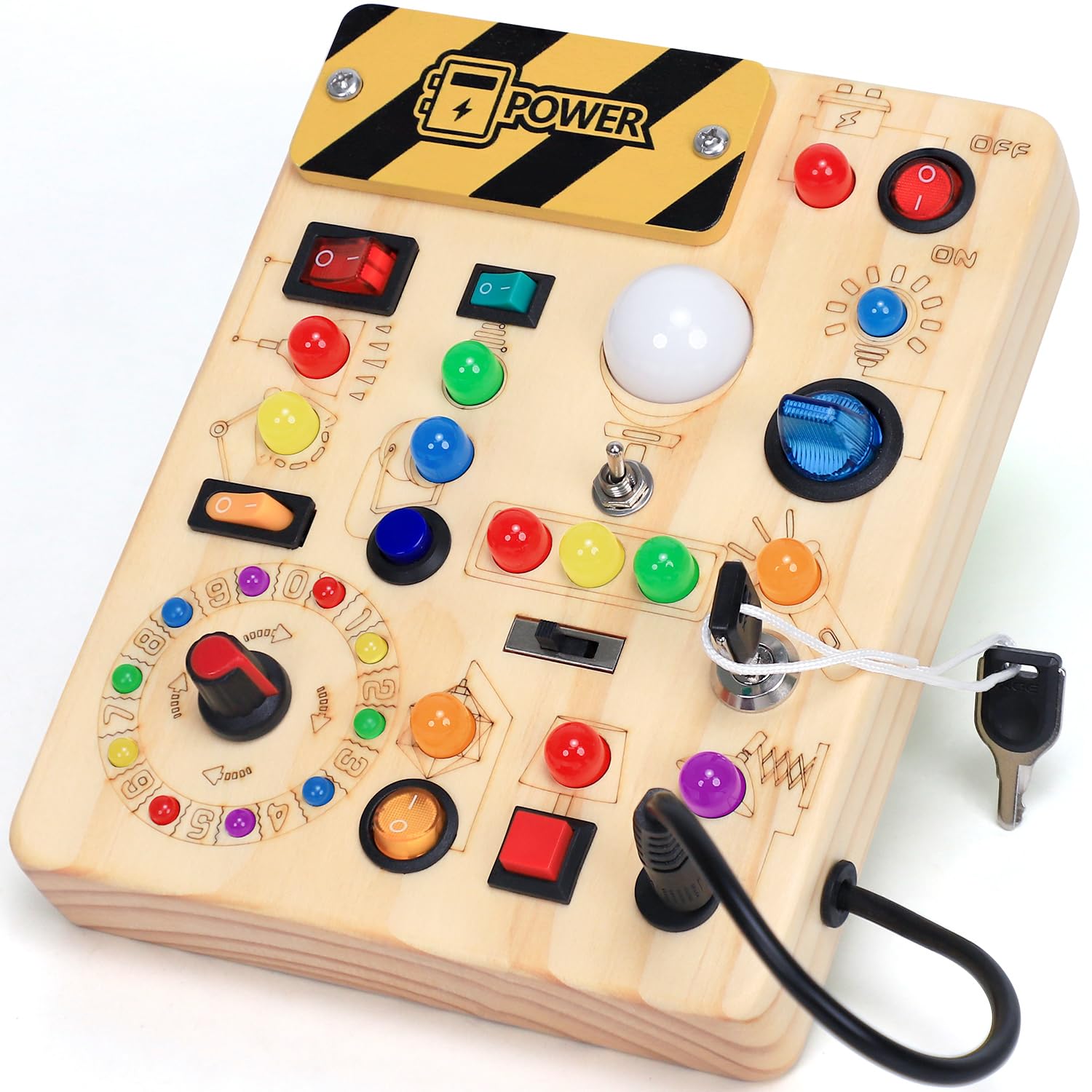
This wooden board packs 13 different switches — toggle, push-button, slider, and rocker — each wired to a specific set of LEDs that light up in different colors and patterns. The cause-and-effect feedback is instant and deeply satisfying for a two-year-old who craves control over their environment. A dedicated master switch lets you cut all power at once to save battery life (batteries not included — plan for 2 AAA).
The board measures 6.7 x 5.3 inches, making it one of the most portable options here — it slides easily into a diaper bag for restaurant or car-ride distraction. The backside has engraved A-Z letters and 0-9 numbers, adding a literacy element when the LEDs are off. The wood is solid, not veneer, with hand-sanded edges that feel safe for little fingers.
The LED brightness is calibrated to be eye-safe — bright enough to be engaging but not harsh. The main drawback is battery life: toddlers love flipping switches, and the lights drain AAA batteries faster than you expect. Also, the lack of volume control means there’s no sound, which some kids find less engaging than chirping or music-based toys. For quiet sensory play that builds fine motor skills, this board is hard to beat.
Why it’s great
- Instant cause-effect feedback with 13 distinct mechanical switches
- Compact and lightweight — ideal for travel or quiet-time play
- Engraved letters and numbers on the back add dual-function learning
Good to know
- Requires 2 AAA batteries (not included) and drains them fairly quickly
- No sound effects — purely visual feedback, which some toddlers may find less engaging
5. Peacurh Wooden Peg Puzzles 4-Pack
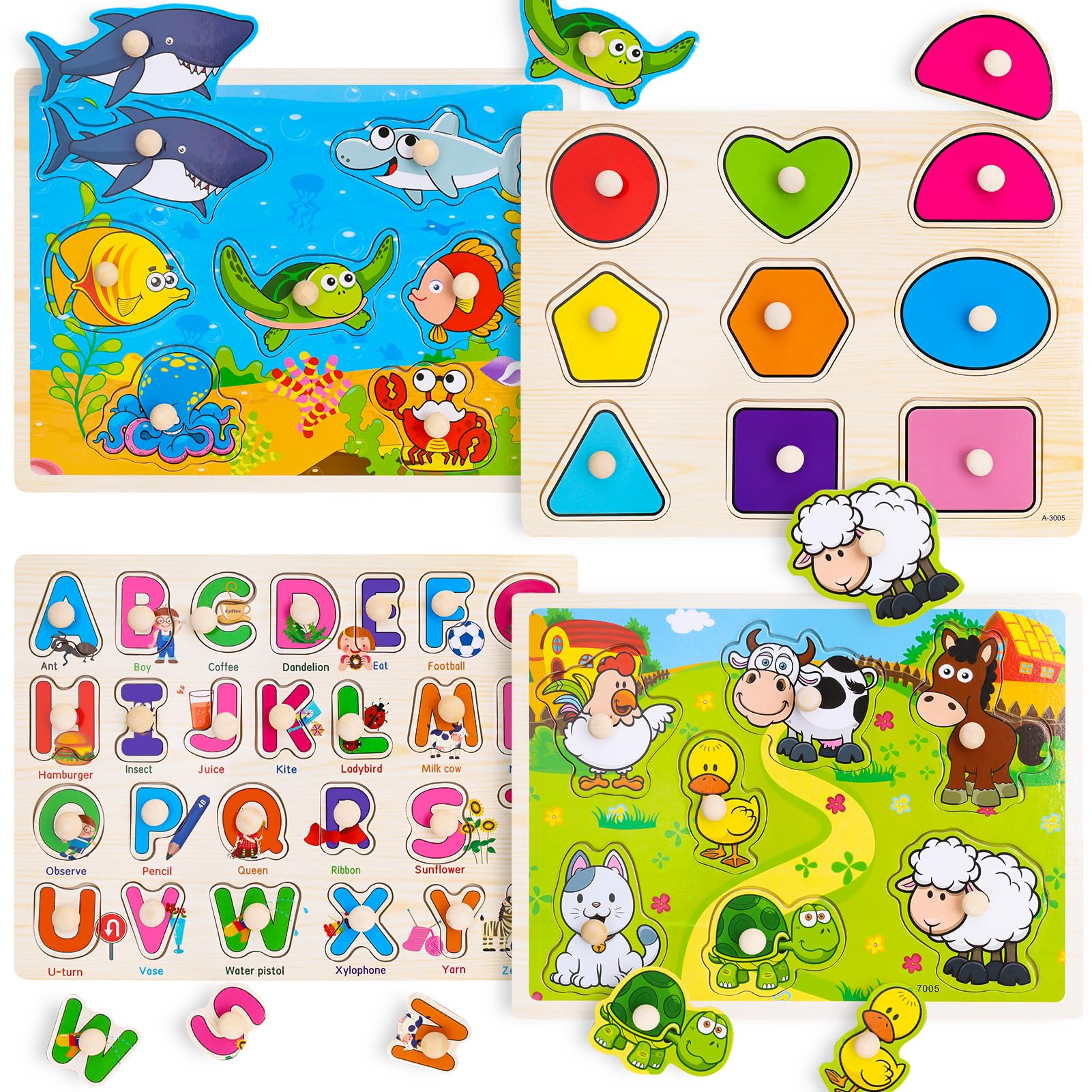
This 4-pack includes an alphabet puzzle (26 pieces), a shape puzzle (9 pieces), a marine animal puzzle (7 pieces), and a farm animal puzzle (7 pieces). Each piece has a chunky wooden peg that fits comfortably between thumb and forefinger, making it easy for a two-year-old to lift and place independently. The base boards have full-color illustrations underneath each cavity, so the child can match the piece to the picture — a crucial scaffolding technique for early puzzle success.
The pegs are the standout feature here — they’re thick enough that even a 12-month-old can grasp them, but the puzzle boards themselves are recommended for ages 2 and up due to the small-piece nature of the alphabet set. The wood is well-sanded with no rough edges, and the surface stickers are tightly laminated to resist peeling. Each board measures 11.6 x 8.7 inches, giving plenty of room for little hands to maneuver pieces.
Alphabet pieces are small enough to require supervision — a determined chewer could pry them apart. The farm and animal puzzles use larger pieces that are less of a concern. The 4-pack format means you can rotate puzzles to keep novelty alive, and the variety (animals, shapes, letters) covers multiple learning domains. For the price point, the density of learning value is excellent, though the alphabet puzzle is best introduced once your child has stopped mouthing objects.
Why it’s great
- Chunky peg knobs are perfectly sized for developing pincer grips
- Four different themes (alphabet, shapes, farm, marine) cover diverse learning areas
- Picture-matching underneath each slot supports independent solving
Good to know
- Alphabet pieces are small and could pose a choking hazard for still-mouthing toddlers
- Stickers may lift if pieces are submerged in water or aggressively chewed
FAQ
Can a 2 year old play games with rules?
How do I know if a learning game is too advanced for my toddler?
What type of learning game builds the most skills for this age?
Final Thoughts: The Verdict
For most families, the learning games for 2 year olds winner is the Peaceable Kingdom Acorn Soup Game because it blends turn-taking, vocabulary growth, and fine motor practice into a single cooperative play session that actually ends before burnout. If you want open-ended stacking that fuels imaginative stories, grab the Fisher-Price Castle Block Set. And for a complete activity library in one box that covers letters, numbers, matching, and puzzles, nothing beats the sheer variety of the TOYVENTIVE Smart Box Set.