A newborn’s brain forms over one million new neural connections every second, and the right tactile, auditory, and visual cues in those early months lay the foundation for motor control, language, and cognitive flexibility. Choosing toys that deliver genuine developmental feedback — not just bright colors — makes the difference between passive entertainment and active learning.
I’m Emma — the founder and writer behind Baby Bangs. I’ve spent years analyzing the sensory science, material safety, and motor-skill benchmarks that define genuinely effective infant learning tools, not just what looks cute in a nursery.
This guide breaks down the core specifications and real-world performance data behind the most effective learning toys for infants, so you can skip the noise and pick the piece that actually builds cause-and-effect reasoning, fine-motor dexterity, and early language exposure.
How To Choose The Best Learning Toys For Infants
Infant learning toys must serve two simultaneous roles: they must be safe for the mouthing and gripping stage, and they must deliver a sensory or mechanical reward that teaches cause and effect. A toy that only makes noise when an adult presses a button does not build independent problem-solving. The right toy responds to the infant’s own action — a kick, a pull, a tap.
Sensory Modalities and Developmental Timing
Between birth and six months, high-contrast visuals and varied textures (crinkle, satin, silicone nubs) stimulate visual tracking and tactile differentiation. From six to twelve months, auditory feedback that changes with the infant’s action — popping sounds, musical notes, animal calls — reinforces the connection between movement and outcome. Look for toys that layer at least two sensory inputs (touch + sound, or sight + texture) without overwhelming the infant.
Material Safety and Construction
Infants under twelve months explore primarily with their mouths. Every surface must be non-toxic, BPA-free, and free of small parts that can break off. Silicone and tightly woven fabric are the gold standards. Wood can work but must be finished with food-safe lacquer. Avoid toys with glued-on components, loose threads, or metal fasteners that could loosen. A toy that passes a bite-and-tug test at home is a good start; third-party certifications offer extra assurance.
Adaptability and Engagement Longevity
A static toy loses its learning value within weeks. The best infant toys offer multiple modes — quiet exploration without batteries, active music play, or language-learning modes that introduce words and numbers. Toys that can be reconfigured for tummy time, seated play, and crib attachment extend the useful window from three months to eighteen months. Check the manufacturer’s minimum and maximum age range; a toy that claims 0–36 months but lacks adjustable complexity is rarely genuinely engaging across that entire span.
Quick Comparison
On smaller screens, swipe sideways to see the full table.
| Model | Category | Best For | Key Spec | Amazon |
|---|---|---|---|---|
| hahaland Silicone Tissue Box | Montessori Cube | Fine motor & object permanence | Silicone box + 9 scarves + 3 crinkle tissues | Amazon |
| Baby Einstein Kick & Play Pad | Electronic Mat | Cause & effect + language exposure | 3 play modes, 3 languages, lights & sounds | Amazon |
| Duchong Pop Up Toy | Interactive Pop-Up | Switch & dial cause-and-effect | 3 modes: animal sounds, game, quiet | Amazon |
| 2PCS Crinkle Books Set | Soft Fabric Book | Tummy time texture exploration | 13 textures, 3D tails, crinkle pages | Amazon |
| Baby Montessori 4-in-1 Set | Stack & Sort | Shape sorting & teething relief | Blocks + cups + sorter + teether | Amazon |
In‑Depth Reviews
1. hahaland Silicone Tissue Box Toy
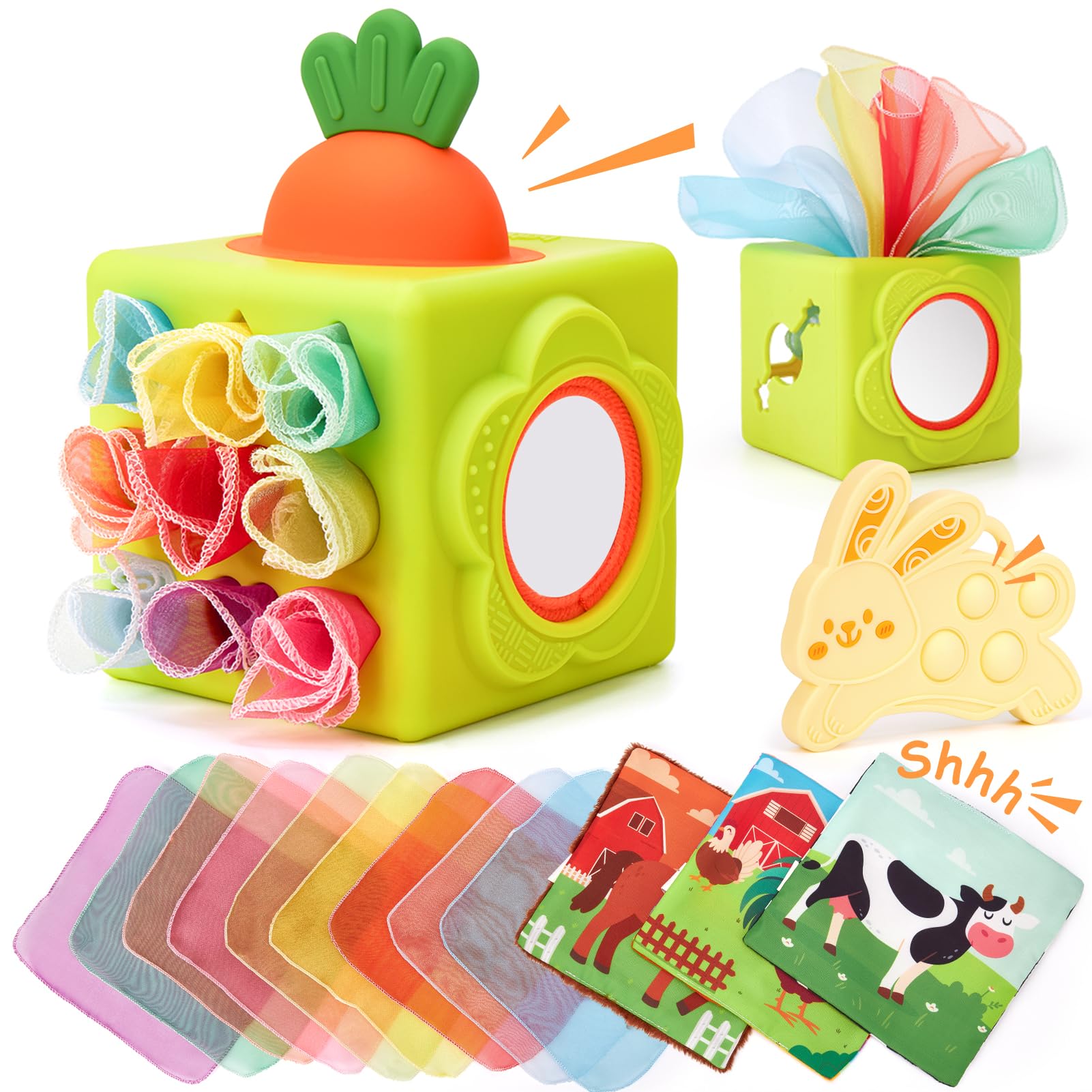
This silicone tissue box solves the two biggest problems with fabric-based sensory toys: they collapse under baby’s grip, and they fray after a few wash cycles. The hahaland box is molded from a single piece of food-grade silicone that holds its shape, so an infant can pull scarves and crinkle tissues repeatedly without the box caving in. The reinforced stitching on the scarves resists fraying even after dozens of pulls and teething sessions.
Each of the six sides offers a different interaction — a tissue pull slot, a carrot pop, a textured sheep, a baby-safe mirror, shaped openings, and a loading hole that teaches object permanence. The included silicone bunny teether with pressable bubbles adds a fine-motor challenge that engages infants from six months well into the second year. The entire set is easy to wipe clean and contains no loose parts that could become choking hazards.
The Montessori-inspired design means every action the baby takes — pulling, pushing, popping — triggers a predictable sensory reward. That repetition builds the neural pathways for cause-and-effect reasoning and hand-eye coordination. Parents report that the toy holds attention for longer stretches than most single-function alternatives, making it a strong anchor for independent play.
Why it’s great
- Sturdy silicone construction won’t collapse or fray
- Six distinct activities target fine motor, object permanence, and sensory exploration
- Easy to clean and includes teether element
Good to know
- Minimum recommended age is 6 months; newborns may not have the grip strength to pull scarves effectively
- Scarves can get lost if not stored back inside the box
2. Baby Einstein Ocean Explorers Kick & Play Pad

Five large kick buttons sit on a soft, colorful mat that can be attached to a crib rail for reclined play or detached for tummy time and seated floor sessions. Each button activates lights, music, and sounds, and the three distinct play modes — Melody, Piano, and Discovery — keep the toy engaging as the infant grows from reflexive kicking to intentional tapping. Discovery Mode introduces colors, numbers, and shapes in three languages, providing early language exposure without overwhelming the child.
The musical feedback is responsive: a kick in Piano Mode produces a clear marimba tone, while Melody Mode plays pre-composed tunes that teach pattern recognition. The lights are bright enough to attract visual attention but not harsh, and the mat material is machine-washable for inevitable drool and spit-up. The unit requires three AA batteries, which are not included.
Where this toy excels over simpler musical mats is the cause-and-effect precision. An infant who kicks hard gets the same response as a gentle tap, which means even low-mobility babies can trigger the learning loop. The three-language option is a rare feature at this tier and adds genuine cognitive variety. The 15.75 x 10.63-inch pad fits most standard cribs and travel playards.
Why it’s great
- Three learning modes adapt to infant development from 0 to 18+ months
- Multilingual language exposure in Discovery Mode
- Detachable for tummy time and seated play
Good to know
- Requires 3 AA batteries not included
- Some parents find the volume cannot be adjusted low enough for very quiet spaces
3. Duchong Pop Up Toy

The Duchong pop-up toy uses four different mechanical triggers — a lever, a switch, a dial, and a button — each requiring a distinct fine-motor action to pop open a hidden animal. This variety is critical: it forces the infant to adapt their grip and motion rather than repeating the same swipe or tap. The animal pops up with a name and sound in Animal Sound Mode, reinforcing vocabulary alongside the physical reward.
Game Mode adds a light-following challenge: the infant must activate the correct button based on a flashing LED, which teaches visual tracking and selective attention. Quiet Mode allows the animals to pop up without any music or sound, making it useful for car rides or waiting rooms where silence is appreciated. The housing is ABS plastic, polished smooth and BPA-free, and the four animals are large enough that they present no choking hazard.
Batteries are not included (three AA), but the quiet mode works entirely mechanically, so the toy retains some learning value even when the batteries die. The 1 x 0.99 x 1-inch dimensions listed in the specs appear to be a data error — the actual unit is roughly the size of a small shoe box, appropriate for a 6–12 month old’s lap or tabletop play.
Why it’s great
- Four distinct mechanical triggers teach varied fine-motor skills
- Quiet Mode maintains play value without batteries
- Animal sounds and names boost early vocabulary
Good to know
- Minimum age is 12 months; younger infants may lack the dexterity for the smaller switch and dial
- Batteries required for sound and light modes
4. 2PCS Crinkle Touch Feel Books

This two-book set covers Jungle Tails and Marine Life, with 13 distinct fabric textures sewn into the pages — corduroy, crinkle, satin, felt, and more. Each texture extends as a 3D tail beyond the book’s edge, giving infants a grab-able target that is difficult to miss during tummy time. The crinkle paper between the fabric layers produces a satisfying rustle when squeezed or turned, providing immediate auditory feedback without batteries.
The books include a BB sound device inside the crocodile on one page, adding a squeak element that surprises and delights. The high-contrast illustrations are designed for developing vision, and the straps allow the books to hang from a stroller, car seat, or play gym. At just 0.1 kilograms, they are light enough for an infant to lift and wave, and the fabric is machine-washable and odourless.
Compared to cardstock or vinyl books, this set is genuinely indestructible — no torn pages or sharp edges. The main limitation is that the books are passive: they reward touch and grip, but they do not teach cause-and-effect beyond the crinkle sound. They work best as a first sensory tool for tummy time and as a portable distraction during travel, not as a primary developmental toy for older infants.
Why it’s great
- 13 distinct fabric textures promote tactile differentiation
- Crinkle sounds and BB device provide auditory reward without batteries
- Lightweight, washable, and hangable for travel and stroller use
Good to know
- Passive design — no mechanical cause-and-effect interaction
- Limited developmental range; best for 0–6 months tummy time
5. Baby Montessori 4-in-1 Shape Sorter Set
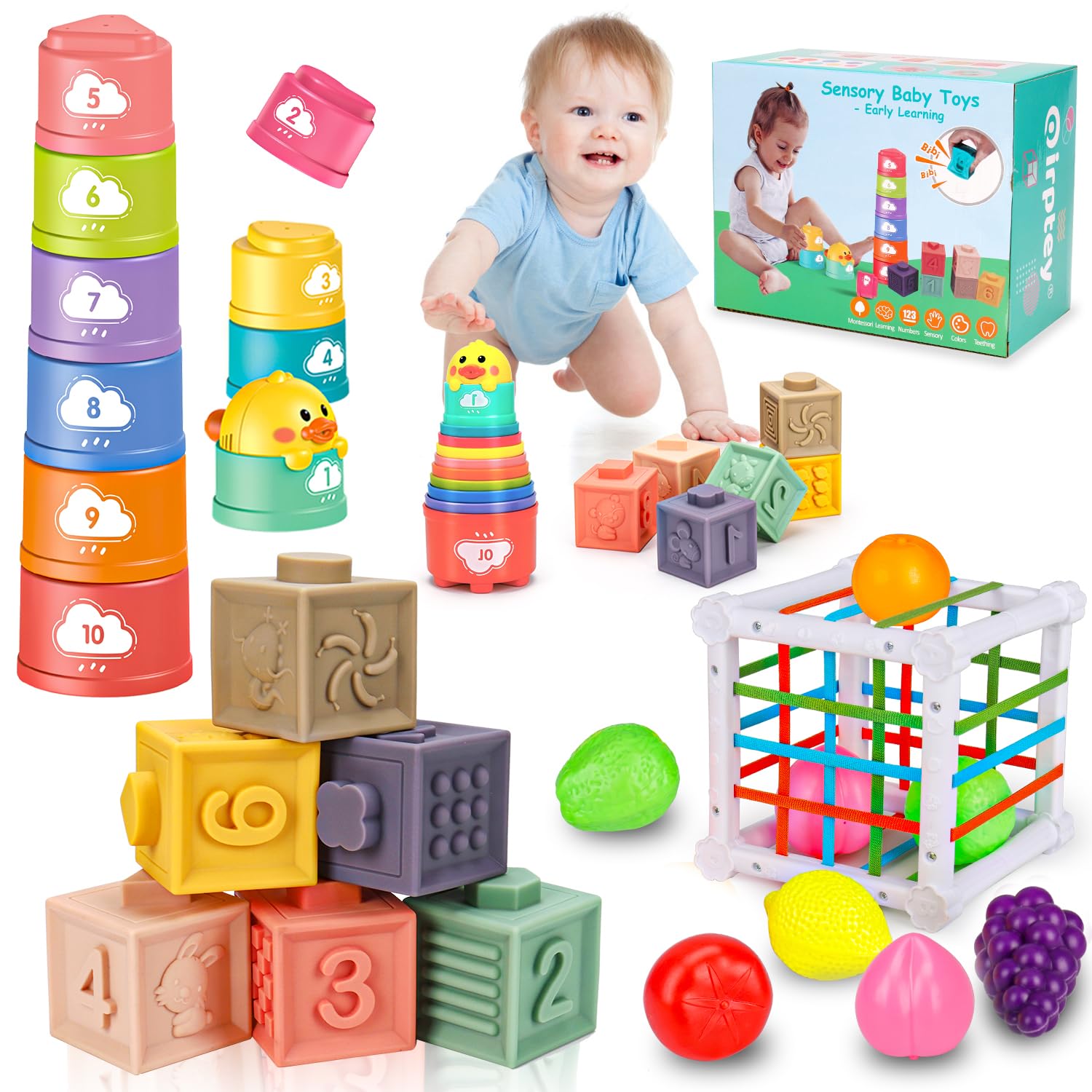
This 4-in-1 set combines stacking blocks, stacking cups, a shape sorter bin, and teething toys into a single package, all made from food-grade silicone and high-quality ABS. The shape sorter bin features six fruit-shaped blocks (guava, orange, peach, tomato, lemon, grape) that are sized for an infant’s palm and have a soft, squeezable texture that makes them easy to grip. Each block has an embossed animal or number for additional sensory detail.
The stacking cups are nested and textured on the outside, with numbers printed on the base so they double as counting tools for older infants. The blocks can be submerged for bath play without water damage. The teething toys are integrated into the set — the fruit blocks are made from silicone that can be chilled for gum relief. The construction is reinforced; no seams or glued parts that could separate during mouthing.
The primary educational aim is shape recognition and spatial awareness, but the set also supports color identification, counting, and fine-motor stacking. The minimum age listed is 18 months, which feels conservative — the teething elements and simple stacking work well from 9 to 12 months, while the shape sorting challenges older toddlers. The trade-off for the material quality is that the set is heavier than all-fabric alternatives, and the sorter bin could be larger for easier access.
Why it’s great
- Four functions in one set — stacking, sorting, teething, and counting
- Food-grade silicone and ABS construction safe for mouthing
- Fruit-shaped blocks are easy to grip and embossed for extra texture
Good to know
- Shape sorter bin could be larger for easier access
- Minimum age of 18 months may undersell its value for 9–12 month olds
FAQ
At what age should I introduce crinkle books to my infant?
Are electronic kick pads safe for newborns?
How do silicone toys compare to wooden toys for teething?
Why do some learning toys specify a minimum age of 12 or 18 months?
Final Thoughts: The Verdict
For most parents, the learning toys for infants winner is the hahaland Silicone Tissue Box because it packs six distinct Montessori activities into a single food-grade silicone unit that is easy to clean and stays engaging from six months well into the second year. If you want cause-and-effect learning with language exposure, grab the Baby Einstein Kick & Play Pad. And for a versatile stacking and sorting set that doubles as teething relief, nothing beats the Baby Montessori 4-in-1 Shape Sorter Set.