At six months, your baby’s brain is exploding with new connections — every rattle, crinkle, and pull builds neural pathways that shape motor control, cause-and-effect logic, and sensory integration. The right toy doesn’t just distract; it actively challenges your infant to reach, grasp, shake, and problem-solve without overstimulating fragile attention spans.
I’m Emma — the founder and writer behind Baby Bangs. I’ve spent years analyzing the developmental milestones of this specific age window and the hardware that supports them, from fabric GSM ratings to silicone durometer and rattle decibel levels.
The demand for genuinely developmental learning toys for 6 month old infants has surged, but most marketed options are either visually overwhelming or lack the tactile variety needed for real sensory growth.
How To Choose The Best Learning Toy For 6 Month Old
A 6-month-old is in the thick of sensorimotor exploration — everything goes to the mouth, and every interaction teaches cause and effect. The ideal toy balances safety, sensory variety, and developmental challenge without overwhelming a baby who can’t yet crawl fully or sit unassisted for long periods. This guide breaks down the three critical pillars to evaluate before you buy.
Material Safety and Gum-Friendly Design
Babies this age explore primarily with their mouths, so material safety is non-negotiable. Look for food-grade silicone, BPA-free ABS, or certified non-toxic plush with reinforced stitching that won’t fray. Avoid hard plastics with sharp edges or small parts that could pose a choking hazard — the AAP warns that any object small enough to fit inside a toilet paper roll is dangerous for a 6-month-old. Silicone offers the best balance: it’s firm enough to hold shape during pulls, soft enough for teething, and easy to sanitize.
Sensory and Motor Skill Demands
At six months, babies are developing the pincer grasp (thumb and forefinger), trunk rotation, and early cause-and-effect logic. The best learning toys present a variety of tactile experiences — crinkles, squeakers, rattles, mirrors, and textured surfaces — that encourage reaching, grasping, pulling, and shaking. A toy that only lights up or makes electronic sounds is passive entertainment. A true developmental toy requires the baby to act: pull a scarf, squeeze a block, stack a cup, or push a button. That active engagement builds neural pathways in a way flashy lights cannot.
Portability and Cleanability for Real-Life Chaos
Life with a 6-month-old involves drool, spit-up, travel, and constant rotation of activities. A toy that’s difficult to clean will become a bacteria trap. Silicone and ABS plastic wipe down easily and can be tossed in the dishwasher. Plush toys should be machine-washable or spot-clean only. Size and weight matter, too — a compact, lightweight toy that fits in a diaper bag and can be secured with a strap or clip makes it a true travel companion. Avoid oversized inflatables if you’re flying; save those for tummy time at home.
Quick Comparison
On smaller screens, swipe sideways to see the full table.
| Model | Category | Best For | Key Spec | Amazon |
|---|---|---|---|---|
| hahaland Silicone Tissue Box Toy | Silicone Activity Cube | Fine motor & object permanence | 6-in-1 silicone cube with 9 scarves & 3 crinkle tissues | Amazon |
| hahaland Sensory Garden Plush Set | Plush Sensory Garden | Tactile variety & travel play | 11-piece set with squeaker, mirror, crinkle & rattle | Amazon |
| Jyusmile 5-in-1 Montessori Set | Complete Montessori Bundle | Versatile learning on the go | 5-in-1 includes pull string, rattle, blocks, rings, balls | Amazon |
| Qirptey 4-in-1 Shape Sorter Set | Silicone & ABS Sorter | Shape sorting & teething in one | 4-in-1 with shape sorter, stacking cups, blocks & teether | Amazon |
| Thremhoo Jumbo Inflatable Roller | Inflatable Crawling Toy | Tummy time & crawling motivation | Glow-in-the-dark sequin roller with rattling balls inside | Amazon |
In‑Depth Reviews
1. hahaland Silicone Tissue Box Toy
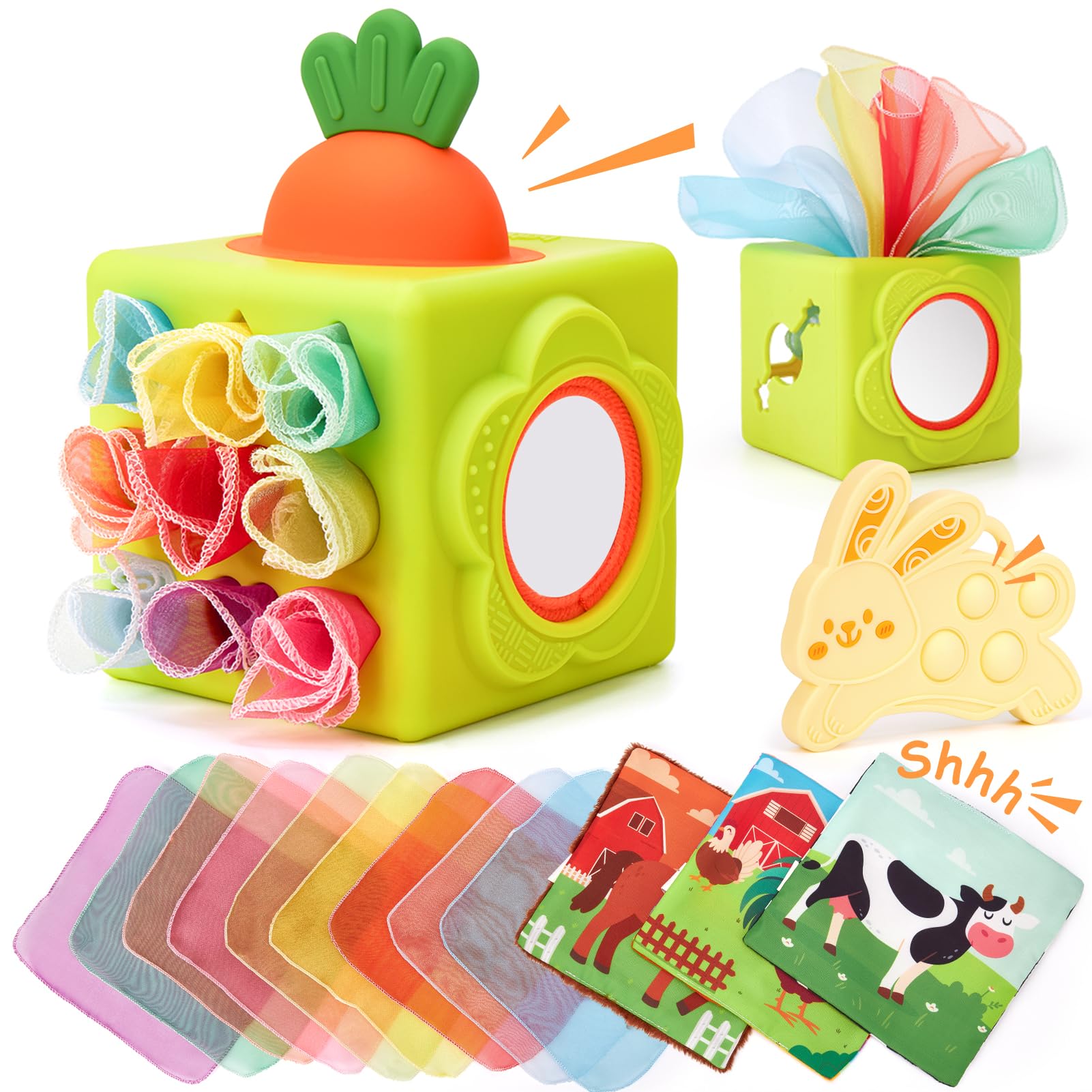
This 6-in-1 activity cube from hahaland is the most thoughtfully designed single-toy solution for a 6-month-old’s developmental checklist. The silicone body mimics a real tissue box, so babies practice the cause-and-effect “pull and drop” sequence that builds object permanence and hand-eye coordination. Each face of the cube offers a different challenge: a pull slot for scarves, a carrot push-and-pop, large loading openings for shape posting, textured sheep patches, and a baby-safe mirror for self-recognition.
The included accessories — 9 colorful pull scarves with reinforced stitching, 3 crinkle sensory tissues, and a detachable silicone bunny teether with pressable bubbles — provide layered sensory input without overwhelming noise or flashing lights. At roughly 4.7 inches cubed, it’s compact enough for travel but heavy enough (due to solid silicone) to stay put during tugging. The silicone is free of BPA, phthalates, and lead, and it can be wiped clean or tossed in the dishwasher after a particularly slobbery session.
Parents who have tried flimsy fabric tissue boxes report that this silicone version solves the two biggest frustrations: the box collapses under repeated pulls (it doesn’t), and the scarves fray at the seams (these are reinforced). The bunny teether also doubles as a sensory popper, extending play value through the 12-month mark. For a single purchase that covers motor skills, teething relief, and sensory exploration, this is the strongest value in the category.
Why it’s great
- Silicone construction stays upright during vigorous pulling — no flimsy collapse
- Reinforced scarf stitching prevents fraying after repeated washing
- Detachable teether popper adds separate sensory channel for teething relief
Good to know
- Scarves may need air-drying to maintain crinkle texture after machine washing
- Some babies may prefer more variety than the single cube format offers
2. hahaland Sensory Garden Plush Set

Where the silicone tissue box excels at structured repetition, this sensory garden set from hahaland covers the opposite need: broad, open-ended tactile exploration. The set contains 11 pieces — plush carrots, flowers, fruits, and veggies — each with a different sensory feature: squeaker, rattle, crinkle paper, varied fabric textures, and a baby-safe mirror built into the play box lid. The garden theme encourages “planting” and “pulling” motions that strengthen the forearm muscles babies will need for crawling and later for handwriting.
What sets this apart from typical plush sets is the hidden pocket feature. Inside the sensory box, a concealed pocket holds crinkle tissue “surprises” that babies discover through tugging — a small but meaningful object permanence exercise. The plush is tested against regulatory safety standards, and there are no small parts that could detach. The entire kit packs into the box, making it a self-contained travel activity that fits in a diaper bag without losing pieces.
The facial expressions on each plush piece are deliberate — happy faces help babies begin to associate visual cues with emotion, and the mirror lets them practice matching those expressions on their own face. For a 6-month-old who is starting to sit up and reach, this is a rich, low-stimulation alternative to light-up electronic toys. The only tradeoff is that the plush material is less durable than silicone during teething — supervised play is recommended to prevent fabric wear.
Why it’s great
- Hidden crinkle pocket adds surprise object permanence challenge
- Self-contained box stores all pieces neatly for travel and cleanup
- Facial expressions on each piece aid early emotion recognition learning
Good to know
- Plush material may show wear from persistent teething — supervise mouth play
- Mirror surface can smudge easily and needs regular wiping
3. Jyusmile 5-in-1 Montessori Set
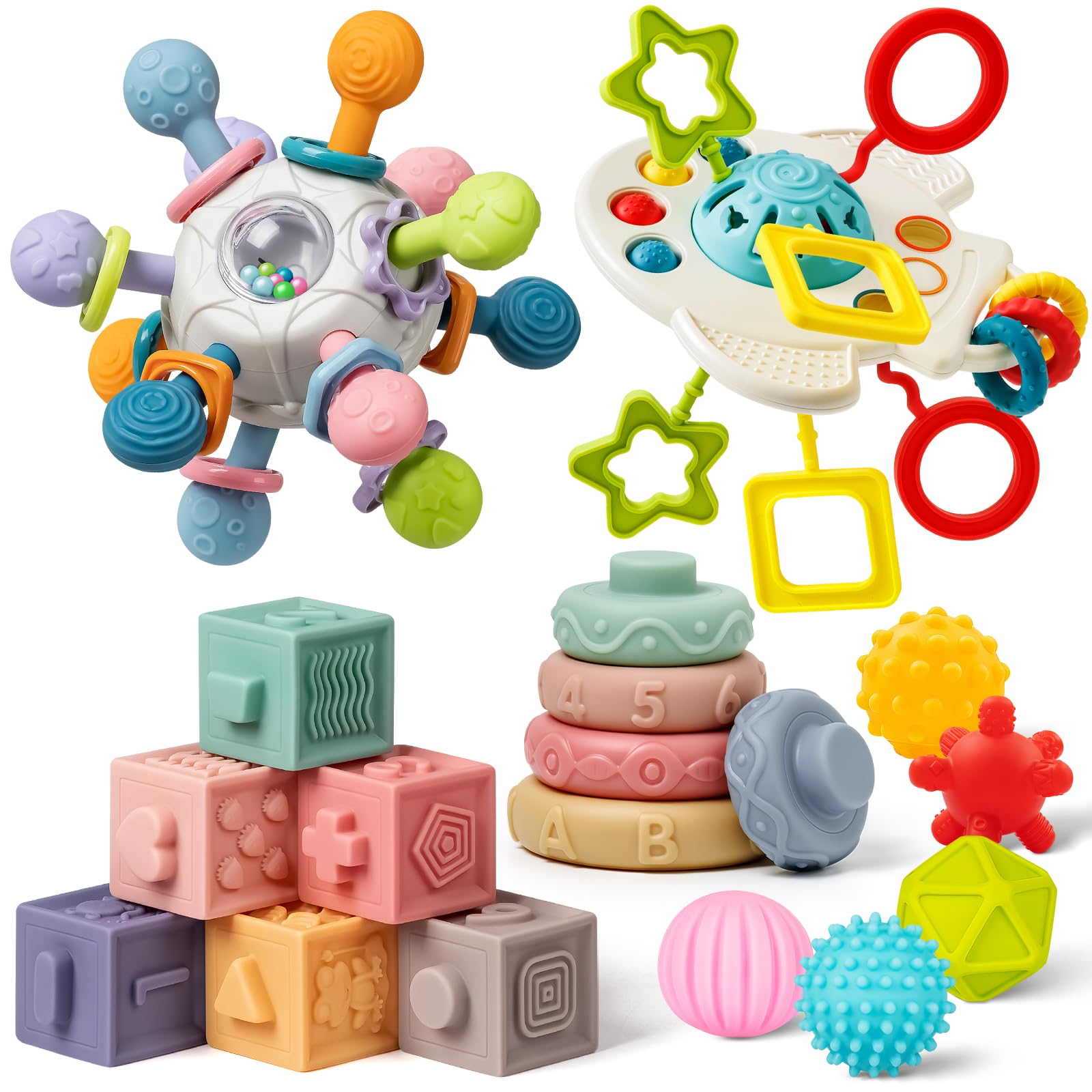
This bundle is a practical, no-frills starter kit for parents who want to test several learning modalities without buying five separate toys. The set includes a pull string toy with a unique airplane design, a rattle teether with 12 soft rubber tips, 6 stacking blocks, 5 stacking rings, and 5 textured sensory balls. Every component is made from BPA-free, non-toxic, food-grade materials, and the entire set weighs under 2 pounds, making it easy to rotate pieces throughout the day.
The pull string toy deserves special mention for its travel-friendly design — the silicone pull cords, pop bubbles, sliding button ball, and built-in jingle ball offer five distinct actions in one palm-sized unit. The stacking rings and blocks introduce early color and number identification, and the textured balls provide variable grip challenges that build hand strength. The rattle teether, with its 12 rubber tips, doubles as a gum massager for teething pain while producing a soft rustle and click when twisted — satisfying the 6-month-old obsession with cause and effect.
The broadest weakness is that no single component matches the depth of the standalone tissue box or sensory garden — each piece is good but not exceptional. However, for parents who want maximum variety in a single purchase, this set delivers more distinct play actions than any other product in this roundup. The blocks and rings work well as bath toys, extending utility into the 12-month range.
Why it’s great
- Five distinct toy types in one package — excellent variety for the price
- Pull string toy packs multiple actions in a travel-friendly size
- Squeezable blocks and rings produce squeaking sounds that reinforce cause-effect
Good to know
- No single component has the depth of a dedicated developmental toy
- Stacking blocks may be too lightweight for babies who still mouth aggressively
4. Qirptey 4-in-1 Shape Sorter Set
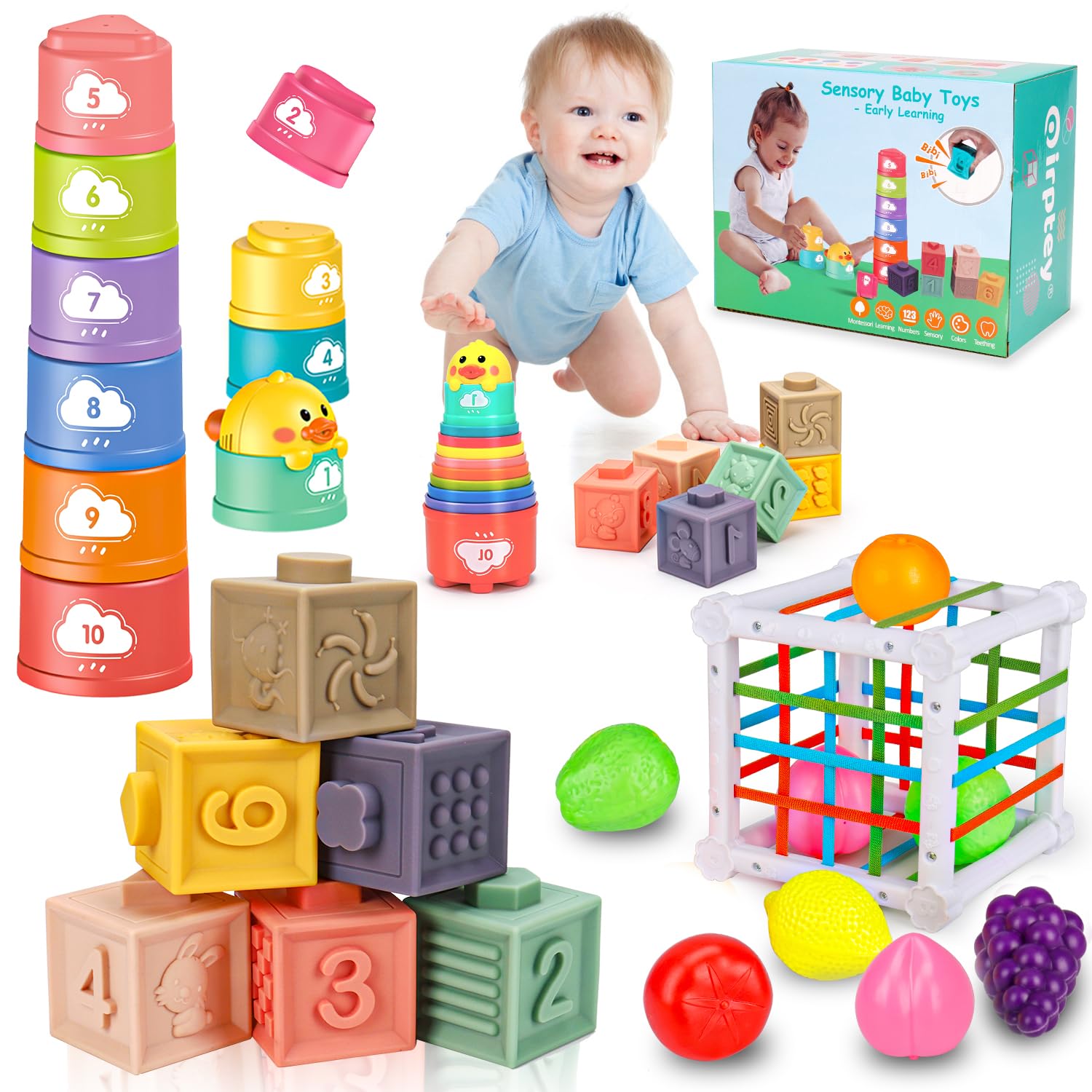
Designed with older infants in mind (manufacturer minimum age is 18 months), this set still works well for advanced 6-month-olds who are already sitting and reaching with purpose. The 4-in-1 configuration includes stacking blocks with embossed animals and numbers, stacking cups with textured exteriors, a shape sorter bin with fruit-shaped pieces (guava, orange, peach, tomato, lemon, grape), and a silicone teether that attaches to the bin lid. The hybrid material construction — food-grade silicone for the teether and soft parts, high-quality ABS for the sorter bin — ensures durability without sharp edges.
The shape sorter pieces are notably larger than average — about 2 inches each — which makes them safe for mouthing but still challenging for the developing pincer grasp. The fruit shapes provide a natural color-recognition learning opportunity without cartoonish distortion. The cups can be stacked, nested, or used in the bath, and the embossed textures on the blocks offer tactile variety. Parents report that the silicone teether portion stays securely attached to the bin but is easy to remove for separate play or dishwasher cleaning.
The main limitation for the 6-month-old is that the full shape-sorting task requires problem-solving skills that typically emerge closer to 9-10 months. At 6 months, most babies will enjoy mouthing the pieces and banging the cups together rather than correctly sorting. That’s fine for sensory exploration, but if you want a toy that will challenge your baby at exactly 6 months, the tissue box or sensory garden offers more age-appropriate tasks. This set has strong longevity through age 2.
Why it’s great
- Large fruit-shaped pieces are safe for mouthing and easy to grasp
- Silicone teether attaches to bin but removes for separate play
- Stacking cups work as bath toys — extends utility well past 12 months
Good to know
- Shape sorting is developmentally advanced for most 6-month-olds
- ABS bin may be too rigid for aggressive teething — supervise mouth contact
5. Thremhoo Jumbo Inflatable Roller
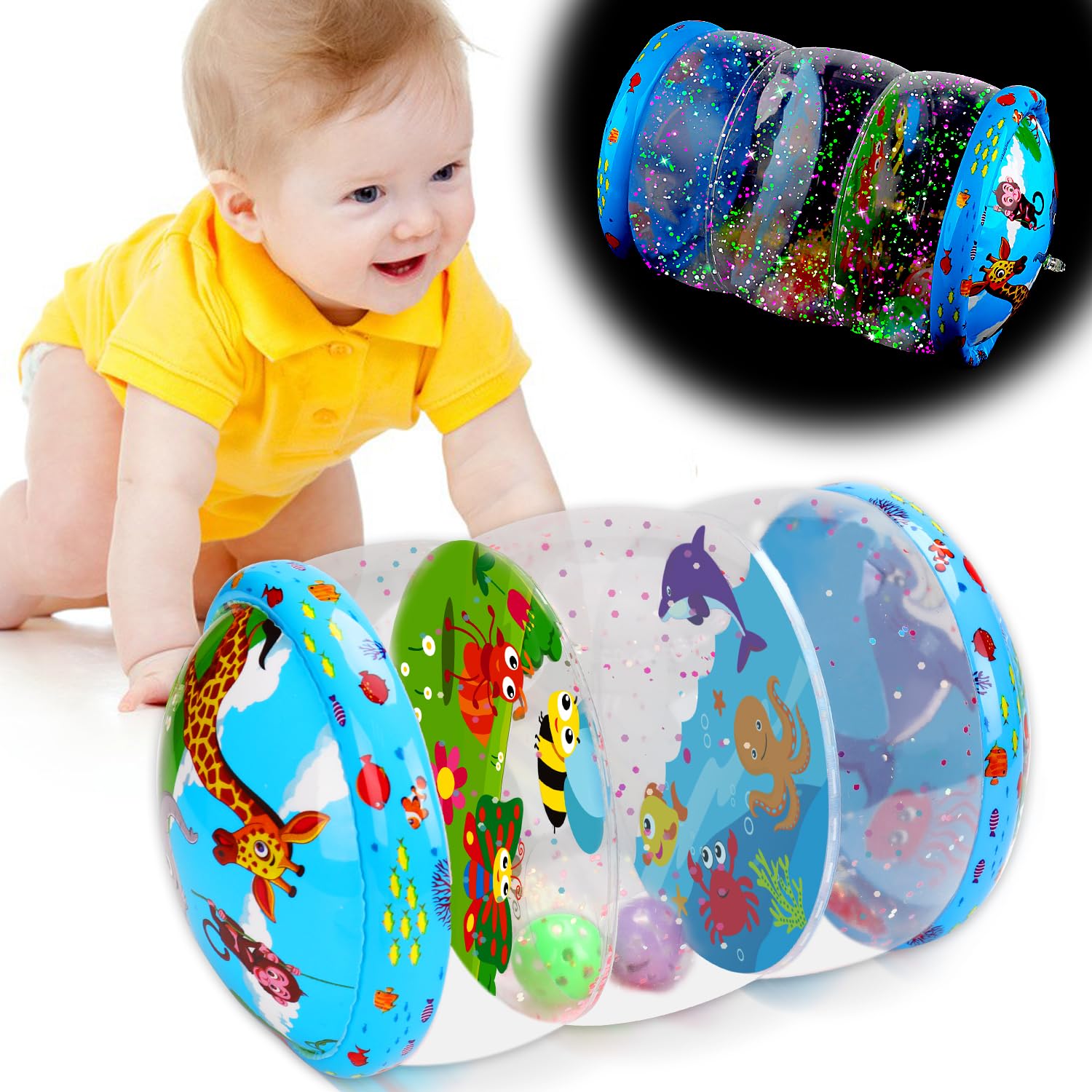
While most learning toys for 6-month-olds focus on seated or stationary play, this inflatable roller addresses the critical milestone of crawling. At 16 inches long and 8.5 inches tall, it’s large enough to roll when pushed but light enough (0.18 kilograms) for a baby to influence its movement. The exterior features glow-in-the-dark sequins that shift color as the roller turns, plus animal graphics of sea and land creatures that double as vocabulary starters for parents narrating playtime.
The roller contains two rattling balls inside that shift with every tumble, creating an auditory reward that encourages the baby to crawl after it. The glow effect requires pre-charging under direct light (sunlight or lamp), but the sequins are bright enough to hold attention in dim rooms. The inflatable construction makes it easy to deflate for travel, and the plastic is non-toxic and easy to wipe clean. For babies who are already scooting or army-crawling, this toy can accelerate the transition to hands-and-knees crawling by providing a moving target that responds to their actions.
The main limitation is that the material is thin vinyl — while non-toxic, it’s not teething-resistant. A determined baby with emerging teeth can puncture it, and the sequins are attached to the surface, not embedded, so aggressive mouthing may loosen them. This is best used as a supervised tummy time and crawling aid rather than a chew toy. Also, the manual inflation process (no pump included) requires lung effort and the ball inside can be a choking hazard if the vinyl ruptures — inspect regularly for wear.
Why it’s great
- Moving target with rattling balls actively motivates crawling practice
- Glow-in-the-dark sequins add visual appeal during dim-light tummy time
- Deflates for easy travel and compact storage
Good to know
- Thin vinyl is vulnerable to punctures from emerging teeth
- Sequins and internal balls pose choking risk if material tears — inspect often
FAQ
What is the single most important feature to look for in a learning toy for a 6-month-old?
Is an electronic light-up toy appropriate for a 6-month-old?
How many different textures does a 6-month-old need in one toy?
Can a shape sorter work for a 6-month-old or is that too advanced?
Final Thoughts: The Verdict
For most parents seeking a single, high-impact purchase, the best learning toys for 6 month old is the hahaland Silicone Tissue Box Toy because its silicone construction, layered sensory channels, and cause-and-effect mechanics directly target the 6-month developmental checklist without overstimulation. If you want maximum tactile variety for open-ended exploration, grab the hahaland Sensory Garden Plush Set. And for a budget-friendly starter kit that covers five learning modalities in one box, the Jyusmile 5-in-1 Montessori Set offers unbeatable variety for the investment.