Eight-year-olds have crossed a threshold: they can follow multi-step instructions, understand cause and effect, and crave challenges that feel like real work. The best learning toys for this age don’t just occupy hands; they stretch thinking. Whether it’s snapping together a circuit that powers a flying saucer or programming a robot to navigate a course, these kits teach physics, coding, and engineering principles through direct, satisfying play.
I’m Emma — the founder and writer behind Baby Bangs. I spent the last decade analyzing kids’ STEM toy data, studying which specifications actually drive engagement versus which features just look good on the box.
After sorting through hundreds of customer reports and technical specs, I narrowed the field to seven kits that genuinely build skills. This guide to the learning toys for 8 year olds covers building kits, science labs, and electronic sets that turn screen time into hands-on problem solving.
How To Choose The Best Learning Toy For An 8 Year Old
Eight-year-olds are in a sweet spot: they can handle small parts, read basic instructions, and persist through multi-step builds. The right kit balances open-ended creativity with structured outcomes. Focus on three things: the volume of repeatable projects, the complexity of the core skills taught, and whether the kit includes interactive feedback like motion, light, or sound.
Project Count and Replay Value
Kits with 100+ experiments or 10+ build configurations offer significantly more long-term engagement than single-project sets. A child who finishes one circuit build and stops has learned less than a child who builds 15 variations. Look for manuals with clear step-by-step illustrations and bonus experiment suggestions that use household items.
Interactive Feedback
Kids at eight are motivated by cause-and-effect. Toys that include motors, LEDs, buzzers, or app-based control systems create immediate feedback loops. A robot that actually moves after assembly or a circuit that plays a song reinforces understanding of why the build worked. Purely passive construction kits often lose appeal after the first assembly.
Quick Comparison
On smaller screens, swipe sideways to see the full table.
| Model | Category | Best For | Key Spec | Amazon |
|---|---|---|---|---|
| Thames & Kosmos Roller Coaster Engineering | Physics / Building | Learning force & motion | 32-page manual with physics explanations | Amazon |
| National Geographic Circuit Maker | Circuitry | Safe electronics exploration | 120+ electrical projects, no tools needed | Amazon |
| IQKidz APP/Remote Control Robot | Robotics / Coding | Intro to programming | 440 pieces, app & remote control | Amazon |
| SMILESSKIDDO Snap Circuits | Circuitry | High project variety | 420+ projects, 35 circuit parts | Amazon |
| Doctor Jupiter Ultimate Science Kit | Chemistry | Hands-on lab experiments | 135+ experiments, separate leak-proof bottles | Amazon |
| Educational Insights Math Whiz | Math Skills | Building arithmetic fluency | 3 game modes, 8 difficulty levels per skill | Amazon |
| choopheme 10 in 1 Stem Building Kit | Construction | Early engineering / vehicle builds | 10 build models, 112 pieces storage box | Amazon |
In‑Depth Reviews
1. Thames & Kosmos Roller Coaster Engineering STEM Kit
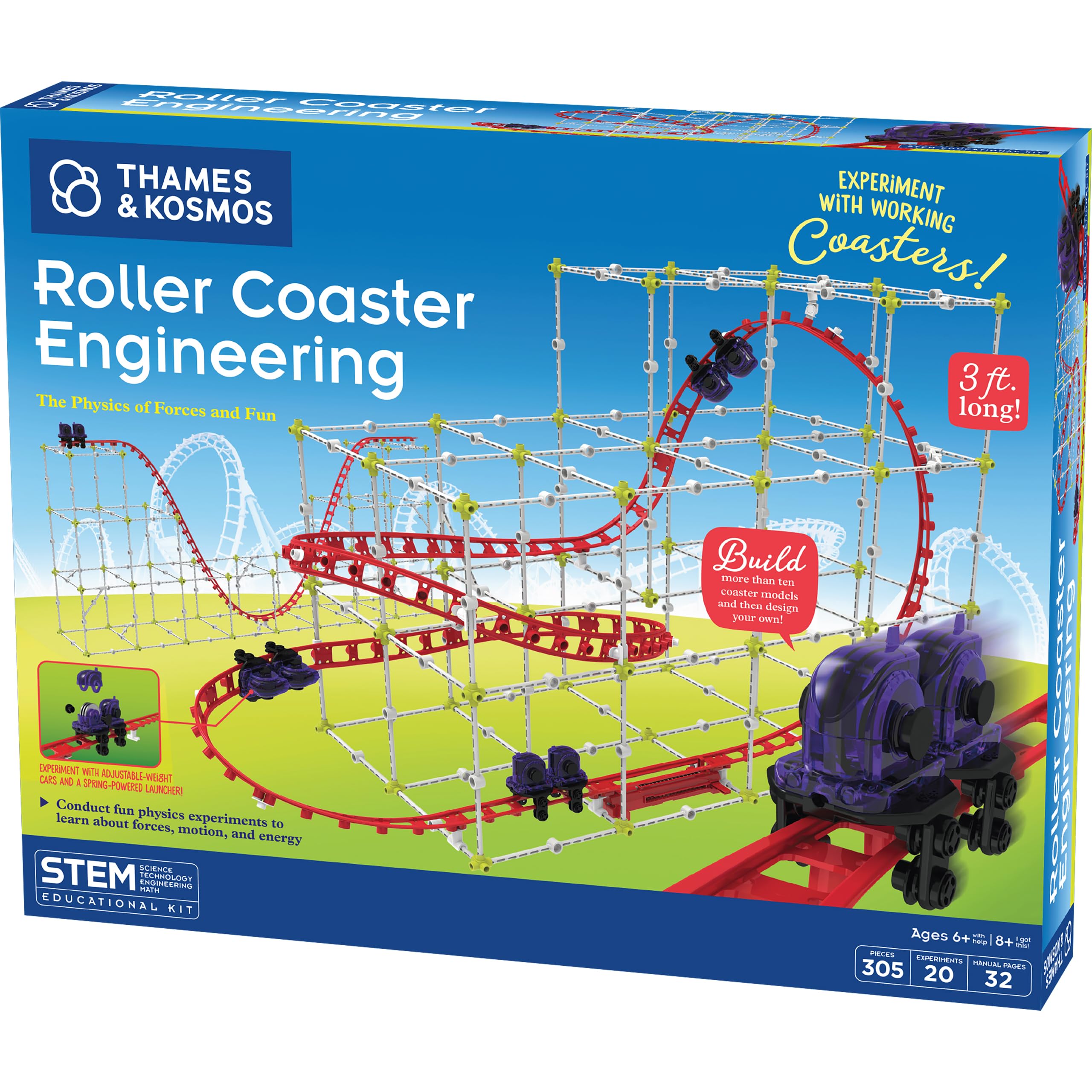
This kit is a masterclass in applied physics. Kids design and build working roller coaster models, experimenting with loops, drops, and curves to explore force, motion, energy, and velocity. The durable plastic building system snaps together securely and is fully reusable, so your child can keep rebuilding and testing new configurations long after the first coaster is done.
The 32-page full-color manual does more than show assembly steps—it explains the science behind each section. When your child watches the car complete a loop without falling, they intuitively grasp centripetal force. Challenging building tasks at the end encourage iterative thinking: failed coasters get redesigned, not abandoned.
No batteries or electronics are involved, which makes this a pure mechanical-engineering lesson. For an eight-year-old who loves understanding how things work, this kit delivers genuine cognitive stretch without any screen distraction.
Why it’s great
- Teaches real physics concepts (force, energy, velocity) through hands-on building.
- Reusable parts mean endless coaster redesigns.
- Detailed manual combines building instructions with scientific explanations.
Good to know
- No electronics or moving parts beyond the car itself—purely mechanical.
- Some younger 8-year-olds may need adult help with tricky track alignments.
2. National Geographic Circuit Maker Kit

National Geographic brings its trusted educational approach to electronics with this 120-project circuit kit. The components snap together securely with included wires—no soldering or additional tools required. Kids can build a keyboard that plays songs, create a light show with multiple LEDs, amplify their voice through a sound system, and even power a spinning copter.
Safety is a clear priority: the components are designed for complete protection, and the illustrated instructions include a QR code linking to video walkthroughs. The “no tools needed” design means an eight-year-old can independently swap components and test new circuit configurations. Projects range from simple single-LED builds to more complex parallel circuits.
This award-winning set from Blue Marble (Toy of the Year winner) is the cleanest introduction to circuitry I’ve seen for this age group. It teaches the language of electrical engineering through direct experimentation, and the variety of outputs—sound, light, motion—keeps engagement high through the 120th project.
Why it’s great
- 120+ unique projects provide months of exploration.
- Snap-on connections make circuit building safe and frustration-free.
- Video instructions support independent learning.
Good to know
- Requires AA batteries which are not included.
- Ideal for ages 8+, but some projects benefit from adult guidance.
3. IQKidz APP/Remote Control STEM Robot Kit
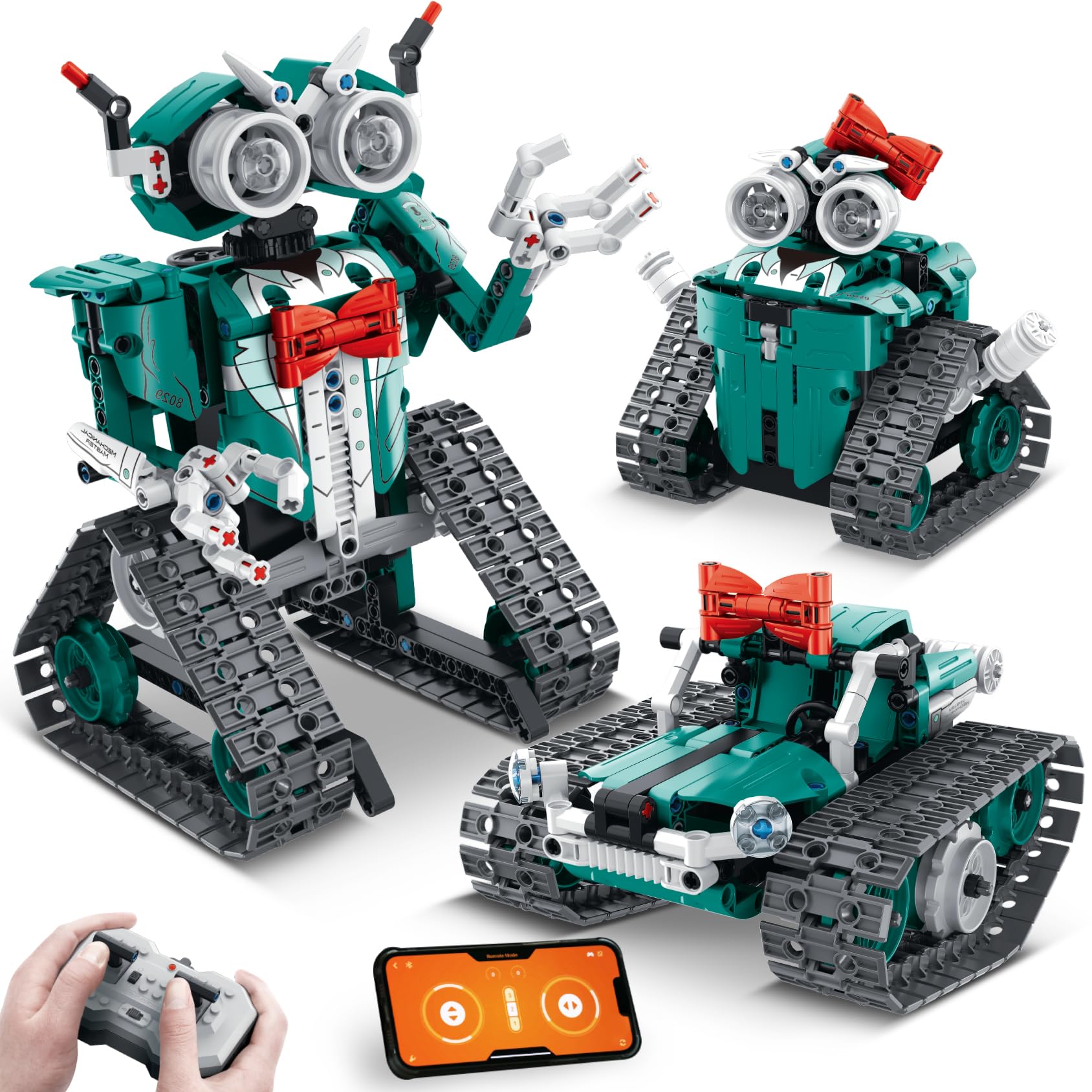
This 3-in-1 building kit combines construction, robotics, and introductory programming. With 440 pieces, your child can build a robot with movable fingers and a red bowtie, then rebuild it into a stunt tank or a robot girl. The high piece count and multiple build options keep the hands busy for hours.
The real star is the control system. Kids can use the included remote control or the easy-to-use app to make their robot move forward, backward, turn, spin, and follow a programmed path. This teaches basic coding logic—sequencing commands to create autonomous behavior. The app interface is intuitive enough for an eight-year-old to start programming within minutes.
All pieces are made from sturdy plastic that won’t easily separate during play. The set includes extra parts to cover lost pieces, and it runs on disposable batteries for simple replacement. For a child fascinated by robots and electronics, this kit bridges building and coding in one cohesive experience.
Why it’s great
- Three build options extend replay value significantly.
- App-based programming teaches coding logic without a computer screen.
- Sturdy plastic construction holds up to active play.
Good to know
- Requires disposable batteries for the robot and remote.
- Some younger builders may need help with the initial assembly of complex joints.
4. SMILESSKIDDO Electronics Exploration Kit

With over 420 projects and 35 circuit components, this kit from SMILESSKIDDO offers the highest project count in this roundup. Kids can build circuits that include a spray module, RGB lights, flying saucer accessories, and more. It introduces concepts like parallel and series connections without needing any soldering or extra tools.
The included 37-page manual and four indicator cards guide building through 118 structured examples, then free assembly encourages kids to experiment independently. Components simply snap onto the plastic plate, making it easy to swap parts and test new ideas. The kit does require AA batteries (not included) to power the projects.
For an eight-year-old who burns through projects quickly, the sheer scale of this set ensures they won’t run out of new configurations to try. The mix of standard outputs (lights, sounds) with the unique spray module adds novelty that standard circuit kits don’t offer.
Why it’s great
- 420+ projects is the highest count available at this tier.
- Snap-together design requires zero soldering or tools.
- Includes unique components like a spray module and flying saucer.
Good to know
- Some younger users may be overwhelmed by the sheer number of pieces.
- AA batteries are required but not included.
5. Doctor Jupiter Ultimate Science Kit

Doctor Jupiter’s kit packs 135+ experiments into one box, ranging from color-changing liquids and glowing water to underwater volcanoes and magic potions. The chemical materials come in separate leak-proof bottles, which is a critical detail for safety and mess reduction. The included instruction manual and bonus experiment booklet provide clear step-by-step directions with illustrations.
This kit is designed for parent-child bonding, making it a great option for family science nights. The experiments teach real chemical reactions using safe household ingredients alongside the provided chemicals. Kids can also access 90+ bonus experiments online that use everyday items, effectively extending the kit’s life beyond the initial 135 projects.
For an eight-year-old who loves mixing and watching things fizz, bubble, and glow, this is the best hands-on chemistry introduction available. It builds patience, careful measurement, and observation skills—all without requiring any prior science knowledge.
Why it’s great
- 135+ experiments plus 90+ bonus online projects.
- Leak-proof chemical bottles reduce mess and increase safety.
- Easy-to-follow instructions with step-by-step illustrations.
Good to know
- Some experiments require additional household items.
- Adult supervision recommended for chemical-based projects.
6. Educational Insights Math Whiz

Math Whiz is a dedicated handheld game that practices addition, subtraction, multiplication, and division. It offers three distinct modes: Drill, Challenge, and Calculator. Drill mode presents a progressive sequence of problems; Challenge mode turns it into a numbers elimination game; Calculator mode serves as a standard digital calculator for homework help.
Key for sustained learning: each skill has eight difficulty levels. As your child masters facts, the games increase complexity automatically. The LCD screen is clear, and the compact size means it goes in a backpack for road trips, waiting rooms, and car rides. Two AAA batteries are required but not included.
This is the best screen-free option for building math fluency. For an eight-year-old who struggles with times tables or needs extra practice, the gamified format removes the boredom of flash cards while delivering measurable progress.
Why it’s great
- Portable, handheld design makes practice easy anywhere.
- Three modes keep gameplay varied and engaging.
- Eight difficulty levels per skill adapt to growing ability.
Good to know
- Requires 2 AAA batteries not included.
- Focuses exclusively on arithmetic—not broader math concepts.
7. choopheme 10 in 1 Stem Building Block Kit

This 112-piece building block kit can be assembled into 10 different engineering vehicles—bulldozer, toy crane, forklift, windmill, gantry crane, and more. The included instruction manual provides step-by-step assembly pictures for each model, so kids can work independently. The pieces are made of non-toxic plastic and come with a sturdy storage box for cleanup.
For an eight-year-old new to STEM building kits, this is a low-friction starting point. The 10 models range from simple to more complex, allowing kids to progress naturally. Completed models actually move, giving a satisfying mechanical payoff after each build. The set is designed for ages 4-8, so it works well for the younger end of the 8-year-old range.
The biggest limitation is the modest 112-piece count compared to more advanced kits. Kids who complete all 10 builds quickly may want a larger set next. But for a budget-friendly introduction to engineering concepts like gear mechanics and structural stability, this kit delivers perfectly.
Why it’s great
- 10 different vehicle builds teach mechanical variety.
- Non-toxic plastic and sturdy storage box included.
- Clear illustrated instructions support independent building.
Good to know
- 112 pieces limit complexity for more advanced builders.
- Some models may feel repetitive after completing a few builds.
FAQ
What is the ideal project count for an 8-year-old’s STEM kit?
Are circuit kits safe for an 8-year-old who’s never used electronics?
Should I choose a building kit or a chemistry set for my 8-year-old?
Final Thoughts: The Verdict
For most users, the learning toys for 8 year olds winner is the Thames & Kosmos Roller Coaster Engineering because it teaches real physics concepts through iterative building and requires no electronics or screens. If you want a high-project-count electronics introduction, grab the National Geographic Circuit Maker. And for an interactive robotics and coding experience, nothing beats the IQKidz APP/Remote Control Robot Kit.