A cold room only feels colder when the heater blasts hot air at your feet while the far corner stays freezing. Large spaces — living rooms, open-concept apartments, garages, or shop floors — need a unit that actually moves enough heated air to fill the volume, not just toast the spot you’re standing in. The difference between a space that feels “warmer” and one that’s truly comfortable comes down to oscillation range, fan speed in CFM, and whether the heating element matches the square footage.
I’m Emma — the founder and writer behind Baby Bangs. I’ve spent years dissecting heater specifications, cross-referencing coverage claims with real cubic-foot air movement, and tracking which thermostat algorithms actually prevent the room from swinging between hot blasts and chilly drafts.
A real large space heater has to circulate warmth beyond the immediate vicinity, maintain a stable temperature without cycling the fan on and off every five minutes, and do it all while keeping safety certifications and noise levels in check for everyday use.
How To Choose The Best Large Space Heater
Buying a heater for a big room means you cannot rely on the same specs that work for a small bedroom. The key factors shift when you need to maintain warmth across 200 square feet or more — here is what actually separates an effective unit from a wasted outlet.
Forced Air vs Radiant vs Convection — Which Moves Enough Heat?
Radiant heaters warm objects directly but do little to raise ambient air temperature across a large area. Forced-air units use a fan to push heated air outward, making them the most practical choice for open floor plans and garages. Convection panel heaters rely on natural airflow, which works well in sealed rooms but struggles in drafty or high-ceiling spaces. If you need consistent warmth without cold spots, forced air with a ceramic or PTC element delivers the fastest results.
Oscillation Degrees and Airflow Distance
Horizontal oscillation of 90 degrees or more is the minimum for a large room — the heater needs to sweep heat across the width of the space rather than blasting a narrow column. Vertical oscillation, like the 60-degree tilt on the DREO 714, pushes warm air upward so it doesn’t pool on the floor. Also check CFM (cubic feet per minute) claims: units below 100 CFM often leave far corners cold even when they claim high wattage coverage.
Thermostat Logic and ECO Mode Honesty
A heater that cycles on a simple on-off thermostat creates temperature swings of several degrees, making the room feel alternately stuffy and drafty. Look for heaters with adaptive or inverter-based thermostats that modulate power output instead of shutting off completely. True ECO mode measures both temperature and rate of change to keep the room steady at lower average power — this is especially important for large spaces where thermal mass makes recovery slow.
Quick Comparison
On smaller screens, swipe sideways to see the full table.
| Model | Category | Best For | Key Spec | Amazon |
|---|---|---|---|---|
| Ballu Convection Panel | Convection | Silent whole-room warmth | Inverter technology / 250 sq ft primary | Amazon |
| DREO Whole Room Heater 714 | Forced Air | 3D oscillation coverage | 12 ft/s airflow / 60° vertical tilt | Amazon |
| Lasko 751320 Tower | Forced Air | Budget tower for rooms up to 150 sq ft | 1500W ceramic / Widespread oscillation | Amazon |
| JNDRO Wall-Mounted (PTC-SL001) | Radiant | Space-saving wall mount | 120° oscillation / Child lock | Amazon |
| JNDRO 24-Inch Wall Mount (PTC-SL002) | Radiant | Adjustable 900W-1500W settings | 24-inch width / ECO mode thermostat | Amazon |
| DR. INFRARED DR218-3000W | Radiant | Greenhouse / workshop use | 3000W / 600 sq ft coverage | Amazon |
| Dr. Infrared Heater DR-975 | Forced Air | Heavy-duty shop / garage | 7500W / 800 sq ft / Hardwired | Amazon |
In‑Depth Reviews
1. Ballu Convection Panel Space Heater
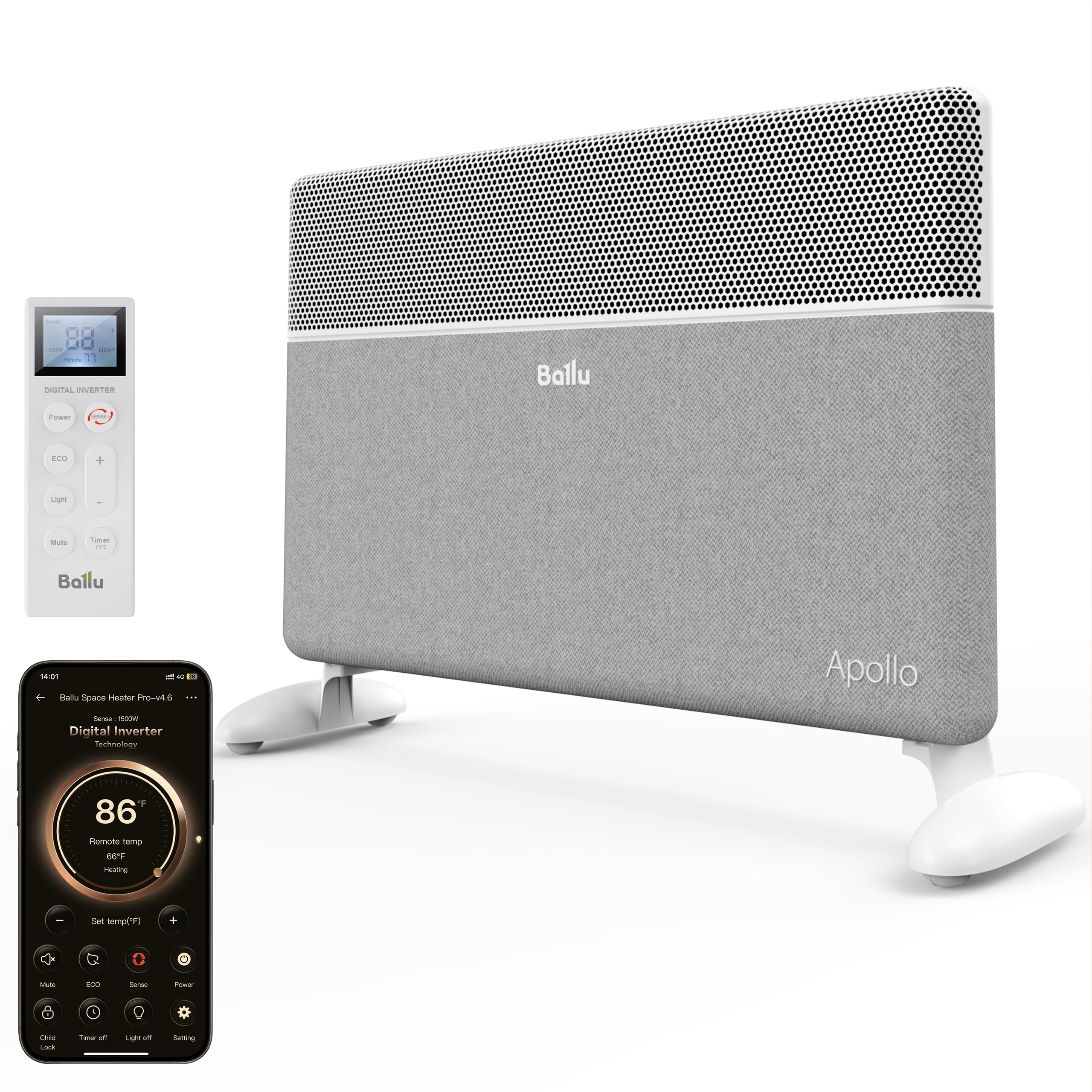
The Ballu stands apart because its patented Hedgehog heating element and inverter-driven thermostat actually modulate power rather than just switching on and off. In a 250-square-foot room, the heater reaches a steady temperature within 90 minutes and holds it within a tight band — no sudden cold drafts or overheating cycles. The convection method means no fan noise (the unit is genuinely silent), making it the strongest pick for living rooms or bedrooms where constant fan hum would be distracting.
The LED remote displays both the set temperature and the actual room temperature, updating every minute via a built-in sensor near the remote rather than inside the unit. This avoids the common problem where the heater shuts off because its internal thermostat thinks the air is warmer than it is near your seating area. The app lets you schedule daily heat curves, and Alexa control works smoothly for hands-free adjustment. At 27 inches wide and only 4 inches deep, the freestanding panel with casters tucks under a window or against a wall without eating floor space.
For rooms above 500 square feet, the Ballu functions as supplemental warmth, but its real strength is as a primary heater in smaller-to-medium large rooms where you want quiet, stable, draft-free comfort. The all-metal body and V0-rated flame-retardant cord provide genuine long-term safety, and the 2-year warranty backs the build quality. The only real catch is that convection heating takes longer to warm up a cold room than a forced-air unit — plan for 30 minutes to feel the difference.
Why it’s great
- Near-silent operation with no fan noise
- Inverter thermostat holds temperature precisely without cycling swings
- App scheduling and Alexa compatible for smart home integration
Good to know
- Takes 30-60 minutes to fully warm a cold room from scratch
- Convection method works best in sealed spaces, not drafty garages
2. DREO Whole Room Heater 714
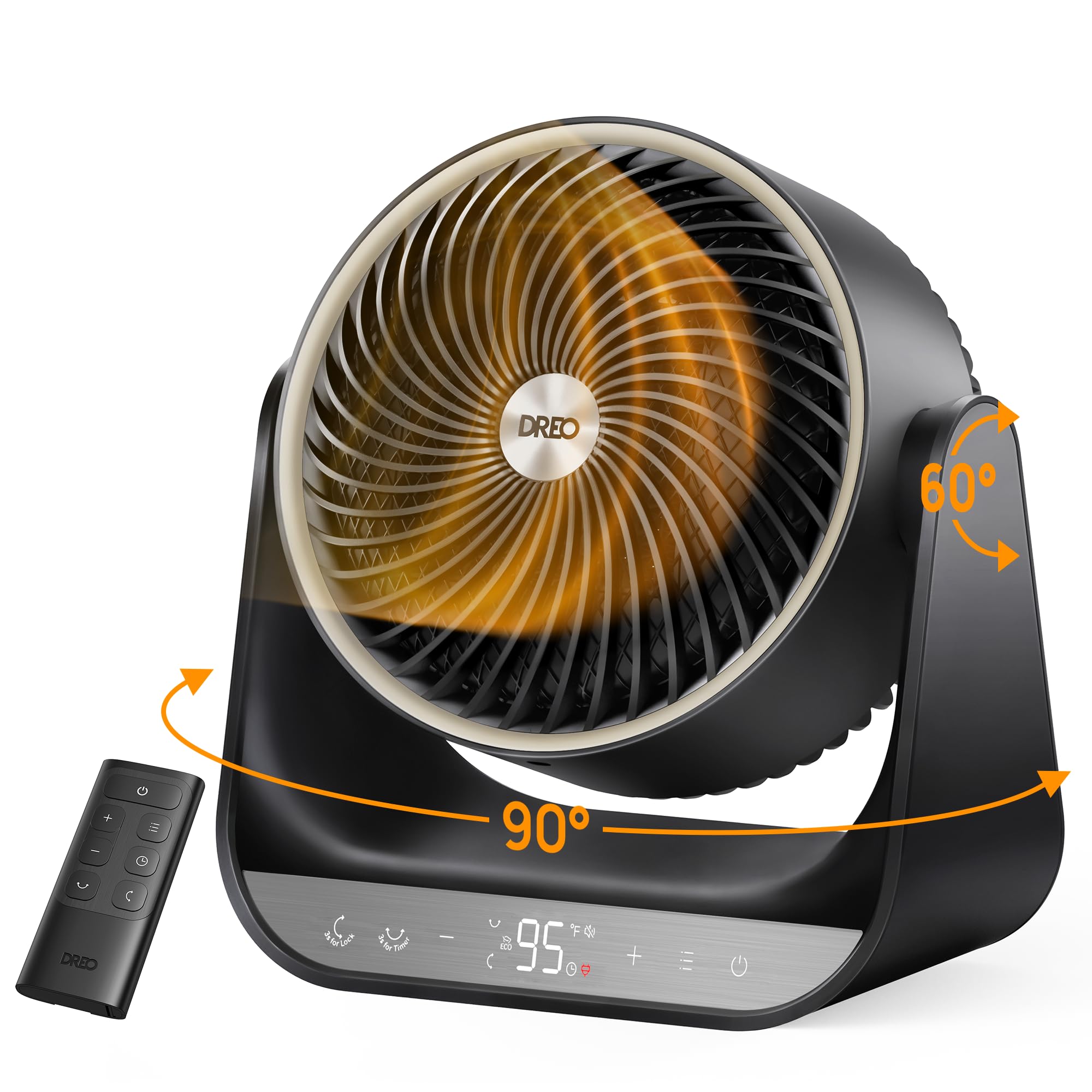
The DREO 714 redefines what forced-air heating can do in a medium-to-large room by combining 60-degree vertical oscillation with 90-degree horizontal sweep. That 3D motion pushes warm air from floor level toward the ceiling and across the room simultaneously, reducing the temperature gradient between your feet and your face. At 12 feet per second airflow, the heater circulates the entire air volume rather than creating a hot spot directly in front of the unit — this is the closest forced-air gets to full-room convection coverage.
Powered by a 1500W PTC element, the DREO hits its target temperature within seconds of startup and then switches to ECO mode, which adjusts power in 1-degree Fahrenheit increments between 41°F and 95°F. The brushless DC motor keeps noise at 34 dB — whisper level even on high fan speed — and the 12-hour timer lets you schedule it to pre-warm a bedroom before you wake up. The remote includes batteries, which is a small but welcome detail that many competitors skip.
The pedestal form factor stands 12.4 inches tall, so it fits under desks or end tables without blocking airflow. The ETL listing and flame-retardant housing cover the safety basics, and the tip-over switch is sensitive enough to trigger even at a slight angle. The main limitation is the coverage area: DREO rates it for 161-269 square feet, so very large open basements or workshops will still feel cool in the far corners. For standard living rooms and master bedrooms, this is the most effective fan-forced unit available.
Why it’s great
- 60° vertical oscillation prevents heat pooling on the floor
- 12 ft/s airflow and 120 CFM move heat across the full room volume
- Whisper-quiet 34 dB motor won’t disturb sleep or conversation
Good to know
- Coverage tops out around 270 square feet
- Plastic housing feels sturdy but not as premium as all-metal units
3. Lasko 1500W Ceramic Tower Space Heater 751320

Lasko’s 751320 has been a reliable workhorse for years because it keeps the formula simple: 1500 watts of ceramic forced air, a quiet tower form factor, and widespread oscillation that actually moves the air column across the room. For spaces up to 150 square feet — standard bedrooms, small living rooms, home offices — this unit delivers consistent warmth without the complexity of apps or ECO modes. The self-regulating ceramic element prevents overheating by automatically reducing power if airflow is blocked.
The slim tower measures only 7.25 inches wide and 22.5 inches tall, sliding into tight corners beside furniture. The built-in carry handle makes it easy to move between rooms, and the remote stores onboard so you won’t lose it. The electronic controls include high heat, low heat, and automatic thermostat mode, plus an adjustable timer. The cool-touch housing stays safe to the touch even after hours of operation, which matters in homes with kids or pets.
The main trade-off is coverage: Lasko rates it at 150 square feet, not the 200+ that larger rooms need. The oscillation is wide but only horizontal, so heat tends to stay at floor level unless you place the unit on a raised surface. Also, the remote uses basic infrared, so you need line-of-sight to change settings. For the budget buyer looking for a no-fuss heater that just works, this is the safest bet in the mid-range.
Why it’s great
- Self-regulating ceramic element prevents overheating
- Slim tower and carry handle make it easy to move room to room
- ETL listed with cool-touch housing for household safety
Good to know
- Best suited for rooms up to 150 sq ft — not ideal for large open spaces
- Horizontal oscillation only; no vertical tilt for ceiling-level warmth
4. JNDRO Wall-Mounted Space Heater (PTC-SL001)
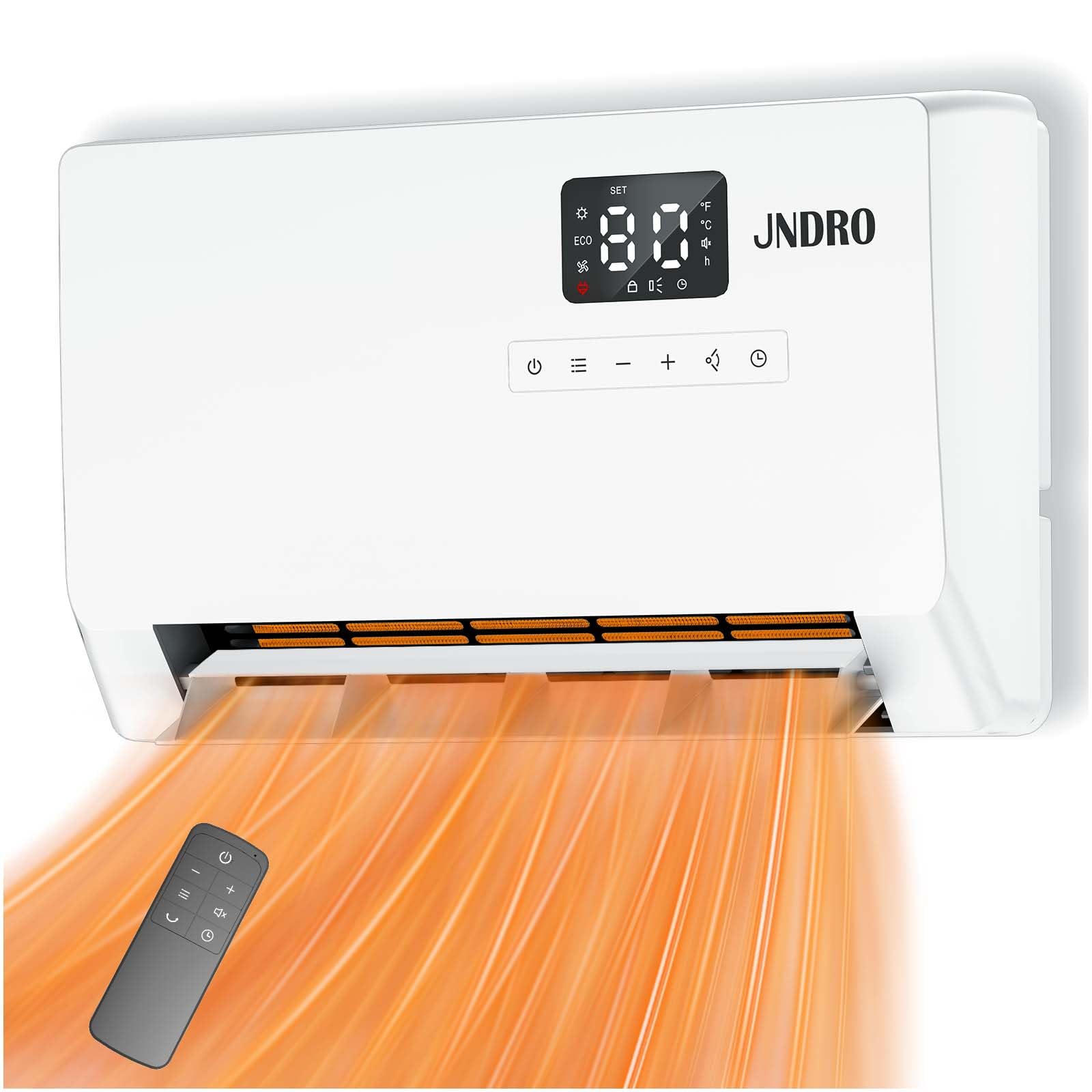
The JNDRO wall-mounted heater (PTC-SL001) solves the floor-space problem elegantly, mounting flush against the wall while delivering up to 120 degrees of oscillation. For rooms where every square inch of floor is used — home offices, laundry rooms, small living spaces — this unit keeps heat out of the walking path. The ECO thermostat mode monitors ambient temperature and adjusts output automatically, maintaining comfort between 41°F and 95°F without wasting electricity on full-power blasts.
The 24-hour programmable timer lets you schedule heat for specific blocks, and the remote control works from across the room without needing line-of-sight thanks to RF rather than infrared. The child lock prevents accidental setting changes, which is a genuine safety feature for families with curious toddlers. The unit measures only 4.65 inches deep, so it protrudes minimally from the wall. The included mounting bracket is straightforward to install, though you will need to locate wall studs for secure mounting.
The coverage rating of 200 square feet is reasonable for a 1500W radiant unit, but the radiant heating method means the air near the floor will feel cooler than the air at the heater’s level. The 60-degree, 90-degree, and 120-degree oscillation options give you flexibility, but the heater lacks forced air, so heat distribution depends on natural convection once the warm air leaves the unit. For supplemental heating in a well-insulated room, this is a clean, unobtrusive solution.
Why it’s great
- Wall-mounted design saves floor space completely
- Child lock and 24-hour timer for family-friendly safety scheduling
- Up to 120° oscillation angle for wide horizontal coverage
Good to know
- Radiant heat method leaves floor-level air cooler
- Requires secure wall mounting into studs for stability
5. JNDRO 24-Inch Wall Mounted Electric Heater (PTC-SL002)
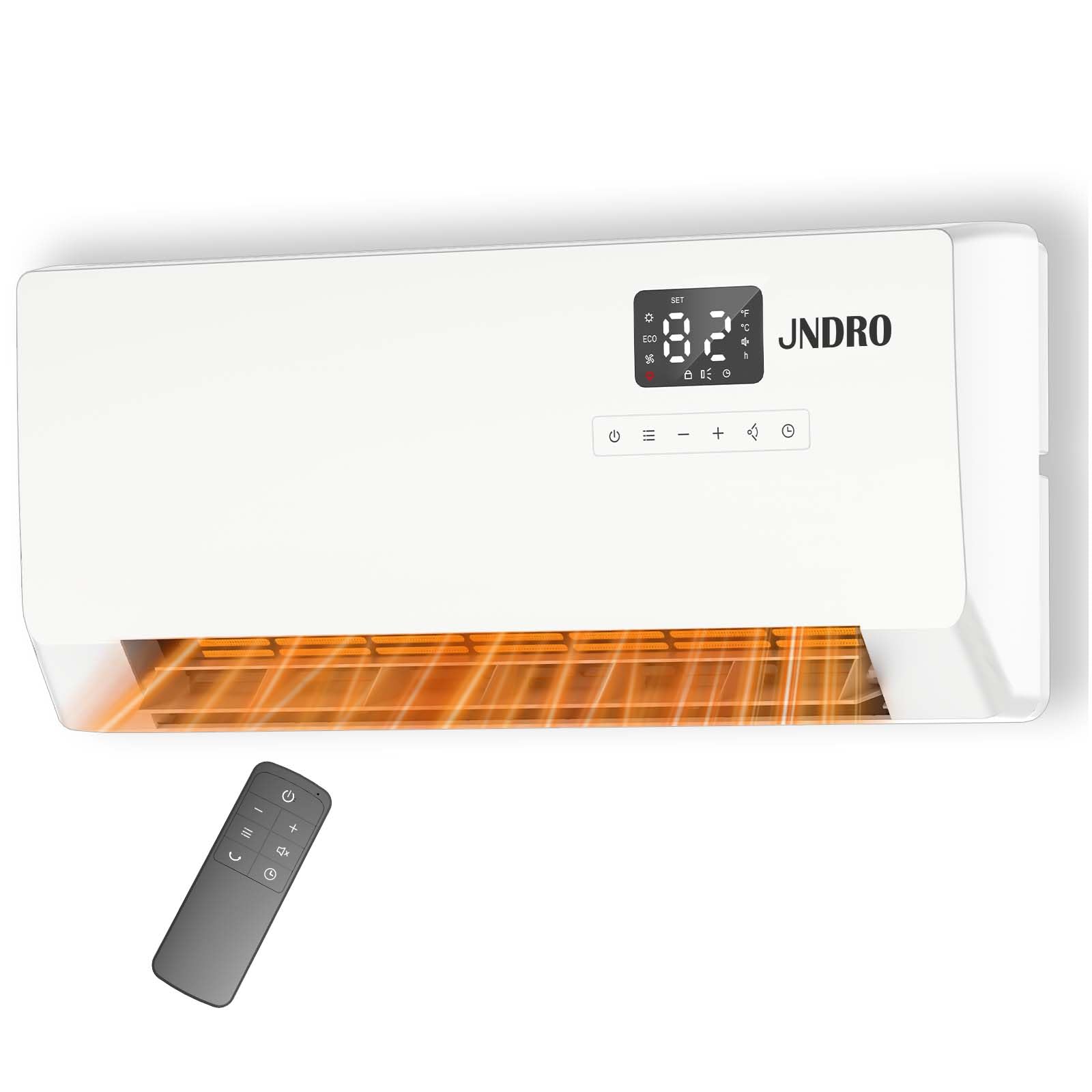
The larger 24-inch version of JNDRO’s wall-mounted heater (PTC-SL002) adds three adjustable power settings — 900W, 1300W, and 1500W — giving you control over energy draw depending on the season and room size. On a mild fall day, running the heater at 900W is enough to take the chill off without running up the electric bill. The ECO mode switches intelligently between these levels based on the room’s temperature, keeping the thermostat reading within a narrow range without manual intervention.
The high-precision thermostat updates the display with the current ambient temperature and automatically reduces power when the set point is reached. The 60°, 90°, and 120° oscillation settings are identical to the smaller model, but the longer body distributes heat across a wider physical area, making it better suited for large bedrooms or open-concept living rooms up to 200 square feet. The child lock works the same way, preventing the settings from being changed accidentally.
The wall-mount design saves the same floor space, but the 22.83-inch width is more noticeable on the wall — it looks like a small radiator panel rather than a compact appliance. The remote control works reliably from across the room, and the 12-month replacement warranty provides reasonable peace of mind. The main downside is the same as the smaller JNDRO: radiant heat leaves floor-level air colder, and there is no fan to actively circulate warm air downward.
Why it’s great
- Three power levels allow energy-efficient heating for different weather
- Longer 24-inch body distributes heat across a wider area
- ECO mode automatically selects the right wattage for the room temperature
Good to know
- Radiant method does not actively push warm air to floor level
- Larger wall footprint may be visually obtrusive in small rooms
6. DR. INFRARED HEATER DR218-3000W

The DR218 moves into a different category altogether — this is a 3000-watt, 240-volt radiant heater built specifically for greenhouses, workshops, and garages, not living rooms. With an IPX4 rating, it can handle splashing water from plant watering or damp workshop conditions without shorting out. The coverage rating of 600 square feet is realistic for a well-insulated greenhouse or garage, and the high/low heat settings let you dial back power when the space is already above freezing.
The radiant heating method means it warms objects and plants directly rather than heating the air, which is actually beneficial in a greenhouse where you want to keep leaf surfaces warm without overly heating the air volume. The enclosed heating element requires minimal maintenance, and the unit is lightweight and portable at 13 inches tall. The included bracket allows wall or ceiling mounting, and the manual provides clear wiring instructions for the 240V, 20A outlet requirement.
The biggest limitation is the power requirement: most standard home outlets cannot handle 3000W at 240V, so this heater requires a dedicated circuit or professional installation. It is also loud by indoor standards — the fan is functional but not quiet. Also, the thermostat is basic compared to the smart ECO modes on smaller units. For its intended use — keeping plants alive or heating a drafty workshop — the DR218 is a rugged, specialized tool.
Why it’s great
- IPX4 splashproof rating suitable for damp greenhouse environments
- 3000W output covers up to 600 sq ft of workshop or garage space
- Lightweight and portable for moving between outbuildings
Good to know
- Requires a dedicated 240V, 20A circuit — not a standard plug-in unit
- Fan noise is noticeable and the thermostat is basic
7. Dr. Infrared Heater DR-975 7500W

The DR-975 is the most powerful unit in this lineup, delivering 7500 watts of forced-air heat over an 800-square-foot coverage area — big enough for a three-car garage, a large workshop, or a commercial storage space. It runs on 240V single-phase power and must be hardwired directly into the electrical system using 8 AWG copper wires; this is not a plug-and-play appliance. The fully enclosed motor and heavy-duty construction are built for continuous operation in industrial-adjacent environments where reliability matters more than quiet operation.
The remote-controlled thermostat lets you set the temperature between 50°F and 85°F, and the five adjustable louvers direct the airflow precisely where you need it — along a workbench, across a tool chest, or toward a drafty bay door. The UL/CUL listing confirms it meets commercial safety standards, and the timer feature allows automatic shutoff after a set period. The unit can be wall-mounted or ceiling-mounted with the included bracket, keeping it out of the way in tight garage spaces.
The noise level is substantial — this heater sounds like a commercial fan running on high, so it is not suitable for occupied living spaces. The 31.25-amp draw requires a dedicated 40-amp breaker, meaning professional installation is strongly recommended unless you have experience with high-voltage wiring. For serious workshop owners who need to keep a large space above freezing through the winter or warm it quickly between projects, the DR-975 delivers unmatched raw heating capacity.
Why it’s great
- 7500W output heats 800 sq ft of garage or workshop space effectively
- Remote thermostat with adjustable louvers for targeted airflow direction
- UL/CUL listed and built with heavy-duty enclosed motor for continuous use
Good to know
- Hardwired installation required — not a standard plug-in unit
- Very loud during operation; inappropriate for living areas
FAQ
Can a 1500W heater really warm a 300-square-foot room?
Is wall mounting better than a floor tower for large rooms?
What does ECO mode actually do on these heaters?
Final Thoughts: The Verdict
For most users, the large space heater winner is the Ballu Convection Panel because its inverter-driven thermostat and silent convection provide stable, draft-free warmth across a 250-square-foot room without the noise or temperature swings of fan-based units. If you want fast 3D oscillation that pushes warm air into every corner, grab the DREO 714. And for heavy-duty garage or workshop heating, nothing beats the raw capacity of the Dr. Infrared Heater DR-975 when hardwired into a suitable 240V circuit.