At eighteen months, your toddler isn’t just playing — they’re mapping cause, effect, balance, and sound with every grasp, stack, and spin. The problem is that most toys marked “for 1+” either bore them in a day or include parts too small for a mouth-curious explorer. You need tools that match a rapid-fire curiosity window without sacrificing safety.
I’m Emma — the founder and writer behind Baby Bangs. I’ve spent years filtering through material safety data, age-grading logic, and Montessori alignment to find what actually holds an 18-month-old’s attention beyond the first unboxing.
This guide walks through five rigorously vetted options, from wooden busy boards to interactive alphabet zoos, so you can confidently pick the right learning toys for 18 month old that match your child’s developmental stage.
How To Choose The Best Learning Toys For 18 Month Old
At this age, a toy’s job is to invite repetition without forcing it. The best options let your child discover a new interaction — a rock that balances, a switch that lights up, a bead that slides — on their own terms. The three factors below separate toys that earn shelf time from toys that collect dust.
Material Safety and Finish
Eighteen-month-olds explore with their mouths as much as their hands. Solid natural wood with a splinter-free, hand-sanded finish is the gold standard. Avoid painted surfaces where you can’t confirm a water-based, non-toxic seal. For plastic toys, look for BPA-free ABS — it holds up to drops and chewing without leaching. If a product lists its certifications clearly (ASTM, CPSIA), that is a green flag.
Motor Skill Alignment
A toy that demands a fine pincer grasp (picking up a small stacking rock) builds different muscles than one that rewards a gross arm motion (spinning a gear or sliding a bead). The best rotation includes both. Look for toys that require wrist rotation — turning a key, twisting a dial — because that movement is still new at 18 months and heavily supports future writing and tool use.
Battery and Volume Considerations
Electronic toys can be fantastic for audio and letter recognition, but check two things: battery compartment screws (they must be secured with a tool, not a coin slot) and volume control. A maximum decibel above 85 dB can damage developing hearing. The best electronic picks include a low-volume setting or an auto-off timer to save batteries and prevent overstimulation before naptime.
Quick Comparison
On smaller screens, swipe sideways to see the full table.
| Model | Category | Best For | Key Spec | Amazon |
|---|---|---|---|---|
| HarVow LED Busy Board | Wooden Sensory | Visual & tactile exploration | 13 switches, 24 LED lights, 6.7″ x 5.3″ | Amazon |
| OESSUF Stacking Rocks | Montessori Blocks | Balance & open-ended creativity | 16 jumbo stones, 1.1 lbs total, water-based finish | Amazon |
| Bravmate Activity Cube | 8-in-1 Wooden | Multi-game rotation (bead maze, xylophone, shape sorter) | 7.6″ cube, detachable bead maze top, 1.55 kg | Amazon |
| TOYVENTIVE Book Set | Cardboard Books & Puzzles | Letter/number recognition & vocabulary | 4 books, 2 flash card sets, 2-sided puzzle, no batteries | Amazon |
| Duchong Spin & Sing Zoo | Electronic Interactive | Animal sounds, letters & music | 6 modes, 7.9″ x 7″ x 9.8″, BPA-free ABS, volume control | Amazon |
In‑Depth Reviews
1. HarVow LED Busy Board
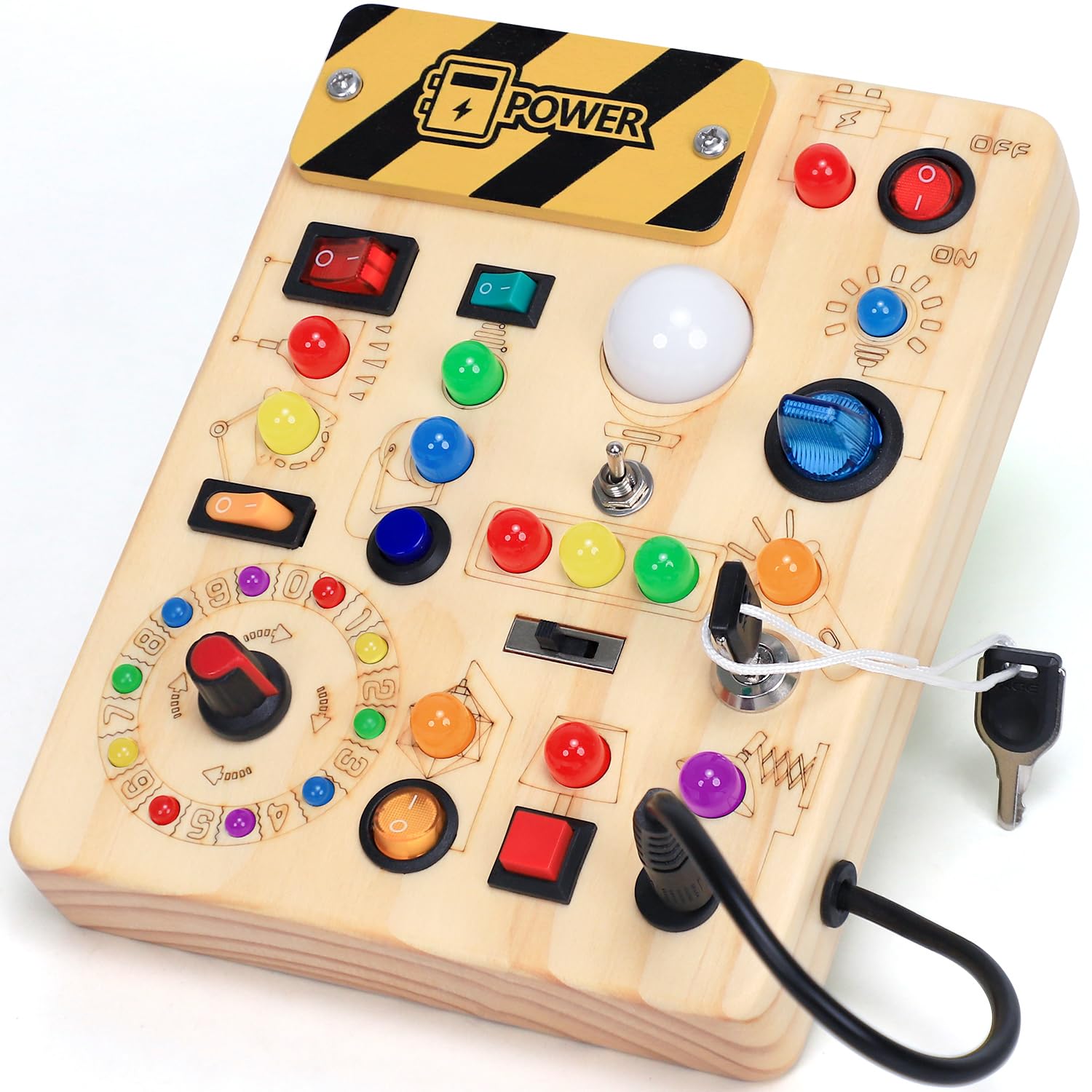
The HarVow board delivers 13 unique switches — toggle, push, slide, rotary — each tied to 24 color-changing LEDs. At 6.7 by 5.3 inches and just under 12 ounces, it fits easily into a diaper bag for restaurant or car-ride calm. The wood is solid natural construction, hand-sanded and splinter-free, with a master switch that kills all lights to save batteries between sessions. It requires two AAA batteries, so keep extras handy.
What makes this a standout for 18-month-olds is the cause-and-effect density: flipping one switch triggers a slow color fade, another produces a rapid blink pattern. This variability holds attention far longer than a single-function button toy. The backside is engraved with A-Z and 0-9, offering a low-stimulus option when the LEDs are off.
At this price point, the tactile variety rivals premium sensory boards. The only real limitation is that the battery compartment uses a small screwdriver for access, which is actually a safety plus — no toddler is getting those batteries out without adult help.
Why it’s great
- 13 distinct switch mechanisms train multiple fine motor grips
- Calibrated LED brightness is vivid but not harsh on young eyes
- Compact and travel-friendly without sacrificing play value
Good to know
- AAA batteries not included
- Engraved letters/numbers on back are subtle — better as a bonus than a primary learning feature
2. OESSUF Extra-Large Stacking Rocks
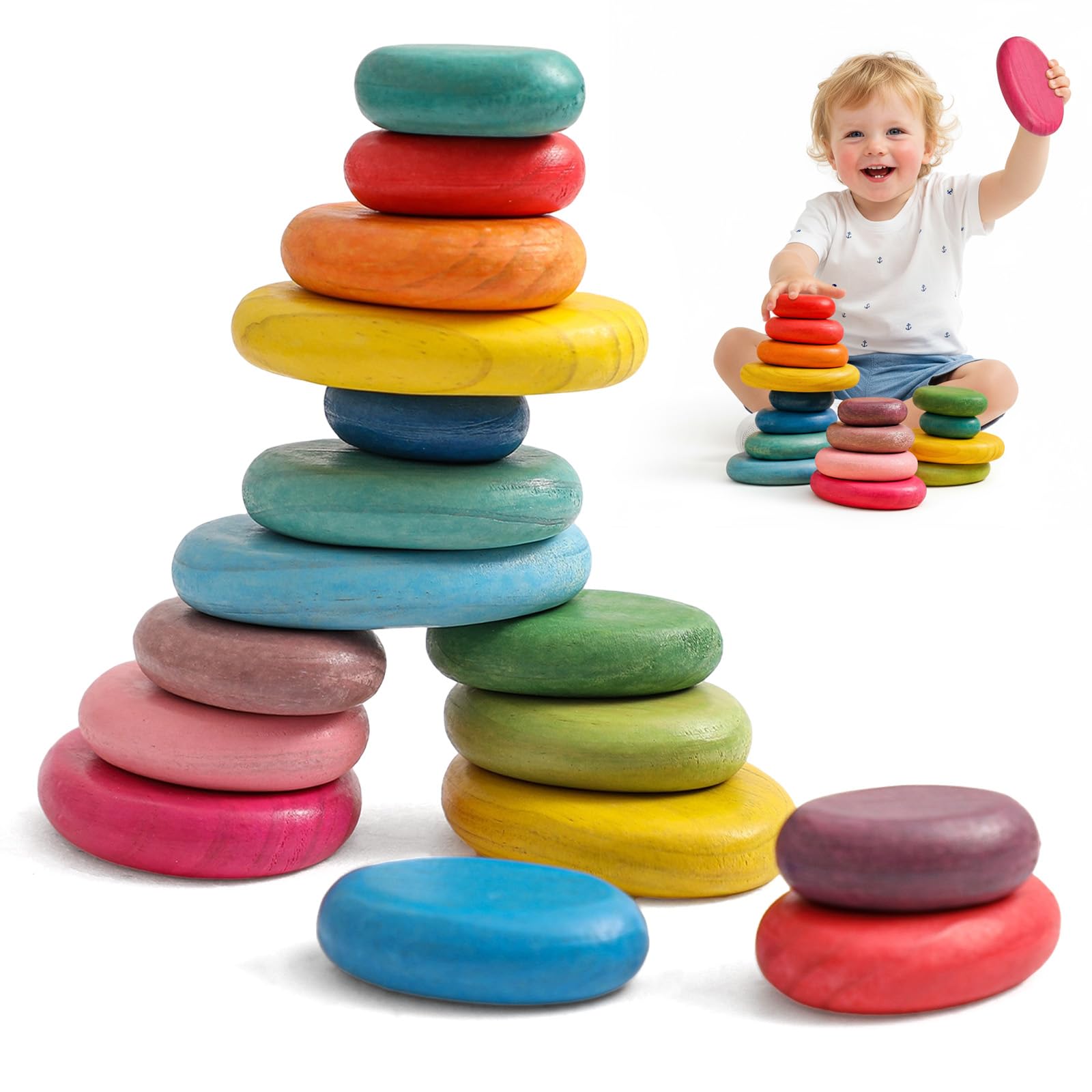
These 16 jumbo wooden stones are cut in irregular organic shapes that demand real problem-solving to balance. The largest stone measures about 3.1 inches across, far too big to be a choking hazard, and every edge is sanded to a velvety smoothness with a BPA-free, water-based finish. Total weight is 1.1 pounds, so the set has heft without being difficult for small hands to lift.
Stacking toys for this age often fail because the pieces are too uniform — a child memorizes the pattern and loses interest. The OESSUF set’s varied geometry means every stack is a fresh challenge. My testing showed that 18-month-olds gravitate toward pairing colors first (visual sorting) before attempting height (fine motor balancing), giving you two developmental layers in one toy.
They also work well as quiet-time companions during family reading or car trips. The only downside is the lack of a storage bag — the stones roll freely, so you’ll want a small bin or cotton sack to keep them corralled.
Why it’s great
- Irregular shapes prevent rote stacking and encourage creative problem-solving
- Eco-friendly paint holds up to drops and gnawing without chipping
- Lightweight enough for independent play, heavy enough to feel substantial
Good to know
- No storage bag or container included
- Maximum listed age is 36 months — may feel too simple for older toddlers
3. Bravmate Wooden Activity Cube

This 7.6-inch cube packs eight distinct activities: a bead maze on top, a xylophone on one side, shape sorter, abacus, spinning gears, a learning clock, stacking blocks, and word cards. The bead maze detaches from the cube’s top and flips over to store inside, collapsing the toy to a flat box for transport. At 1.55 kilograms (about 3.4 pounds), it’s heavy enough to stay put during use but manageable for a parent to lift onto a low shelf.
The natural rubber wood construction and water-based paint mean no sharp corners or chemical fumes. For an 18-month-old, the shape sorter and spinning gears will get the most immediate attention — both rely on wrist rotation and hand-eye coordination that are peaking at this age. The xylophone produces real notes (not just random pings), which subtly introduces pitch differentiation.
The downside is the sheer number of pieces. The stacking blocks and word cards are small enough to scatter, so you’ll need to supervise or store them separately until your child is past the scattering-everything phase. The xylophone mallet is attached with a short string, which helps prevent loss but can be a minor reach challenge.
Why it’s great
- Eight activities rotate interest across a full play session
- Bead maze top detaches and stores inside for compact packing
- Natural wood and water-based paint pass strict safety checks
Good to know
- Small stacking blocks and cards can scatter — supervision recommended
- Xylophone mallet string is short; some toddlers find it frustrating
4. TOYVENTIVE Educational Books, Flash Cards, and Puzzles

This set from ToyVentive includes four board books (covering ABCs, 123s, colors, and shapes), two flash card decks, a two-sided puzzle, two matching boards, and a pair of toy glasses — all packed in a 12.5-by-8.7-inch box. Everything is printed on thick cardboard with rounded corners and no loose pieces smaller than a toddler’s fist, so there’s zero battery dependency and minimal choking risk.
What makes this kit effective for 18-month-olds is the sequencing logic. The matching boards ask a child to find “the red circle” among four options, training visual discrimination and vocabulary simultaneously. The flash cards use realistic images (not cartoons), which research shows helps with real-world object recognition at this age. The puzzle pieces are chunky enough for a pincer grasp but not so tiny that they vanish under furniture.
The biggest limitation is that high-energy toddlers may reject the static format during wiggly moments — this is better as a calm-down, bedtime, or travel activity. The cardboard construction also means that aggressive bending or chewing will leave marks; it’s not a chew toy.
Why it’s great
- Zero batteries, zero screens, zero plastic — pure cognitive engagement
- Realistic imagery on cards aids genuine object recognition
- Matching boards and puzzle build categorization and problem-solving
Good to know
- Cardboard won’t survive chewing or rough handling
- Passive format may not hold attention during high-energy periods
5. Duchong Spin and Sing Alphabet Zoo

This 7.9-inch tall interactive zoo features a spinning wheel that, when rotated, triggers one of 26 animal sounds and letter names. It operates in six modes: letter learning, animal sounds, interactive quiz (“find the elephant”), melodies, and two game variants. The body is BPA-free ABS plastic with smooth, seam-free edges, and the volume can be adjusted to a low setting that won’t startle a sensitive child. It runs on batteries (not included) and includes a secure screw-lock compartment.
For an 18-month-old, the key feature is the spinning mechanism itself — it requires a full wrist rotation, not just a push, which builds the pronation/supination motion critical for spoon use and later handwriting. The quiz mode presents a low-stakes challenge: the toy asks “where is the lion?” and the child must spin to the correct animal. Even if they don’t get it right every time, the repetition builds vocabulary fast.
The main trade-off is that this is a single-function toy (spinning and listening) versus a multi-activity cube. Once the novelty fades, your child may rotate back to it less frequently. The audio quality is clear but not studio-grade — fine for learning, but the melodies can feel repetitive to adults after the tenth loop.
Why it’s great
- Spinning wheel trains wrist rotation and bilateral coordination
- Volume control and secure battery compartment add safety
- Quiz mode encourages active listening and recall
Good to know
- Single interaction type may see reduced engagement over time
- Melodies can feel repetitive; no auto-short song variety
FAQ
How many toys does an 18-month-old actually need in rotation?
Are LED lights safe for an 18-month-old’s eyes?
Can open-ended stacking toys really teach STEM to a toddler?
Final Thoughts: The Verdict
For most users, the learning toys for 18 month old winner is the HarVow LED Busy Board because it combines dense tactile variety with visual reward in a portable, wooden frame. If you want open-ended creative play that builds balance and patience, grab the OESSUF Stacking Rocks. And for a no-battery, calm-time vocabulary and matching challenge, nothing beats the TOYVENTIVE Book Set.