At six years old, a child’s brain is a sponge for patterns, logic, and cause-and-effect — the exact ingredients that make a great learning toy. The difference between a toy that gets played with once and one that builds real skills comes down to how it wraps education inside a game they actually want to win. The right pick turns math drills, engineering challenges, or science experiments into the highlight of their afternoon.
I’m Emma — the founder and writer behind Baby Bangs. I’ve spent years analyzing how toy design, age-appropriate complexity, and repeat-play value separate the forgettable from the foundational.
After comparing dozens of options across board games, science kits, building sets, and electronic puzzles, I narrowed the field to the five best candidates for learning toys for 6 year olds that actually hold their attention and deliver measurable skill-building.
How To Choose The Best Learning Toys For 6 Year Olds
A 6-year-old is in a sweet spot — they’ve outgrown toddler toys but aren’t yet ready for complex logic puzzles. The ideal learning toy sits at the intersection of simple rules, tactile interaction, and a reward loop that feels like play, not homework. The three factors below separate the toys that build lasting skills from those that gather dust.
Game Mechanics That Teach Math Fluency
For this age group, the most effective math toys embed addition, subtraction, and early multiplication into a game with dice, spinners, or electronic feedback. Look for toys that offer multiple difficulty levels so the challenge grows as their speed improves. A toy like the Math Whiz from Educational Insights lets a child step through progressively harder problems, turning repetitive practice into a game with clear win conditions.
Science Kits That Encourage Exploration Without Messy Chaos
The best science kits for a 6-year-old come with illustrated step-by-step instructions and at least 20 experiments that use common household items like baking soda or vinegar. Check that the kit includes safety goggles and child-safe tools like beakers and test tubes. The Doctor Jupiter science kit and the National Geographic chemistry set both hit this mark, offering over 50 experiments each in structured, easy-to-follow formats.
Building Sets That Develop Fine Motor Skills and Spatial Reasoning
A quality building set for this age should include at least 100 pieces in varied shapes and colors, plus an idea booklet with instructions for 5-10 different models. Rounded edges and non-toxic materials are non-negotiable. The Qirptey 125-piece set earns its place by including a storage box and instructions for race cars, robots, and dinosaurs — giving a 6-year-old both guidance and room to invent their own creations.
Quick Comparison
On smaller screens, swipe sideways to see the full table.
| Model | Category | Best For | Key Spec | Amazon |
|---|---|---|---|---|
| Learning Resources Math Island | Board Game | Family math practice | 2 number dice + operation die | Amazon |
| Educational Insights Math Whiz | Electronic Game | On-the-go math drills | 8 difficulty levels per skill | Amazon |
| National Geographic Junior Chemistry Set | Science Kit | Hands-on chemistry discovery | 50 experiments + 20 lab tools | Amazon |
| Doctor Jupiter My First Science Kit | Science Kit | Screen-free STEM exploration | 50+ experiments, step-by-step manual | Amazon |
| Qirptey 125 Pcs STEM Building Blocks | Building Set | Creative model building | 125 pieces + idea booklet | Amazon |
In‑Depth Reviews
1. Learning Resources Math Island Addition & Subtraction Game

The Math Island Game transforms addition and subtraction practice into a board game where players navigate a volcano-themed island. The inclusion of two 10-sided number dice and an operation die means no two equations are the same, keeping the math fresh across multiple play sessions. The volcano popper — a dice launcher triggered when players land on special spaces — adds a tactile surprise that six-year-olds find irresistible.
At its core, this is a family game night tool disguised as a toy. The 2-4 player design encourages siblings or parents to join in, turning math fact drills into a social activity. The game board, character pieces, and dice are all durable enough for repeated use, and the instructions are straightforward enough that a 6-year-old can set it up with minimal help.
Where this toy shines is in building mental math speed. Because players must solve equations to move forward, the reward loop is immediate — solve faster, progress faster. Over time, children internalize addition and subtraction facts without the tedium of worksheets. It’s a rare balance of fun and fluency.
Why it’s great
- Combines physical board game mechanics with math practice
- Volcano popper adds high engagement for young children
- Works well for siblings of different ages with minimal setup
Good to know
- Limited to addition and subtraction only — no multiplication
- Requires 2 players minimum for full game experience
2. Educational Insights Math Whiz

The Math Whiz is a compact, handheld electronic game that covers addition, subtraction, multiplication, and division across three modes: Drill, Challenge, and Calculator. With eight difficulty levels per skill in Drill mode, it scales from basic addition to division problems suitable for older children. The LCD screen provides clear visual feedback, and the audio cues reinforce correct answers without being distracting.
What sets this apart from a phone app is the dedicated, distraction-free hardware. No ads, no notifications, no temptation to swipe to a video. It runs on two AAA batteries and fits in a backpack or car seat pocket, making it ideal for road trips, waiting rooms, or quiet time at home. The Challenge mode, a numbers elimination game, adds a puzzle-layer that keeps children engaged even after they’ve mastered basic facts.
For a 6-year-old just starting math, the lower difficulty levels provide a gentle entry point. As their fluency improves, the higher levels ensure the toy remains useful for years. The Calculator mode also gives older siblings or parents a way to use it for homework checks, extending the toy’s lifespan beyond early elementary school.
Why it’s great
- Covers all four operations with granular difficulty scaling
- Fully portable and battery-operated for on-the-go use
- No screen distractions — dedicated math practice only
Good to know
- Requires two AAA batteries (not included)
- Screen is small — not ideal for vision-sensitive children
3. National Geographic Junior Chemistry Set

The National Geographic Junior Chemistry Set from Blue Marble (a Toy of the Year Award winner) packs 50 experiments into a single box with over 20 kid-safe lab tools. The kit includes test tubes, goggles, beakers, and a mini volcano — all designed for small hands. The illustrated instruction manual walks children through each experiment step-by-step, using common household items like baking soda and vinegar to create reactions that feel like magic.
For a 6-year-old, the experiments are designed to be simple enough to complete independently with some adult supervision, but complex enough to teach real chemistry concepts like acid-base reactions, color changes, and gas production. The inclusion of safety goggles from the start reinforces good lab habits. The kit’s durability is notable — the plastic tools can withstand drops and spills without cracking.
Where this kit excels is in repeatability. The 50 experiments are grouped by concept, so a child can revisit the same type of reaction multiple times with slight variations, deepening their understanding. It’s screen-free, encourages messy play in a controlled way, and provides enough content to occupy many afternoons. The U.S.-based support team is a bonus for parents who need experiment troubleshooting.
Why it’s great
- Award-winning brand with 50 structured experiments
- Includes real lab tools — goggles, test tubes, beakers
- Uses common household items, no expensive refills needed
Good to know
- Some experiments require adult supervision for safety
- Storage of small tools can be messy without organization
4. Doctor Jupiter My First Science Kit
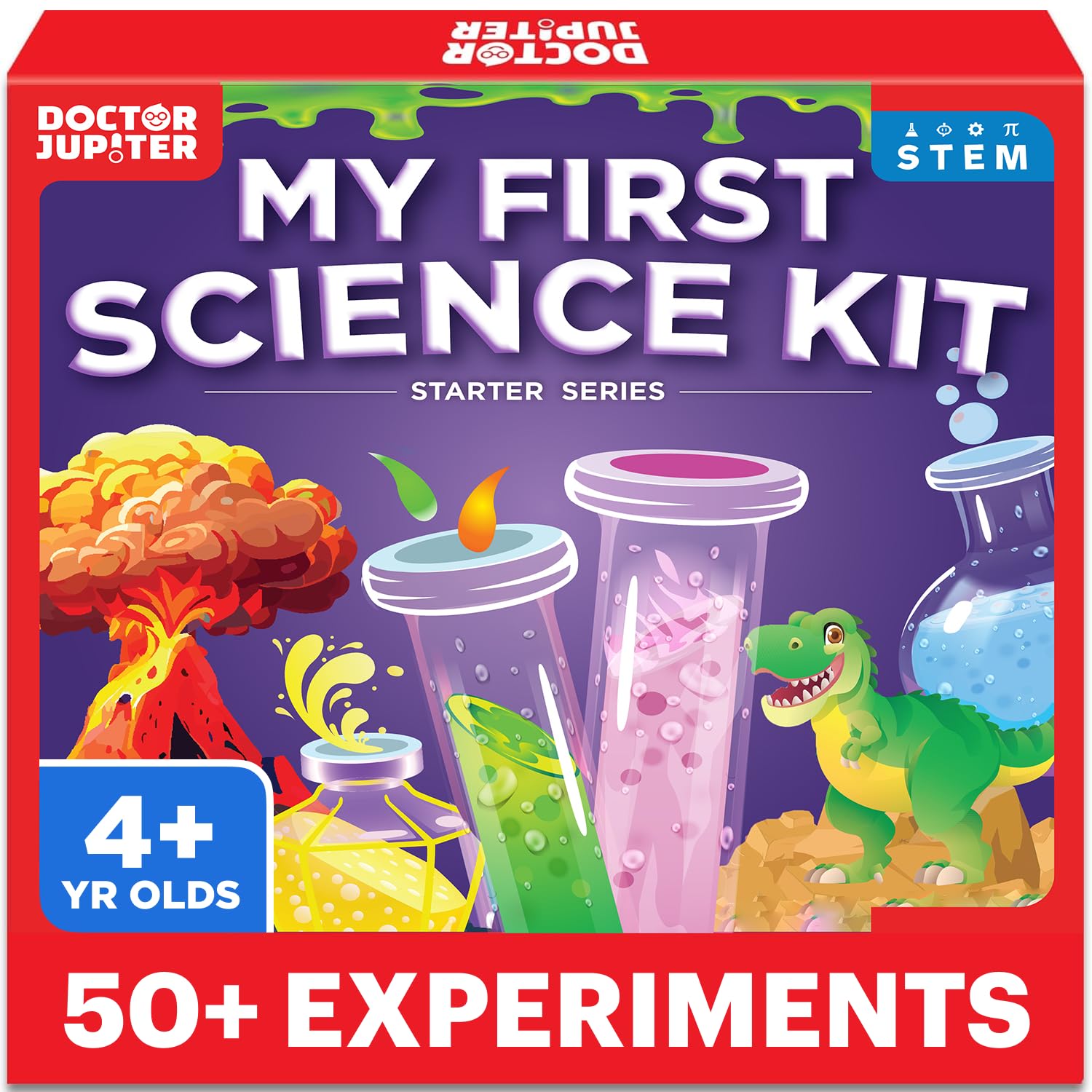
Doctor Jupiter’s My First Science Kit offers over 50 experiments, including making dinosaur squishies, an infinity soap volcano, oobleck, and exploding colors. The variety is enormous — everything from chemistry reactions to sensory play to crafting perfumes and face masks. The kit is designed for ages 4-8, but the 50+ experiment count ensures a 6-year-old won’t run out of new activities quickly.
The included instruction manual is fully illustrated with step-by-step guidance, making it easy for a child to follow along with minimal adult intervention. The kit is ASTM F963-17 certified for safety, and the materials — baking soda, corn starch, jelly powder, food colors — are all non-toxic. The cardboard box packaging doubles as storage, though you may want a separate container for the small accessories after the first few experiments.
What makes this kit particularly strong for this age group is the mix of scientific experimentation and open-ended creativity. Making perfumes or face masks appeals to children who might not be immediately drawn to “science,” while the volcano and oobleck experiments satisfy the classic hands-on crowd. It’s a great way to introduce STEM concepts through play that doesn’t feel academic.
Why it’s great
- Huge variety of experiments beyond standard volcano reactions
- ASTM safety certified with clear illustrated instructions
- Encourages both scientific and creative play
Good to know
- Some experiments require additional household supplies
- Cardboard box storage is not water-resistant
5. Qirptey 125 Pcs STEM Building Blocks

The Qirptey 125-piece building set is a classic STEM construction kit with a twist: the blocks come in multiple colors and shapes, and the included idea booklet provides instructions for race cars, robots, trucks, and dinosaurs. The pieces are non-toxic, odorless, and feature rounded edges — essential for a 6-year-old who is still developing fine motor control. The plastic is durable enough to survive being stepped on.
At 125 pieces, this set gives enough material to build one large model or several small ones simultaneously. The storage box is sturdy and promotes good organization habits, a detail often overlooked in cheaper building sets. The instructions are clear enough for independent play, but the open-ended nature also encourages children to invent their own designs, fostering spatial reasoning and creativity.
This set is particularly effective for children who enjoy structured building but are not yet ready for complex interlocking systems like LEGO Technic. The blocks snap together with moderate force, providing satisfying tactile feedback without frustrating a child who struggles to connect tiny pieces. It’s a great fine-motor-skill workout disguised as play.
Why it’s great
- 125 pieces offer substantial building variety
- Rounded, non-toxic blocks ideal for developing motor skills
- Storage box included for easy cleanup and organization
Good to know
- Models in instruction booklet are not highly complex
- Some children may want more specialized pieces like wheels
FAQ
What is the single best learning toy for a 6 year old who struggles with math?
How many experiments should a science kit include for a 6 year old?
Are electronic math games better than board games for this age?
Final Thoughts: The Verdict
For most users, the learning toys for 6 year olds winner is the Learning Resources Math Island Addition & Subtraction Game because it seamlessly blends math fact practice with a fun, repeatable board game that the whole family can enjoy. If you want a portable option for practice on the go, grab the Educational Insights Math Whiz. And for screen-free science exploration that sparks curiosity, nothing beats the National Geographic Junior Chemistry Set.