Wildfire smoke carries a toxic cocktail of fine particulate matter (PM2.5), carbon monoxide, and volatile organic compounds that standard dust masks simply cannot stop. The difference between a useless cloth barrier and genuine respiratory protection comes down to a certified fit and the right filter class — anything less leaves your lungs exposed to particles smaller than 2.5 microns.
I’m Emma — the founder and writer behind Baby Bangs. My research focuses on real-world filtration performance, NIOSH certification standards, and the seal integrity that separates effective smoke protection from ineffective accessories.
This guide breaks down the five essential criteria for choosing effective protection, from filter efficiency to face seal design. You’ll walk away knowing exactly what to look for in the best masks for wildfire smoke.
How To Choose The Best Masks For Wildfire Smoke
Choosing the right mask for wildfire smoke means looking beyond what’s comfortable and understanding what actually stops microscopic combustion particles. Here are the critical factors that separate effective respiratory protection from worthless face coverage.
Filter Class: N95, P100, or Something Else?
N95 filters catch 95% of airborne particles, while P100 filters capture 99.97% of particles down to 0.3 microns. For wildfire smoke — where the most dangerous particles are sub-micron — P100 provides a meaningful safety margin. Avoid masks labeled “PM2.5 only” or “dust mask” without a NIOSH certification number.
Seal Integrity: The Real Weak Point
Even the best filter is useless if smoke leaks around the edges. Elastomeric half-masks with silicone face pieces conform better to facial contours than disposable N95 respirators. A proper seal test — covering the exhalation valve and exhaling — should reveal zero air escaping other than through the filter.
Valve vs. Non-Valved Exhalation
One-way exhalation valves reduce heat and moisture buildup inside the mask, making extended wear practical. However, for source control (protecting others from your exhaled air), look for masks with filtered exhalation valves or consider non-valved alternatives.
Quick Comparison
On smaller screens, swipe sideways to see the full table.
| Model | Category | Best For | Key Spec | Amazon |
|---|---|---|---|---|
| 3M 7502 Half Face Respirator | Premium Silicone | Long-wear comfort with P100 filters | Silicone facepiece, P100 filter ready | Amazon |
| 3M 6191 Half Facepiece Kit | Complete Kit | Ready-to-go P100 protection | Includes 2091 P100 filters | Amazon |
| GVS ELIPSE P100 | Low Profile | Discreet P100 with source control | Replaceable P100 filters included | Amazon |
| Honeywell North 770030L | Large Silicone | Larger faces needing a snug silicone seal | Large silicone half-mask, latex-free | Amazon |
| BASE CAMP Family Pack | Multi-User Value | Budget-friendly household smoke relief | 6-layer replaceable filters included | Amazon |
In‑Depth Reviews
1. 3M 7502 Half Facepiece Reusable Respirator (Medium)
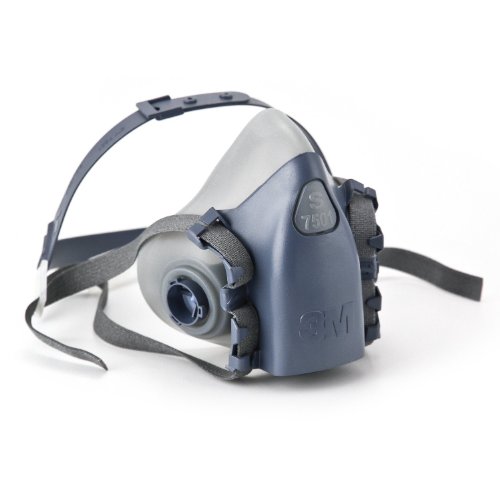
The 3M 7500 Series is widely regarded as the gold standard for half-face respirators, and the 7502 Medium consistently earns top marks from users who wear respiratory protection for extended hours. Its silicone facepiece is noticeably softer and more pliable than thermoplastic elastomer alternatives, which translates directly into a better seal against facial contours — the single most important variable when dealing with wildfire smoke.
User reviews highlight the mask’s exceptional comfort during multi-hour sessions, with several long-term users reporting they’ve discarded elastomeric respirators from four other brands after switching to the 7502. The silicone material is minimally irritating against the skin, and the bayonet mounting system allows easy pairing with 3M’s P100 filters, which capture 99.97% of airborne particles.
While the mask ships without filters, this gives you the flexibility to choose either the 2091 P100 particulate filter or the 7093 P100 cartridge with a hard plastic housing for added durability. The adjustable head straps and buckle closure system distribute tension evenly, reducing pressure points around the nose and cheeks.
Why it’s great
- Medical-grade silicone facepiece for superior seal and all-day comfort
- NIOSH-approved bayonet mount accepts multiple P100 filter options
- Lightweight at just 0.42 pounds, minimizing neck fatigue during extended wear
- User-proven for years in industrial settings, trustworthy for smoke protection
Good to know
- Filters sold separately, adding to the initial investment
- Medium size may not fit very small or very large faces comfortably
- Exhalation valve is non-filtered, not ideal for source control
2. 3M 6191 Half Facepiece Reusable Respirator Kit (Small)

The 3M 6191 is effectively a complete starter kit, bundling the 6000 Series half-facepiece respirator with two 2091 P100 particulate filters right out of the box. For anyone facing imminent wildfire smoke exposure, this eliminates the guesswork of buying filters separately — the mask is ready to provide 99.97% filtration of airborne particles immediately after unpacking.
The 6000 Series facepiece is crafted from thermoplastic elastomer, which is slightly firmer than the silicone used in the 7500 Series but still offers a reliable seal when properly fitted. The small size is particularly valuable for users with narrower facial structures, as many respirators default to medium or large and leave smaller faces vulnerable to seal leakage.
The lightweight design (0.29 pounds) makes this kit comfortable for shorter duration use, though some users note the TPE material becomes less comfortable over very long wear periods compared to silicone. The bayonet connection system is identical to the 7500 Series, so filter upgrades are straightforward down the line.
Why it’s great
- Complete kit includes mask and two P100 filters, ready immediately
- Small size accommodates narrower faces that struggle with standard fit
- Ultra-lightweight at 0.29 pounds for minimal fatigue
- Bayonet filter mount compatible with the full 3M filter range
Good to know
- TPE facepiece is less supple than silicone for extended wear sessions
- Small size may feel tight on average or larger faces
- Industrial/occupational use only — intended for adult users
3. GVS ELIPSE P100 Elastomeric Half Mask with Source Control

The GVS ELIPSE stands out in the half-mask category with its low-profile, streamlined design that reduces the “respirator bulk” many users find cumbersome. Despite its compact form, it delivers genuine P100 filtration (99.97% efficiency against particles down to 0.3 microns) and includes replaceable filters that are integrated directly into the facepiece design rather than using traditional screw-on or bayonet cartridges.
A distinguishing feature of the ELIPSE is its filtered exhalation valve — the exhaled air passes through a filter layer before leaving the mask. This makes it appropriate for source control situations where protecting others from your exhaled air is important, a feature most traditional half-masks lack.
The elastomeric body is flexible and conforms well to various face shapes, though the integrated filter design means filter replacement options are limited to GVS’s proprietary system. For wildfire smoke specifically, the P100 rating provides appropriate protection, and the low breathing resistance makes it practical for walking, light yard work, or commuting in smoky conditions.
Why it’s great
- Filtered exhalation provides true source control, rare in half-masks
- Low-profile design is less visually obtrusive and easier to pack
- P100 filtration ready out of the box with included filters
- Low breathing resistance suitable for active use in smoky air
Good to know
- Proprietary filters limit replacement options to GVS brand
- Integrated filter design means higher filter replacement cost over time
- May not accommodate glasses as easily as bayonet-style respirators
4. Honeywell North Safety 770030L 7700 Series Silicone Half Mask (Large)

Honeywell’s 7700 Series is a direct competitor to the 3M 7500 line, offering a silicone half-mask with a focus on comfort and latex-free construction. The Large size (770030L) is specifically designed for larger facial dimensions, addressing a gap where many respirators top out at medium and leave bigger faces without a proper seal — a critical failure point for smoke protection.
The silicone material is soft, flexible, and hypoallergenic, reducing the risk of skin irritation during prolonged wear in smoky conditions. The 7700 Series uses Honeywell’s bayonet-style cartridge mount, which is compatible with a wide range of Honeywell particulate filters, including P100 options.
This model is sold as mask only (no filters included), allowing you to select the exact filter class you need. For wildfire smoke, pairing it with Honeywell’s P100 filters delivers the same 99.97% efficiency as the 3M equivalents. The large size is ideal for men with wider faces or anyone who finds standard medium respirators too restrictive across the cheeks.
Why it’s great
- Large size accommodates bigger faces that fail to seal with medium masks
- Silicone construction is soft, hypoallergenic, and latex-free
- Bayonet mount system compatible with Honeywell P100 filters
- Proven industrial design from a major safety equipment manufacturer
Good to know
- Filters are sold separately, increasing the initial setup cost
- Limited to Honeywell’s filter ecosystem rather than universal
- Large size will be too loose for smaller and average faces
5. BASE CAMP Family Pack Dust Mask with 6 Activated Carbon Filters
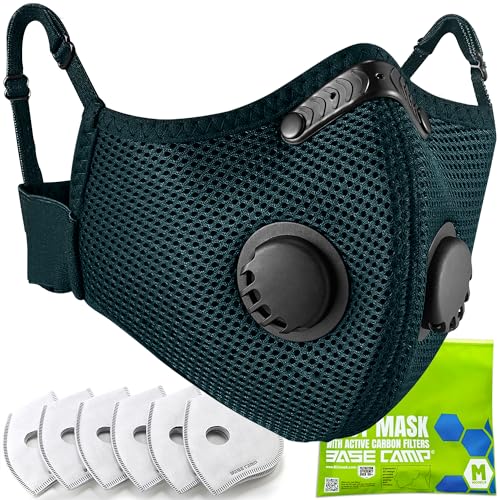
The BASE CAMP Family Pack targets households needing multiple masks on a modest budget, bundling a reusable mask shell with six activated carbon filters. The 6-layer filter system claims 99.6% filtration efficiency and includes carbon media that helps reduce odors — a useful feature when wildfire smoke carries the acrid smell of burning vegetation and structures.
The mask features an adjustable elastic strap system with hook-and-loop closure, plus an enlarged one-way exhalation valve designed to vent heat and moisture more efficiently. This makes it more breathable than many lower-cost face masks, which is important for sustained wear during smoky days when you may need to keep the mask on for hours during clean-up or evacuation tasks.
It is critical to understand that this mask is not NIOSH-certified as a respirator. While the manufacturer claims 99.6% particle filtration, it lacks the independent verification and regulatory oversight that N95 or P100 masks carry. For moderate smoke exposure — such as near the periphery of a wildfire zone rather than directly downwind — it offers budget-friendly multi-user coverage, but for heavy smoke conditions, a certified respirator is the safer choice.
Why it’s great
- Includes six activated carbon filters, good for odor reduction from smoke
- Multi-color design helps household members identify their mask quickly
- Adjustable elastic straps and efficient exhalation valve for comfort
- Lowest entry cost for outfitting a family with reusable masks
Good to know
- Not NIOSH-certified, so filtration claims lack independent verification
- Fabric shell is less effective at creating a face seal than elastomeric masks
- 6-layer filter design increases breathing resistance compared to P100
FAQ
Will an N95 mask protect me from wildfire smoke?
Can I use a surgical mask for wildfire smoke protection?
How often should I replace the filters on my smoke mask?
Do I need a mask with an exhalation valve for smoke?
Final Thoughts: The Verdict
For most users facing wildfire smoke, the best masks for wildfire smoke winner is the 3M 7502 Half Facepiece Respirator because its silicone facepiece creates the most reliable seal for extended wear, and its bayonet mount system gives you the flexibility to pair it with P100 filters for maximum protection. If you need a complete kit ready out of the box, grab the 3M 6191 Half Facepiece Kit. And for a low-profile option with built-in source control, nothing beats the GVS ELIPSE P100 Half Mask.