Selecting the wrong surface for a hospital bed can turn recovery into a cycle of discomfort, sleepless nights, and skin damage. A mattress that fails to redistribute pressure places bony prominences at constant risk, accelerates tissue breakdown, and forces caregivers into endless turning schedules. The right choice hinges on understanding how foam density, air cell design, and moisture management interact with a patient’s specific risk level.
I’m Emma — the founder and writer behind Baby Bangs. Over the years, I’ve analyzed hundreds of medical-grade sleep surfaces, comparing foam formulations, pump noise ratings, and cover materials to separate real clinical value from marketing claims.
This guide breaks down nine of the most serious contenders on the market. Whether you’re managing post-surgery recovery, palliative care, or long-term bed rest, finding the right mattress for hospital bed directly affects skin integrity, sleep quality, and caregiver burden.
How To Choose The Best Mattress For Hospital Bed
Buying a mattress for a hospital bed means trading the comfort-first logic of a standard home mattress for clinical criteria like pressure redistribution, fluid resistance, and weight capacity. The wrong choice can worsen existing skin breakdown or create new pressure points. Focus on these three areas.
Alternating Air Pressure vs. Static Foam
Alternating air pressure systems use a pump to cycle inflation through individual cells, which shifts support points every few minutes. This is the first line of defense for patients who cannot reposition themselves and stand at moderate to high risk for bedsores. Static foam mattresses rely on material density and cut patterns (channel-cut foam, die-cut zones) to spread weight evenly. Foam is quieter, simpler, and often the better call for low-risk patients or those sensitive to pump noise. The trade-off is that foam cannot actively change support points the way air does.
Cover Material and Fluid Resistance
Hospital-grade covers must repel fluids while allowing vapor to escape, or heat and moisture will accumulate against the skin. Nylon covers with polyurethane backing offer low shear friction and wipe clean easily. Vinyl covers are cheaper but trap heat and stick to skin, increasing the risk of maceration. Look for covers that are both waterproof and vapor permeable, with a zipper flap to prevent liquid ingress through the seam.
Weight Capacity and Mattress Dimensions
Standard hospital bed mattresses measure 36 inches wide by 80 or 84 inches long, with a 6-inch thickness being the most common. Check that the product’s maximum weight rating matches the patient’s needs. Foam mattresses with a high-density base layer (typically above 1.8 PCF) hold up better over time for heavier individuals. Bariatric patients may need wider options or reinforced side support to ensure safe transfers.
Quick Comparison
On smaller screens, swipe sideways to see the full table.
| Model | Category | Best For | Key Spec | Amazon |
|---|---|---|---|---|
| Invacare Softform Premier 80″ | Foam | Very high risk prevention | 500 lb capacity, 3-zone U-core | Amazon |
| Drive Med-Aire Low Air Loss | Air | Active moisture management | 20 replaceable 8-inch bladders | Amazon |
| Invacare Softform Premier 84″ | Foam | Taller patients | 84L x 36W x 6T inches | Amazon |
| Medacure 3-Layer Visco Elastic | Foam | Low risk, immediate use | 3-layer high-density memory foam | Amazon |
| ProHeal Multi-Tiered Die-Cut | Foam | Moderate to high risk | Sloped heel, 28 ILD foam | Amazon |
| Excel Sleep Gel Memory Foam | Foam | Cooling + medium firmness | Gel-infused, 6-inch economy | Amazon |
| Livaclean Health Gel Memory Foam | Hybrid | Adjustable bed compatibility | 30mm gel memory foam, 4 straps | Amazon |
| ProHeal High Density Foam | Foam | Low to moderate risk | 5 pressure zones, 28 ILD | Amazon |
| Lunderg Alternating Air Pressure | Air | Active prevention + static mode | 23 dBA pump, flocking cover | Amazon |
In‑Depth Reviews
1. Invacare Softform Premier (IPM1080)

The Invacare Softform Premier is the benchmark for hospital bed foam mattresses. Its single-piece U-core construction with a contoured foam insert creates distinct head, mid-section, and foot zones. The mid-section is firmer to support the heaviest part of the body, while the head and foot sections are softer to offload pressure from the occiput and heels. The individual foam cells allow for superior immersion, and the design is rated for patients up to Very High Risk on the Braden Scale.
The fluid-resistant four-way stretch polyurethane cover reduces shear friction significantly compared to standard vinyl. The bottom layer has a tough coated polyurethane base that resists fluids and extends the mattress lifespan. It supports up to 500 pounds, making it suitable for bariatric patients. The 8-year foam warranty and 4-year cover warranty reflect the manufacturer’s confidence in the materials, though some users report the foam takes a full three days to reach its 6-inch thickness after unboxing.
Clinical feedback consistently mentions a measurable reduction in pressure injury formation within the first month of use. Caregivers appreciate that the cover wipes down easily and that the mattress does not require an electrical pump, eliminating noise as a variable. The main downside is the premium investment, but for facilities or home caregivers dealing with high-risk patients, this mattress delivers industry-standard pressure redistribution that lower-priced foams cannot match.
Why it’s great
- Industry-leading 3-zone foam design for targeted pressure relief
- Fluid-resistant low-shear cover reduces friction damage
- 500 lb weight capacity with reinforced side support for transfers
Good to know
- Foam requires up to 72 hours to fully expand
- Premium price point, especially for the 84-inch variant
2. Drive Medical Med-Aire Low Air Loss System
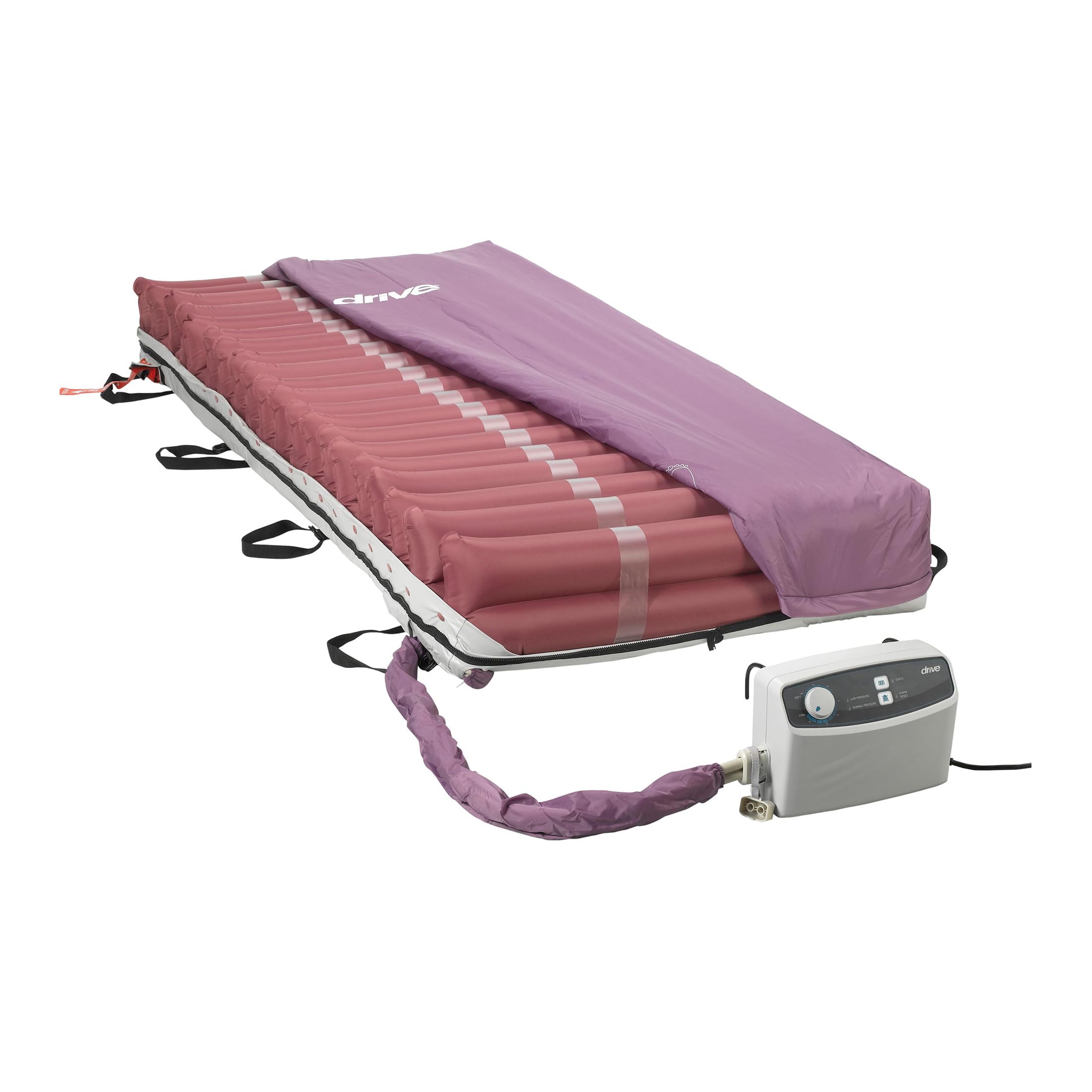
The Drive Med-Aire takes a fundamentally different approach from foam: it is a low air loss mattress replacement system. Instead of static foam, the support surface is a set of 20 individual 8-inch air bladders that cycle through alternating pressure patterns. The pump delivers consistent low air loss, meaning a small amount of air escapes continuously from the cover to wick away moisture. This is the most effective design for patients who are already showing signs of maceration or who sweat heavily while bedridden.
The cover combines vapor permeability with shear friction reduction. The built-in pillow feature provides head stability without a separate pillow, which can reduce neck shear. The audio and visual alarm system alerts caregivers if the internal pressure drops below the therapeutic threshold, a critical safety feature that static foam cannot offer. The bladders are individually replaceable, extending the unit’s life compared to a sealed air mattress that must be discarded if one cell fails.
The trade-off is noise. The pump is not silent, and the alternating motion can feel strange to some patients, especially those who are cognitively aware. Setup is more involved than unrolling a foam mattress, and the pump adds a point of failure. For home caregivers managing advanced pressure ulcers or incontinent patients, the moisture management alone justifies the higher cost. For low-risk or quiet-environment patients, a static foam mattress may be more appropriate.
Why it’s great
- Active low air loss reduces skin moisture better than any foam cover
- Replaceable individual bladders extend product lifespan
- Built-in alarm monitors therapeutic pressure levels
Good to know
- Pump noise may disturb light sleepers
- Requires electricity and periodic maintenance of bladders and hoses
3. Invacare Softform Premier (IPM1084) 84″

The Invacare IPM1084 shares every material advantage of the 80-inch IPM1080 but adds four inches in length, making it the right fit for taller patients who would otherwise have their heels pressed against the footboard. The 3-zone U-core construction and high-density foam layers remain identical, so the pressure redistribution performance does not change. The 500-pound weight capacity applies here as well, and the fluid-resistant polyurethane cover is the same four-way stretch material that reduces shear.
The fluid-resistant cover’s polyurethane base is thicker than many competitors, which matters for long-term durability in facilities where mattresses endure daily cleaning with harsh disinfectants. The machine-washable cover design simplifies hygiene maintenance. The 8-year foam warranty and 4-year cover warranty match the shorter variant, so the investment is protected against premature breakdown.
The main consideration is that this mattress is designed for hospital bed frames that accommodate 84-inch length. Verify your bed frame’s deck measurement before ordering. The foam must also expand fully, and some users report that the side support zones take the longest to reach full height. For taller bedridden patients or those who need extra foot clearance, this is the most clinically sound extended-length option available at this tier.
Why it’s great
- Extended 84-inch length accommodates tall patients without heel pressure
- 3-zone U-core foam delivers proven Very High Risk pressure prevention
- Fluid-resistant stretch cover withstands repeated disinfectant cleaning
Good to know
- Only fits bed frames designed for 84-inch mattress length
- Premium pricing reflects the specialized sizing
4. Medacure 3-Layer Visco Elastic Memory Foam

The Medacure mattress uses three layers of high-density memory foam with a visco elastic top layer that conforms closely to body contours. The convoluted foam cut in the middle layer promotes airflow and reduces heat buildup, which is a common problem with solid memory foam surfaces. Designed with low-risk patients in mind, it distributes weight evenly enough to prevent pressure ulcers from forming during moderate bed rest periods.
The 70 denier removable nylon cover is waterproof and has a non-skid bottom surface. The nylon material generates less friction than vinyl, which helps protect fragile skin during repositioning. The cover zips off in seconds for machine washing, an important hygiene feature for incontinent patients. The mattress decompresses quickly and is ready for use almost immediately after unboxing, unlike some competitor foams that need days to expand.
The biggest limitation is that it is designed for low-risk patients. The foam does not provide the active pressure redistribution that die-cut or multi-tiered foam systems offer for moderate to high-risk individuals. The weight capacity is also unspecified, so heavier patients may bottom out the 6-inch profile. For short-term recovery or patients who are still mobile enough to shift position independently, this mattress offers strong value without compromising on cover quality.
Why it’s great
- Three-layer memory foam with convoluted cut for airflow
- Low-friction waterproof nylon cover with non-skid bottom
- Decompresses quickly for immediate use after delivery
Good to know
- Best suited for low-risk patients, not active bedsore treatment
- Weight capacity is not explicitly stated
5. ProHeal Multi-Tiered Die-Cut Memory Foam

The ProHeal Multi-Tiered mattress addresses a specific clinical pain point: heel pressure. The heel section uses open-cell memory foam with a sloped design that shifts load from the sensitive heel bone to the lower leg. The torso and head sections use high-density die-cut foam, where individual cells compress independently to redistribute pressure. This combination is rated for moderate to high-risk patients, bridging the gap between basic foam and full alternating air systems.
The cover is a low-shear friction nylon that is vapor permeable and waterproof. The bottom layer uses triple laminate vinyl for fluid resistance and fire retardancy. The 360-degree zipper includes a flap that prevents liquid from seeping through the seam, a detail that standard zippers lack. The foam measures at 28 ILD, which provides enough density to prevent bottoming out while still allowing for deep immersion.
The 7-year non-prorated foam warranty and 2-year cover warranty are generous for this price tier. Sloped heel mattresses are rare in the mid-range category, making this a smart pick for patients who have started to develop heel ulcers but do not yet require a full low air loss system. The main trade-off is that the torso section is firmer than some patients prefer, and the die-cut channels can trap small debris if the cover is removed frequently.
Why it’s great
- Sloped heel section offloads pressure from the calcaneus
- Multi-tiered die-cut foam for moderate to high-risk patients
- Zipper flap prevents liquid ingress into the foam core
Good to know
- Torso section may feel too firm for some lighter patients
- Die-cut channels require careful cleaning if debris accumulates
6. Excel Sleep Gel Memory Foam (6-Inch)
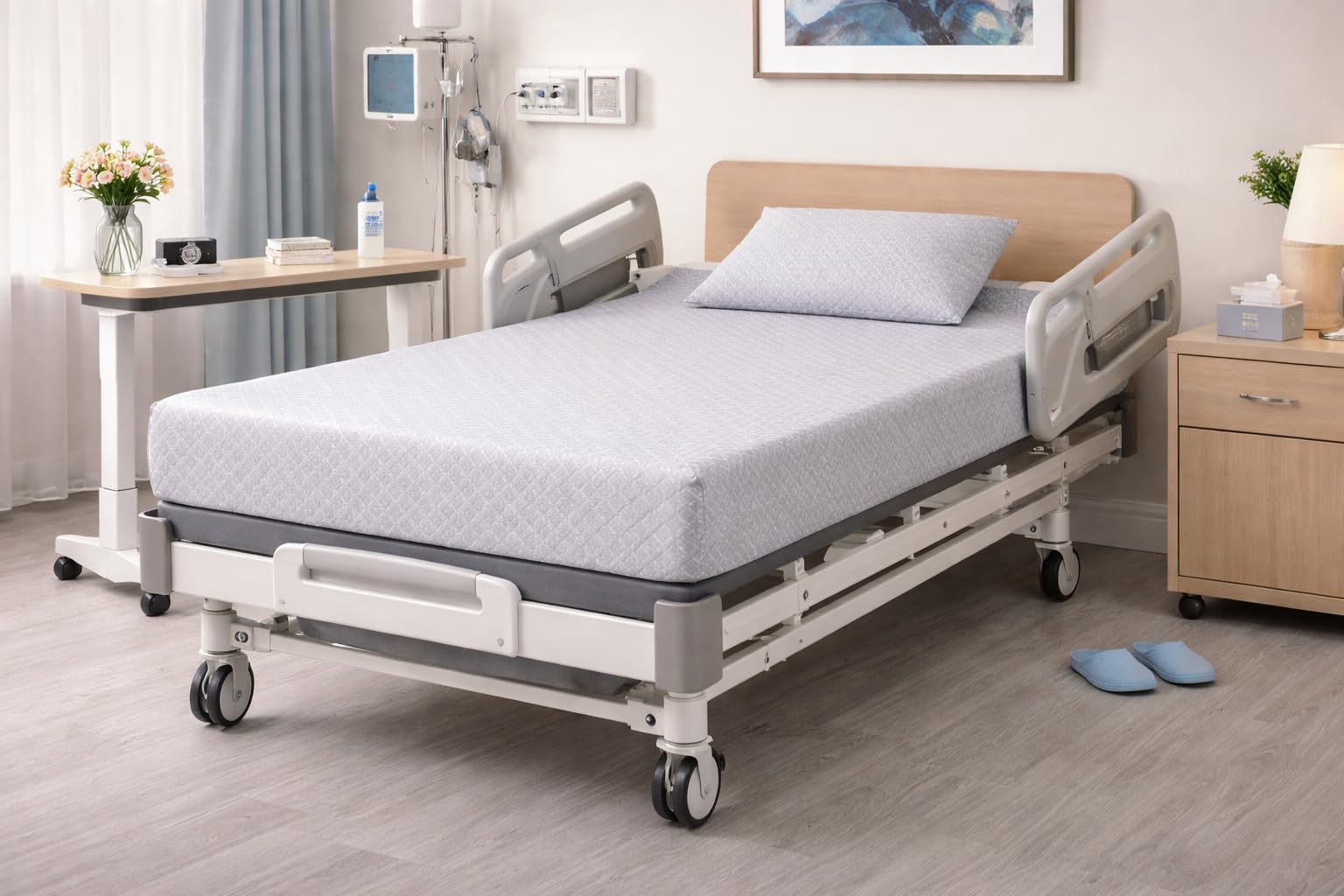
The Excel Sleep mattress is a 6-inch gel-infused memory foam designed for hospital bed frames but also common in campers and daybeds. The gel infusion reduces heat retention compared to traditional memory foam, which matters for patients who run warm or are sensitive to heat buildup. The medium-firm feel provides enough support for back sleepers while still molding to body contours. The manufacturer recommends a weight limit of about 250 pounds per sleeper for this 6-inch profile.
Handcrafted in the USA, the foam uses a high-density base layer to prevent sagging over time. The fabric cover varies in design but is removable and machine washable. Customer feedback consistently highlights that it eliminates the sinking feeling that many hospital bed foam mattresses develop within months. For bedridden patients who cannot shift position, the lack of active pressure redistribution means this is better suited for low-risk prevention than for treating existing ulcers.
The main limitation is the economy construction. This is a 6-inch mattress, and heavier patients approaching the 250-pound upper limit will feel the firmer support layer sooner than they would on a thicker or multi-tiered mattress. The cover material is basic fabric rather than medical-grade nylon or polyurethane, so fluid resistance is lower. For low-risk home care where cooling and a familiar medium-firm feel are priorities, this is a solid value.
Why it’s great
- Gel infusion actively dissipates heat better than standard memory foam
- Medium-firm feel suits back sleepers and patients needing spinal alignment
- Handcrafted in the USA with high-density base foam
Good to know
- Not rated for fluid resistance or high-risk pressure prevention
- 250-pound weight limit may be insufficient for bariatric patients
7. Livaclean Health Gel Memory Foam (Twin XL)

The Livaclean Health mattress combines a 30mm gel memory foam comfort layer with medium density support foam, all in a 6-inch Twin XL profile measuring 80 inches long. The gel layer provides cooling while the medium density foam underneath prevents the patient from sinking too deeply. The mattress is specifically designed for adjustable hospital bed frames and includes four corner straps that anchor the mattress securely during head and foot elevation changes.
The removable waterproof cover uses polyvinyl chloride (PVC) and is breathable and lightweight. While PVC covers are common in this price bracket, they do not have the same low-shear properties as nylon, so patients at risk of friction injuries may need an additional low-shear sheet. The compressed delivery requires 48 hours of expansion time. The manufacturer backs the foam with an 8-year extended protection plan and the cover with a 1-year plan.
The weight capacity is listed at 242 pounds, which places it firmly in the standard adult range rather than bariatric. Medium firmness suits most sleep positions but may not provide enough immersion for patients who are completely immobile and at moderate risk for pressure ulcers. For home care where the bed is frequently adjusted — elevating the head for reading or raising the knees for circulation — the corner straps are a practical detail that many competitors omit at this tier.
Why it’s great
- 30mm gel memory foam layer keeps the sleep surface cool
- Four corner straps prevent shifting on adjustable bed frames
- 8-year foam protection plan at a moderate investment
Good to know
- PVC cover has higher shear friction than nylon alternatives
- 242-pound weight limit may not suit heavier patients
8. ProHeal High Density Foam (36×76)

The ProHeal High Density Foam mattress uses channel-cut polyurethane foam with five distinct pressure zones. The channel cut design allows individual foam columns to compress independently, which improves pressure redistribution compared to a solid slab of foam. The 28 ILD firmness rating means it sits on the firmer end of the spectrum, providing stable support for patients who need assistance with transfers or who sink too deeply into softer foam.
The waterproof cover is made of nylon with a triple laminate vinyl bottom layer for fluid resistance and fire retardancy. The 360-degree zipper with flap prevents moisture from entering through the seam, which is a common failure point on cheaper covers. The foam measures 6 inches thick and is available in the 36-by-76-inch size, which fits standard hospital bed frames shorter than the typical 80-inch deck. The mattress is firm enough for bariatric patients but does not list a specific weight capacity.
The main limitation is that this mattress is intended for low to moderate risk. The channel-cut design is a step up from basic foam but does not provide the multi-tiered or die-cut pressure redistribution that higher-risk patients require. The 28 ILD foam may also feel too firm for lighter patients who do not weigh enough to activate the channel-cut zones. For home caregivers on a tighter budget who need a firm, waterproof surface for a patient at low risk, this is the most economical foam option.
Why it’s great
- Channel-cut 5-zone design improves pressure redistribution over solid foam
- Waterproof nylon cover with triple laminate bottom resists fluids
- Firm 28 ILD foam supports stable transfers
Good to know
- Firm feel may be uncomfortable for lightweight patients
- Best suited for low to moderate risk, not active bedsore treatment
9. Lunderg Alternating Air Pressure Mattress Pad
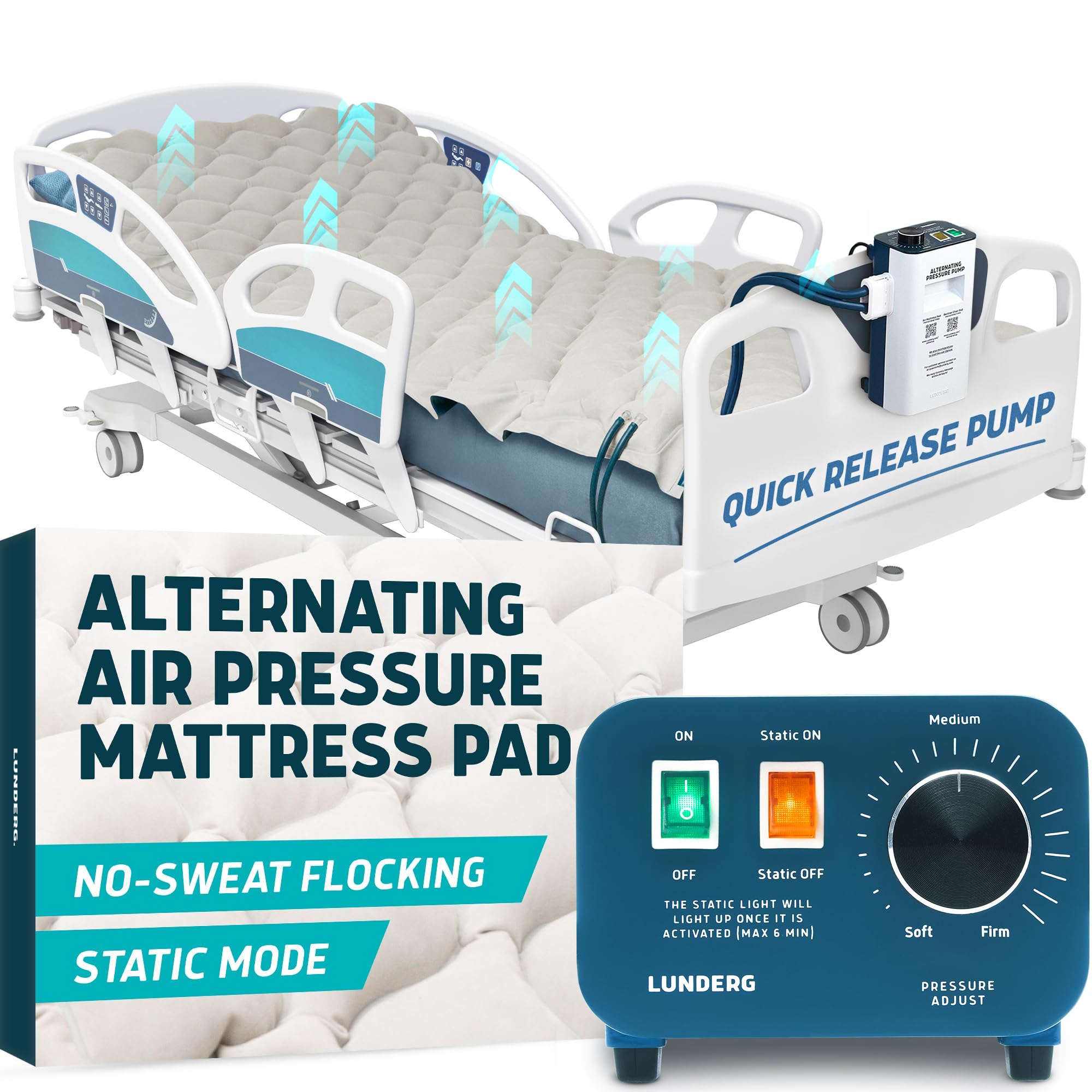
The Lunderg Alternating Air Pressure Pad is a mattress overlay designed to sit on top of an existing hospital mattress or home bed. The pump alternates inflation between two sets of air cells, shifting pressure points every few minutes. The static mode allows the caregiver to stop the alternation and keep all cells fully inflated when the patient needs a stable surface for transfers or sleep. The flocking cover is a notable upgrade from standard vinyl pad surfaces — it feels like fabric rather than plastic, reducing sweating and skin stickiness.
The pump is rated at 23 dBA, making it quieter than most alternating air pumps in this entry-level tier. The soft-to-firm pressure control knob allows precise adjustment. The pad supports up to 300 pounds and includes a patch kit for minor repairs. Setup involves unrolling the pad, connecting the air hoses to the pump valves, and inflating for about 20 minutes to complete three full cycles. The quick connector design makes disassembly for cleaning straightforward.
The main limitation is that this is a pad, not a full mattress replacement. It adds about 4 to 5 inches of height on top of an existing mattress, which can change the effective bed rail height and increase fall risk if not accounted for. The air cells can be felt through the flocking cover by sensitive patients, though most adapt within a few nights. For caregivers managing bedsore prevention on a tight budget, the combination of alternating therapy and a fabric-like surface is a strong entry point into active pressure relief.
Why it’s great
- Alternating air pressure with static mode for transfer stability
- Flocking cover eliminates the sticky vinyl feel of standard air pads
- 23 dBA pump is noticeably quieter than budget alternation pumps
Good to know
- Pad overlay increases bed height and may require bed rail adjustment
- Air cell sensation is noticeable for some patients
FAQ
Can I use a regular home mattress on a hospital bed frame?
How often should a hospital bed mattress be replaced?
What is the difference between low air loss and alternating pressure?
Final Thoughts: The Verdict
For most users, the mattress for hospital bed winner is the Invacare Softform Premier (IPM1080) because its 3-zone U-core foam construction delivers Very High Risk pressure prevention with a fluid-resistant low-shear cover. If you need active moisture management and alternating therapy, grab the Drive Medical Med-Aire Low Air Loss System. And for a budget-conscious starting point with alternating pressure and a comfortable flocking surface, nothing beats the Lunderg Alternating Air Pressure Pad.