You grab the red bag, and your hands know exactly which zippered pouch holds the trauma shears and which compartment stores the compressed gauze. That split-second clarity separates a controlled response from a frantic dig. A well-curated medical kit isn’t a box of bandages—it’s a pre-planned decision tree for the moment your brain goes quiet.
I’m Emma — the founder and writer behind Baby Bangs. I have spent over a decade analyzing emergency preparedness gear, cross-referencing hospital-grade supply lists with real-world field reports from wilderness guides and tactical responders.
The challenge isn’t finding a bag stuffed with adhesive strips; it’s identifying the medical kit that actually carries the right balance of wound-closure hardware, bleed-control tools, and antiseptic solutions for your specific environment—whether that is a suburban glove box or a backcountry ridge line.
How To Choose The Best Medical Kit
Most commercially available medical kits are assembled around the concept of convenience rather than capability. A high piece count often masks a shortage of functional trauma items—you might find ninety adhesive bandages but zero hemostatic gauze or chest seal. The right kit matches your risk profile: a daily commuter needs different supplies than a weekend backpacker or a home prepper. Start by evaluating the wound-care tier the kit supports and work backward to the carrying case.
Wound Closure and Hemorrhage Control Depth
Standard first aid kits stop at adhesive bandages and butterfly closures. A capable medical kit includes at least one trauma dressing, a pressure bandage, and a tourniquet or hemostatic agent for deeper bleeding. Check whether the kit provides sterile surgical-style closure devices like zip-stitch strips that can approximate a laceration edge without sutures—this feature alone raises the kit’s utility from scrape-care to true emergency readiness.
Organizational Architecture and Labeling
Under stress, your ability to locate a specific item collapses if the interior is a single black hole pouch. Kits with labeled compartments or clear plastic dividers reduce search time significantly. Look for a bag that uses color-coded zones or printed labels for categories like “Bleeding Control,” “Burns,” and “Medication”—this design allows a second person, untrained in your system, to retrieve the correct supply without instruction.
Carrying Format and Attachment Versatility
A medical kit that lives in your car trunk needs a hard case or padded soft shell for crush resistance. A kit that attaches to a backpack or molle webbing must be compact and flat. Evaluate whether the kit includes loops, straps, or a carabiner for modular carry. Water resistance is non-negotiable if the kit will face rain, river crossings, or marine environments—check for a waterproof shell or internal dry-bag insert rather than just a water-resistant coating.
Quick Comparison
On smaller screens, swipe sideways to see the full table.
| Model | Category | Best For | Key Spec | Amazon |
|---|---|---|---|---|
| Adventure Medical Kits Hiker | Expedition | Day hikes and ultralight trips | Easy Care labeled compartments | Amazon |
| PUMIER 368-Piece | All-Purpose | Home and vehicle storage | PU leather hard case | Amazon |
| EVERLIT Wound Closure Kit | Trauma | Laceration closure in the field | Zip-stitch adhesive device | Amazon |
| Pasenhome Labeled Kit | Compact | Daily carry and molle attachment | 20 rapid-response compartments | Amazon |
| TLIEAO 330-Piece | Premium | Car and family preparedness | 1680D polyester shell | Amazon |
| RHINO RESCUE 371-Piece | OSHA | Office and home base station | Tilting shelf organizer | Amazon |
| GEVOKE 500-Piece | Professional | Large family and business sites | 500-piece refillable system | Amazon |
In‑Depth Reviews
1. Adventure Medical Kits Hiker
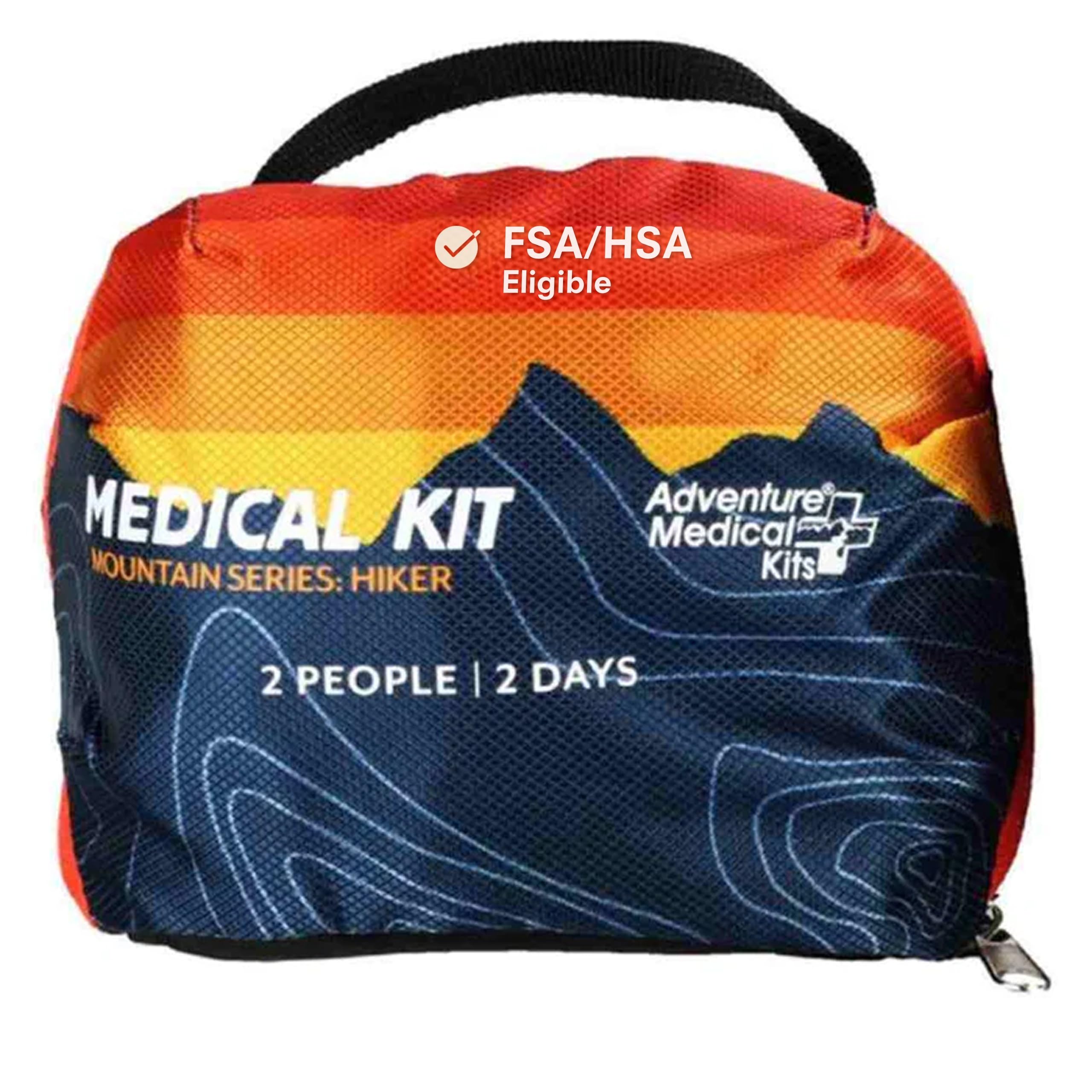
The Adventure Medical Kits Hiker is the gold standard for anyone who needs a purpose-built medical kit that prioritizes weight and organization over raw piece count. The Easy Care system uses clearly labeled internal pockets so you can find a trauma pad or elastic bandage without dumping the entire bag on the ground. At just under 10 ounces, this kit disappears into a backpack or summit pack without adding noticeable bulk.
The contents are expedition-grade: a trauma pad for severe bleeding, a pressure bandage, wound closure strips, and a wilderness first aid guide. It supports two people for up to two days, which means the supplies are concentrated on the injuries most likely to occur on a trail—cuts, blisters, sprains, and minor burns. The water-resistant bag also leaves a small amount of spare volume for personal medications or a tourniquet if you want to upgrade the bleed control capacity.
Long-time Adventure Medical Kits customers consistently praise the Hiker for its balance of completeness and carry comfort. The kit is not designed for office break rooms or glove compartments—it is a trail-first system for people who know the difference between a band-aid and a pressure dressing.
Why it’s great
- Ultralight at 9.9 oz—ideal for day hikes and summit packs
- Easy Care compartments keep supplies visible and sorted
- Includes wilderness medical guide for remote decision-making
Good to know
- Small capacity for two people for two days only
- No tourniquet or hemostatic agent included stock
2. PUMIER 368-Piece First Aid Kit
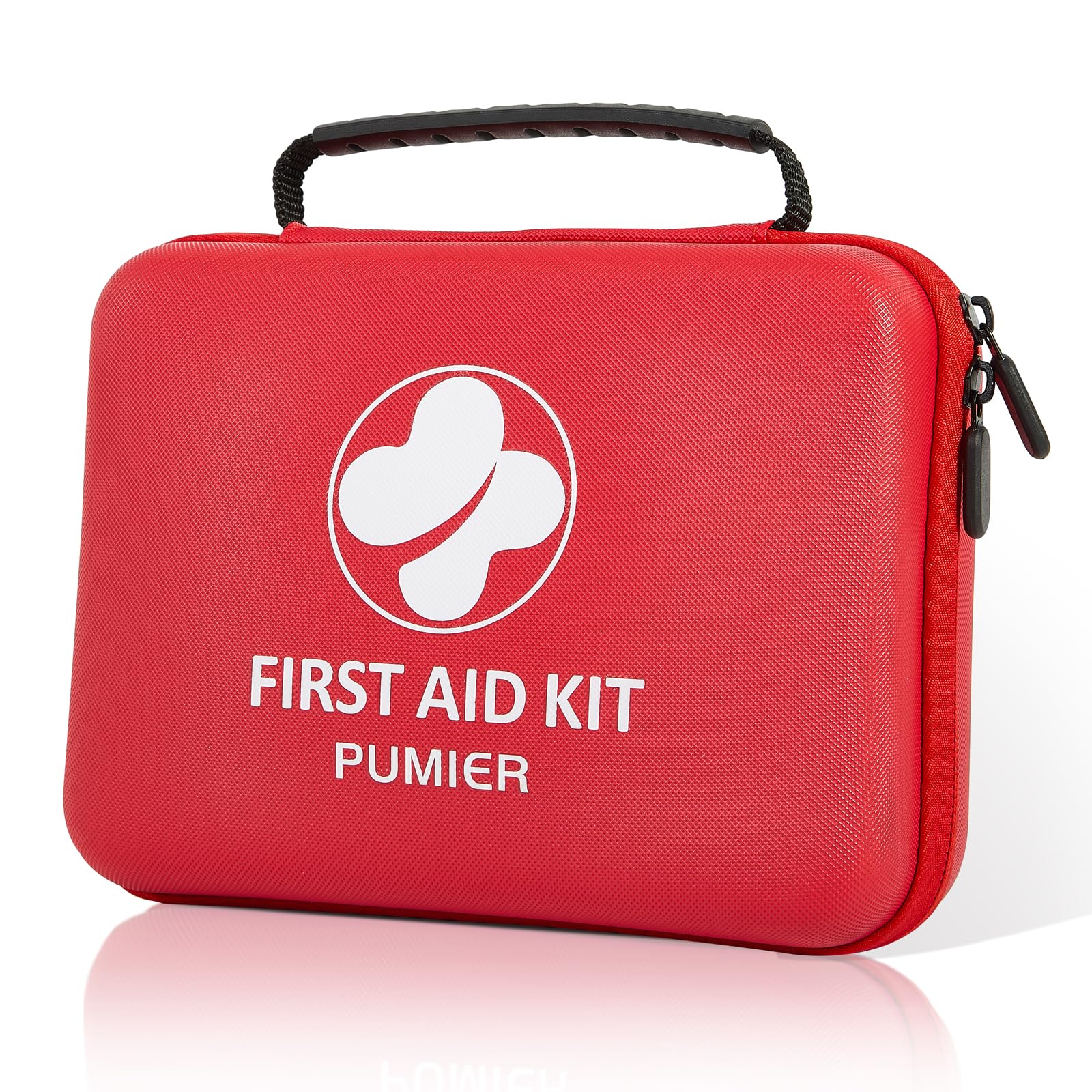
PUMIER’s 368-piece kit takes the all-in-one approach seriously, packing enough adhesive bandages, gauze pads, antiseptic wipes, and trauma supplies to cover a family vehicle or home closet. The hard shell, wrapped in PU leather, is lightweight yet crush-resistant, and the bright red color makes it easy to spot in a trunk or under a seat. The kit comes in a compact 8.5 x 6.7 x 3.3 inch footprint that fits most storage spaces.
Inside, the supplies are categorized in clear plastic bags and separate compartments, which helps you grab the right item without digging through a tangled mess. The assortment includes blister prevention pads, waterproof wound dressings, and a CPR face shield—items that are frequently missing from entry-level kits. The water-resistant shell and zipper closure add protection against moisture and dust during car storage or camping trips.
Buyers consistently note the value-to-content ratio, and many report adding personal medications or a tourniquet to compensate for the kit’s lack of advanced trauma gear. For everyday scrapes, minor burns, and basic wound care, this kit is hard to beat. It is not a tactical trauma bag, but it is one of the most thorough general-purpose kits available at this level.
Why it’s great
- Hard PU leather shell protects supplies from crushing
- Wide assortment with blister and waterproof wound care
- Compact enough for trunk, RV, or boat storage
Good to know
- Bandages run on the smaller side
- No hemostatic gauze or tourniquet included
3. EVERLIT Wound Closure Kit

EVERLIT’s Wound Closure Kit is a specialized supplement, not a standalone general first aid bag. It focuses entirely on one job: closing a laceration in the field without sutures. The hero component is the Zip-Stitch device—a sterile, adjustable adhesive strip that pulls wound edges together and lets the user tighten or loosen tension as swelling changes. This is not a butterfly bandage; it is a true mechanical approximation tool that can produce results comparable to a basic suture line.
The kit also includes sterile wound dressings, large adhesive bandages, elastic bandages, and medical shears. The waterproof transparent dressings allow wound monitoring without removal, which is critical in wet environments or during multi-day backcountry trips. Everything arrives sterile and individually wrapped, so you can deploy the closure device directly onto a clean wound without cross-contamination.
Off-grid users and preppers report using this kit to avoid long ER waits for minor lacerations. The kit is compact enough to slide into an existing medical bag without taking up significant space.
Why it’s great
- Zip-stitch device allows adjustable tension wound closure
- Sterile and individually wrapped for field use
- Waterproof dressings protect wound in wet conditions
Good to know
- Not a complete first aid kit—focuses on laceration only
- Scissors are basic quality, not heavy-duty trauma shears
4. Pasenhome Labeled First Aid Kit

Pasenhome has solved the single biggest frustration with soft medical pouches: the “dig and dump” search pattern. This kit features 20 labeled compartments with brief use notes printed directly on each sleeve, so a panicked helper can identify the trauma pad or eye pad without guessing. The 600D ripstop polyester shell is rugged enough for repeated packing and unpacking, and the MOLLE-compatible straps allow attachment to a backpack, bicycle bag, or camping gear.
Measuring 7.9 x 5.9 x 3.6 inches and weighing about 1.3 pounds, this kit is compact enough for daily carry yet spacious enough to hold trauma pads, gauze rolls, tape, scissors, tweezers, gloves, cotton swabs, an emergency blanket, a triangular bandage, a whistle, and a first aid guide. The two-way zippers make access easy even when the pouch is strapped into a tight spot. There is also a small amount of empty volume left for personal additions like antihistamines or a tourniquet.
Reviewers consistently mention the labeling as a standout feature—it transforms the kit from a generic pouch into a tool that anyone in the family can use effectively. The MOLLE system also makes this a solid choice for cyclists, motorcyclists, and overlanders who need a grab-and-go solution that stays put on rough terrain.
Why it’s great
- 20 rapid-response labels with use notes for fast access
- MOLLE straps for backpack, bike, or vehicle attachment
- Durable 600D ripstop construction with room for additions
Good to know
- Soft shell offers less crush protection than a hard case
- Some items are basic in quality (scissors, tweezers)
5. TLIEAO 330-Piece Premium First Aid Kit
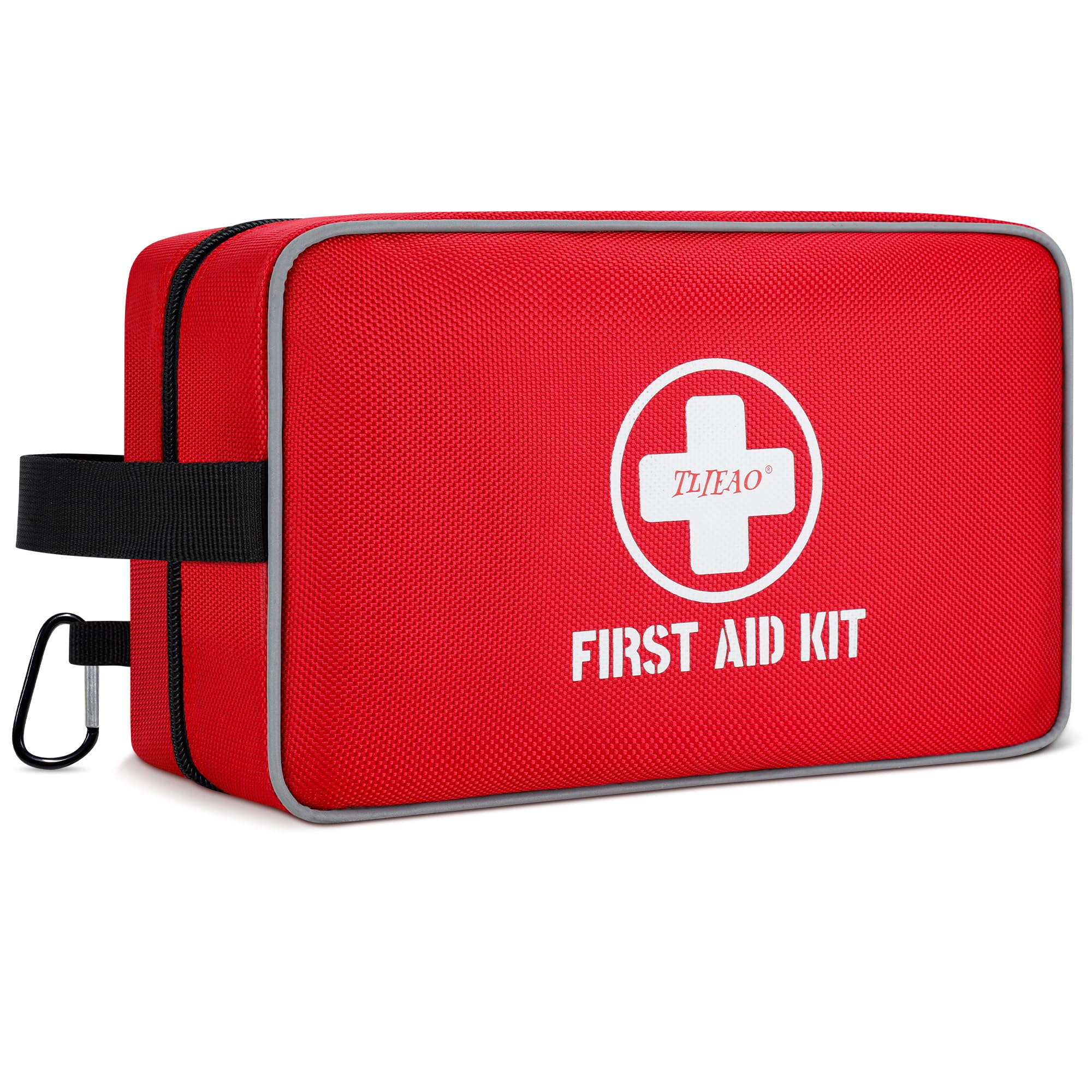
The TLIEAO 330-Piece kit takes a premium approach to the soft-shell medical bag category. The outer shell uses 1680D polyester fiber, which is significantly more tear-resistant than the standard 600D or 1200D fabrics found on most mid-range kits. Reflective piping runs along the front edge, making the kit visible in low-light conditions and allowing it to double as an emergency rescue marker. The double zipper and carry handle are reinforced for daily use.
The interior is divided into labeled compartments with clear visibility so you can immediately locate povidone-iodine prep pads, gloves, an instant ice pack, a tourniquet, and CPR face shield. At 330 pieces, the kit is comprehensive without being overwhelming—there are enough bandage sizes and gauze pads to handle multiple minor incidents before restocking. The bonus carabiner allows you to clip the bag to a backpack or tent loop for quick access.
Users who keep this kit in their vehicle appreciate the form factor—9.44 x 5.9 x 4.33 inches fits under seats or in trunk organizers without eating up too much space. The kit is best suited for families, road trippers, and outdoor enthusiasts who want a higher-grade carrying case with professional-grade supply selection. It is a step up from the budget hard cases in fabric durability and organization.
Why it’s great
- Heavy-duty 1680D polyester shell resists tearing
- Reflective piping aids nighttime location and rescue
- Labeled compartments with clear interior visibility
Good to know
- No user reviews yet to confirm long-term durability
- Soft shell still vulnerable to crushing in heavy cargo
6. RHINO RESCUE 371-Piece OSHA Kit
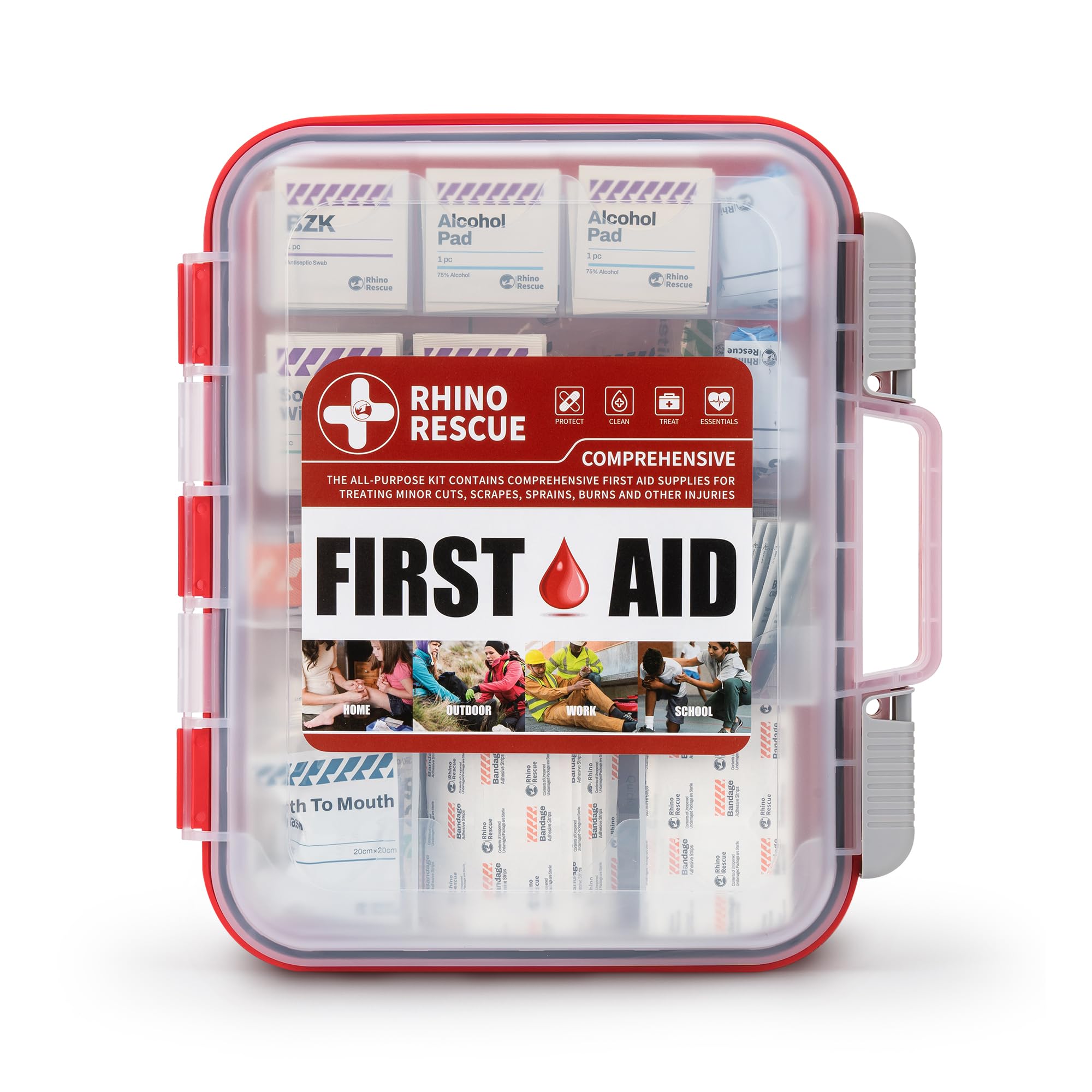
RHINO RESCUE’s 371-piece kit is designed for stationary deployment—offices, schools, workshops, and home pantries where a wall-mounted or shelf-based unit makes sense. The hard plastic case features tilting shelves and a transparent lid, giving you a visual inventory of every compartment without opening the bag. This is the same organizational philosophy used in professional medical storage, adapted for consumer use.
The contents meet OSHA standards for workplace first aid, which means the supply mix prioritizes burn care, bleeding control, and wound cleaning over the “quantity over quality” approach of budget kits. You get assorted bandages, gauzes, pads, burn gel packets, instant cold packs, tapes, and gloves. The case measures 11.6 x 4 x 13 inches and weighs about 3 pounds—heavy for a carry bag but stable for a mounted station.
Buyers consistently rate this kit highly for its organization logic and the quality of individual components. The tilting shelves prevent items from mixing when the case is opened, and the clear lid allows you to see if a restock is needed without unzipping anything. This is not a kit for backpacking or vehicle glove boxes—it is a home or office base station that keeps supplies accessible and orderly.
Why it’s great
- Tilting shelf design keeps supplies organized and visible
- OSHA-compliant content suitable for workplace use
- Transparent lid allows inventory check without opening
Good to know
- Too large and heavy for portable or carry-on use
- No tourniquet or advanced trauma gear included
7. GEVOKE 500-Piece Professional Kit

The GEVOKE 500-Piece kit is the largest capacity option in this lineup, designed for anyone who needs a single bag to cover a large family, a small business, or an expedition team. The bag uses 1680D polyester fiber similar to the TLIEAO kit, with the addition of a MOLLE system on the exterior for attaching modular pouches. Side handles and a top handle make the bag easy to grab from a vehicle or hang on a wall hook.
The interior is divided into labeled compartments with extra space for refilling supplies as they run out. The kit includes reflective strips that improve visibility at night, and the double-zippered design allows access from either side. At 3.92 pounds, the kit is heavier than most portable options, but the trade-off is 500 pieces of coverage across bandages, gauze, trauma pads, antiseptics, gloves, and more. The MOLLE system also supports shoulder strap attachment for hands-free carry in field conditions.
For large-scale preparedness—think multi-family households, construction sites, or group camping trips—this kit provides the depth to handle multiple incidents before restocking is required. The refillable design is a practical long-term advantage: you can buy bulk gauze and bandages to keep the bag topped off without replacing the entire kit. It is the closest thing to a professional response bag at a consumer-grade price point.
Why it’s great
- 500-piece capacity covers large groups and multiple incidents
- MOLLE system allows modular expansion and strap carry
- Reflective strips aid visibility and nighttime rescue
Good to know
- Heavy at 3.92 lbs for a portable medical kit
- No user reviews available to confirm component quality
FAQ
What piece count actually matters in a medical kit?
Can I add a tourniquet to a general purpose first aid kit?
How often should I inspect and restock my medical kit?
What is the difference between a waterproof and water-resistant medical kit?
Final Thoughts: The Verdict
For most users, the medical kit winner is the Adventure Medical Kits Hiker because it combines ultralight carry with expedition-grade wound care organization that works in real backcountry scenarios. If you want a hard case for vehicle readiness and broad supply coverage, grab the Pasenhome Labeled Kit. And for advanced laceration closure in remote settings, nothing beats the EVERLIT Wound Closure Kit as a supplement to your primary bag.