Leg swelling, throbbing veins, and that heavy ache that sets in by midday aren’t just discomfort—they’re signals your circulatory system needs support. Medical-grade compression stockings apply precise pressure from ankle to thigh, actively pushing blood back toward the heart and reducing fluid buildup.
I’m Emma — the founder and writer behind Baby Bangs. I’ve analyzed compression fabric specifications, pressure gradient accuracy, and user retention data across dozens of models to find the stockings that actually deliver therapeutic value without sacrificing daytime wearability.
Below, I break down the five stockings most likely to meet a medical need. This is your targeted guide to the best medical compression socks for women, focused on graduated pressure integrity and real-world fit for recovery and daily circulation.
How To Choose The Best Medical Compression Socks For Women
The term “medical compression” is not a marketing flourish—it refers to a specific range of graduated pressure measured in mmHg. Over-the-counter “support socks” at 8–15 mmHg address mild fatigue but do not meet the therapeutic threshold for edema, DVT prevention, or post-venous procedure recovery. True medical grade stockings start at 15–20 mmHg for light swelling and climb to 20–30 mmHg or 30–40 mmHg for significant circulatory conditions. Understanding this pressure ladder is the first step toward a stocking that actually works.
Graduated Compression — Why Pressure Gradient Matters
A medical compression stocking must apply the highest pressure at the ankle and gradually decrease up the leg. This gradient actively propels blood upward, counteracting gravity. Non-graduated or uniformly tight hosiery can restrict circulation instead of assisting it. Look for product descriptions that explicitly state “graduated compression” with ankle-to-calf or ankle-to-thigh pressure reduction. Stockings that do not disclose a graduated design are not medical compression.
Length and Toe Design — Matching Your Condition
Knee-high stockings work for most lower-leg swelling and varicose veins below the knee. Thigh-high or waist-high (pantyhose) stockings are required when the issue extends above the calf, for severe DVT, or post-surgical recovery. Open-toe designs allow toe inspection, better breathability, and accommodate foot bandages or sensitivity. Closed-toe styles provide full warmth and a polished look under pants. Choose the length that isolates the affected area without unnecessary fabric bunching behind the knee.
Stay-Up Mechanisms — Silicone vs. Elastic Bands
A thigh-high stocking that slips down every twenty minutes is functionally useless, defeating the compression gradient and creating a tourniquet effect at the knee. The most reliable anti-slip systems use a wide silicone dot-grip lining along the top band. Pure elastic bands without silicone tend to roll, dig in, or migrate downward. This is the single most common point of failure in thigh-high medical hosiery and the primary reason users abandon them early.
Quick Comparison
On smaller screens, swipe sideways to see the full table.
| Model | Category | Best For | Key Spec | Amazon |
|---|---|---|---|---|
| Amazon Basics Thigh High | Thigh High | Post-procedure recovery and all-day medical use | 20-30 mmHg with silicone dot-grip top | Amazon |
| JOBST Relief Knee High | Knee High | Targeted lower-leg swelling and varicose veins | 20-30 mmHg closed-toe design | Amazon |
| Laubawck Pantyhose Stockings | Pantyhose | Full-leg compression with opaque coverage | 20-30 mmHg graduated support tights | Amazon |
| Doc Miller Thigh High | Thigh High | Pregnancy and mild varicose vein support | 15-20 mmHg open-toe design | Amazon |
| Soxland Women’s Pack | Knee High | Daily rotation and travel-friendly use | 6-pair therapeutic graduated | Amazon |
In‑Depth Reviews
1. Amazon Basics Medical Compression Stockings
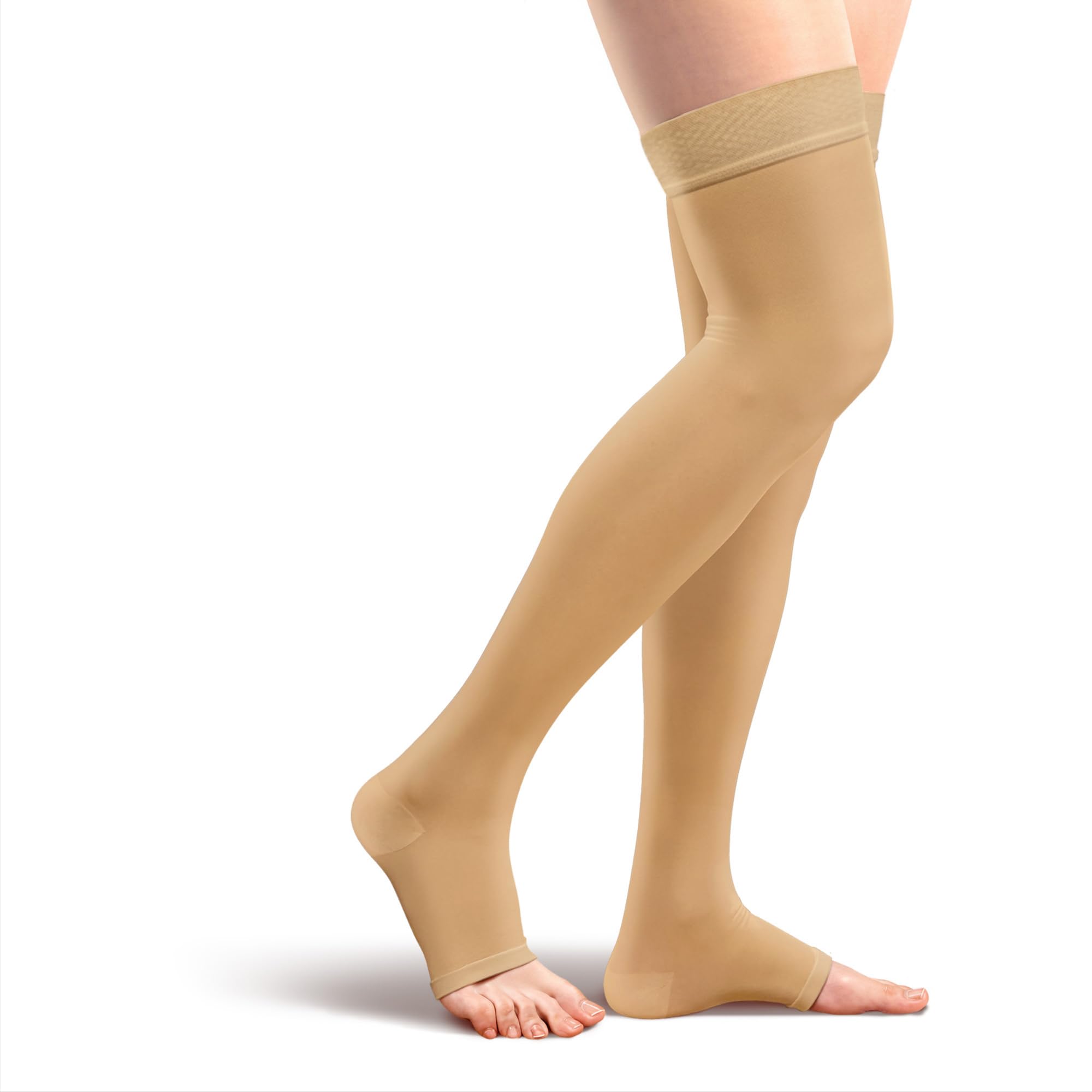
Amazon Basics steps into the medical compression category with a thigh-high stocking that hits the 20-30 mmHg therapeutic range without hospital-grade pricing. The open-toe design is a functional advantage for patients who need toe sensitivity checks after procedures or prefer breathable coverage during long recovery periods. The opaque fabric conceals the leg well, making this stocking less clinical in appearance.
The silicone dot-grip lining along the top band is the standout feature—real-world reviews consistently confirm these stay up under jeans and during extended wear. The knit heel pocket reinforces the stocking geometry, preventing rotation around the ankle. Users with muscular legs report the compression remains effective even after 24 hours of continuous wear, though the elastic band can cause thigh numbness in some wearers after several hours.
Manufactured in the USA from hospital-grade materials, this stocking uses thicker medical-weight yarns that resist stretching over repeated wash cycles. The sizing chart aligns well with standard leg measurements, but the thigh band tension is not adjustable—if your thigh circumference falls at the upper end of a size range, consider moving up one size to avoid excessive pressure at the top band.
Why it’s great
- Reliable silicone grip top that prevents roll-down
- Graduated 20-30 mmHg compression stays effective over long wear
- Made in USA with durable hospital-grade yarns
Good to know
- Thigh band may cause numbness on some body types
- Open-toe design requires careful sizing for foot comfort
2. JOBST Relief 20-30 mmHg Compression Stockings

JOBST is a name familiar to anyone who has been fitted for compression hosiery in a clinic setting, and the Relief model brings that institutional pedigree to a knee-high format. The 20-30 mmHg pressure is appropriate for moderate varicose veins, pregnancy-related edema, and general lower-leg swelling that does not extend above the knee. The closed-toe construction provides full foot coverage and a smooth line under dress trousers.
The fabric feel is noticeably denser than off-the-shelf support socks, with a fine-knit structure that distributes pressure evenly without creating pinch points at the ankle or behind the knee. The top band is a wide elastic cuff designed to anchor just below the knee—there is no silicone grip here, so the hold depends on accurate calf circumference sizing. Users with very tapered calves may experience slippage if the band cannot get sufficient purchase.
For daily wear from morning to evening, the closed-toe design can feel constrictive for those with wider forefeet or bunions. Consider measuring your ankle circumference separately against the size chart, as the ankle graduation is the most critical point. JOBST stockings are generally machine-washable in cold water, but air drying is essential to preserve the elastic gradient.
Why it’s great
- Clinical-grade brand with consistent 20-30 mmHg graduation
- Dense knit fabric distributes pressure without pinch points
- Closed-toe option offers full foot coverage for work wear
Good to know
- No silicone grip band—relies on elastic cuff and calf fit
- Closed-toe design may not suit wide forefeet or bunions
3. Laubawck Compression Pantyhose Stockings

Laubawck’s pantyhose-style stocking is a practical solution for women who need full-leg graduated compression from ankle to waist. The 20-30 mmHg pressure gradient covers the entire lower body, making it a strong candidate for those with swelling that extends into the thighs or for post-surgical recovery involving the legs. The opaque closed-toe fabric hides imperfections while providing consistent compression down to the toes.
The unisex sizing is generous, accommodating a range of hip and waist measurements without the restrictive waistband feel common in medical waist-high hosiery. The fabric is a thicker opaque nylon-spandex blend that holds its shape across multiple wears but runs warm in high temperatures. Since this is a full pantyhose, getting the correct waist-to-ankle length ratio is critical—a stocking that is too short will over-compress the crotch and bunch behind the knees.
This model is a smart alternative to wearing two separate thigh-high stockings, especially for women who prefer one-piece application. The trade-off is bathroom convenience: you must fully remove the pantyhose for restroom visits. If you are mobile and out of the house for long stretches, this can be a real friction point. For at-home recovery or short outings, it eliminates the upper thigh gap that sometimes leaves a compression shadow line.
Why it’s great
- Full-leg to waist compression eliminates thigh band pressure
- Opaque fabric is more wearable under skirts and dresses
- Unisex sizing fits a wide range of hip and waist proportions
Good to know
- Must be fully removed for bathroom breaks
- Can run warm due to thick opaque material
4. Doc Miller Thigh High Open Toe Compression Stockings
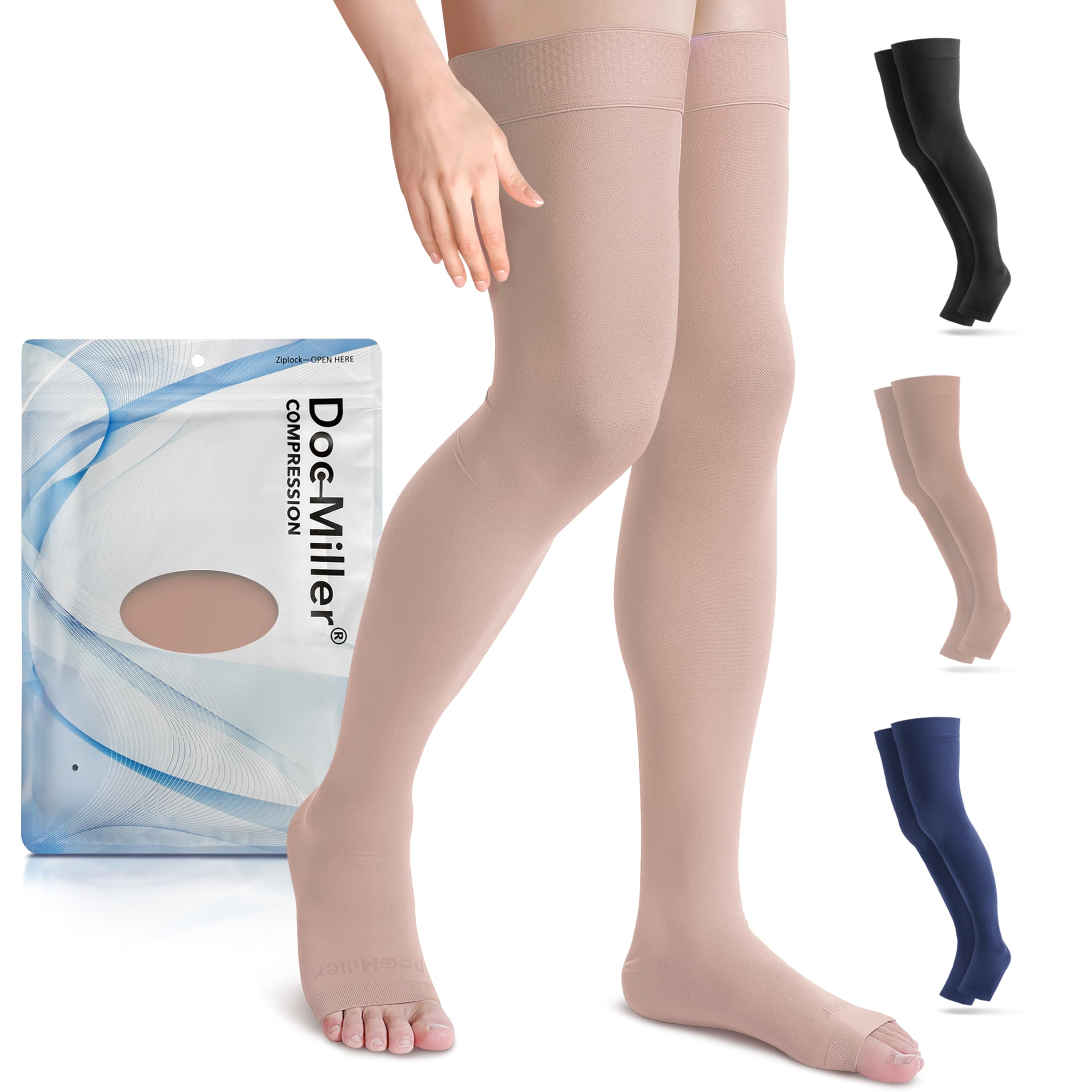
Doc Miller steps into the mild-to-moderate compression zone with a 15-20 mmHg thigh-high stocking aimed at varicose veins and pregnancy-related leg fatigue. This pressure range is often the starting point for women new to compression hosiery who find 20-30 mmHg too intense for all-day wear. The open-toe design provides unrestricted toe movement and is particularly helpful in the third trimester when foot swelling varies day to day.
The unisex fit means the calf and thigh circumferences are not gender-optimized, which can lead to a looser calf contour on narrower legs. The top band relies on a stretch elastic rather than a silicone strip, so the stay-up performance depends heavily on your thigh measurement matching the size chart precisely. Users with athletic or very full thighs may find the band stays put, while those with naturally tapered upper legs may need to adjust periodically.
For the price, the construction quality is acceptable—the knit is smooth and the heel pocket is correctly shaped to prevent twisting. But the 15-20 mmHg rating places this stocking firmly in the “light medical” category rather than the heavy therapeutic range. If your doctor prescribed 20-30 mmHg for DVT or significant edema, this model will not meet that requirement. It is best suited for comfort during pregnancy or for general tired legs that need some lift.
Why it’s great
- Lower 15-20 mmHg pressure is more tolerable for beginners and pregnancy
- Open-toe design accommodates foot swelling and sensitivity
- Smooth knit with correct heel pocket prevents twisting
Good to know
- Pressure is too low for DVT or significant edema treatment
- No silicone grip band; may require adjustment on tapered thighs
5. Soxland Women’s Compression Socks Therapeutic Graduated (Pack of 6)
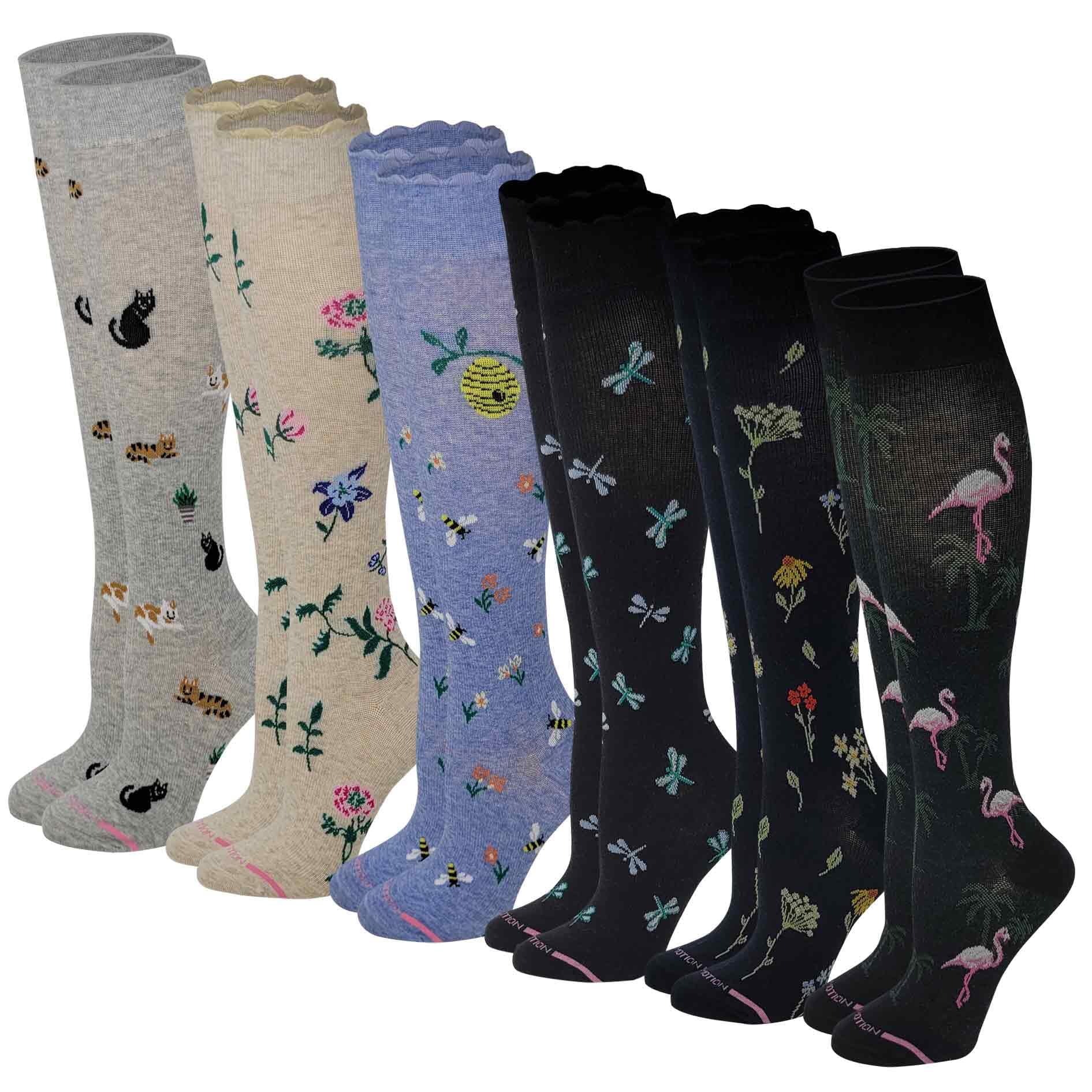
Soxland takes a multi-pack approach, bundling six pairs of knee-high therapeutic compression socks designed for women who want variety and convenience. The graduated compression is not advertised with a specific mmHg range—the listing uses “therapeutic graduated” language, which typically corresponds to a mild 15-20 mmHg level. This puts the pack in the everyday wellness category rather than strict medical therapy.
The fabric blend includes a higher cotton content than most medical-grade stockings, which improves breathability and reduces sweating—a genuine plus for all-day office wear, air travel, or light hiking. The knit is thinner and more flexible than hospital-grade hosiery, making them easier to pull on without a donning aid. The top band is a standard elastic cuff with no silicone lining, so they will stay put on calves with average circumference but may drift downward on slender legs.
This pack is an excellent value for women who need daily lower-leg compression for mild swelling, varicose vein prevention during long flights, or general leg fatigue from standing work. The six-pair rotation means you can wear a fresh pair each day and still have spares for travel. But if your doctor has prescribed a specific 20-30 mmHg or 30-40 mmHg level for a venous condition, the unspecified pressure graduation here is not a suitable substitute for a medical-grade stocking.
Why it’s great
- Six-pair value pack ideal for daily rotation and travel
- Higher cotton blend improves breathability for all-day wear
- Easier to pull on than heavier medical-grade stockings
Good to know
- No specific mmHg rating—likely falls in the 15-20 mmHg range
- Standard elastic cuff may slip on very slender calves
FAQ
Can I wear 20-30 mmHg compression stockings if I have never worn compression before?
What is the difference between open-toe and closed-toe compression stockings?
Final Thoughts: The Verdict
For most users, the best medical compression socks for women winner is the Amazon Basics Thigh High because it delivers reliable 20-30 mmHg graduated compression with a silicone grip top that actually stays up, at a price that undercuts most clinic brands. If you want a dedicated knee-high option for targeted lower-leg work, grab the JOBST Relief. And for a full-leg compression solution that eliminates thigh bands entirely, nothing beats the Laubawck Pantyhose Stockings.