You bought the crib, swaddled the bassinet, and baby-proofed every outlet. But the one thing that wakes you at 3 a.m. isn’t the crying — it’s the silence. A standard audio monitor cannot tell you if your infant is breathing, and that uncertainty is its own kind of exhaustion. Medical-grade baby monitors close that gap by tracking pulse rate, oxygen saturation, or breathing motion in real time, delivering alerts before worry becomes panic.
I’m Emma — the founder and writer behind Baby Bangs. I’ve spent hundreds of hours cross-referencing FDA clearance status, sensor accuracy data, and real-world parent feedback to separate the clinical-grade tools from the marketing hype.
This guide evaluates wearable sock systems, camera-based breathing trackers, and wearable-free motion sensors to help you choose the right medical-grade baby monitor for at-home use that fits your baby’s age, your comfort with data, and your home setup.
How To Choose The Best Medical-Grade Baby Monitor For At-Home Use
Choosing a medical-grade baby monitor means understanding the difference between clinical data and surveillance comfort. The monitors here aren’t just video feeds — they actively track physiological signs that indicate distress. Before you buy, match the technology to your baby’s age, your tolerance for false alarms, and your daily routine.
FDA Clearance vs. Consumer-Grade Sensors
FDA-cleared devices like the Owlet Dream Sock have undergone clinical testing for pulse rate and oxygen accuracy. Non-cleared trackers, such as the Sense-U or Nanit, use movement or pixel analysis — they detect anomalies, not clinical thresholds. For newborns under six months, FDA clearance adds a layer of reliability that consumer-grade algorithms cannot guarantee.
Wearable Socks vs. Wearable-Free Camera Tracking
Wearable socks (Owlet, Sense-U Smart Sock) measure pulse and oxygen directly against the skin. They offer real-time physiological data but require proper fit and can trigger false alarms if the sock shifts. Wearable-free systems (Philips Avent, Nanit) track breathing motion via AI, require no hardware touching the baby, and work longer into toddlerhood, but they rely on line-of-sight camera placement and adequate lighting.
Camera Resolution and Night Vision Clarity
Medical-grade monitoring isn’t just about the sensor — you also need to see whether your baby’s chest is rising. 2K or 4K UHD provides enough detail in low light to distinguish subtle motion. Cameras with active noise reduction, such as the eufy E21, also cut ambient household hum, so you hear breathing changes rather than the furnace kicking on.
Data Privacy and Local Storage
Health data is sensitive. Systems that offer local SD card recording (Sense-U, eufy) or dedicated encrypted local connections (Philips Avent Secure Connect, eufy privacy switch) reduce the risk of cloud breaches. Systems requiring subscription-based cloud storage for historical data (Nanit, Owlet) are convenient but create a long-term data trail you should be aware of.
Quick Comparison
On smaller screens, swipe sideways to see the full table.
| Model | Category | Best For | Key Spec | Amazon |
|---|---|---|---|---|
| Owlet Dream Duo (Gen 3) | Sock + Camera | FDA-cleared pulse & oxygen tracking | Optical pulse oximetry, 2K HD camera | Amazon |
| Philips Avent Premium Connected | Wearable-Free | Non-contact breathing motion tracking | Pixel-based breathing rate analysis | Amazon |
| Owlet Dream Duo (Gen 1) | Sock + Camera | Budget-friendly FDA-cleared system | Optical pulse oximetry, 1080p cam | Amazon |
| Nanit Pro + Smart Monitor | Wearable-Free | AI sleep insights with stand | 1080p HD, floor stand included | Amazon |
| Nanit Smart System 8″ | Wearable-Free | Dedicated display + app integration | 8″ Home Display, 1080p video | Amazon |
| eufy Security E21 | Camera + Monitor | No-WiFi local connection option | 4K UHD, 5000mAh battery cam | Amazon |
| Sense-U Pro Breathing + Cam | Wearable Pad + Cam | Breathing motion + vibration alert | BLE abdominal movement tracker | Amazon |
| Sense-U Smart Sock + Cam | Sock + Camera | Heart rate tracking via shoe-sock | Optical sensor, 2.5K PTZ cam | Amazon |
In‑Depth Reviews
1. Owlet Dream Duo (Gen 3) All-in-One Bundle

The Owlet Dream Duo (Gen 3) is the only system on this list that combines an FDA-cleared pulse oximetry sock with a dedicated 2K HD camera. The Dream Sock tracks pulse rate and oxygen saturation in real time, sending alerts to the base station and app when readings leave preset zones. The accompanying Dream Sight camera delivers sharper-than-1080p video with a 130-degree wide-angle lens, making it easy to check on breathing visually without entering the room.
Predictive Sleep Technology uses historical data to suggest optimal wake windows, which can help establish more predictable sleep schedules. The base station doubles as a nightlight and includes a cable guard certified by ASTM for safety. The system is SGS-certified for cybersecurity, and 256-bit encryption protects both video and health data. Up to 18 months of sock monitoring covers the highest-risk period for SIDS, and the camera remains usable through toddlerhood.
The socks are designed for babies 6–30 lbs and come in four fabric sizes. Setup requires a 2.4 GHz Wi-Fi network for the sock, while the camera supports both 2.4 and 5 GHz bands. Parents who want deeper analytics can upgrade to Owlet360 for daily morning reports and long-term wellness tracking. The combination of clinical-grade sensors and HD video makes this the most comprehensive medical-grade option for at-home use.
Why it’s great
- FDA-cleared pulse rate and oxygen tracking provides clinical-level peace of mind
- 2K HD camera with wide-angle lens offers sharper night vision than standard 1080p monitors
- Predictive Sleep Technology helps optimize nap and bedtime schedules
- 256-bit encryption and SGS cybersecurity certification protect sensitive health data
Good to know
- Requires 2.4 GHz Wi-Fi for the sock connection, which may not be standard in all modern routers
- Sock only usable up to 18 months, after which only the camera continues monitoring
- Optional Owlet360 subscription adds ongoing costs for deeper sleep analytics
2. Philips Avent Premium Connected Baby Monitor

The Philips Avent Premium Connected Monitor takes a completely wearable-free approach. Its SenseIQ technology analyzes millions of pixels per second through the camera feed to detect the tiniest breathing motions from the baby’s chest. No sock, no pad, no wearable — just a 1080p camera with a dedicated 5-inch parent screen. The breathing tracking operates continuously as long as the baby is within the camera’s field of view, and no contact with the infant is required.
The system includes a cry detection and translation feature that uses a scientifically validated algorithm to identify five distinct types of cries — hunger, discomfort, tiredness, pain, and burping. While early user feedback suggests the translations are not always accurate, the raw cry detection and motion tracking are reliable. The Secure Connect System provides a private, encrypted local connection between the camera and parent unit, with a range of up to 1300 feet outdoors.
The 2-in-1 wall and crib mount offers flexible placement options, and the 5-inch HD screen provides enough detail to see chest movement even in low light. The camera is equipped with night vision for 24-hour use. Parents who want a no-wearable system for a baby who kicks off socks or hoodies will find this the most practical medical-grade alternative to sock-based monitors.
Why it’s great
- Fully wearable-free — no sock, pad, or clip touches the baby
- SenseIQ pixel-based breathing motion tracking works through the camera alone
- Private encrypted connection with no Wi-Fi necessary for core functionality
- 1300-foot range allows monitoring from anywhere in the home
Good to know
- Cry translation accuracy varies and may not be reliable enough for clinical decisions
- Breathing tracking requires the baby to remain in the camera’s line of sight
- Parent screen battery life is decent but the unit itself is not battery-powered
3. Owlet Dream Duo (Gen 1)

The Gen 1 Owlet Dream Duo is the entry-level version of the same FDA-cleared pulse oximetry system found in the Gen 3. It tracks live pulse rate and oxygen saturation through the Dream Sock, and pairs it with the Owlet Cam 2 for 1080p HD video streaming. The sock fits babies from 5 to 30 lbs (0–18 months) and includes four fabric sock sizes, a base station, and a cam mounting kit.
The primary difference from the Gen 3 is the camera resolution (1080p vs. 2K) and the absence of the Predictive Sleep Technology that Gen 3 introduced. The Gen 1 still provides real-time alerts via light, sound, and in-app notifications when readings fall outside preset zones. The base station acts as a standalone alarm even if your phone is not nearby, which is a crucial safety feature for medical-grade monitoring.
Gen 1 includes 48 hours of free video clip storage with an optional upgrade to 14 days through Owlet360. The system is U.S.-version only and requires 2.4 GHz Wi-Fi for the sock setup. For parents who want FDA-cleared monitoring at a lower entry point, the Gen 1 delivers the same core clinical tracking as the newer generation, albeit with a less sophisticated camera and no AI sleep coaching.
Why it’s great
- Same FDA-cleared pulse oximetry as Gen 3 for core health tracking
- Base station provides offline alarm even without smartphone nearby
- Four sock sizes included for 0–18 month use
- Lower entry point for FDA-cleared monitoring
Good to know
- Camera is 1080p rather than 2K HD found in Gen 3
- No Predictive Sleep Technology or AI sleep coaching
- Only 48 hours of free video storage, upgrade to 14 days requires subscription
- U.S.-version only, will not work outside the country
4. Nanit Pro Smart Baby Monitor + Floor Stand
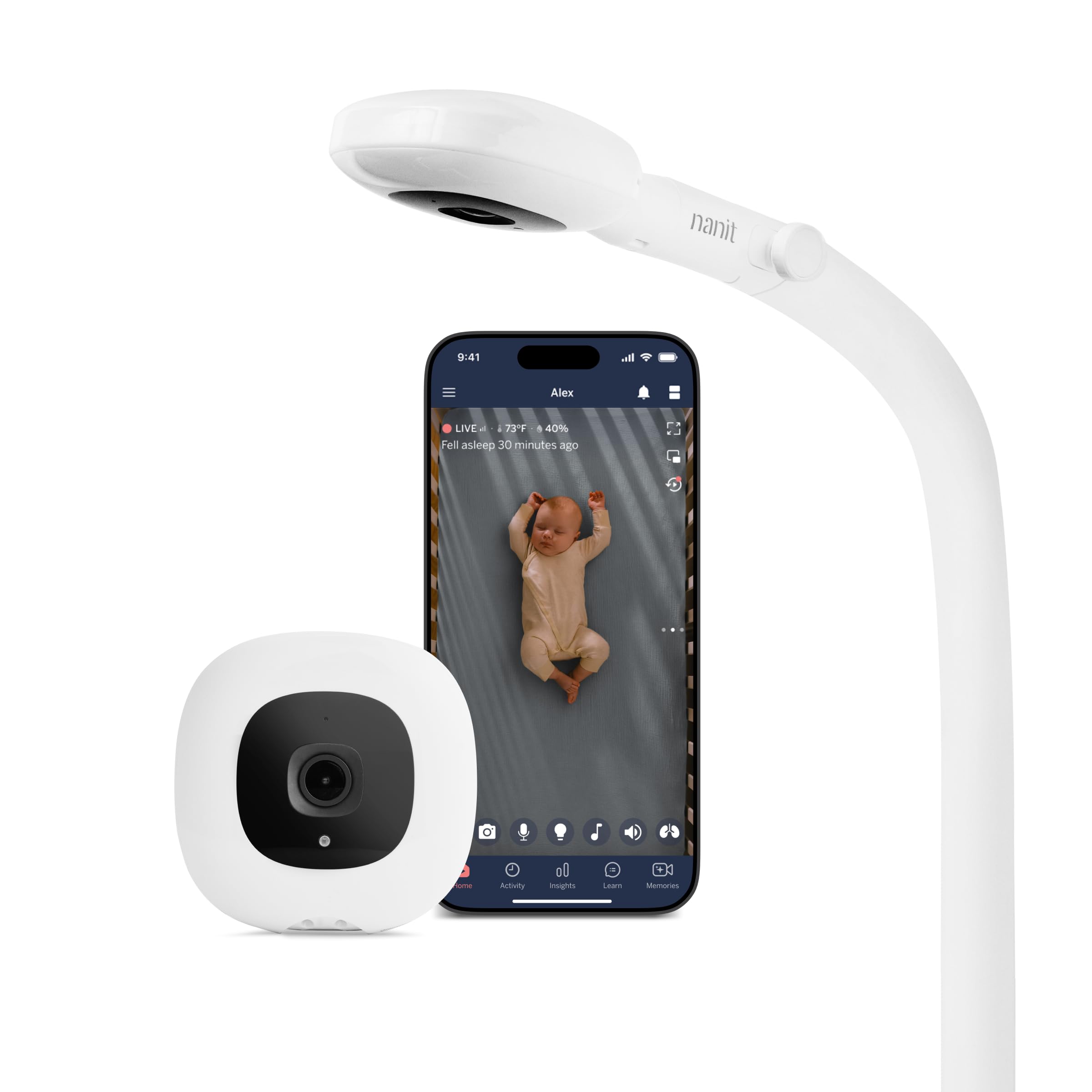
The Nanit Pro Smart Baby Monitor is a wearable-free system that relies on AI-powered camera analysis to track sleep patterns, breathing motion, and nursery conditions. The 1080p HD camera with night vision captures continuous video, and the companion app provides real-time notifications for cry detection, cough recognition, sound events, and motion reports. The included ASTM-certified Floor Stand positions the camera at the optimal height for overhead viewing.
Unlike the Owlet system, Nanit does not track pulse rate or oxygen saturation — it monitors breathing motion through pixel analysis and provides a Sleep Score along with personalized sleep tips. The free trial of Nanit Insights unlocks auto-captured sleep data, a real-time Sleep Dashboard, and a 2-day look back at sleep analysis and video clips. After the trial, ongoing Insights access requires a subscription.
The camera supports split-screen viewing for two cameras, making it expandable across multiple rooms. Security includes 256-bit AES encryption and two-factor authentication. The floor stand is a significant value add compared to wall-mount-only systems, as it allows flexible placement without drilling. For parents who prefer a camera-only solution with sleep analytics, the Nanit Pro offers the most sophisticated AI sleep coach on the market.
Why it’s great
- No wearable required — AI tracks breathing motion through video alone
- ASTM-certified Floor Stand included saves on mounting hardware
- Detailed Sleep Score and personalized sleep coach insights
- Supports two-camera split screen for multi-room monitoring
Good to know
- Does not track pulse rate or oxygen levels like Owlet systems
- Advanced sleep analytics require ongoing subscription after free trial
- Camera must maintain line-of-sight to track breathing motion accurately
5. Nanit Smart Baby Monitor System with 8-Inch Display
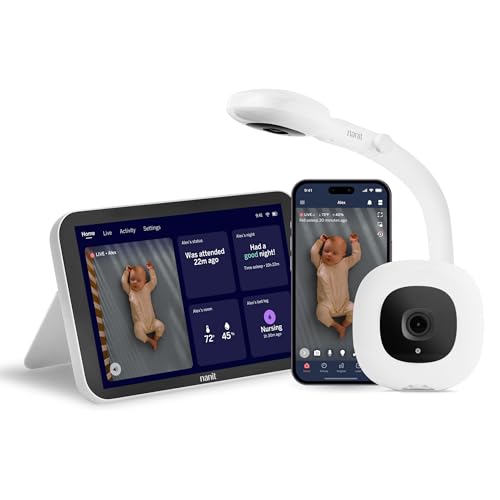
This version of the Nanit system includes the same 1080p HD camera but adds an 8-inch Home Display that functions as a dedicated touchscreen parent unit. The display allows live monitoring without needing to unlock your smartphone, and it integrates seamlessly with the Nanit app for multi-user access. The Home Display runs 3–6 hours of screen-on monitoring depending on brightness, and charges fully in under 2.5 hours.
The system tracks sleep duration, sleep efficiency, bedtime and wake times, and parental visits automatically. It monitors nursery temperature and humidity, offers cough and cry detection, and provides a daily Sleep Score plus AI-powered sleep coach insights with next-nap predictions. The 8-inch screen is large enough to see chest movement clearly, even at night, without zooming or squinting.
For parents who keep the display in their bedroom or living room, the dedicated unit eliminates the need to constantly check a phone. The system includes the same camera and floor stand as the base Nanit Pro, but the Home Display adds a permanent monitoring station that multiple caregivers can glance at. The battery life in background audio mode extends significantly longer, making it practical for overnight use.
Why it’s great
- 8-inch touchscreen display provides dedicated monitoring without smartphone dependency
- AI-driven sleep tracking and next-nap predictions help optimize routines
- Nursery temperature and humidity monitoring included
- Multi-user access allows grandparents and nannies to check in remotely
Good to know
- Screen-on battery lasts only 3–6 hours before needing charging
- No pulse oximetry or oxygen tracking — breathing motion only
- Advanced Insights features require subscription after free trial
6. eufy Security E21 Baby Monitor
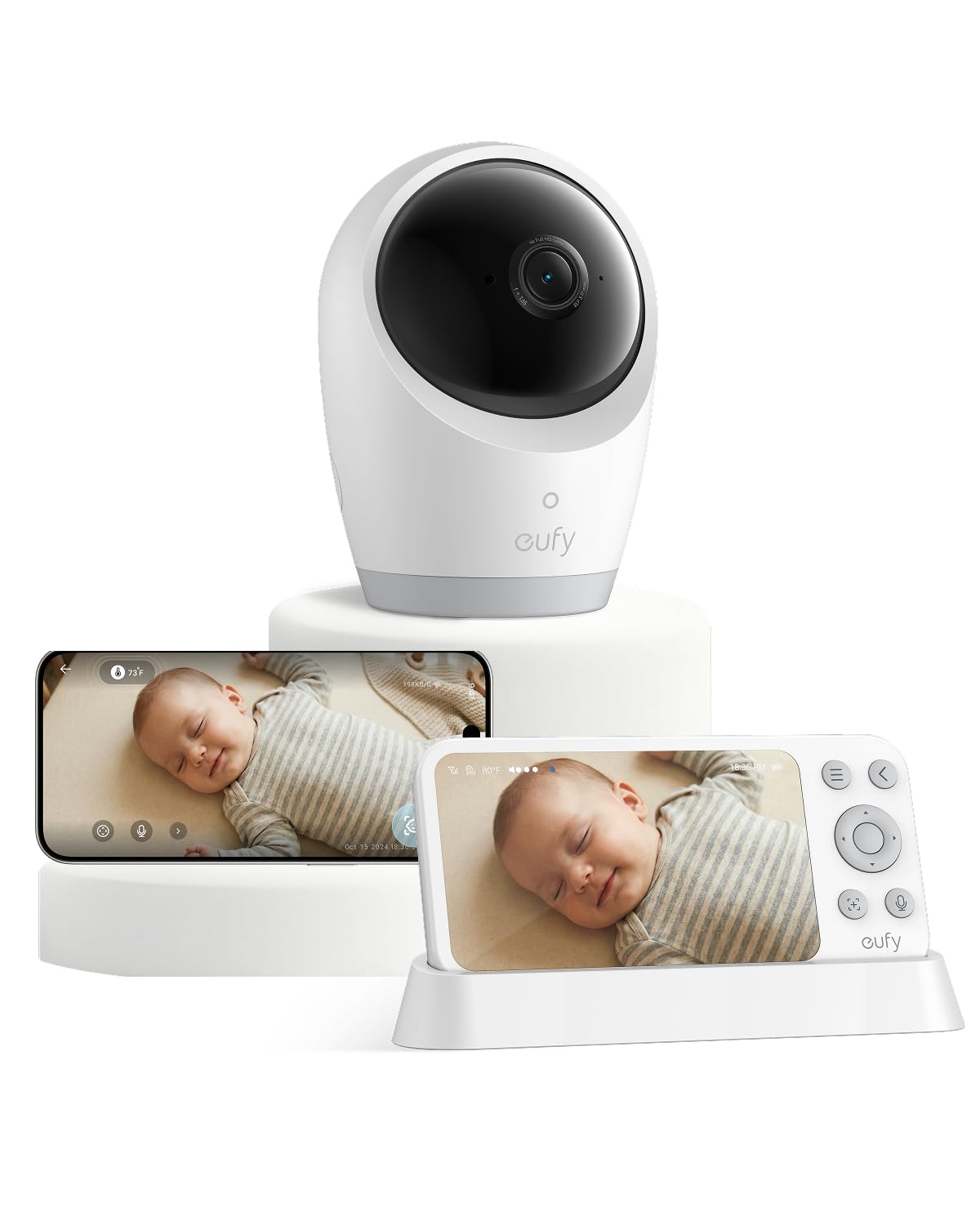
The eufy Security E21 is a 4K UHD baby monitor that offers a unique hybrid connection: you can run it over Wi-Fi for remote viewing or flip a physical privacy switch to cut off Wi-Fi entirely and use a private local connection. This makes it the only monitor on the list that can function entirely without the internet while still streaming ultra-high-definition video to a dedicated parent screen.
The camera has a 330-degree pan and 60-degree tilt range with 8x zoom, and the 5-inch 720p parent screen provides enough detail to see chest movement. Active Noise Reduction cuts background noise by 20 dB, so you hear only the sounds you need to hear. The 5000mAh battery-powered camera can be moved around the home or taken to a hotel without needing a power outlet nearby.
The parent unit supports split-screen viewing for a second camera, which is useful for twins or multi-room setups. RSA-1024 and AES-128 encryption protect the local connection. The system includes a mounting plate and cot mount set for flexible installation. For parents who are uncomfortable with cloud-based health data, the eufy E21 provides the highest video quality available with the strongest privacy controls.
Why it’s great
- Physical privacy switch cuts off Wi-Fi for a completely local, encrypted connection
- 4K UHD video with 8x zoom provides the highest resolution in this comparison
- 5000mAh battery-powered camera can be used anywhere without a plug
- Active Noise Reduction cuts background noise by 20 dB for clear audio
Good to know
- No medical-grade sensor — it is a high-end surveillance monitor, not a health tracker
- Parent screen is 720p rather than 1080p or higher
- Does not track breathing motion, pulse, or oxygen levels
7. Sense-U Pro Baby Breathing Monitor with 2.5K PTZ Camera
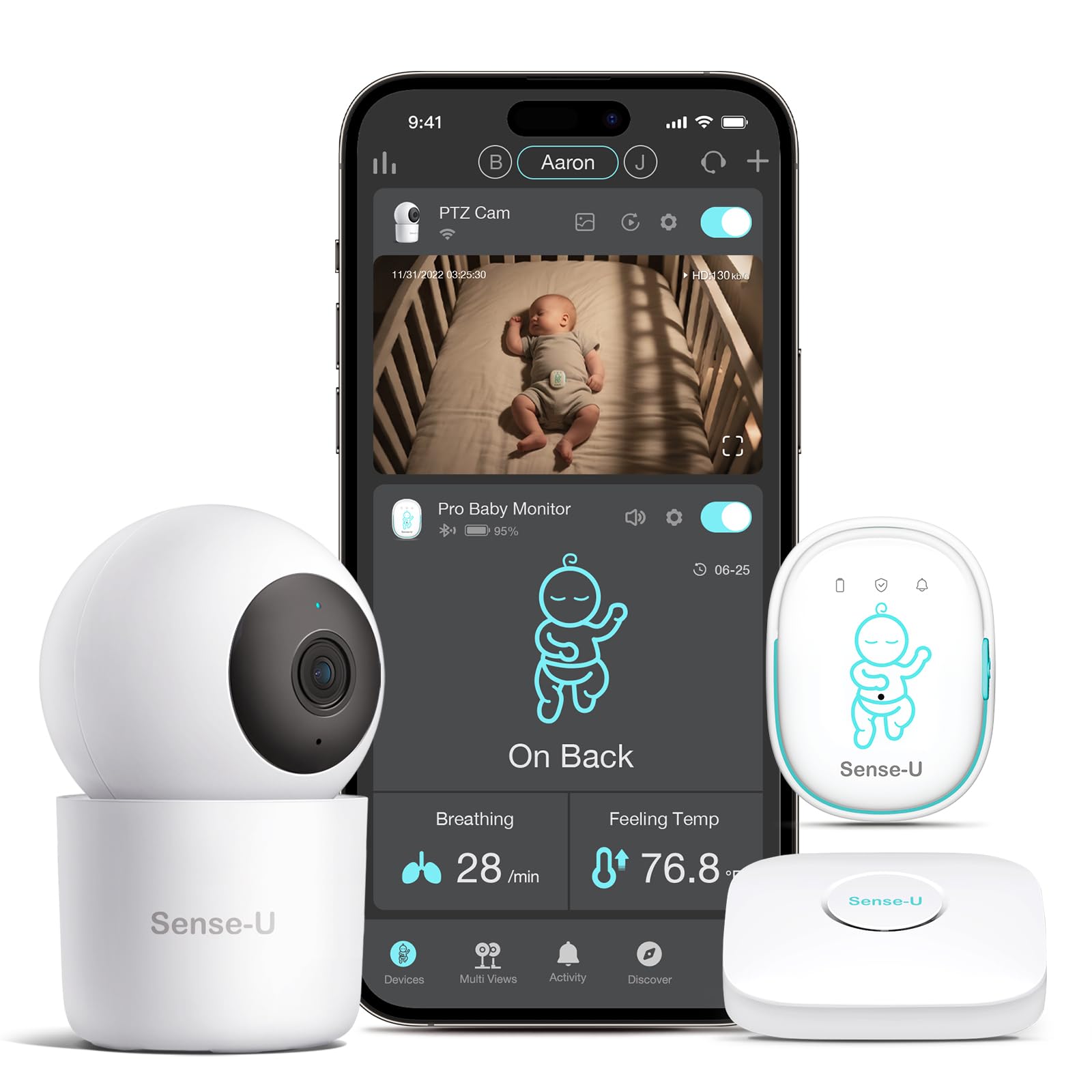
The Sense-U Pro uses a wearable pad (worn on the baby’s diaper or onesie) to track abdominal breathing motion via Bluetooth Low Energy 4.0+. If the monitor detects a 15-second pause in movement, it triggers a gentle vibration in an attempt to stimulate the baby naturally. If movement doesn’t resume, an audible alert sounds and notifications are sent to the smartphone. This two-stage alert is unique among motion-based trackers.
The system includes a 2.5K PTZ (pan-tilt-zoom) camera with cry detection, motion detection, night vision, two-way talk, and background audio with active noise cancellation. There are no mandatory monthly fees — all recordings are stored locally on an SD card (not included), with optional cloud storage available. The base station also tracks room temperature and humidity, and supports twin monitoring with two sensors connected to one base.
The Sense-U Pro provides detailed sleep analysis including light sleep, deep sleep, awake times, and overall sleep trends. The wearable pad is placed outside the baby’s clothing, so nothing touches the skin. Bluetooth Low Energy operates at a fraction of typical smartphone radiation levels, which may appeal to parents concerned about radiofrequency exposure. The system is FSA/HSA eligible.
Why it’s great
- Two-stage alert — gentle vibration first, audible alarm second if breathing doesn’t resume
- No monthly fees: local SD card recording with optional cloud storage
- Wearable pad sits outside clothing, no skin contact required
- BLE 4.0+ technology operates at very low radiation levels
Good to know
- Wearable pad can be kicked or shifted during active sleep, causing false alerts
- App connectivity and performance can be inconsistent depending on phone and network
- Not FDA-cleared — it is a motion-based consumer device, not a clinical monitor
8. Sense-U Smart Baby Sock Monitor with 2.5K PTZ Camera
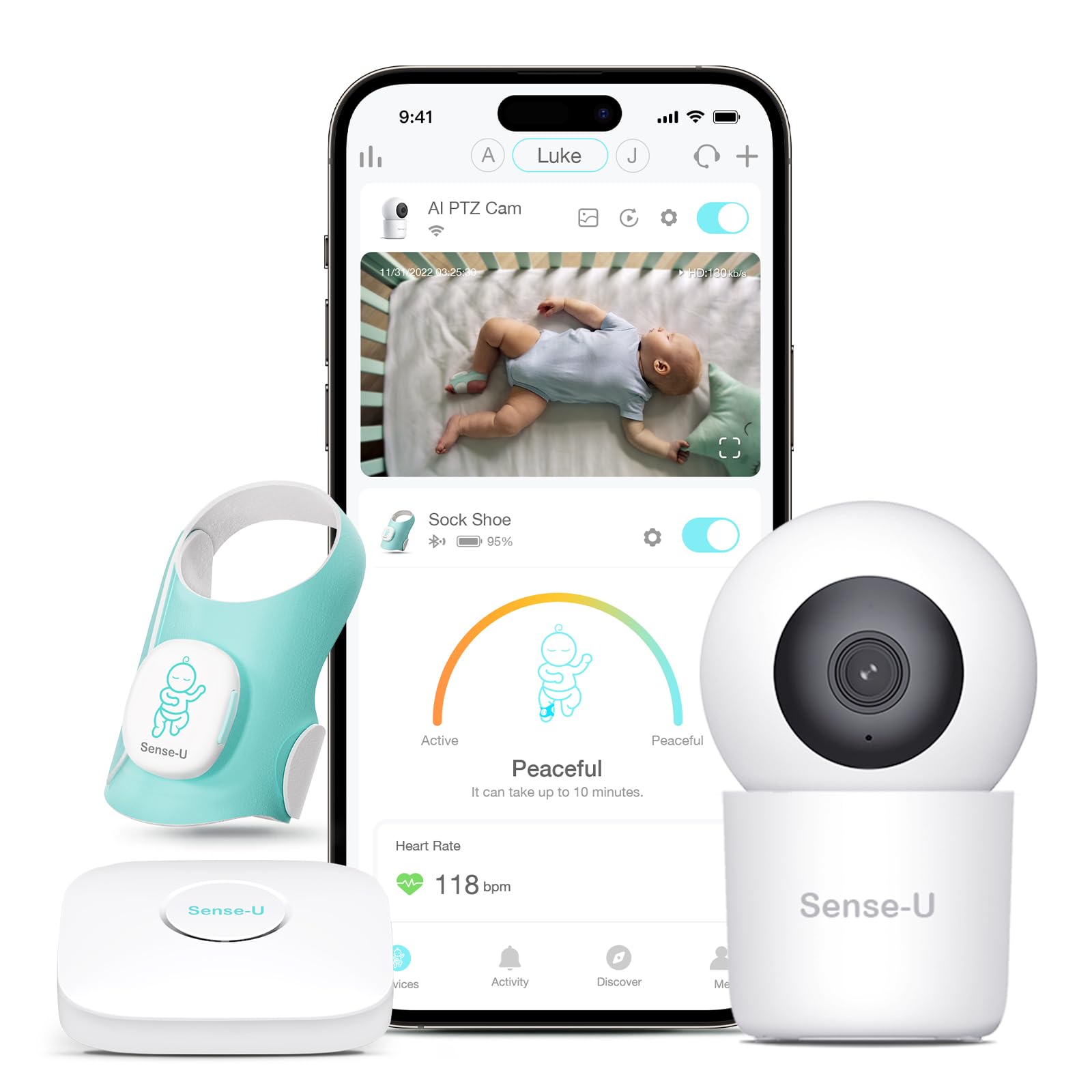
The Sense-U Smart Sock Monitor tracks heart rate and movement via an optical sensor built into a shoe-style fabric sock. Unlike the Pro pad, this is a direct-contact wearable that measures pulse and sleep patterns. It uses the same 2.5K PTZ camera as the Pro system for video monitoring, providing crystal-clear night vision, cry detection, motion alerts, and background audio — all with no monthly fee.
The sock is designed like a tiny shoe that stays put on babies 1–18 months, made from soft, breathable fabric. Three size options are available. The base station supports twin monitoring (two socks with one base station). Sleep analysis includes deep sleep, light sleep, nap times, sleep efficiency, and awake periods. The camera features pan-tilt-zoom capability and two-way talk for real-time interaction.
User reviews note that the camera quality is excellent, but the sock’s optical sensor can be finicky: heart rate readings may drop when the baby is actively kicking, and the base station must be in close proximity for reliable connection. The system requires 2.4 GHz Wi-Fi for the base station connection. For parents who want a wearable that tracks heart rate without locking into the Owlet subscription ecosystem, the Sense-U Sock is a budget-friendly alternative.
Why it’s great
- Optical heart rate tracking provides direct physiological data without pulse oximetry
- Shoe-style design stays on active babies who kick off regular socks
- 2.5K PTZ camera with no subscription required for local recording
- Supports twins with two socks paired to one base station
Good to know
- Heart rate accuracy suffers if the baby is moving or kicking vigorously
- Base station requires very close proximity to the sock for reliable connection
- Not FDA-cleared — it is a consumer wellness tracker, not a clinical device
- Only 2.4 GHz Wi-Fi supported for base station connectivity
FAQ
What is the difference between FDA-cleared and consumer-grade baby monitors?
Can a medical-grade baby monitor replace a pulse oximeter prescribed by a doctor?
How do wearable-free monitors (Philips Avent, Nanit) detect breathing?
What is the maximum age for using a medical-grade sock monitor?
Do medical-grade baby monitors require a subscription?
Final Thoughts: The Verdict
For most users, the medical-grade baby monitor for at-home use winner is the Owlet Dream Duo (Gen 3) because it combines FDA-cleared pulse oximetry with a 2K HD camera in a single system that requires no ongoing subscription for core health alerts. If you want a wearable-free solution that keeps nothing touching your baby, grab the Philips Avent Premium Connected. And for maximum video clarity with complete privacy control and no Wi-Fi dependency, nothing beats the eufy Security E21.