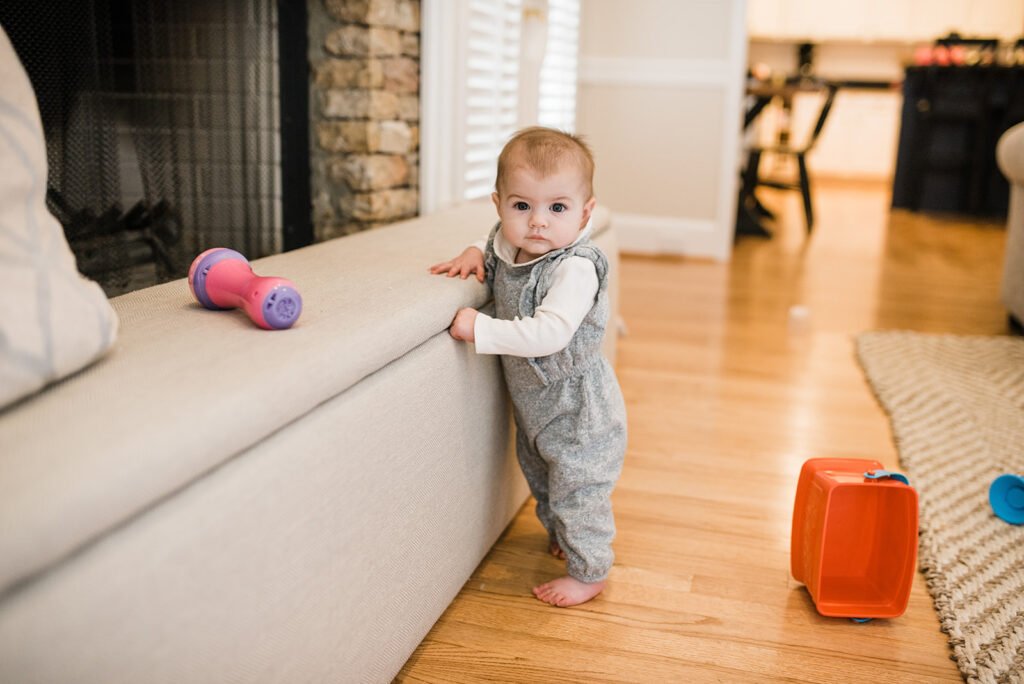
A fireplace hearth can be made safer for babies by covering sharp edges with padded bumpers, restricting access with a gate or screen.
You have the fire going, the baby starts scooting across the rug, and suddenly that raised brick ledge looks less like a cozy design detail and more like a hazard. The hearth is typically the exact height of a curious toddler’s forehead and just hard enough to cause a scare.
Childproofing a fireplace hearth doesn’t take much, but it does take a few specific products and some basic layout planning. This guide walks through the most practical options — from stick-on bumpers to DIY covers — so you can pick the approach that fits your setup.
Why The Hard Edges Sneak Up On You
Most parents think about fireplace safety in terms of heat and flames. The hearth itself — the raised stone or brick platform — is usually a second thought until the baby starts standing and cruising around furniture.
Hearth edges are often square, hard, and at head height for a toddler. A fall toward the fireplace can mean a direct hit on stone or tile, which is why covering those edges matters even when the fireplace isn’t in use.
The good news is that several ready-made products exist, and none require tools or installation experience. Foam padding, bumper kits, and baby gates are the main categories, each suited to different hearth shapes and room layouts.
Foam Padding Options
Baby Safety Foam covers the entire hearth surface with adhesive-backed padding that cushions bumps. It’s designed specifically for fireplaces and comes in straight pieces and corner pieces for a complete fit. Many parents find this the simplest solution because it doesn’t require measuring or cutting — just peel and stick.
The Three Main Approaches To Childproofing
Every hearth is different, and your choice depends on size, shape, and whether the fireplace is used regularly. The three most common strategies cover nearly every situation.
- Padded edge bumpers: These adhesive strips attach to the top and front edges of the hearth. They’re designed for flat, solid surfaces and work best on straight, simple hearth shapes. The Cardinal Gates small hearth pad kit is one example that covers edges without wrapping around the entire surface.
- Full hearth cushions: Larger cushioned sets, like the KidKusion Hearth Cushion, provide about 8.33 feet of padding in a three-piece set. They sit on top of the hearth rather than sticking to it, making them easy to remove when the fireplace is in use.
- Barrier gates and screens: A baby gate or freestanding fireplace screen blocks physical access entirely. A gate encircles the fireplace area, while a screen sits directly in front to prevent contact with hot glass. Both are effective but take up floor space.
If your hearth is unusually shaped, some companies offer custom-sized guards made to your exact measurements. That’s a good option for curved or stepped hearths where standard kits don’t fit well.
What To Look For In Hearth Padding Kits
Not all bumper kits are the same. The main differences come down to coverage length, material thickness, and how the pieces fit together. A typical large kit includes three 30-inch straight pieces and two corner pieces, giving roughly 12.5 feet of total coverage — enough for most standard hearths.
The medium hearth pad kit from Cardinal Gates covers the entire hearth edge with childproof padding and is designed for flat surfaces. Many parents choose this size when they need more coverage than a basic edge bumper but don’t have an extra-large hearth. Walmart carries the full line, including bumpers for flat surfaces in several sizes.
For the broadest comparison, here’s a quick look at common product types and what they typically cover.
| Product Type | Typical Coverage | Best For |
|---|---|---|
| Edge bumper strips | Edges only | Straight, narrow hearths |
| Medium hearth pad kit | Full edge + some top surface | Standard rectangular hearths |
| Large hearth pad kit | Up to 12.5 feet including corners | Wide or L-shaped hearths |
| KidKusion Hearth Cushion | 8.33 feet (3 pieces) | Non-adhesive, removable padding |
| Custom foam guard | Made to exact measurements | Unusual shapes or extra-large hearths |
Adhesive kits stay in place well but can be harder to remove or reposition. Cushion-style pads are easier to take off for cleaning or when you need the fireplace surface clear. Consider how often you use the fireplace before choosing between them.
DIY Option: Building A Hearth Cover Bench
If store-bought padding doesn’t match your décor or your hearth is an unusual shape, a DIY approach is an alternative. Building a wooden cover that sits over the hearth turns a hazard into a functional bench or shelf while keeping the fireplace usable later.
One popular method involves these five steps:
- Measure the hearth carefully. Measure length, width, and depth. Account for any raised edges or irregular corners.
- Build a base frame. Construct a simple wooden box that fits snugly over the hearth without pressing against the firebox itself.
- Add dense foam padding. Attach upholstery foam to the top surface before adding fabric. This gives a soft landing surface.
- Cover with fabric. Staple or glue fabric over the foam and frame. Choose a fire-resistant fabric if the cover will be used near the fireplace.
- Attach a top piece. Finish with a wood or foam top, depending on whether you want a bench, a display surface, or a purely protective cover.
The result is a custom-sized cover that blends into the room. The DIY hearth cover steps on the Meandreegs blog go into detail on each stage, including how to build the frame without power tools.
One thing to keep in mind: a DIY cover adds weight and bulk. Make sure it sits securely and doesn’t slide when a child leans on it. Some parents add non-slip pads underneath for extra stability.
How To Choose The Right Barrier Or Screen
When you need to block the fireplace area entirely — especially if the fireplace is used often — a barrier is the most reliable option. A freestanding fireplace screen blocks the area directly in front of the firebox, preventing a child from touching hot glass or reaching for flames.
A baby gate, on the other hand, creates a perimeter around the entire fireplace zone, including the hearth. This is useful if you want to keep a child away from both the heat and the sharp hearth edges at the same time. Many parents use a combination: a screen in front of the firebox and a gate around the hearth.
| Barrier Type | Primary Purpose | Consideration |
|---|---|---|
| Freestanding screen | Blocks hot glass and direct fire access | Doesn’t cover hearth edges |
| Baby gate (pressure or hardware mount) | Creates a no-access zone around the fireplace | Takes up floor space; needs to be wider than the hearth |
| Combination screen + gate | Full heat + edge coverage | Most secure but requires two separate products |
For gas fireplaces with glass doors, a screen is especially important because the glass stays hot long after the fireplace is turned off. A child can get a serious burn from touching the glass even 30 minutes after the fire is out.
The Bottom Line
Childproofing a fireplace hearth comes down to three options: adhesive edge bumpers, full-surface foam pads, or a DIY wooden cover. Each works, and the right choice depends on hearth shape, room layout, and how much you want to change the look. Start with a simple bumper kit for straight edges, or opt for a gate-and-screen combination if the fireplace is actively used.
Your pediatrician or a local childproofing specialist can help assess your home’s specific layout and recommend products or configurations that match your baby’s mobility stage — especially if the hearth is unusually shaped or located near other hazards like stairs.
References & Sources
- Walmart. “Cardinal Gates Hearth Pad Kit for Fireplaces” Fireplace child-proofing bumpers cover hearth edges to prevent contact with hard or sharp surfaces, and are specifically designed for flat, solid surfaces.
- Meandreegs. “Fireplace Hearth Cover Diy Bench” A DIY approach to baby-proofing a fireplace involves measuring twice, building a base, fitting foam, adding fabric, and attaching a top.